Duration Neglect

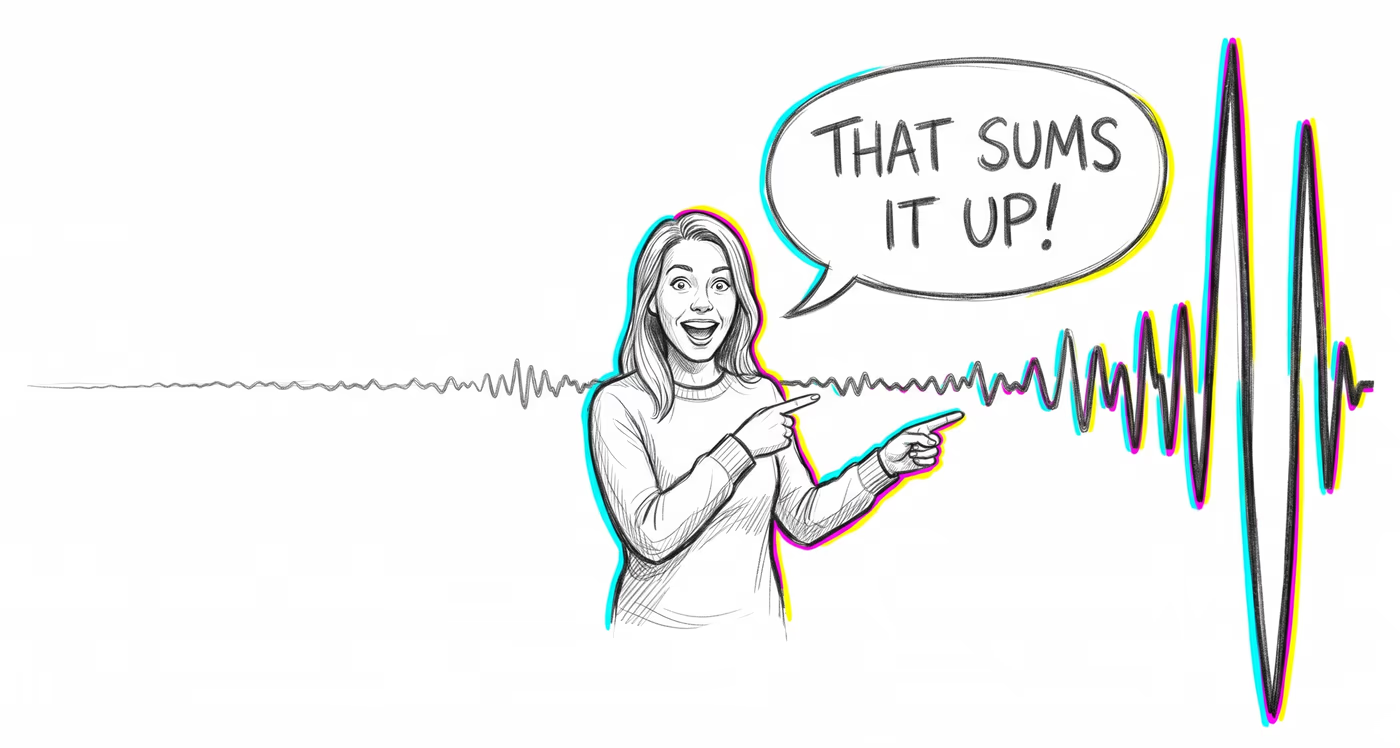
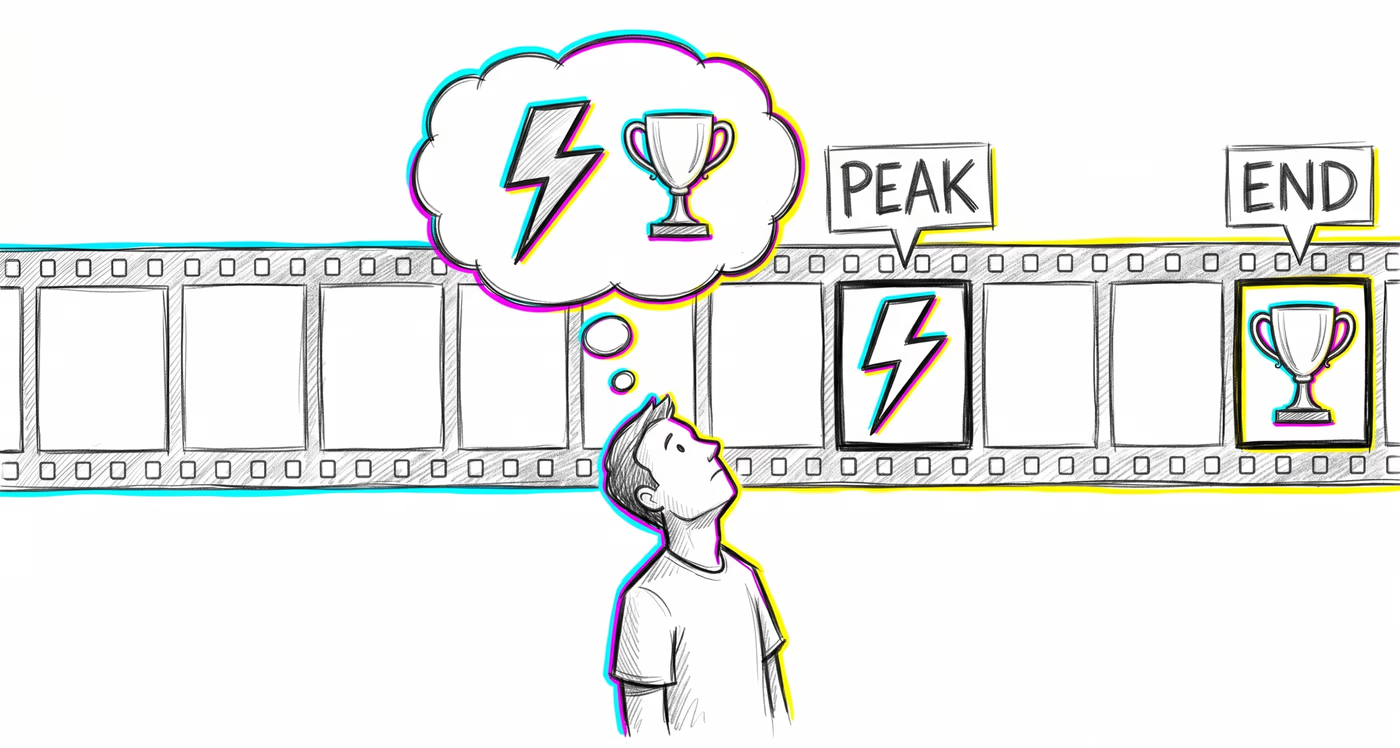
Ignoring how long an experience lasted and judging it almost entirely by its most intense moment and its ending.

WHAT IT IS

The glitch, explained plainly.

Imagine you had two bad days at school. One lasted the whole day and was pretty bad. The other was only one hour but was also pretty bad and ended on a really sour note. When you think back later, you'd probably say they felt about equally terrible—even though one was way longer—because your brain only really remembers the worst part and how it ended, not how many hours you suffered.

Duration Neglect describes a systematic failure in how people reconstruct past experiences: the actual length of an event contributes remarkably little to their overall assessment of how pleasant or unpleasant it was. Instead, people rely on a few representative 'snapshots'—particularly the peak intensity and the final moments—to form a global evaluation. This means that a 60-minute ordeal and a 5-minute ordeal can receive identical retrospective ratings if they share similar peak and ending intensities. The bias has profound implications for decision-making, because the 'remembered self' that guides future choices operates on these distorted evaluations rather than on the objective sum of moment-to-moment experience.

SOUND FAMILIAR?

Where it shows up.

  1. 01 Maria had two labor experiences. Her first lasted 14 hours and her second lasted 6 hours, but both peaked at similar pain levels and the second ended more abruptly. When asked years later which was worse, she rates them almost identically despite the first being more than twice as long.
  2. 02 A hotel chain redesigns checkout to include a complimentary espresso and a warm goodbye from the manager. Guest satisfaction scores rise dramatically, even though nothing about the room quality, amenities, or the length of the stay changed.
  3. 03 Two patients undergo physical therapy programs—one for 8 weeks and another for 4 weeks—with identical exercises and peak discomfort. The 8-week patient's program tapers off gently in the final session. Both patients later rate their total discomfort as roughly equal, and the 8-week patient is actually more willing to repeat the program.
  4. 04 A product manager reviews two customer support call recordings: one lasted 22 minutes and another 7 minutes. Both had a frustrating peak and ended with the agent resolving the issue warmly. In the post-call survey, customers gave nearly identical satisfaction ratings, so the manager concludes call length doesn't matter for satisfaction.
  5. 05 A researcher designs a study where participants endure loud, unpleasant noise for either 30 seconds or 90 seconds, but the 90-second version gradually softens in the last 20 seconds. When asked which they'd repeat, most choose the 90-second version—objectively more total noise exposure—because their memory of it is less aversive.
IN DIFFERENT DOMAINS

Where it shows up at work.

The same glitch looks different depending on the terrain. Finance, medicine, a relationship, a team — same mechanism, different costume.

Finance & investing

Investors may judge the quality of an investment period by its peak return and its final value at the time of sale, rather than by the cumulative returns or the total duration of holding. A stock held for five years with a dramatic peak and a decent exit price may be remembered more favorably than one held equally long with steady but unremarkable gains, distorting future allocation decisions.

Medicine & diagnosis

Patients consistently evaluate the overall pain of medical procedures based on peak intensity and final moments, not total duration. This leads patients to rate longer procedures with gentle endings as less painful than shorter ones that end abruptly, affecting their willingness to return for repeat screenings and follow-up care.

Education & grading

Students may judge an entire semester-long course primarily by its most intense moment (a particularly engaging or stressful lecture) and the final class, rather than by the cumulative hours of instruction. This can lead to course evaluations that poorly reflect the overall quality of teaching across the term.

Relationships

People tend to evaluate past relationships based on the emotional peak (the most intense moment of love or conflict) and how the relationship ended, rather than its total length. A brief but passionate affair that ended amicably may be remembered more fondly than a long, stable partnership that ended in an argument.

Tech & product

Users evaluate app or website experiences based on the most frustrating or delightful moment and the final interaction, not total session time. Designers exploit this by ensuring smooth checkout flows and pleasant exit screens, knowing that a well-designed ending can compensate for earlier friction in a lengthy user journey.

Workplace & hiring

Employees evaluate work projects or meetings primarily by peak stress or excitement moments and how things wrap up, rather than total hours invested. A grueling six-month project with a celebratory launch may be remembered more positively than a three-month project that ended with unresolved loose ends.

Politics Media

Voters often judge a political administration by its most dramatic moment (a crisis or triumph) and its final period in office, neglecting the cumulative record across years. Campaign strategists exploit this by focusing on strong closing messages and memorable peak moments rather than comprehensive policy timelines.

HOW TO SPOT IT

Ask yourself…

  • Am I judging this experience based on how it ended or its most intense moment, rather than considering its full length?
  • If this experience had lasted twice as long with the same peak and ending, would my evaluation change at all?
  • Am I making a future decision based on a memory that might be ignoring how much total time I actually spent suffering or enjoying something?
HOW TO DEFEND AGAINST IT

The playbook.

  • Keep a real-time journal or log during extended experiences, noting your feelings at regular intervals, so you have objective data to compare against your retrospective memory.
  • When evaluating a past experience, explicitly ask yourself: 'How long did this actually last?' and factor duration into your assessment before making future decisions.
  • Use segmented ratings (e.g., rate each phase of an experience separately) rather than a single global evaluation to reduce the dominance of peak and end moments.
  • Before deciding whether to repeat an experience, review any timestamped data (photos, notes, calendar entries) that can reconstruct the full timeline rather than relying on memory alone.
  • When comparing two experiences of different lengths, normalize for duration by asking: 'Per unit of time, which was actually better or worse?'
FAMOUS CASES

In history.

  • Redelmeier, Katz, and Kahneman's (2003) colonoscopy trial: Patients who had their procedure extended with a less painful ending rated the overall experience as less unpleasant and were significantly more likely to return for follow-up colonoscopies, despite enduring objectively more total discomfort.
  • Kahneman et al.'s (1993) cold-pressor experiment: Subjects chose to repeat a 90-second cold water immersion (with a gentler ending) over a 60-second version, preferring more total pain because their memory of the longer trial was less aversive.
WHERE IT COMES FROM
Academic origin

Barbara L. Fredrickson and Daniel Kahneman, 1993. The concept of duration neglect was demonstrated across multiple publications including work in Psychological Science and the Journal of Personality and Social Psychology.

Evolutionary origin

In ancestral environments, the intensity of a threat or reward mattered far more for survival than how long it lasted. Remembering that a particular berry patch attracted a dangerous predator (peak danger) and whether the encounter ended safely (end state) was more actionable than tracking the exact minutes of exposure. This snapshot-based memory compression was an efficient strategy for storing survival-relevant information without consuming excessive cognitive resources on temporal bookkeeping.

IN AI SYSTEMS

How the machines inherit it.

Recommendation algorithms that optimize for peak engagement moments and session-ending satisfaction rather than total time-on-platform quality can exploit duration neglect. Users may rate an AI-curated experience highly based on one spectacular recommendation and a satisfying sign-off, even if the overall content stream was mediocre for most of the session. Sentiment analysis models trained on retrospective user reviews inherit duration neglect because the training data itself reflects peak-and-end-biased evaluations rather than moment-to-moment experience quality.

Read more on Wikipedia
FREE FIELD ZINE

10 glitches quietly running your life.

A free field-zine PDF — ten cognitive glitches named, illustrated, with a defense move for each. Plus the weekly Glitch Report on Fridays — one bias named, two spotted in the wild, one defense move. Unsubscribe any time.

EXPLORE MORE

Related glitches.

LAUNCH PRICE

Train against your blindspots.

50 cards are free to preview. Buyers unlock the rest of the deck plus the interactive training — Spot-the-Bias Quiz unlimited, Swipe Deck with spaced repetition, My Blindspots, Decision Pre-Flight, the Printable Deck + Cheat Sheets, and the Field Guide e-book. $29.50$59.

Unlock the full deck

Everything below — yours forever. Pay once, use across every device.

Half-off launch — limited to the first 100 readers. Auto-applied at checkout.
$59 $29.50
one-time payment · lifetime access
  • All interactive digital cards — search, filter, flip, shuffle on any device
  • Five training modes — Spot-the-Bias Quiz, Swipe Deck, Pre-Flight, Blindspots, Journal
  • Curated Lenses + Decision Templates + Defense Playbook
  • Printable Deck PDFs + Field Guide e-book + Cheat Sheets + Anki Export
  • Every future improvement, included
Unlock  $29.50

30-day refund · no questions asked

Unlock the full deck

Everything below — yours forever. Pay once, use across every device.

Half-off launch — limited to the first 100 readers. Auto-applied at checkout.
$59 $29.50
one-time payment · lifetime access
  • All interactive digital cards — search, filter, flip, shuffle on any device
  • Five training modes — Spot-the-Bias Quiz, Swipe Deck, Pre-Flight, Blindspots, Journal
  • Curated Lenses + Decision Templates + Defense Playbook
  • Printable Deck PDFs + Field Guide e-book + Cheat Sheets + Anki Export
  • Every future improvement, included
Unlock  $29.50

30-day refund · no questions asked