Leveling and Sharpening

aka Leveling-Sharpening · Memory Leveling and Sharpening

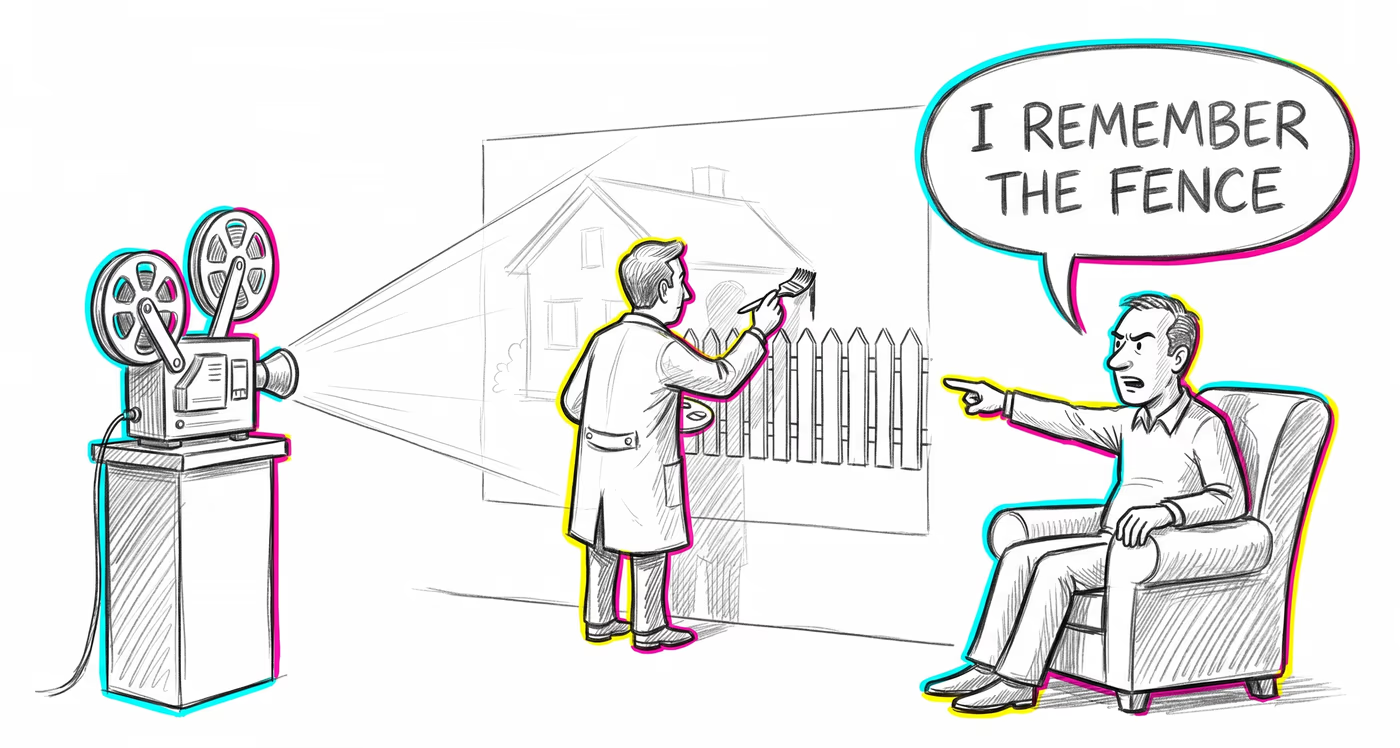
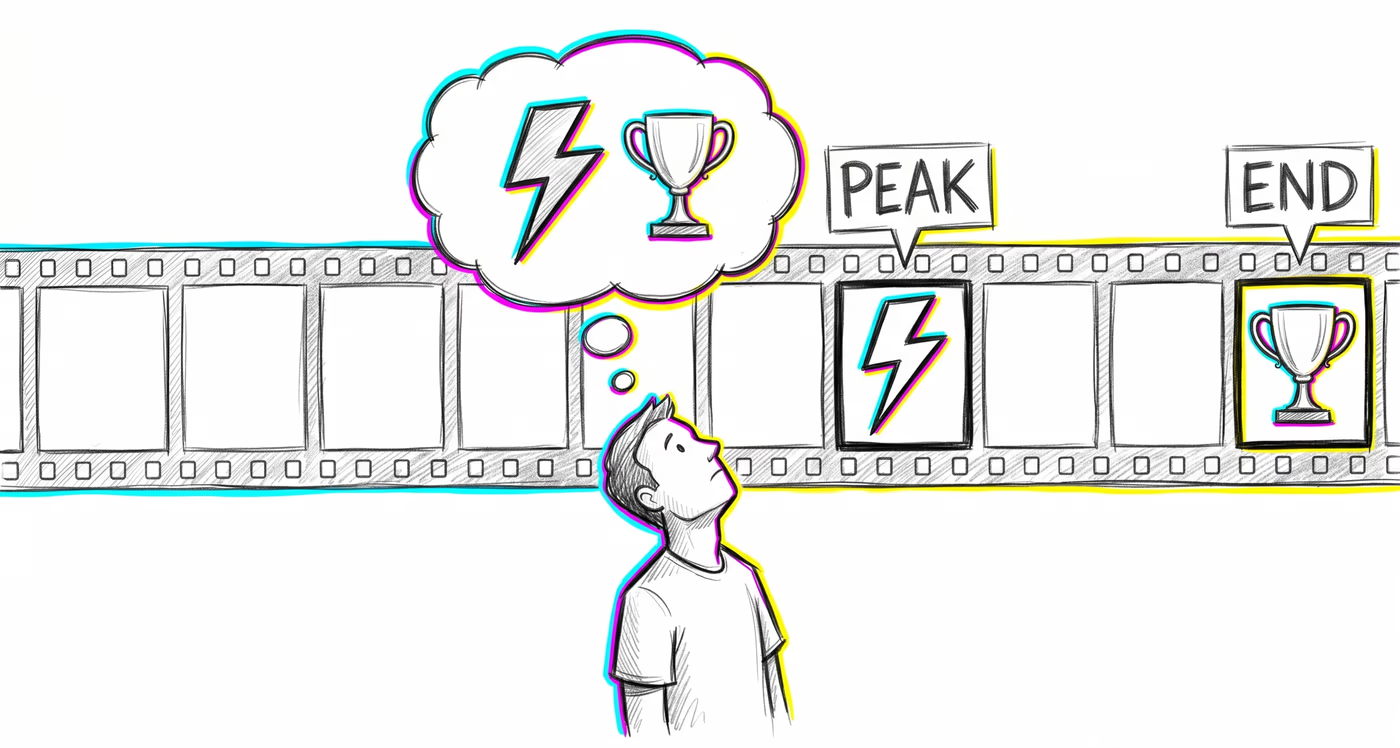
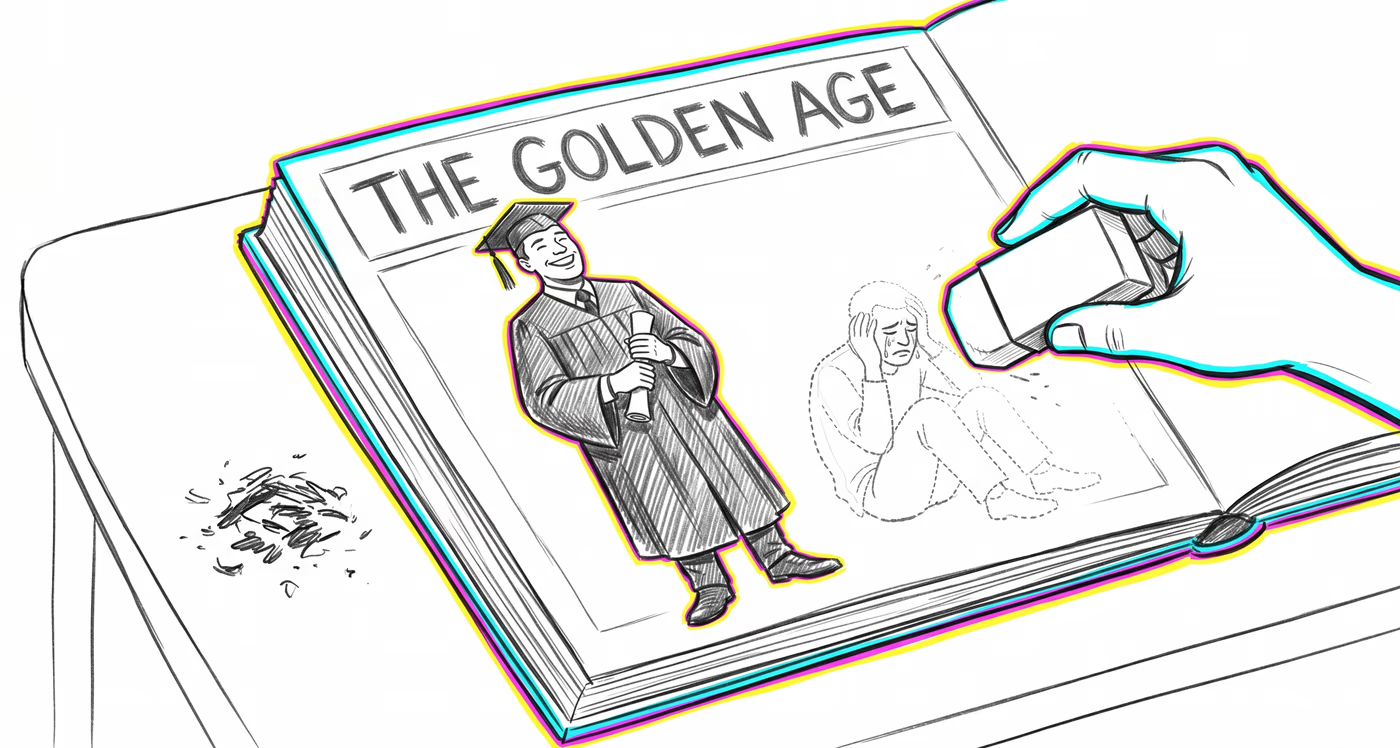
Memories gradually losing minor details (leveling) while select remaining details get exaggerated (sharpening) with each retelling.

WHAT IT IS

The glitch, explained plainly.

Imagine you heard a really long bedtime story, and then you tried to tell it to your friend. You'd probably forget a bunch of the boring parts and skip them, but the one really cool or scary part? You'd make that part even bigger and more exciting. That's leveling (dropping the boring stuff) and sharpening (pumping up the exciting stuff).

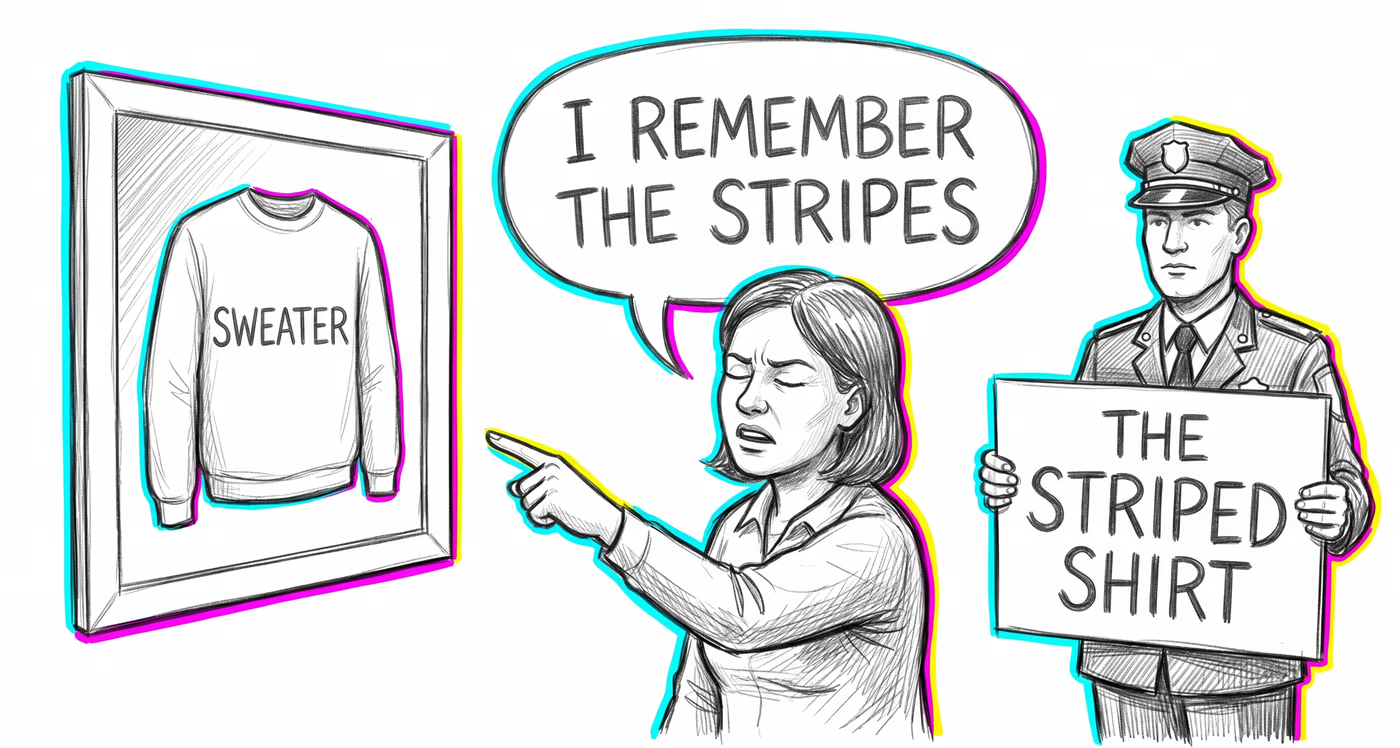
Leveling and sharpening describe complementary processes that reshape memories over time and through retelling. Leveling is the gradual loss of peripheral or seemingly unimportant details, making a recollection shorter, simpler, and more streamlined. Sharpening is the simultaneous tendency to selectively retain and amplify certain details, inflating their emotional weight or narrative importance relative to the now-absent context. Together, these processes transform rich, complex experiences into compact, schema-consistent narratives that feel coherent but may diverge substantially from what actually occurred.

SOUND FAMILIAR?

Where it shows up.

  1. 01 Maria tells her coworker about a meeting where the CEO criticized one team's quarterly results. By the third retelling to different colleagues, the CEO's measured concern has become a furious tirade, while the positive feedback given to three other teams has been entirely omitted from her account.
  2. 02 After a hiking trip, James writes in his journal about the breathtaking summit view and the terrifying moment he almost slipped on a rock ledge. He makes no mention of the four uneventful hours of gradual uphill walking that constituted 90% of the hike. Months later he reads the entry and believes the entire trip was a sequence of peak experiences.
  3. 03 A witness to a minor traffic collision tells police the red car was 'speeding recklessly' and 'nearly flipped over,' but cannot recall which direction either vehicle came from, whether the traffic light was green or red, or how many other cars were present at the intersection. Each time she recounts the event she adds more dramatic descriptors to the collision itself.
  4. 04 During a company retrospective, a project manager recounts a product launch from two years ago. She clearly recalls the one server outage that lasted twenty minutes and describes it in vivid detail, but has completely forgotten that the launch also involved a successful marketing campaign, strong user signups, and positive press coverage — details that were in her own original report.
  5. 05 A historian studying oral traditions notices that a community's founding story, passed down through five generations, now centers entirely on a single dramatic act of bravery by the founder. Contemporaneous written records reveal the founding involved years of negotiation, multiple leaders, and mundane logistical challenges — none of which survive in the oral version, while the bravery episode has acquired vivid details not found in any primary source.
IN DIFFERENT DOMAINS

Where it shows up at work.

The same glitch looks different depending on the terrain. Finance, medicine, a relationship, a team — same mechanism, different costume.

Finance & investing

Investors tend to remember dramatic market crashes or windfalls in exaggerated detail while forgetting the long stretches of steady, unremarkable returns that constituted most of their portfolio history, leading to distorted risk perceptions.
Medicine & diagnosis

Patients recounting symptoms to a doctor tend to drop routine or mild complaints (leveling) while amplifying the intensity and frequency of the most alarming symptom (sharpening), which can skew clinical diagnosis.

Education & grading

Students retelling a lesson or lecture retain and exaggerate the one surprising fact or dramatic anecdote the teacher used, while the broader conceptual framework and nuanced arguments fade from recall, distorting their understanding of the material.

Relationships

Over time, people reconstruct relationship histories by dropping the many neutral or pleasant interactions (leveling) and amplifying either the worst conflicts or the most romantic moments (sharpening), creating a polarized narrative that doesn't reflect the relationship's actual texture.

Tech & product

User feedback sessions are often recalled by product teams as highlighting one or two dramatic complaints while the moderate, mixed, or positive feedback from the same session is forgotten, skewing design priorities.

Workplace & hiring

When managers retell the story of a past project, they tend to drop the incremental contributions of many team members (leveling) and amplify the role of one hero or one villain (sharpening), distorting performance attribution.

Politics Media

As political events are retold through news cycles and social media, nuanced policy positions and contextual details are stripped away (leveled) while the most provocative quote or dramatic moment is amplified (sharpened), fueling polarization and misinformation.

HOW TO SPOT IT

Ask yourself…

  • Has my version of this story gotten shorter or simpler since the original event — and which details have I dropped?
  • Am I giving disproportionate weight or vividness to one particular detail while forgetting the broader context?
  • If I compared my retelling to a recording or written record of the original, would I find significant omissions and exaggerations?
HOW TO DEFEND AGAINST IT

The playbook.

  • Write down important events as soon as possible in detailed, factual form before memory reconstruction begins.
  • When retelling an event, deliberately ask yourself what you might be leaving out and what you might be inflating.
  • Cross-reference your recollection with other witnesses, written records, or recordings before treating it as authoritative.
  • Practice the habit of prefacing retellings with explicit uncertainty: 'I might be exaggerating this part' or 'I'm not sure I remember the full context.'
  • When hearing a secondhand or thirdhand account, ask for the original source or documentation rather than relying on the retold version.
FAMOUS CASES

In history.

  • Allport and Postman's 1947 serial reproduction experiments demonstrated how rumors about wartime events in the United States became shorter and more distorted as they passed through chains of people, with peripheral details vanishing and emotionally charged elements becoming exaggerated.
  • Bartlett's 1932 'War of the Ghosts' serial reproduction study showed British participants progressively dropping culturally unfamiliar details from a Native American story while amplifying and embellishing elements that fit Western narrative schemas.
WHERE IT COMES FROM
Academic origin

Frederic Bartlett first described leveling and sharpening as memory distortion processes in 'Remembering' (1932). Gordon Allport and Leo Postman formalized the concepts in their study of rumor transmission in 'The Psychology of Rumor' (1947). Philip Holzman and George Klein extended the framework to individual cognitive styles at the Menninger Foundation in 1954.

Evolutionary origin

In ancestral environments, rapid communication of survival-relevant information — the location of a predator, the identity of a threat — demanded that stories be compressed to their essential elements and that critical details be emphasized. Stripping away irrelevant context (leveling) and amplifying danger signals or actionable information (sharpening) would have allowed groups to transmit high-priority warnings efficiently through oral chains.

IN AI SYSTEMS

How the machines inherit it.

Language models trained on internet text inherit leveling and sharpening patterns present in their training data: common, schema-consistent facts and narratives are over-represented (sharpened) while nuanced, rare, or contextual details are underrepresented or lost (leveled). This can cause LLMs to generate oversimplified or dramatized summaries that mirror the distortions of human oral transmission.

FREE FIELD ZINE

10 glitches quietly running your life.

A free field-zine PDF — ten cognitive glitches named, illustrated, with a defense move for each. Plus the weekly Glitch Report on Fridays — one bias named, two spotted in the wild, one defense move. Unsubscribe any time.

EXPLORE MORE

Related glitches.

LAUNCH PRICE

Train against your blindspots.

50 cards are free to preview. Buyers unlock the rest of the deck plus the interactive training — Spot-the-Bias Quiz unlimited, Swipe Deck with spaced repetition, My Blindspots, Decision Pre-Flight, the Printable Deck + Cheat Sheets, and the Field Guide e-book. $29.50$59.

Unlock the full deck

Everything below — yours forever. Pay once, use across every device.

Half-off launch — limited to the first 100 readers. Auto-applied at checkout.
$59 $29.50
one-time payment · lifetime access
  • All interactive digital cards — search, filter, flip, shuffle on any device
  • Five training modes — Spot-the-Bias Quiz, Swipe Deck, Pre-Flight, Blindspots, Journal
  • Curated Lenses + Decision Templates + Defense Playbook
  • Printable Deck PDFs + Field Guide e-book + Cheat Sheets + Anki Export
  • Every future improvement, included
Unlock  $29.50

30-day refund · no questions asked

Unlock the full deck

Everything below — yours forever. Pay once, use across every device.

Half-off launch — limited to the first 100 readers. Auto-applied at checkout.
$59 $29.50
one-time payment · lifetime access
  • All interactive digital cards — search, filter, flip, shuffle on any device
  • Five training modes — Spot-the-Bias Quiz, Swipe Deck, Pre-Flight, Blindspots, Journal
  • Curated Lenses + Decision Templates + Defense Playbook
  • Printable Deck PDFs + Field Guide e-book + Cheat Sheets + Anki Export
  • Every future improvement, included
Unlock  $29.50

30-day refund · no questions asked