Law of Triviality

aka Bikeshedding · Bike-Shed Effect · Bicycle-Shed Effect

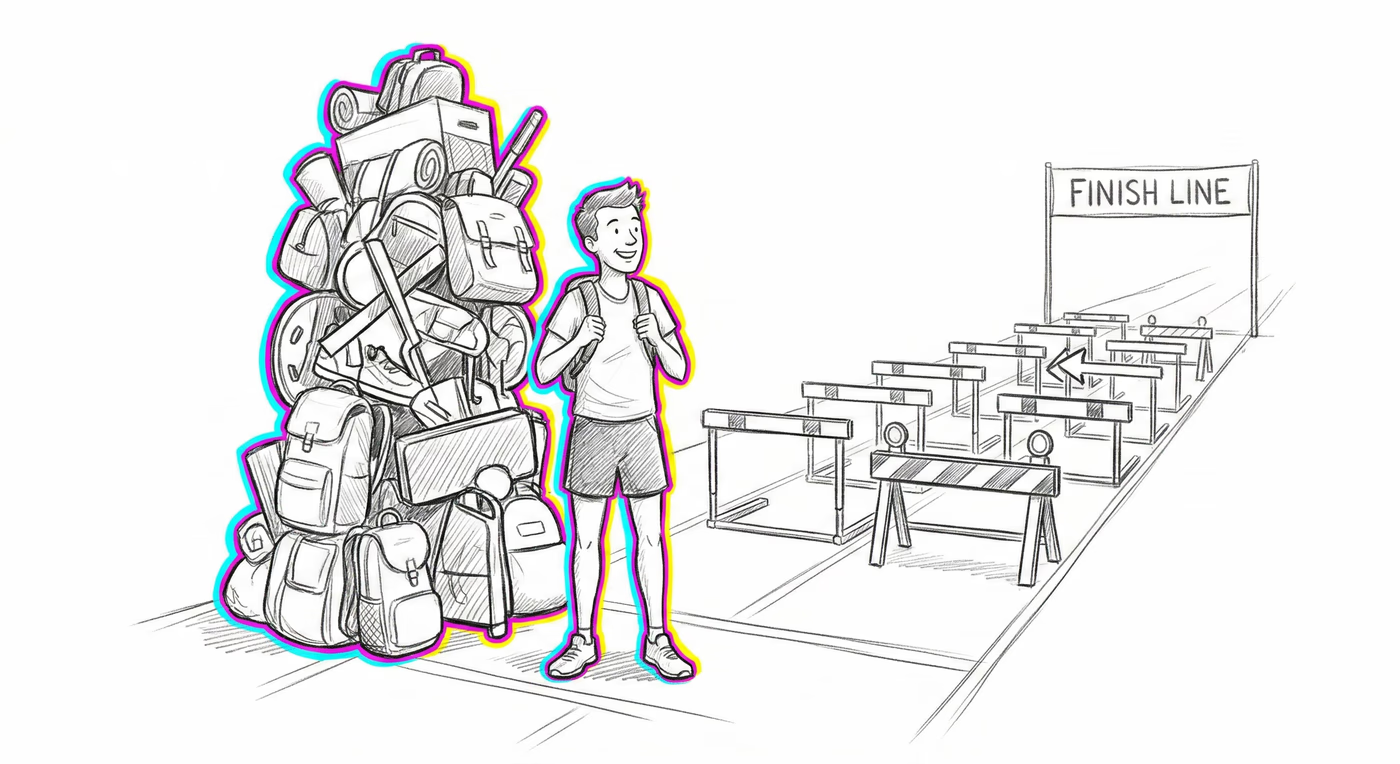
Spending disproportionate time on trivial, easy-to-grasp issues while glossing over important, complex ones.

WHAT IT IS

The glitch, explained plainly.

Imagine your family needs to decide two things: which house to buy and what color to paint the mailbox. The house is so complicated — mortgages, inspections, neighborhoods — that everyone just says 'looks fine.' But the mailbox color? Everyone has an opinion and argues about it for an hour. That's bikeshedding: the easy stuff gets all the attention while the hard, important stuff gets ignored.

The Law of Triviality describes a systematic pattern in group and individual decision-making where attention and discussion time are inversely proportional to the importance and complexity of the issue at hand. People gravitate toward simple, relatable topics where they feel competent to contribute, while complex, high-stakes decisions are rushed through or deferred because few participants feel qualified to engage meaningfully. This creates an organizational paradox where billion-dollar decisions receive minutes of scrutiny while minor expenditures generate hours of debate. The effect is amplified in group settings where members seek to demonstrate participation and relevance, finding it far easier to opine on familiar details than to grapple with abstract, technical, or high-risk matters.

SOUND FAMILIAR?

Where it shows up.

  1. 01 During a two-hour product strategy meeting, the team spends 15 minutes reviewing the proposed pivot to a new market segment worth $10M in potential revenue, then spends the remaining 90 minutes debating whether the company's internal Slack channels should use emoji reactions or threaded replies.
  2. 02 A city council convenes to vote on a $200M transportation infrastructure overhaul and a $2,000 proposal for new benches in the town square. The infrastructure plan passes in eight minutes with no questions. The bench proposal triggers a 45-minute debate about wood vs. metal, paint colors, and armrest styles.
  3. 03 A startup's board meeting agenda includes reviewing the company's burn rate and runway (6 months of cash left) and selecting a catering vendor for the office. The CEO notices the board spends twice as long discussing lunch options as discussing the financial crisis, with every member contributing opinions on food but only the CFO commenting on the budget.
  4. 04 An open-source project receives a pull request that refactors a critical security module. It sits unreviewed for three weeks. Meanwhile, a pull request changing the project's README formatting generates 47 comments and four counter-proposals within 48 hours.
  5. 05 A hospital's administrative committee is tasked with approving both a new electronic health records system and a new break room coffee machine. The committee quickly defers the EHR decision to 'a subcommittee that can study it further,' then proceeds to spend the rest of the meeting enthusiastically comparing coffee machine models, brands, and brewing methods, feeling productive by the end.
IN DIFFERENT DOMAINS

Where it shows up at work.

The same glitch looks different depending on the terrain. Finance, medicine, a relationship, a team — same mechanism, different costume.

Finance & investing

Investment committees may rubber-stamp complex derivative strategies or large portfolio reallocations with minimal debate, then spend extensive time scrutinizing small expense line items like office supply budgets or conference travel costs, misallocating their analytical attention away from the decisions with the greatest financial impact.
Medicine & diagnosis

Hospital boards may quickly approve multimillion-dollar equipment purchases or complex care protocols on expert recommendation, then spend disproportionate meeting time debating minor issues like waiting room magazine selections or staff parking assignments, leaving critical clinical governance decisions under-examined.

Education & grading

Faculty committees tend to breeze through curriculum overhauls or accreditation requirements while devoting extensive debate to trivial matters like the wording of syllabus disclaimers, the format of course evaluation forms, or the design of departmental letterhead.

Relationships

Couples planning a wedding may quickly agree on major commitments like the venue and guest list but get into prolonged, emotionally charged arguments over minor details like napkin colors, font choices on invitations, or the flavor of cake, depleting goodwill on trivialities.

Tech & product

Development teams frequently bikeshed on code style debates (tabs vs. spaces, naming conventions, UI button colors) while deferring architectural decisions about scalability, security, or technical debt that will have far greater long-term impact on the product.

Workplace & hiring

In organizational restructurings, leadership teams may fast-track major layoffs or departmental mergers with limited discussion while spending hours debating the new office seating arrangement or the wording of the internal announcement email.

Politics Media

Public discourse and media coverage often fixate on a politician's wardrobe choice, a verbal gaffe, or a flag pin rather than engaging with substantive policy proposals on healthcare, taxation, or national security that are more complex and harder for audiences to evaluate.

HOW TO SPOT IT

Ask yourself…

  • Am I spending more time on this topic because it's genuinely important, or because it's easy for me to understand and contribute to?
  • Has the group's energy and participation suddenly increased — is that because we've hit a critical issue or because we've drifted to something trivial?
  • If I ranked every item on today's agenda by actual impact, would the time allocation match the rankings?
HOW TO DEFEND AGAINST IT

The playbook.

  • Use structured agendas that allocate discussion time proportional to the impact and stakes of each item, placing the most complex and important items first when energy is highest.
  • Before any meeting, assign each agenda item an 'impact score' and share it with all participants so trivial items are explicitly labeled as such.
  • Implement a 'parking lot' system: when trivial tangents emerge, capture them on a side list and redirect the group to high-priority items.
  • Appoint a 'triviality checker' — a rotating role whose job is to call out when discussion time is disproportionate to the issue's importance.
  • For complex items, provide pre-read briefing materials that lower the comprehension barrier, so more participants can engage meaningfully with important decisions.
FAMOUS CASES

In history.

  • The original illustrative case from Parkinson's 1957 book describes a fictional committee that approved a nuclear reactor in minutes but debated a bicycle shed for 45 minutes, based on Parkinson's real observations of British government committees.
  • In 1999, Poul-Henning Kamp's email to the FreeBSD mailing list documented how open-source contributors spent weeks debating trivial changes to the sleep(1) command while significant architectural decisions went unreviewed, popularizing the term 'bikeshedding' in software development.
WHERE IT COMES FROM
Academic origin

C. Northcote Parkinson, 1957, in his book 'Parkinson's Law, and Other Studies in Administration.' The term 'bikeshedding' was popularized by Poul-Henning Kamp in a 1999 email to the FreeBSD mailing list.

Evolutionary origin

In ancestral environments, rapid consensus on concrete, observable problems (where to camp, how to arrange a shelter) was directly survival-relevant and rewarded quick engagement. Abstract, large-scale planning was rarely required. The brain evolved to prioritize tangible, comprehensible challenges where individual input could make an immediate difference, while deferring to leaders or specialists on matters beyond personal understanding.

IN AI SYSTEMS

How the machines inherit it.

AI development teams may bikeshed on model naming conventions, dashboard aesthetics, or demo presentation formatting while rushing through critical decisions about training data bias, safety alignment, or evaluation methodology. In LLM fine-tuning, teams sometimes over-optimize trivial prompt formatting details while under-investing in addressing substantive issues like hallucination rates or harmful output patterns.

FREE FIELD ZINE

10 glitches quietly running your life.

A free field-zine PDF — ten cognitive glitches named, illustrated, with a defense move for each. Plus the weekly Glitch Report on Fridays — one bias named, two spotted in the wild, one defense move. Unsubscribe any time.

EXPLORE MORE

Related glitches.

LAUNCH PRICE

Train against your blindspots.

50 cards are free to preview. Buyers unlock the rest of the deck plus the interactive training — Spot-the-Bias Quiz unlimited, Swipe Deck with spaced repetition, My Blindspots, Decision Pre-Flight, the Printable Deck + Cheat Sheets, and the Field Guide e-book. $29.50$59.

Unlock the full deck

Everything below — yours forever. Pay once, use across every device.

Half-off launch — limited to the first 100 readers. Auto-applied at checkout.
$59 $29.50
one-time payment · lifetime access
  • All interactive digital cards — search, filter, flip, shuffle on any device
  • Five training modes — Spot-the-Bias Quiz, Swipe Deck, Pre-Flight, Blindspots, Journal
  • Curated Lenses + Decision Templates + Defense Playbook
  • Printable Deck PDFs + Field Guide e-book + Cheat Sheets + Anki Export
  • Every future improvement, included
Unlock  $29.50

30-day refund · no questions asked

Unlock the full deck

Everything below — yours forever. Pay once, use across every device.

Half-off launch — limited to the first 100 readers. Auto-applied at checkout.
$59 $29.50
one-time payment · lifetime access
  • All interactive digital cards — search, filter, flip, shuffle on any device
  • Five training modes — Spot-the-Bias Quiz, Swipe Deck, Pre-Flight, Blindspots, Journal
  • Curated Lenses + Decision Templates + Defense Playbook
  • Printable Deck PDFs + Field Guide e-book + Cheat Sheets + Anki Export
  • Every future improvement, included
Unlock  $29.50

30-day refund · no questions asked