Mood-Congruent Memory

aka Mood-Congruent Memory Bias · Mood-Congruent Recall · Mood-Congruency Effect

Current mood acting as a filter on memory — feeling sad brings sad memories forward, feeling happy surfaces happy ones.

WHAT IT IS

The glitch, explained plainly.

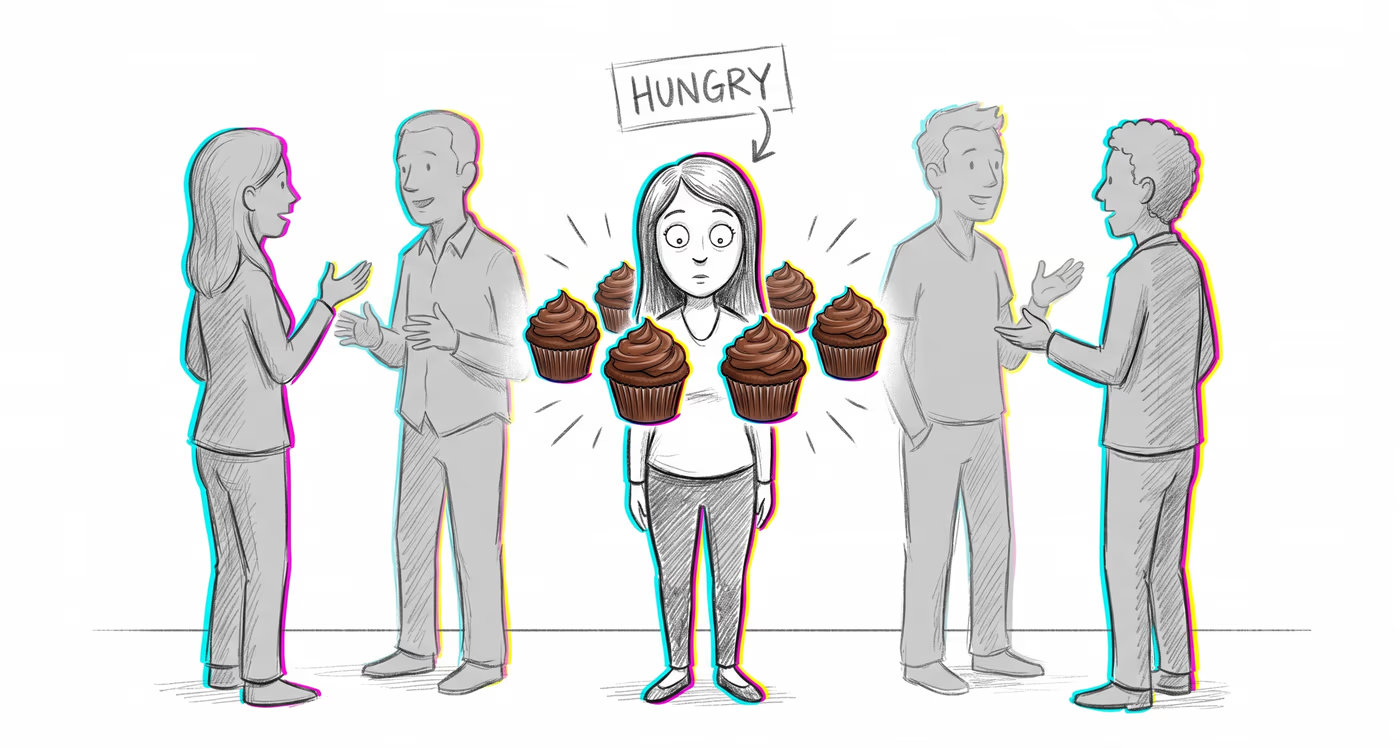
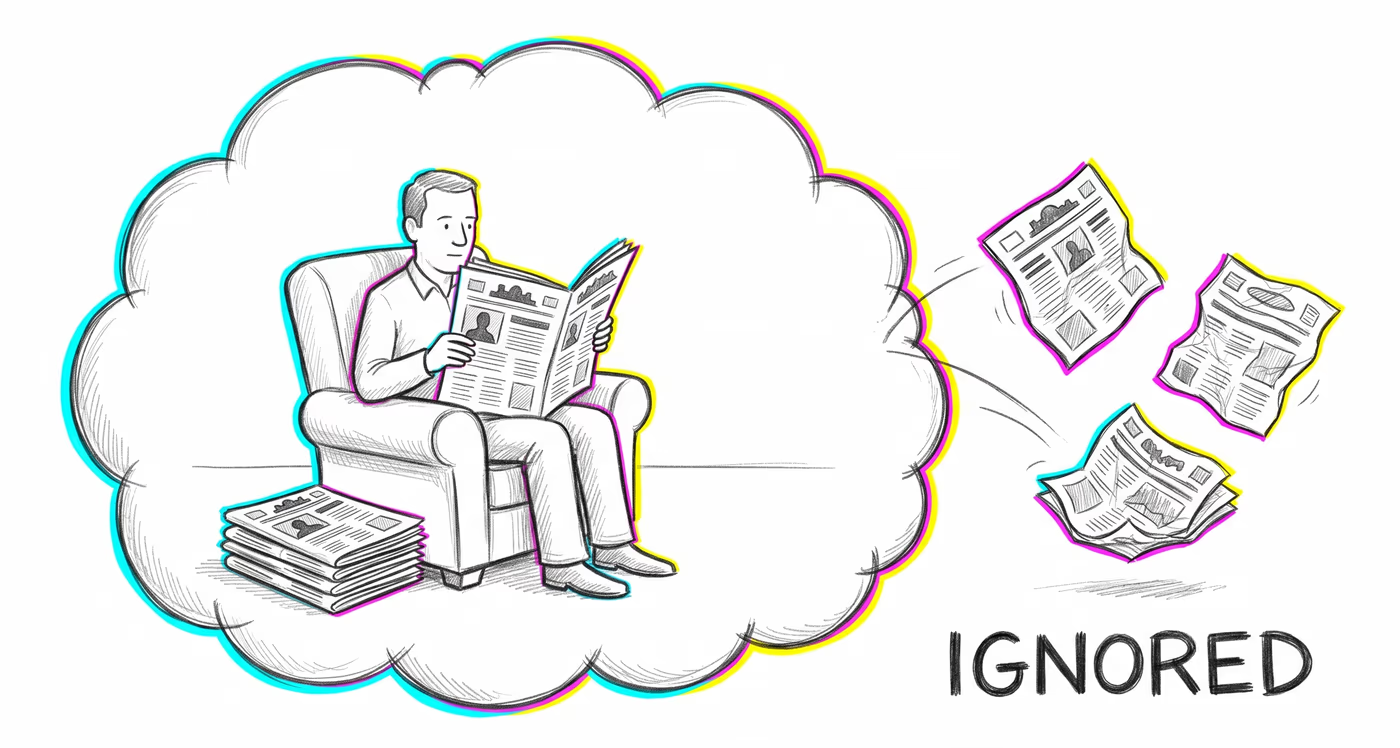
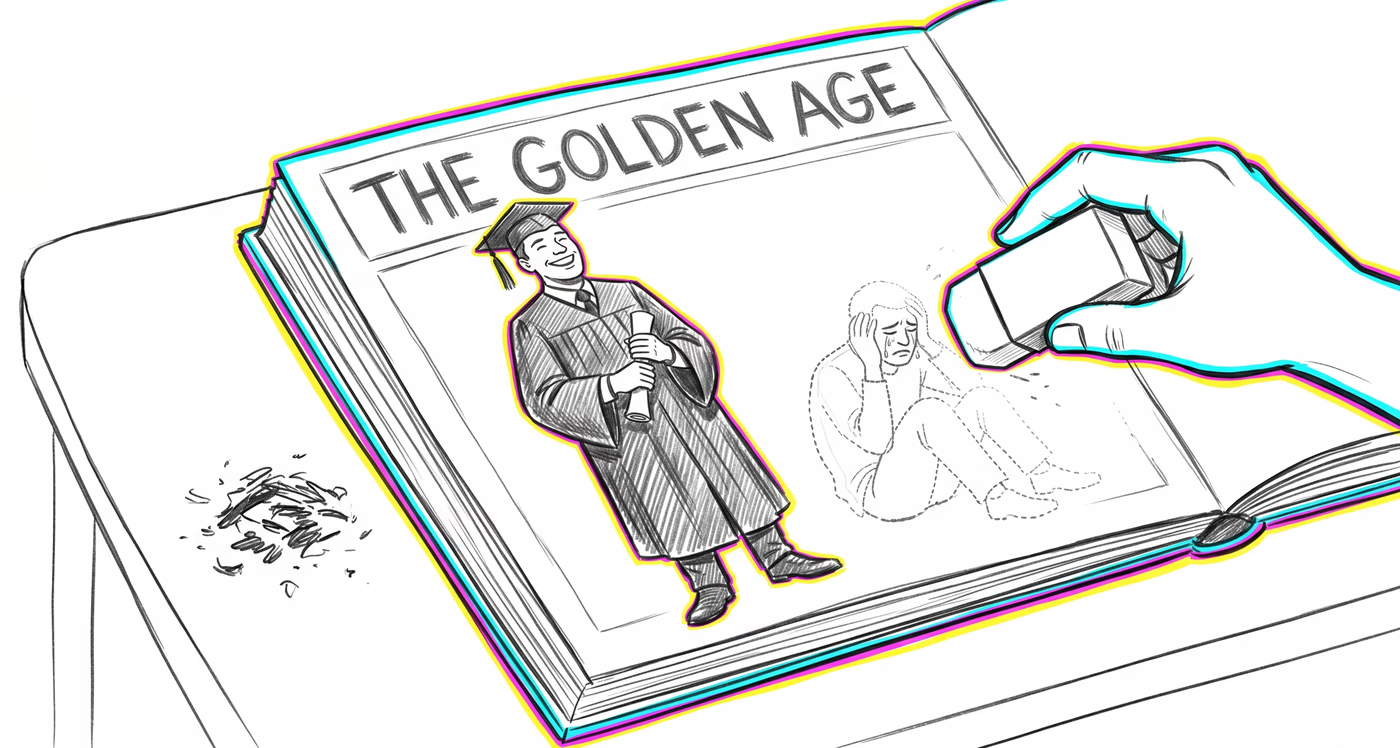
Imagine your brain is like a big toy box. When you feel happy, it's like a magnet that only pulls out the happy toys — your fun birthday party, the time you scored a goal. But when you feel sad, the magnet flips and only pulls out the sad toys — the time your friend was mean, the day it rained on your picnic. The toys didn't change, but which ones come to the top depends on how you feel right now.

Mood-congruent memory is the phenomenon in which a person's current emotional state acts as a retrieval cue, selectively facilitating access to memories that share the same affective valence. When someone is happy, positive memories become more accessible and vivid, while negative experiences fade into the background; the reverse occurs during sadness or anxiety. This creates a self-reinforcing feedback loop — the recalled memories deepen the current mood, which in turn makes even more mood-matching memories available. The effect is particularly pronounced for active recall rather than simple recognition, and it has significant clinical implications because it can sustain and intensify depressive episodes by locking individuals into cycles of negative remembering.

SOUND FAMILIAR?

Where it shows up.

  1. 01 Maria just received a rejection email from a job she wanted. While updating her résumé afterward, she finds herself recalling the two previous interviews she bombed, and the time she was passed over for a promotion — but completely forgets the three offers she's successfully landed in the past two years.
  2. 02 After his team wins a championship game, Coach Davis sits down to write his season review. He finds himself emphasizing the players' improvement arcs and clutch performances, while glossing over the mid-season losing streak and disciplinary issues that nearly derailed the team. His report reads far more positively than his mid-season notes did.
  3. 03 During a tense quarterly review where revenue is down, the CFO asks the leadership team to recall lessons from previous downturns. Every executive at the table primarily recalls past crises that ended badly — layoffs, lost clients, failed pivots — even though the company has successfully weathered several downturns before. Their recollections skew the discussion heavily toward worst-case planning.
  4. 04 A therapist notices that her patient, who arrived in an unusually cheerful mood after a date, describes his childhood as 'mostly happy with some rough patches.' In previous sessions when the patient was anxious, he described the same childhood as 'pretty difficult with a few bright spots.' The facts haven't changed — only which memories surface first.
  5. 05 A venture capitalist, elated after closing a successful fund round, reviews her portfolio and rates the riskiest startup investment as 'promising with manageable challenges.' Two months later, after a different portfolio company collapses, she re-evaluates the same startup and now recalls all the red flags she initially dismissed, rating it as 'high risk.' No new information about the startup has emerged between the two evaluations.
IN DIFFERENT DOMAINS

Where it shows up at work.

The same glitch looks different depending on the terrain. Finance, medicine, a relationship, a team — same mechanism, different costume.

Finance & investing

Investors experiencing portfolio losses tend to recall past financial setbacks more readily, leading to panic selling, while those riding a bull market recall their wins and take on excessive risk — both driven by a skewed memory sample that matches their current emotional state rather than a balanced assessment of their track record.

Medicine & diagnosis

Patients in pain or distress during a medical visit tend to recall previous negative health experiences more vividly, potentially over-reporting symptom history and severity. Clinicians in a negative mood after a diagnostic error may over-recall past mistakes, leading to defensive medicine and excessive testing.

Education & grading

Students who are anxious before an exam primarily recall past failures and blanked answers, increasing test anxiety in a feedback loop. Teachers in a frustrated mood may more readily recall a student's past behavioral problems rather than their academic improvements, skewing evaluations.

Relationships

During an argument, partners disproportionately recall past grievances and hurtful incidents, making the current conflict feel like part of an unbroken pattern of dysfunction. During periods of contentment, the same partners recall shared joys and overlook past friction, reinforcing relationship satisfaction.

Tech & product

Users who encounter a bug while already frustrated with an app tend to recall every previous glitch and slow load time, amplifying their negative perception of the product in reviews and support tickets. Conversely, users in a positive state after a smooth experience rate the product more favorably and recall fewer issues.

Workplace & hiring

Managers conducting performance reviews while in a negative mood are more likely to recall an employee's past mistakes and missed deadlines, while overlooking achievements. Employees who just received praise tend to recall their career highlights, inflating confidence during salary negotiations.

Politics Media

Voters feeling anxious about the economy tend to recall previous governmental failures and broken promises, making them more receptive to opposition messaging. Consumers of news in an angry mood preferentially recall past scandals involving the opposing political party, deepening partisan divides.

HOW TO SPOT IT

Ask yourself…

  • Am I remembering mostly negative (or positive) past experiences right now — and does that match an unusually strong mood I'm currently in?
  • If I were in the opposite emotional state, would I be telling this same story about my past differently?
  • Am I making a judgment about a pattern in my life based primarily on memories that happen to match how I feel right now?
HOW TO DEFEND AGAINST IT

The playbook.

  • Keep a written journal or decision log during various mood states so you can consult balanced evidence rather than relying on in-the-moment recall.
  • Before making important decisions, deliberately force yourself to recall three experiences that contradict your current emotional tone.
  • Use the 'mood check' technique: explicitly label your current mood before engaging in any retrospective evaluation or decision-making.
  • Delay consequential decisions when you recognize you are in a strong emotional state — positive or negative — to allow mood-incongruent memories to surface.
  • Ask a trusted friend or advisor to provide their perspective on the situation, since they are not subject to the same mood-driven retrieval bias.
FAMOUS CASES

In history.

  • Post-2008 financial crisis, widespread investor pessimism led market participants to disproportionately recall the dot-com crash and Great Depression, fueling prolonged risk aversion and delayed market recovery beyond what fundamentals warranted.
  • Studies of eyewitness testimony show that witnesses who are frightened during a crime recall more threatening details and fewer neutral contextual facts, a pattern consistent with mood-congruent retrieval distorting legal evidence.
WHERE IT COMES FROM
Academic origin

Gordon H. Bower, 1981. Bower formalized the concept in his landmark paper 'Mood and Memory' published in American Psychologist, proposing the associative network theory of affect to explain how emotional states bias memory retrieval.

Evolutionary origin

In ancestral environments, matching current emotional states to past experiences of the same kind served a survival function. Fear-state recall of previous threats helped primates quickly identify and avoid similar dangers, while positive-mood recall of successful foraging sites or safe territories reinforced approach behaviors. The mood-memory link ensured that the most survival-relevant experiences — those emotionally tagged as dangerous or rewarding — were prioritized in working memory when the organism was in a similar state again.

IN AI SYSTEMS

How the machines inherit it.

Sentiment analysis models and recommendation systems can exhibit an analog of mood-congruent memory. When trained on data annotated or generated by users in consistent emotional states, models learn to associate certain topics with particular emotional valences, creating feedback loops — for example, a recommendation algorithm that detects a user's negative engagement pattern may surface increasingly negative content, mirroring and amplifying the user's current mood rather than offering balanced information. LLMs conditioned on emotionally toned conversation history can similarly skew their retrieval and generation toward mood-matching content.

FREE FIELD ZINE

10 glitches quietly running your life.

A free field-zine PDF — ten cognitive glitches named, illustrated, with a defense move for each. Plus the weekly Glitch Report on Fridays — one bias named, two spotted in the wild, one defense move. Unsubscribe any time.

EXPLORE MORE

Related glitches.

LAUNCH PRICE

Train against your blindspots.

50 cards are free to preview. Buyers unlock the rest of the deck plus the interactive training — Spot-the-Bias Quiz unlimited, Swipe Deck with spaced repetition, My Blindspots, Decision Pre-Flight, the Printable Deck + Cheat Sheets, and the Field Guide e-book. $29.50$59.

Unlock the full deck

Everything below — yours forever. Pay once, use across every device.

Half-off launch — limited to the first 100 readers. Auto-applied at checkout.
$59 $29.50
one-time payment · lifetime access
  • All interactive digital cards — search, filter, flip, shuffle on any device
  • Five training modes — Spot-the-Bias Quiz, Swipe Deck, Pre-Flight, Blindspots, Journal
  • Curated Lenses + Decision Templates + Defense Playbook
  • Printable Deck PDFs + Field Guide e-book + Cheat Sheets + Anki Export
  • Every future improvement, included
Unlock  $29.50

30-day refund · no questions asked

Unlock the full deck

Everything below — yours forever. Pay once, use across every device.

Half-off launch — limited to the first 100 readers. Auto-applied at checkout.
$59 $29.50
one-time payment · lifetime access
  • All interactive digital cards — search, filter, flip, shuffle on any device
  • Five training modes — Spot-the-Bias Quiz, Swipe Deck, Pre-Flight, Blindspots, Journal
  • Curated Lenses + Decision Templates + Defense Playbook
  • Printable Deck PDFs + Field Guide e-book + Cheat Sheets + Anki Export
  • Every future improvement, included
Unlock  $29.50

30-day refund · no questions asked