Rosy Retrospection

aka Rosy View · Rose-Tinted Glasses Effect · Positive Memory Bias

Remembering the past as better than it actually was, enhancing the good parts and forgetting the bad.

WHAT IT IS

The glitch, explained plainly.

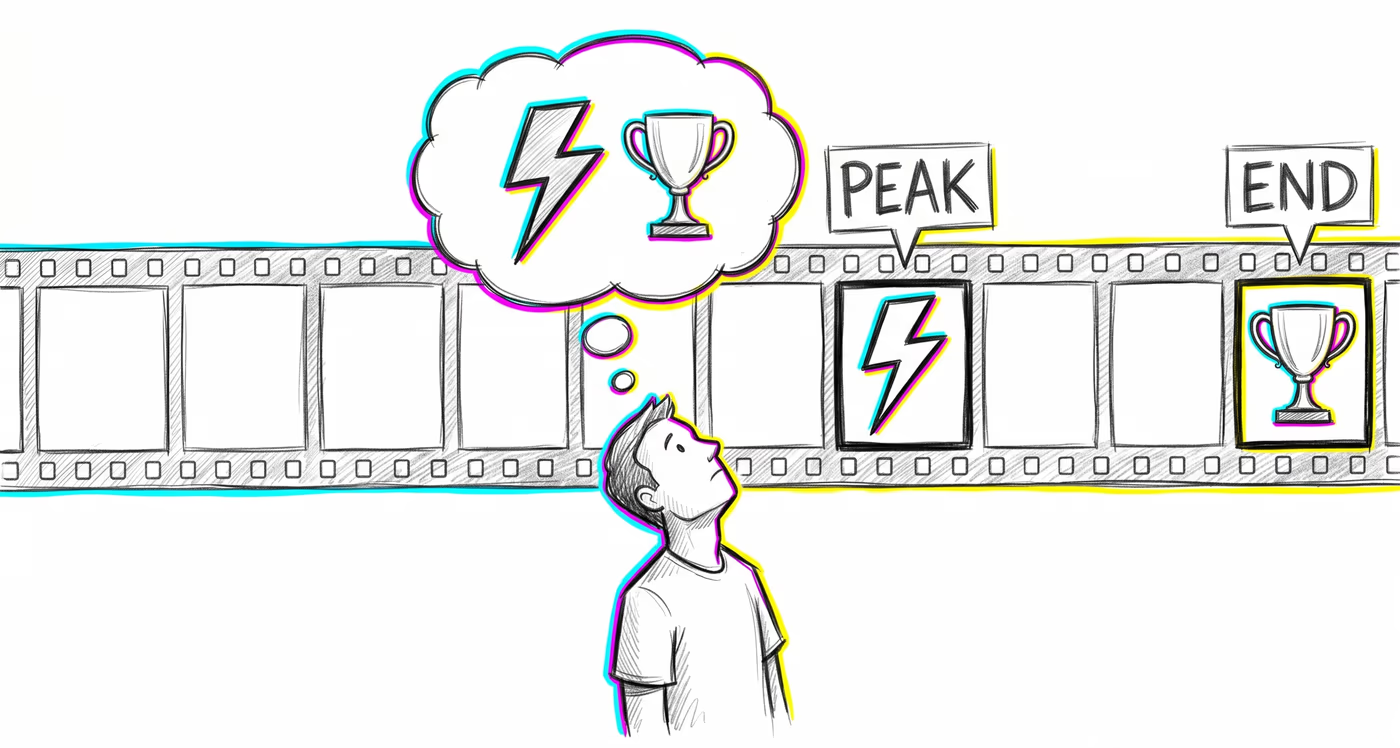
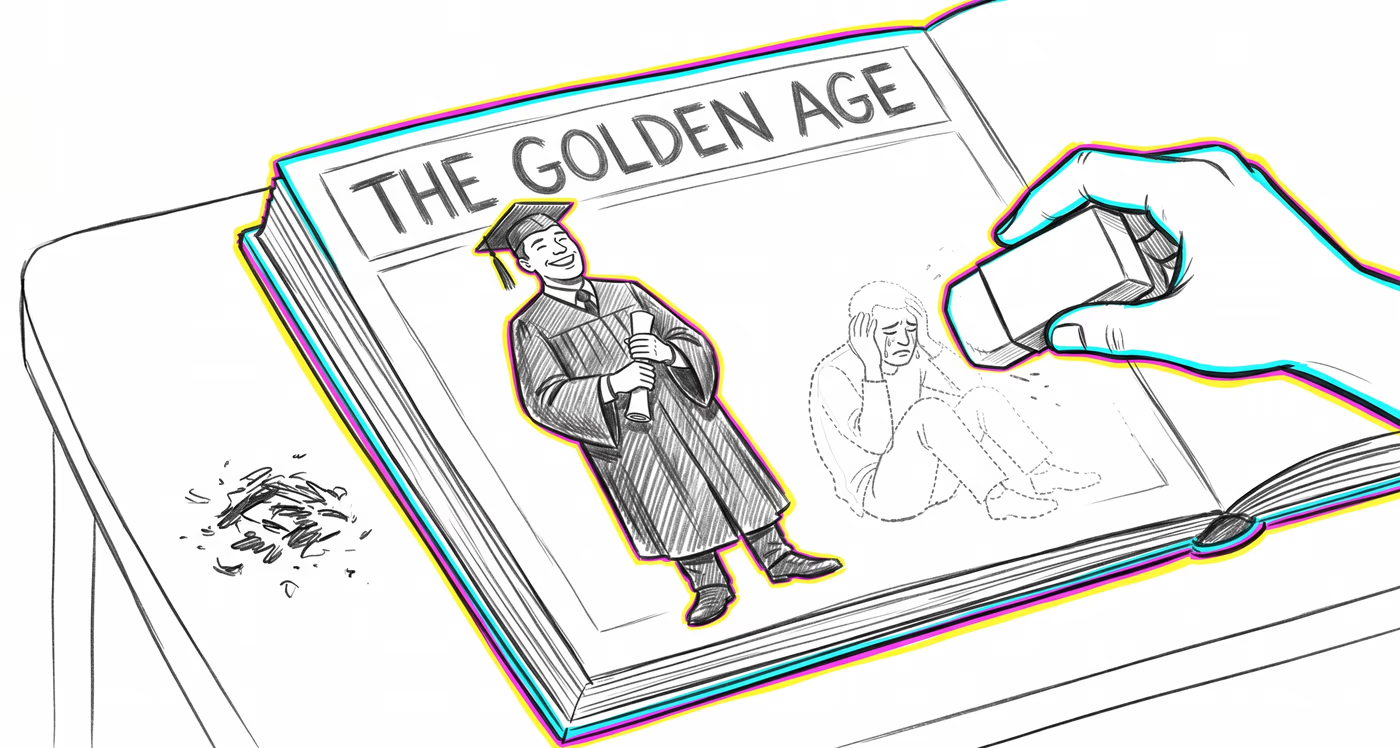
Imagine you went to a theme park. While you were there, it was super hot, the lines were really long, and your ice cream melted. But a few months later, when someone asks how it was, you mostly just remember the awesome roller coaster and the fireworks, and you say 'It was amazing!' Your brain is like a photo editor that keeps making old pictures look prettier over time.

Rosy retrospection describes the systematic distortion of autobiographical memory in which individuals evaluate past experiences more favorably in hindsight than they rated those same experiences while they were actually occurring. This bias operates through the differential fading of emotional affect — negative feelings attached to memories decay faster than positive feelings, leaving a net positive residue over time. The effect has been documented across diverse life events including vacations, academic experiences, military service, and relationships, and it grows stronger as the temporal distance from the event increases. Importantly, rosy retrospection shapes not only how we feel about the past but also how we make future decisions, as people rely on these inflated positive memories when choosing whether to repeat activities or recommend them to others.

SOUND FAMILIAR?

Where it shows up.

  1. 01 After leaving a demanding startup where she regularly worked 80-hour weeks, cried from stress, and developed insomnia, Maria keeps telling her current coworkers at a calmer company that her old job was 'the most exciting time of my life.' She's seriously considering going back, despite her therapist's session notes documenting severe burnout during that period.
  2. 02 A city council member argues passionately against modernizing the town's downtown district, citing how 'perfect' the area was in the 1990s. Historical records show the district actually suffered from high vacancy rates, frequent vandalism, and declining foot traffic during that same decade.
  3. 03 A project manager estimates a new software migration will take 3 months, based on her memory that the last one 'went pretty smoothly.' Her team's retrospective documents from that project reveal it actually took 7 months and involved two major outages and a vendor dispute — details she has genuinely forgotten.
  4. 04 A marathon runner signs up for another race, recalling how 'incredible' last year's event felt. During the actual race last year, she recorded voice memos at various checkpoints describing severe knee pain, nausea, and regret — but when she listens back, she's genuinely surprised, because her memory is of exhilaration and accomplishment.
  5. 05 A venture capitalist consistently underfunds contingency budgets for new portfolio companies, reasoning from his recollection that his earlier investments encountered 'a few bumps but mostly went fine.' His own quarterly reports from those periods document multiple near-failures, emergency bridge rounds, and founder conflicts that he now characterizes as minor growing pains.
IN DIFFERENT DOMAINS

Where it shows up at work.

The same glitch looks different depending on the terrain. Finance, medicine, a relationship, a team — same mechanism, different costume.

Finance & investing

Investors remember previous bull markets as smoother and more predictable than they actually were, leading them to underestimate volatility and take on excessive risk based on selectively positive memories of past market conditions.
Medicine & diagnosis

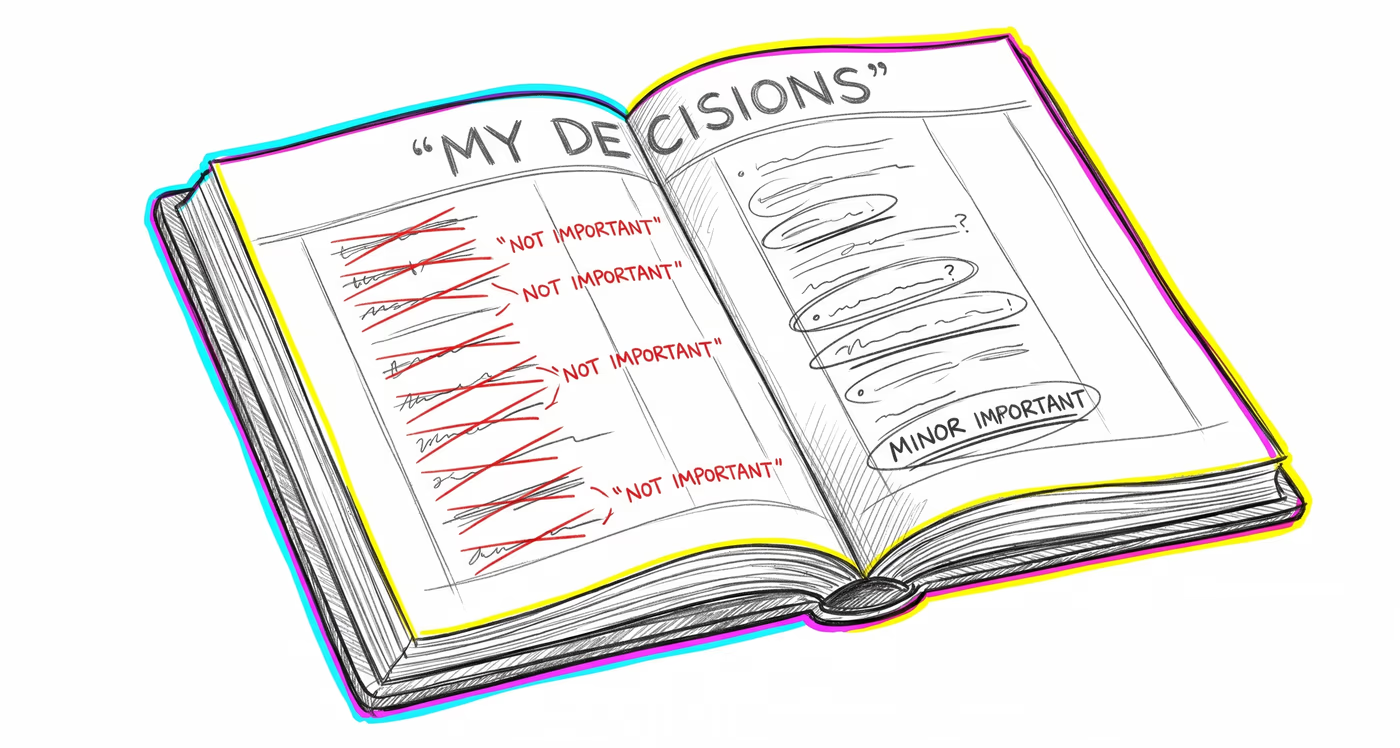
Patients recalling past illnesses or medical procedures tend to remember them as less painful and disruptive than documented at the time, leading to delayed medical consultations ('It wasn't that bad last time') or underreporting of symptom severity to clinicians.

Education & grading

Teachers and administrators idealize past cohorts of students as more disciplined and capable than current ones, a pattern that fuels resistance to pedagogical innovation and creates unrealistic benchmarks for present students.

Relationships

People idealize former romantic partners after breakups as the negative emotional memories fade faster than positive ones, leading to cycles of returning to unhealthy relationships or unfairly comparing new partners to a polished version of an ex.

Tech & product

Product teams recall previous launches as smoother than they were, leading to underestimated timelines, under-resourced QA processes, and repeated integration problems that post-mortems had flagged but team memory has softened.

Workplace & hiring

Employees remember previous jobs or managers more favorably over time, creating a 'grass was greener' effect that fuels dissatisfaction with current roles and drives premature job-hopping based on inflated memories rather than documented experiences.

Politics Media

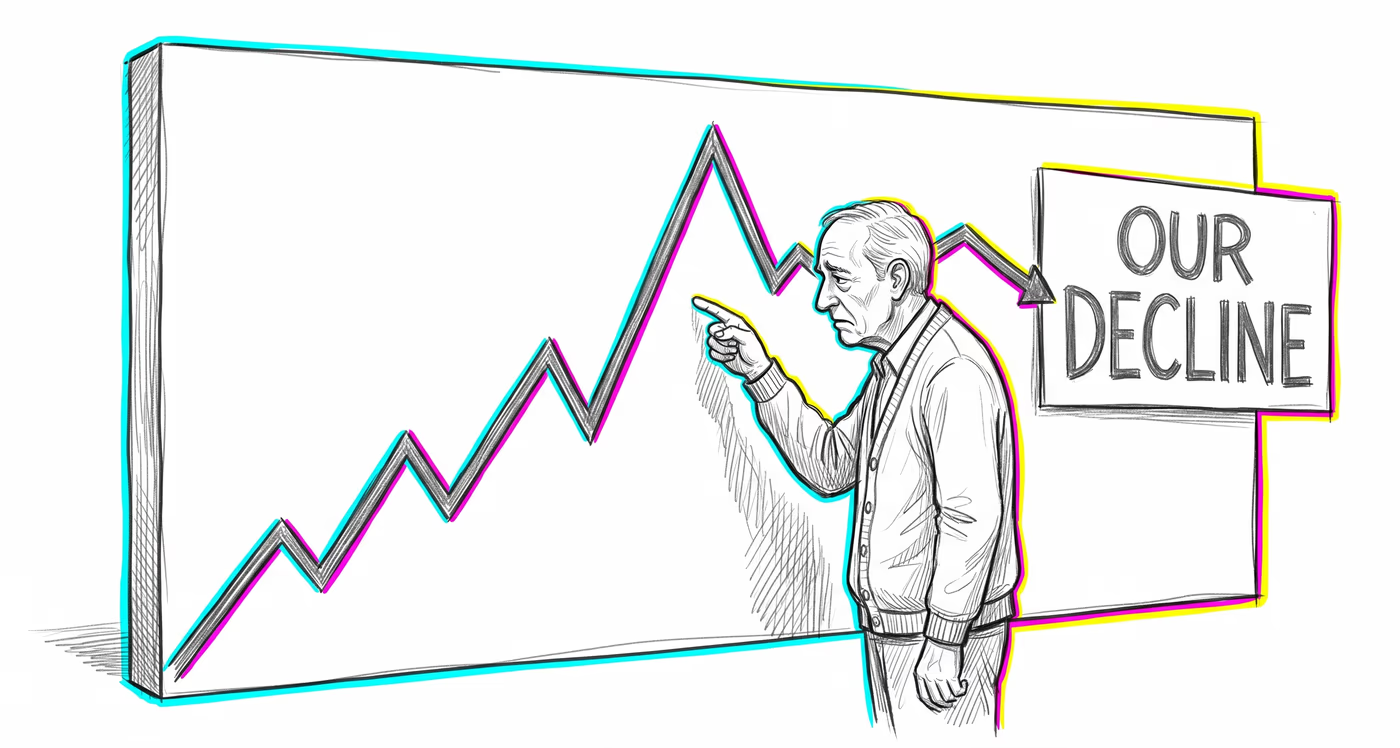
Politicians leverage voters' rosy memories of past decades — 'things used to be better' — to frame the present as a decline, even when objective indicators like crime rates, life expectancy, or poverty levels show measurable improvement.

HOW TO SPOT IT

Ask yourself…

  • Am I remembering mostly highlights of this past experience, or can I also recall specific frustrations and difficulties that I know occurred?
  • If I check a journal, old messages, or photos from that time, would they match the emotional tone of what I'm remembering right now?
  • Am I using my memory of how something 'used to be' to justify dissatisfaction with my current situation — and is that memory actually accurate?
HOW TO DEFEND AGAINST IT

The playbook.

  • Keep a real-time journal or log of experiences, including frustrations and difficulties, to create an accurate reference point you can consult later.
  • Before making decisions based on past experience, deliberately try to recall three specific negative aspects of that experience.
  • Ask people who shared the experience to independently describe both the good and bad parts — compare their account to yours.
  • Use the 'documentary test': if a neutral camera crew had filmed the experience, what would they have captured that your memory is omitting?
  • When you catch yourself saying 'it used to be better,' pause and list concrete, verifiable metrics that allow objective comparison between then and now.
FAMOUS CASES

In history.

  • The widespread idealization of the 1950s in American political discourse as a golden era of prosperity, despite well-documented racial segregation, gender inequality, and economic exclusion for large segments of the population.
  • Post-reunification nostalgia for East Germany ('Ostalgie'), where many former East Germans remembered life under communism more positively than contemporary surveys from that era recorded.
  • The 'Make America Great Again' political movement, which drew on voters' rosy memories of previous decades to frame the present as a period of decline.
WHERE IT COMES FROM
Academic origin

Terence R. Mitchell and Leigh Thompson, who first proposed and formalized the concept in their 1994 theoretical paper 'A Theory of Temporal Adjustments of the Evaluation of Events: Rosy Prospection and Rosy Retrospection,' followed by empirical validation in Mitchell, Thompson, Peterson, & Cronk (1997) in the Journal of Experimental Social Psychology.

Evolutionary origin

Organisms that could recover psychologically from setbacks and approach previously challenging but beneficial activities again — such as foraging in dangerous territory or enduring the pain of childbirth — had a reproductive advantage. A memory system that softens past hardships encourages repeated engagement with activities that carry short-term costs but long-term survival benefits, while also maintaining the psychological resilience and optimism needed to face future challenges.

IN AI SYSTEMS

How the machines inherit it.

Training data inherits rosy retrospection when it draws on human-written retrospective accounts — memoirs, reviews, and historical narratives that systematically overweight positive aspects of past events. Sentiment analysis models trained on such data may learn a positivity skew for past-tense language. Recommendation systems that rely on user recall ratings (rather than in-the-moment ratings) may over-recommend experiences that users remember fondly but didn't actually enjoy, perpetuating a feedback loop of inflated satisfaction scores.

Read more on Wikipedia
FREE FIELD ZINE

10 glitches quietly running your life.

A free field-zine PDF — ten cognitive glitches named, illustrated, with a defense move for each. Plus the weekly Glitch Report on Fridays — one bias named, two spotted in the wild, one defense move. Unsubscribe any time.

EXPLORE MORE

Related glitches.

LAUNCH PRICE

Train against your blindspots.

50 cards are free to preview. Buyers unlock the rest of the deck plus the interactive training — Spot-the-Bias Quiz unlimited, Swipe Deck with spaced repetition, My Blindspots, Decision Pre-Flight, the Printable Deck + Cheat Sheets, and the Field Guide e-book. $29.50$59.

Unlock the full deck

Everything below — yours forever. Pay once, use across every device.

Half-off launch — limited to the first 100 readers. Auto-applied at checkout.
$59 $29.50
one-time payment · lifetime access
  • All interactive digital cards — search, filter, flip, shuffle on any device
  • Five training modes — Spot-the-Bias Quiz, Swipe Deck, Pre-Flight, Blindspots, Journal
  • Curated Lenses + Decision Templates + Defense Playbook
  • Printable Deck PDFs + Field Guide e-book + Cheat Sheets + Anki Export
  • Every future improvement, included
Unlock  $29.50

30-day refund · no questions asked

Unlock the full deck

Everything below — yours forever. Pay once, use across every device.

Half-off launch — limited to the first 100 readers. Auto-applied at checkout.
$59 $29.50
one-time payment · lifetime access
  • All interactive digital cards — search, filter, flip, shuffle on any device
  • Five training modes — Spot-the-Bias Quiz, Swipe Deck, Pre-Flight, Blindspots, Journal
  • Curated Lenses + Decision Templates + Defense Playbook
  • Printable Deck PDFs + Field Guide e-book + Cheat Sheets + Anki Export
  • Every future improvement, included
Unlock  $29.50

30-day refund · no questions asked