Naive Allocation

aka Naive Diversification · Diversification Bias · Diversification Heuristic

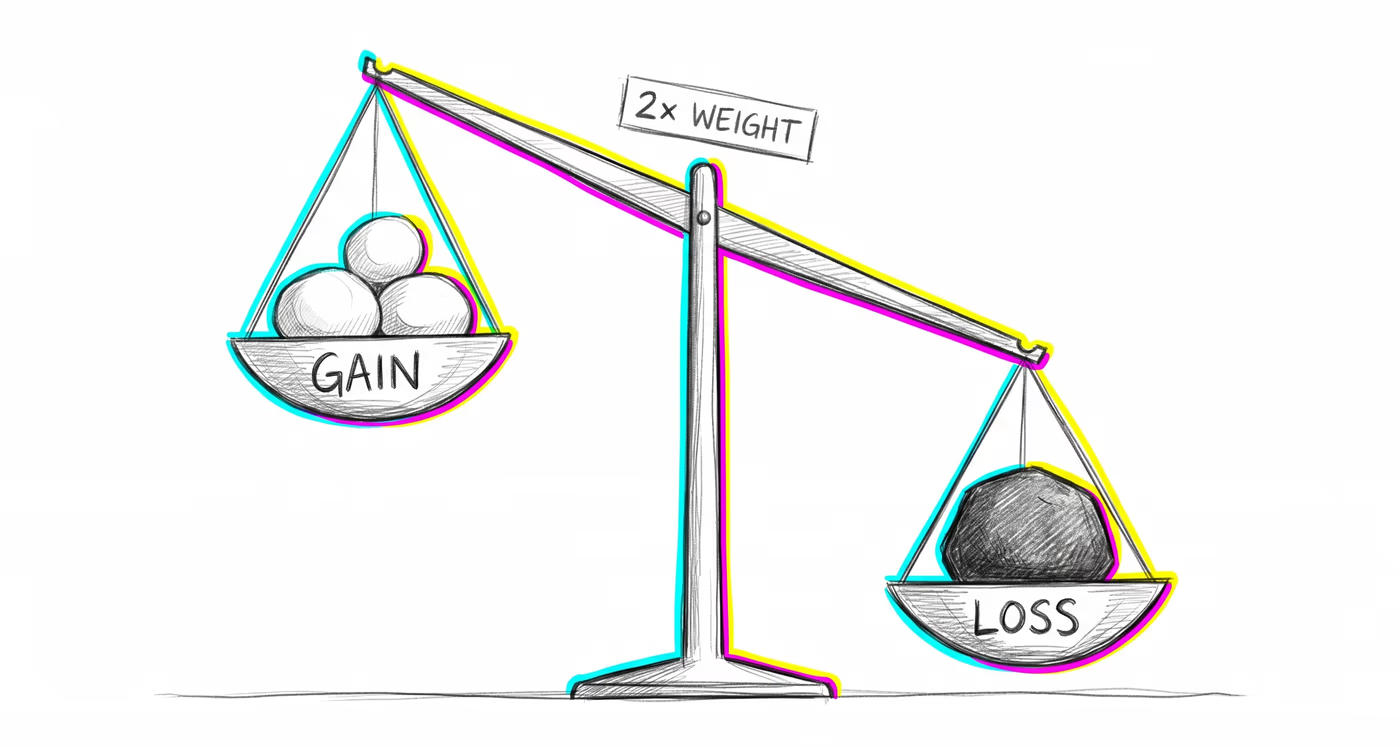
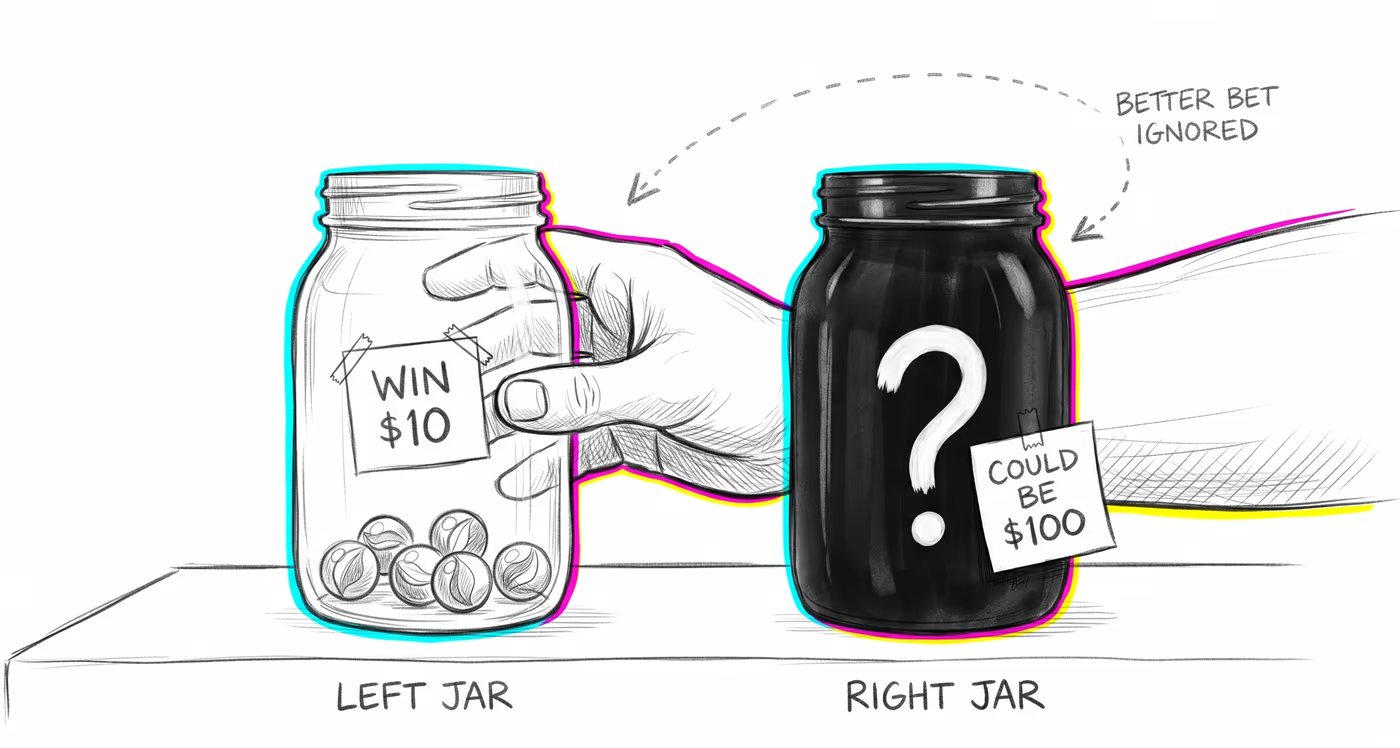
Dividing resources equally among all available options regardless of merit, simply because equal splitting feels fair.

WHAT IT IS

The glitch, explained plainly.

Imagine you have a bag of marbles and four jars. Instead of thinking about which jar deserves the most marbles, you just put the same number in each jar because it 'feels fair.' Even if one jar is really important and the others don't matter, you still split them evenly because counting equal amounts is easier than actually deciding.

Naive allocation describes the systematic tendency for people to spread their resources—money, time, attention, or effort—equally across whatever options are presented to them, without considering the relative value or suitability of each option. This behavior is heavily influenced by the partition of options: if the menu of choices is restructured to include more items from one category, allocations shift toward that category even when underlying preferences haven't changed. The bias is especially pronounced when decisions must be made simultaneously rather than sequentially, as the simultaneous framing triggers a portfolio-like mindset where diversification itself becomes the decision heuristic. Crucially, this means that people's allocations can be manipulated simply by changing how options are grouped or how many sub-options exist within each category.

SOUND FAMILIAR?

Where it shows up.

  1. 01 Maria is setting up her 401(k) and sees ten available funds—seven stock funds and three bond funds. Without researching any of them, she allocates 10% to each fund, resulting in a 70% stock allocation. When her coworker, whose plan offers three stock funds and seven bond funds, does the same thing, he ends up with only 30% in stocks. Both believe they made sensible, diversified choices.
  2. 02 A project manager has a budget to distribute across her team's initiatives. She has three customer-facing projects and one internal infrastructure project. Rather than assessing which projects would generate the most value, she splits the budget into four equal portions, giving the infrastructure project the same resources as each customer project despite very different expected returns.
  3. 03 A nonprofit board must allocate a grant across program areas. When the grant application listed 'Education' as one category and 'Health' as another, the board split funds 50/50. The next year, the application subdivided 'Health' into 'Mental Health,' 'Nutrition,' and 'Preventive Care.' The board now allocated only 25% to Education and 75% to the three health subcategories, even though their community's needs hadn't changed.
  4. 04 When asked to pick snacks for the next three office meetings all at once, David selects three completely different options—chips, fruit, and cookies—even though he knows everyone on the team prefers cookies. Had he ordered week by week, he would have just ordered cookies each time.
  5. 05 An angel investor evaluates five startups in a pitch competition and decides to spread her investment equally across all five, reasoning that diversification is always wise. She does this despite having significantly more domain expertise and conviction about two of the companies, and despite the fact that one of the five operates in a sector she believes is declining.
IN DIFFERENT DOMAINS

Where it shows up at work.

The same glitch looks different depending on the terrain. Finance, medicine, a relationship, a team — same mechanism, different costume.

Finance & investing

Investors in defined contribution retirement plans tend to divide contributions equally across whatever funds are offered, causing their actual asset allocation to mirror the plan's menu structure rather than their own risk tolerance or financial goals. A plan heavy on equity funds produces equity-heavy participants, regardless of individual circumstances.


Medicine & diagnosis

When clinicians or patients must allocate limited treatment time or resources across multiple health concerns simultaneously, they may default to equal attention for each issue rather than triaging based on severity, leading to undertreatment of the most critical condition.

Education & grading

Students preparing for multiple exams often divide study time equally across all subjects rather than concentrating on the material they find most difficult, resulting in over-preparation for easy topics and under-preparation for hard ones.

Relationships

People sometimes divide their social time equally across all friend groups or family members rather than investing more in the relationships they value most or that need the most attention, leading to shallow maintenance of connections that matter and unnecessary effort on those that don't.

Tech & product

Product teams distributing engineering resources equally across all features rather than prioritizing based on user impact. Additionally, when A/B testing platforms present multiple metrics, teams may weight all metrics equally instead of focusing on the primary success metric.

Workplace & hiring

Managers distributing budgets, headcount, or training resources equally across departments regardless of each department's strategic importance or growth potential, often because the equal split avoids political conflict rather than because it maximizes organizational value.

Politics Media

News organizations allocating equal airtime to multiple political candidates or policy positions regardless of their public support or policy substance, a form of naive balance that can distort public perception of relative importance.

HOW TO SPOT IT

Ask yourself…

  • Am I splitting resources equally just because it feels fair, or have I actually evaluated each option's relative importance?
  • Would my allocation change if these options were grouped or labeled differently?
  • Am I diversifying because I genuinely want variety, or because choosing all at once is making me hedge against uncertainty I wouldn't feel if I chose one at a time?
HOW TO DEFEND AGAINST IT

The playbook.

  • Force yourself to rank options before allocating: assign a priority score to each option and allocate proportionally to those scores.
  • Ask 'If I could only choose one, which would it be?' repeatedly to surface genuine preferences before distributing resources.
  • When facing simultaneous choices, mentally simulate making them one at a time to check if your preferences change.
  • Examine whether the partition of options is influencing you: would you allocate differently if the categories were combined or split differently?
  • Set a minimum threshold of analysis per option—spend at least a few minutes evaluating each before defaulting to equal splits.
FAMOUS CASES

In history.

  • Benartzi and Thaler's 2001 study of UCLA employee retirement plans demonstrated that workers' equity allocations shifted dramatically depending on whether their plan offered more stock funds or more bond funds, despite identical underlying financial goals.
  • The Halloween candy field experiment by Read and Loewenstein showed that trick-or-treaters who chose from two bowls at once diversified more than those who chose sequentially at separate houses, demonstrating the bias even in children's simple decisions.
WHERE IT COMES FROM
Academic origin

First demonstrated by Itamar Simonson in 1990 in a marketing context (variety-seeking in consumer choices). Extended to financial decision-making by Shlomo Benartzi and Richard H. Thaler in 2001. The term 'diversification bias' was coined by Daniel Read and George Loewenstein in 1995.

Evolutionary origin

In ancestral environments with high uncertainty about future needs and resource availability, spreading resources across multiple sources (food caches, foraging sites, social alliances) hedged against unpredictable losses. An equal-spread strategy minimized catastrophic risk when information about the relative quality of options was scarce or unreliable.

IN AI SYSTEMS

How the machines inherit it.

Recommendation systems and automated portfolio tools may inherit naive allocation when training data reflects users' equal-split behavior, perpetuating suboptimal diversification as if it were a revealed preference. Algorithmic resource-allocation systems may also default to equal distribution across categories when objective functions are underspecified, mirroring the human heuristic.

Read more on Wikipedia
FREE FIELD ZINE

10 glitches quietly running your life.

A free field-zine PDF — ten cognitive glitches named, illustrated, with a defense move for each. Plus the weekly Glitch Report on Fridays — one bias named, two spotted in the wild, one defense move. Unsubscribe any time.

EXPLORE MORE

Related glitches.

LAUNCH PRICE

Train against your blindspots.

50 cards are free to preview. Buyers unlock the rest of the deck plus the interactive training — Spot-the-Bias Quiz unlimited, Swipe Deck with spaced repetition, My Blindspots, Decision Pre-Flight, the Printable Deck + Cheat Sheets, and the Field Guide e-book. $29.50$59.

Unlock the full deck

Everything below — yours forever. Pay once, use across every device.

Half-off launch — limited to the first 100 readers. Auto-applied at checkout.
$59 $29.50
one-time payment · lifetime access
  • All interactive digital cards — search, filter, flip, shuffle on any device
  • Five training modes — Spot-the-Bias Quiz, Swipe Deck, Pre-Flight, Blindspots, Journal
  • Curated Lenses + Decision Templates + Defense Playbook
  • Printable Deck PDFs + Field Guide e-book + Cheat Sheets + Anki Export
  • Every future improvement, included
Unlock  $29.50

30-day refund · no questions asked

Unlock the full deck

Everything below — yours forever. Pay once, use across every device.

Half-off launch — limited to the first 100 readers. Auto-applied at checkout.
$59 $29.50
one-time payment · lifetime access
  • All interactive digital cards — search, filter, flip, shuffle on any device
  • Five training modes — Spot-the-Bias Quiz, Swipe Deck, Pre-Flight, Blindspots, Journal
  • Curated Lenses + Decision Templates + Defense Playbook
  • Printable Deck PDFs + Field Guide e-book + Cheat Sheets + Anki Export
  • Every future improvement, included
Unlock  $29.50

30-day refund · no questions asked