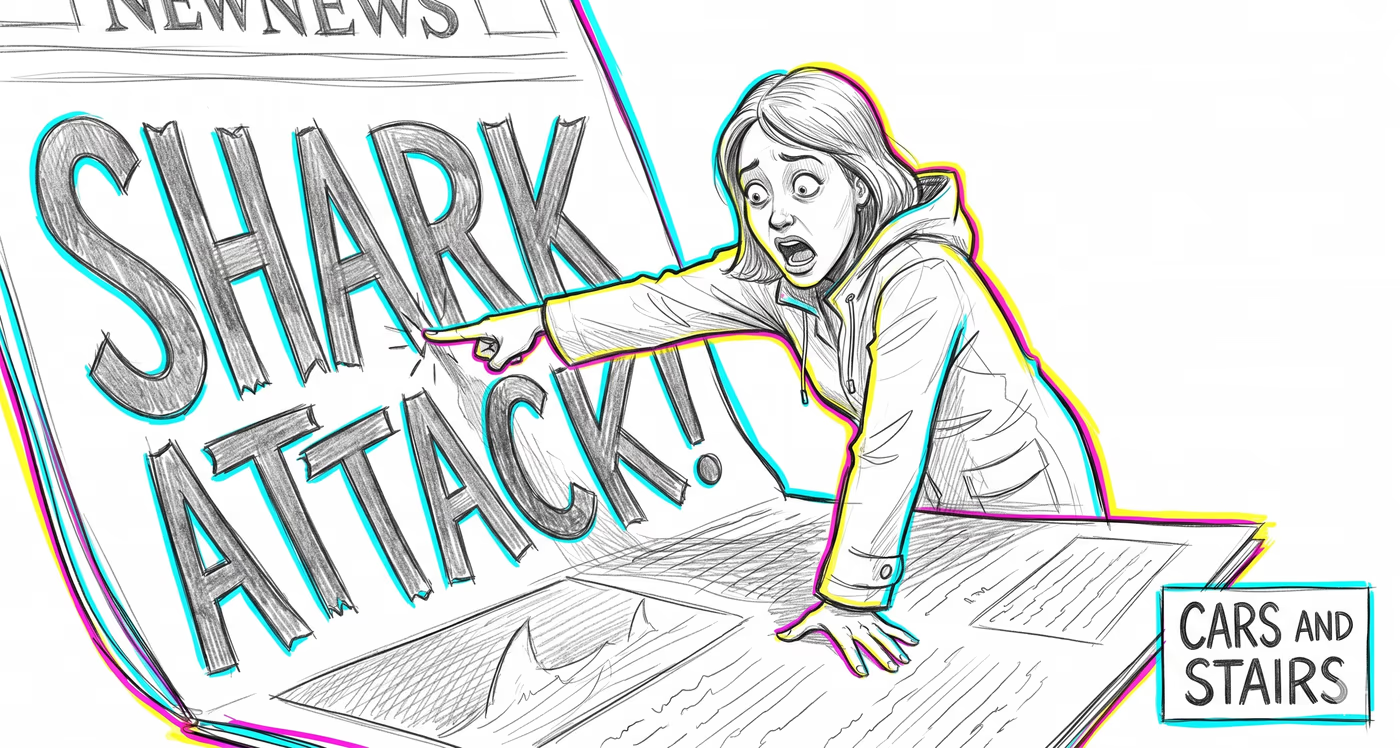
Neglect of Probability

aka Probability Neglect · Probability Blindness

Ignoring actual probabilities when making decisions and focusing only on how bad or good the outcome would feel.

WHAT IT IS

The glitch, explained plainly.

Imagine you hear there's a tiny, tiny chance a monster lives under your bed. Even though Mom says there's almost zero chance it's real, you're so scared of the monster that you can't sleep — you only think about how scary the monster is, not about how unlikely it is. That's what adults do too: they forget to ask 'how likely is this?' and only think about 'how bad (or good) would this be?'

Neglect of Probability describes a pattern in which individuals bypass statistical likelihood entirely when evaluating risks or rewards, making decisions based almost exclusively on the vividness, desirability, or dreadfulness of possible outcomes. Unlike biases that distort how probabilities are calculated, this bias involves skipping the probability calculation altogether — the mental math simply never happens. The effect is dramatically amplified when outcomes are emotionally charged: a terrifying or exhilarating possibility commandeers attention so completely that whether it has a 1% or 99% chance of occurring becomes functionally irrelevant. This produces a characteristic flattening where people react nearly identically to vastly different levels of risk, treating rare catastrophes and common inconveniences with comparable alarm, or treating lottery-odds windfalls and near-certain gains with comparable excitement.

SOUND FAMILIAR?

Where it shows up.

  1. 01 After reading a news article about a rare bacterial infection from a hot tub, Maria drains her backyard hot tub and refuses to use any public pool or spa. When her husband points out that the infection rate is roughly 1 in 4 million uses, she responds, 'I don't care about the numbers — did you see what it did to that woman's skin?'
  2. 02 A city council votes to spend $12 million installing radiation detectors in public buildings after a single tabloid story about a 'dirty bomb' threat, while simultaneously cutting $3 million from the road safety budget that currently prevents an estimated 40 traffic fatalities per year. Council members justify it by saying the radiation threat is 'too terrifying to ignore.'
  3. 03 An investor liquidates her entire portfolio of index funds and moves everything into cash after watching a documentary about a possible catastrophic market collapse. She acknowledges that historical data shows such collapses are extremely rare and markets always recover, but says, 'If it happens even once, I'd lose everything — I can't live with that possibility.'
  4. 04 A pharmaceutical company's clinical trial shows a new cancer drug extends average survival by 14 months, but 0.02% of patients experience a dramatic allergic reaction. The FDA advisory panel spends 80% of the hearing debating the allergic reaction rather than the survival benefit, and ultimately recommends against approval despite the overwhelming net positive expected outcome.
  5. 05 During a product launch meeting, a software team decides to delay release by two months to add an elaborate failover system against a server exploit that has been observed only once globally in the past decade, while leaving unpatched a common vulnerability that affects 15% of similar applications. The team lead explains, 'If that exotic exploit hits us, we'd be on the front page of every tech blog.'
IN DIFFERENT DOMAINS

Where it shows up at work.

The same glitch looks different depending on the terrain. Finance, medicine, a relationship, a team — same mechanism, different costume.

Finance & investing

Investors overreact to vivid but rare market crash scenarios — liquidating positions, buying excessive insurance products, or avoiding entire asset classes — while underweighting high-probability, moderate-impact risks like inflation erosion or fee drag. Lottery ticket purchases are a classic example: the emotional pull of a massive jackpot overrides the astronomical improbability of winning.
Medicine & diagnosis

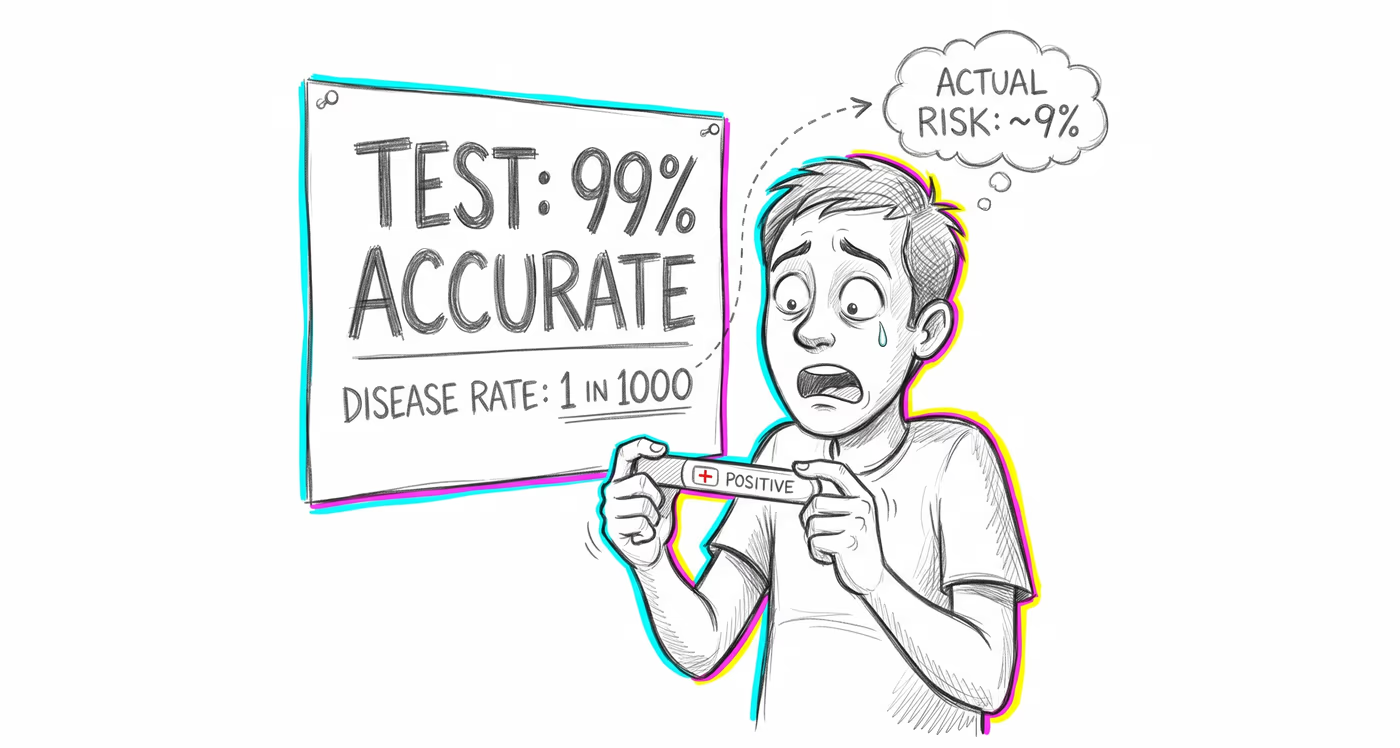
Patients refuse beneficial treatments (vaccines, surgeries, medications) because of extremely rare but frightening side effects, while ignoring the much higher probability of harm from the untreated condition. Clinicians may also over-order tests for rare dramatic diseases after encountering a vivid case, diverting resources from more statistically prevalent conditions.

Education & grading

Students and parents may fixate on extremely rare school safety threats that receive media coverage while neglecting far more probable risks to academic outcomes, such as chronic absenteeism, poor nutrition, or insufficient sleep. Test anxiety can also be driven by probability neglect — students catastrophize about the worst-case outcome of a single exam rather than weighing the actual statistical impact on their overall grade.

Relationships

People may end relationships or avoid commitment because they fixate on a vivid worst-case scenario (betrayal, abandonment) rather than weighing the actual probability of that outcome against the many more probable positive outcomes of the partnership. Jealousy is often fueled by an emotionally charged imagined scenario whose actual likelihood is never assessed.

Tech & product

Product teams disproportionately invest engineering resources into preventing spectacular but vanishingly rare failure modes (data breach headlines) while underinvesting in fixing high-probability, lower-drama usability issues that affect thousands of users daily. Security theater — visible but ineffective measures — thrives on probability neglect.

Workplace & hiring

Organizations allocate disproportionate budget to guard against dramatic but unlikely risks (lawsuits, PR disasters) while chronically underfunding responses to high-probability issues like employee burnout, turnover, or gradual productivity decline. Project risk management often ignores the full probability continuum, treating risks as binary present-or-absent rather than weighted by likelihood.

Politics Media

Media coverage of vivid but rare threats (terrorism, plane crashes, exotic diseases) triggers public demand for expensive legislative and policy responses, while statistically greater threats (traffic fatalities, air pollution, diet-related illness) receive comparatively little political attention. Politicians exploit this by emphasizing emotionally charged worst-case scenarios to justify regulation regardless of actual probability.

HOW TO SPOT IT

Ask yourself…

  • Am I reacting to how scary or exciting this outcome feels, or have I actually looked up how likely it is?
  • If I replaced the emotionally vivid outcome with a boring one of equal expected value, would I still make the same choice?
  • Can I state the actual probability as a number — and does my level of concern match that number?
HOW TO DEFEND AGAINST IT

The playbook.

  • Force yourself to write down the actual probability as a number before making the decision — consult reliable data sources rather than relying on gut feeling.
  • Use expected value calculations: multiply the probability of the outcome by its magnitude, and compare options on this basis rather than on outcome vividness alone.
  • Apply the 'frequency format' reframe: instead of '0.001% chance,' think 'this happens to 1 person out of 100,000 — am I making a policy for 100,000 people or panicking for 1?'
  • Create a risk comparison table: place the feared outcome alongside everyday risks you already accept (driving, crossing the street) to recalibrate your emotional response.
  • Introduce a cooling-off period before making fear-driven or excitement-driven decisions — emotional intensity fades faster than probability changes.
FAMOUS CASES

In history.

  • The U.S. response to Love Canal in the late 1970s, where the federal government launched an aggressive hazardous waste cleanup program without examining the actual probability that the waste was causing illness, leading to the Superfund legislation.
  • The U.S. Food Additives Amendment of 1958 (Delaney Clause), which prohibited any carcinogenic substance in food regardless of how minuscule the cancer probability, leading to substitution with ingredients posing greater overall health risks.
  • The 'Summer of the Shark' panic in 2001, where widespread U.S. media coverage and legislative action followed despite no statistical increase in shark attacks.
  • Post-9/11 fear-driven shift from flying to driving in the United States, which researchers estimate caused approximately 1,600 additional road fatalities in the year following the attacks due to the substituted risk.
WHERE IT COMES FROM
Academic origin

The term 'probability neglect' was coined by Cass Sunstein in his 2002 paper 'Probability Neglect: Emotions, Worst Cases, and Law.' The underlying phenomena were explored by Jonathan Baron and colleagues in 1993 (studies with children), and by Rottenstreich and Hsee in their 2001 paper 'Money, Kisses, and Electric Shocks: On the Affective Psychology of Risk' in Psychological Science. The broader theoretical foundation rests on Kahneman and Tversky's work on heuristics and biases (1970s) and Slovic, Finucane, Peters, and MacGregor's affect heuristic framework (2002).

Evolutionary origin

In ancestral environments, threats were typically binary and immediate — a predator is either present or absent, and the cost of ignoring even a small cue of danger was death. Quickly mobilizing a fear response to any possibility of a lethal threat, regardless of its exact probability, was far more adaptive than pausing to compute precise odds. The brain evolved to prioritize outcome severity over outcome likelihood because in survival contexts, the magnitude of the consequence (being eaten) vastly outweighed the cost of overreacting (unnecessary flight).

IN AI SYSTEMS

How the machines inherit it.

Machine learning models trained on human-labeled data can inherit probability neglect when training labels reflect human emotional reactions to outcomes rather than calibrated probabilistic judgments. Recommender systems may overweight rare but sensational content (because humans engaged with it disproportionately), and risk-scoring algorithms may overweight dramatic but improbable failure modes if calibrated against human expert judgments that themselves neglect base rates. LLMs can reproduce probability neglect in their reasoning by treating vividly described but unlikely scenarios as more decision-relevant than they statistically warrant.

Read more on Wikipedia
FREE FIELD ZINE

10 glitches quietly running your life.

A free field-zine PDF — ten cognitive glitches named, illustrated, with a defense move for each. Plus the weekly Glitch Report on Fridays — one bias named, two spotted in the wild, one defense move. Unsubscribe any time.

EXPLORE MORE

Related glitches.

LAUNCH PRICE

Train against your blindspots.

50 cards are free to preview. Buyers unlock the rest of the deck plus the interactive training — Spot-the-Bias Quiz unlimited, Swipe Deck with spaced repetition, My Blindspots, Decision Pre-Flight, the Printable Deck + Cheat Sheets, and the Field Guide e-book. $29.50$59.

Unlock the full deck

Everything below — yours forever. Pay once, use across every device.

Half-off launch — limited to the first 100 readers. Auto-applied at checkout.
$59 $29.50
one-time payment · lifetime access
  • All interactive digital cards — search, filter, flip, shuffle on any device
  • Five training modes — Spot-the-Bias Quiz, Swipe Deck, Pre-Flight, Blindspots, Journal
  • Curated Lenses + Decision Templates + Defense Playbook
  • Printable Deck PDFs + Field Guide e-book + Cheat Sheets + Anki Export
  • Every future improvement, included
Unlock  $29.50

30-day refund · no questions asked

Unlock the full deck

Everything below — yours forever. Pay once, use across every device.

Half-off launch — limited to the first 100 readers. Auto-applied at checkout.
$59 $29.50
one-time payment · lifetime access
  • All interactive digital cards — search, filter, flip, shuffle on any device
  • Five training modes — Spot-the-Bias Quiz, Swipe Deck, Pre-Flight, Blindspots, Journal
  • Curated Lenses + Decision Templates + Defense Playbook
  • Printable Deck PDFs + Field Guide e-book + Cheat Sheets + Anki Export
  • Every future improvement, included
Unlock  $29.50

30-day refund · no questions asked