Outgroup Derogation

aka Outgroup Bias · Outgroup Hostility · Outgroup Negativity Bias

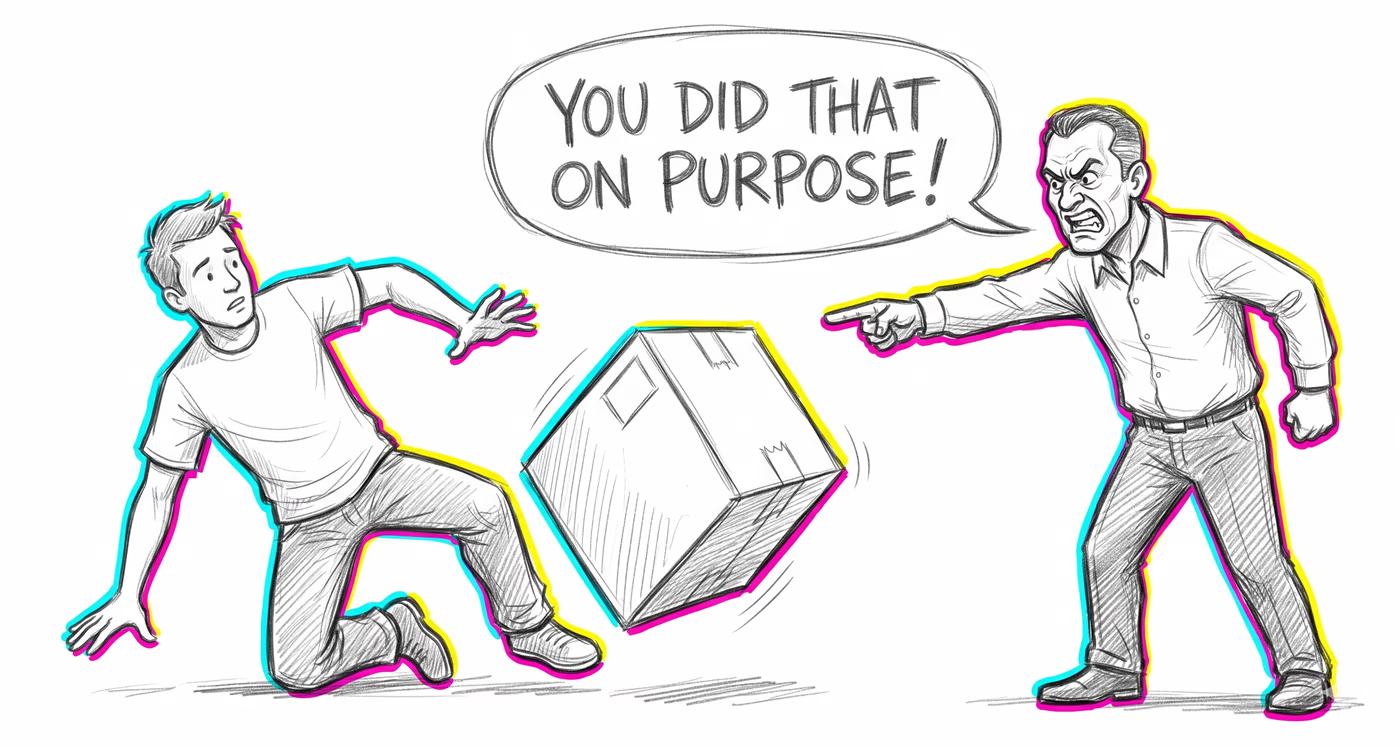
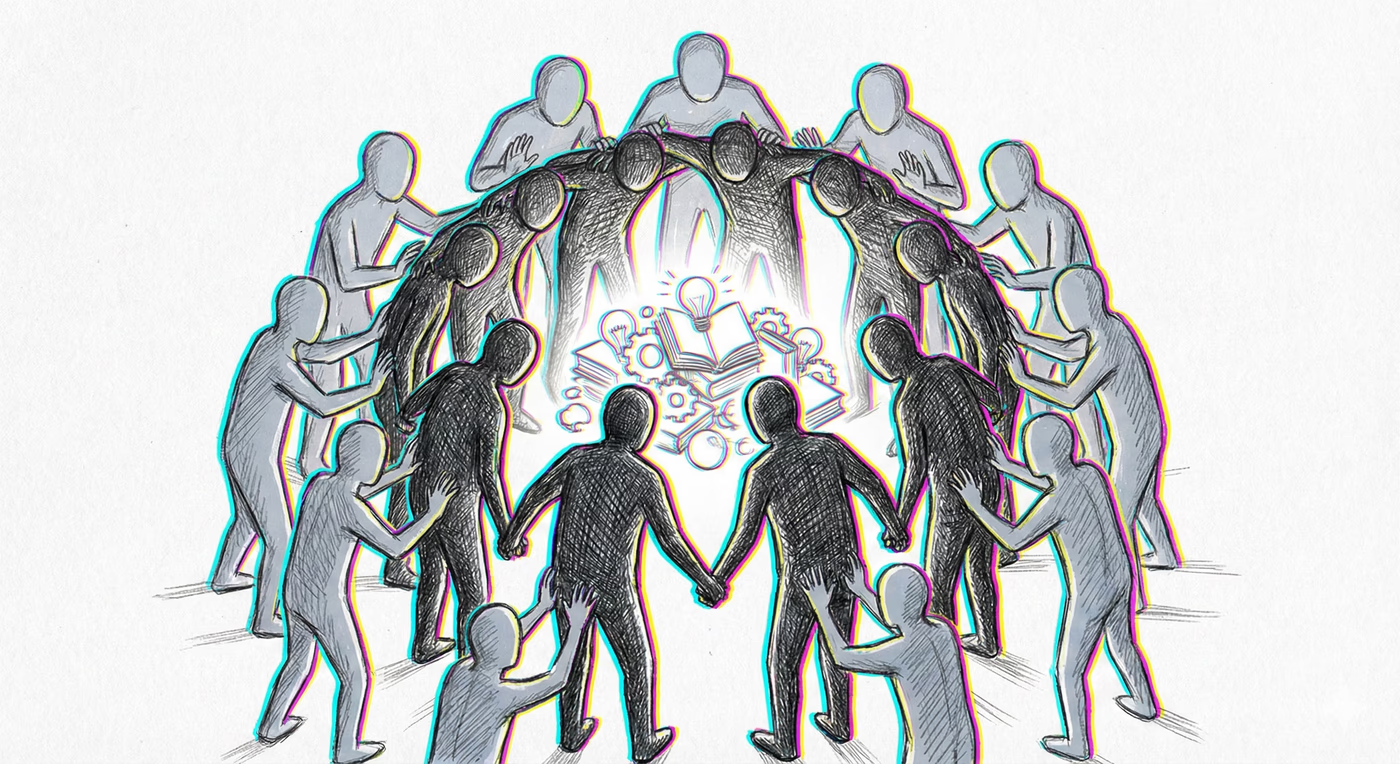
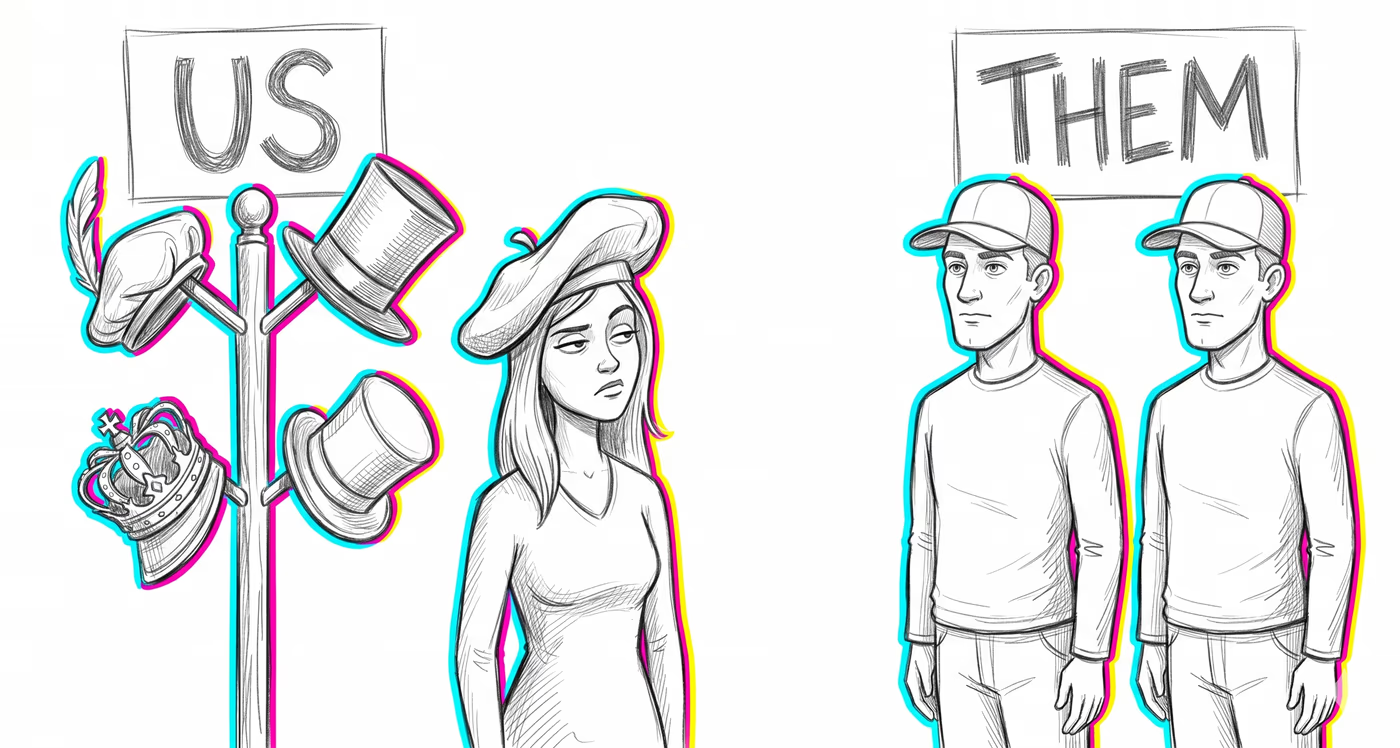
Viewing, evaluating, and treating outsiders more negatively simply because they aren't part of your group.

WHAT IT IS

The glitch, explained plainly.

Imagine you're on a playground and you have your group of friends. You don't just like your friends more — you also think the other group of kids is mean, weird, or not as smart, even though you've never really talked to them. You might say bad things about them or refuse to share your toys with them, just because they're 'not one of us.'

Outgroup derogation is the active, negative component of intergroup bias: rather than merely preferring one's own group, it involves directing hostility, contempt, or negativity toward groups perceived as different. This goes beyond passive indifference — people actively attribute negative traits to outgroup members, use harsher language when describing their behavior, withhold cooperation or resources, and in extreme cases dehumanize them entirely. Research distinguishes it from ingroup favoritism, showing that while favoring one's group is nearly universal and automatic, outgroup derogation is a distinct psychological process that tends to escalate under conditions of perceived threat, competition, or when group identity is strongly activated. The bias operates at both explicit and implicit levels, shaping everything from snap judgments about strangers to institutional policies that systematically disadvantage non-members.

SOUND FAMILIAR?

Where it shows up.

  1. 01 A hiring committee reviews two equally qualified candidates. When they learn that one candidate previously worked at a competitor company, several committee members begin pointing out minor weaknesses in that candidate's resume — weaknesses they completely overlooked in the other candidate's nearly identical profile. They ultimately describe the competitor's former employee as 'probably not a cultural fit.'
  2. 02 During a neighborhood dispute over a proposed park redesign, residents from the east side of town begin characterizing west-side residents as 'entitled' and 'out of touch,' despite both groups expressing nearly identical concerns about parking. When a west-side resident makes a reasonable compromise suggestion, an east-side resident dismisses it by saying, 'Well, what do you expect from people over there?'
  3. 03 A product manager at a tech company reads a bug report submitted by an engineer from a recently acquired startup. She immediately assumes the code quality from 'those acquisition people' is probably poor and deprioritizes the report. When an engineer from her original team submits a similar bug report the next day, she escalates it urgently, noting how insightful the catch was.
  4. 04 A university student joins a study group for organic chemistry. When a student from a rival university's exchange program asks to join, the group agrees but then consistently ignores her suggestions during sessions. After she correctly solves a problem, one member whispers to another, 'Even a broken clock is right twice a day.' They attribute her success to luck rather than competence.
  5. 05 An analyst at a consulting firm is asked to evaluate two nearly identical market reports — one from a partner firm and one from a competitor. She spends considerably more time searching for flaws in the competitor's report and ultimately writes a review that highlights three minor methodological limitations in the competitor's work, while describing the partner's report as 'thorough and well-reasoned,' even though it contains the same limitations.
IN DIFFERENT DOMAINS

Where it shows up at work.

The same glitch looks different depending on the terrain. Finance, medicine, a relationship, a team — same mechanism, different costume.

Finance & investing

Investors may systematically undervalue companies headquartered in countries or regions they view as outgroups — applying harsher scrutiny to their earnings reports while giving domestic or culturally similar firms the benefit of the doubt, contributing to home-country bias in portfolio allocation.
Medicine & diagnosis

Healthcare providers may unconsciously spend less time with patients from ethnic or cultural outgroups, take their pain reports less seriously, or attribute their symptoms to lifestyle factors rather than medical conditions — leading to diagnostic delays and treatment disparities.

Education & grading

Teachers may unconsciously give lower grades or less constructive feedback to students from social, ethnic, or cultural outgroups, while attributing the academic struggles of outgroup students to lack of effort or ability rather than to situational factors.

Relationships

People tend to be more critical and suspicious of a friend's or family member's new romantic partner if that person comes from a different cultural, religious, or socioeconomic background — scrutinizing their motives and character more harshly than they would someone from a similar background.

Tech & product

Platform recommendation algorithms trained on engagement data can amplify outgroup derogation by surfacing content that portrays outgroups negatively (generating more clicks and reactions), creating feedback loops that reinforce users' hostile attitudes toward people outside their ideological or demographic group.

Workplace & hiring

Teams that develop strong subgroup identities — such as between departments, office locations, or legacy vs. acquired employees — often derogate the work quality, competence, and intentions of the other group, creating silos and blocking cross-functional collaboration.

Politics Media

Political partisans attribute malicious intent to policy proposals from the opposing party while interpreting identical proposals from their own party charitably. Media coverage amplifies this by framing outgroup politicians' actions in more negative terms, reinforcing viewers' hostility toward the political outgroup.

HOW TO SPOT IT

Ask yourself…

  • Am I attributing negative traits to this person primarily because of the group they belong to, rather than their individual behavior?
  • Would I judge this same action or statement differently if it came from someone in my own group?
  • Am I searching harder for flaws in this person's work or argument because they are an outsider to my group?
HOW TO DEFEND AGAINST IT

The playbook.

  • Practice individuation: Before forming judgments about someone from an outgroup, deliberately identify three unique characteristics about them that have nothing to do with their group membership.
  • Apply the 'swap test': Replace the outgroup label with your own group and ask whether you would still make the same judgment — if not, the evaluation is likely driven by group bias rather than evidence.
  • Seek meaningful cross-group contact: Pursue collaborative, equal-status interactions with outgroup members toward shared goals, which research shows reliably reduces derogation.
  • Monitor your language: Notice whether you describe outgroup behaviors in more abstract, dispositional terms ('they are aggressive') versus concrete, situational terms ('he pushed back on the deadline') — abstract negative language is a linguistic marker of outgroup derogation.
  • Expand your identity: Cultivate superordinate identities (e.g., 'we are all engineers' rather than 'my team vs. their team') to recategorize former outgroup members as part of a shared ingroup.
FAMOUS CASES

In history.

  • The Robbers Cave Experiment (1954): Muzafer Sherif demonstrated that arbitrarily assigned groups of boys rapidly developed intense outgroup hostility — name-calling, flag-burning, and cabin raids — when placed in competition, showing how easily derogation emerges from mere group categorization and resource rivalry.
  • Jane Elliott's Blue Eyes/Brown Eyes exercise (1968): A schoolteacher split her class by eye color and observed that children designated as the 'superior' group immediately began derogating and bullying children in the 'inferior' group, demonstrating that outgroup derogation can be triggered by completely arbitrary distinctions within hours.
  • The Rwandan genocide (1994): Decades of cultivated Hutu-Tutsi outgroup derogation — reinforced through propaganda media labeling Tutsis as 'cockroaches' — contributed to systematic dehumanization that escalated into mass violence.
WHERE IT COMES FROM
Academic origin

Henri Tajfel and colleagues (1970–1971) formalized the concept through the minimal group paradigm experiments at the University of Bristol, demonstrating that outgroup discrimination and derogation emerged from mere social categorization alone. Muzafer Sherif's earlier Robbers Cave experiment (1954) provided foundational field evidence. Marilynn Brewer's influential 1999 paper 'The Psychology of Prejudice: Ingroup Love or Outgroup Hate?' further distinguished outgroup derogation as a construct separate from ingroup favoritism.

Evolutionary origin

In ancestral environments, unknown individuals from outside one's kin-based or tribal group were genuine threats — potential competitors for food, water, territory, and mates. A bias toward suspicion, hostility, and preemptive aggression toward outsiders conferred a survival advantage by motivating coalition defense, resource guarding, and rapid threat response. Groups that effectively mobilized against outsiders were more likely to survive intergroup competition.

IN AI SYSTEMS

How the machines inherit it.

Large language models trained on human-generated text absorb and reproduce patterns of outgroup derogation present in their training data, using more negative language when describing certain social, ethnic, or political groups. Recommendation algorithms amplify outgroup hostility by surfacing content that generates strong emotional engagement — and content derogating outgroups reliably drives clicks and shares. Sentiment analysis tools may also encode outgroup derogation, scoring language about certain groups more negatively due to biased training corpora, which can cascade into discriminatory content moderation or hiring decisions.

Read more on Wikipedia
FREE FIELD ZINE

10 glitches quietly running your life.

A free field-zine PDF — ten cognitive glitches named, illustrated, with a defense move for each. Plus the weekly Glitch Report on Fridays — one bias named, two spotted in the wild, one defense move. Unsubscribe any time.

EXPLORE MORE

Related glitches.

LAUNCH PRICE

Train against your blindspots.

50 cards are free to preview. Buyers unlock the rest of the deck plus the interactive training — Spot-the-Bias Quiz unlimited, Swipe Deck with spaced repetition, My Blindspots, Decision Pre-Flight, the Printable Deck + Cheat Sheets, and the Field Guide e-book. $29.50$59.

Unlock the full deck

Everything below — yours forever. Pay once, use across every device.

Half-off launch — limited to the first 100 readers. Auto-applied at checkout.
$59 $29.50
one-time payment · lifetime access
  • All interactive digital cards — search, filter, flip, shuffle on any device
  • Five training modes — Spot-the-Bias Quiz, Swipe Deck, Pre-Flight, Blindspots, Journal
  • Curated Lenses + Decision Templates + Defense Playbook
  • Printable Deck PDFs + Field Guide e-book + Cheat Sheets + Anki Export
  • Every future improvement, included
Unlock  $29.50

30-day refund · no questions asked

Unlock the full deck

Everything below — yours forever. Pay once, use across every device.

Half-off launch — limited to the first 100 readers. Auto-applied at checkout.
$59 $29.50
one-time payment · lifetime access
  • All interactive digital cards — search, filter, flip, shuffle on any device
  • Five training modes — Spot-the-Bias Quiz, Swipe Deck, Pre-Flight, Blindspots, Journal
  • Curated Lenses + Decision Templates + Defense Playbook
  • Printable Deck PDFs + Field Guide e-book + Cheat Sheets + Anki Export
  • Every future improvement, included
Unlock  $29.50

30-day refund · no questions asked