Out-Group Homogeneity

aka Outgroup Homogeneity Effect · Outgroup Homogeneity Bias · They All Look Alike Effect

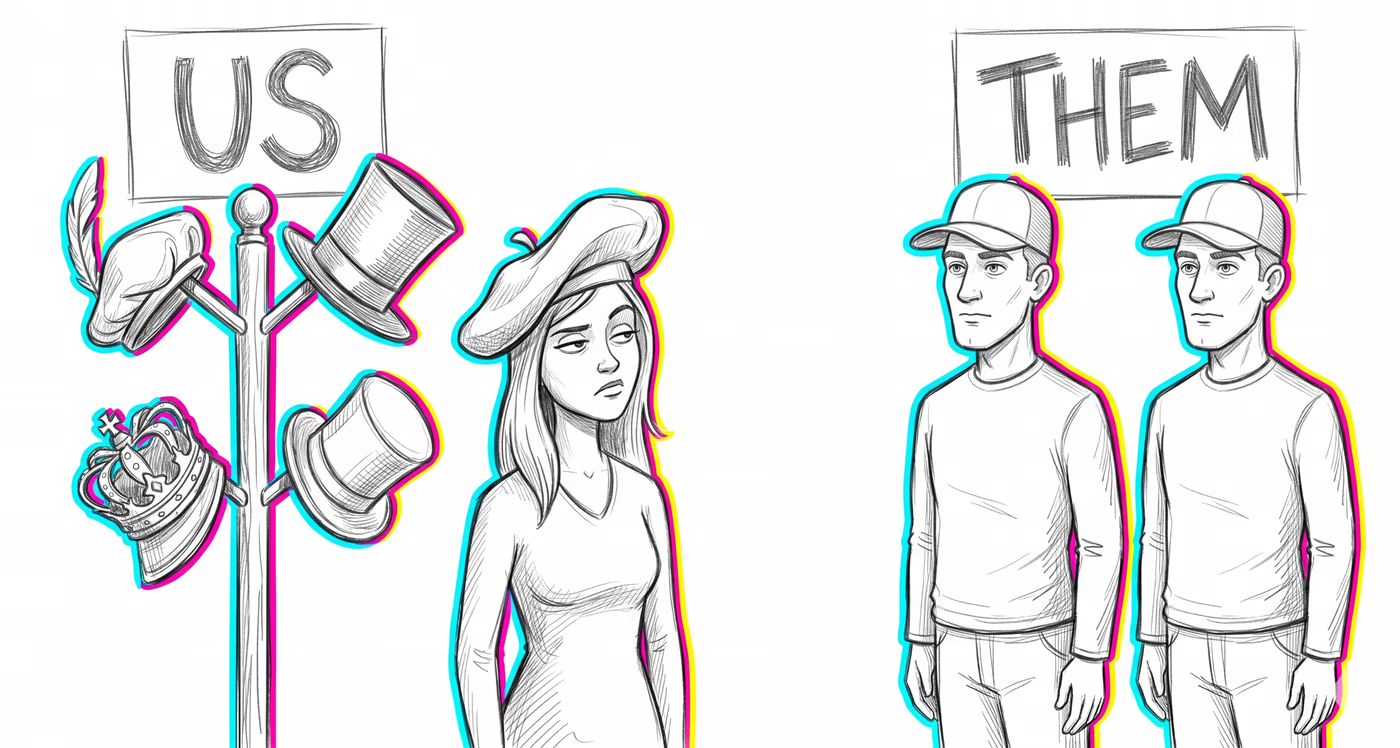
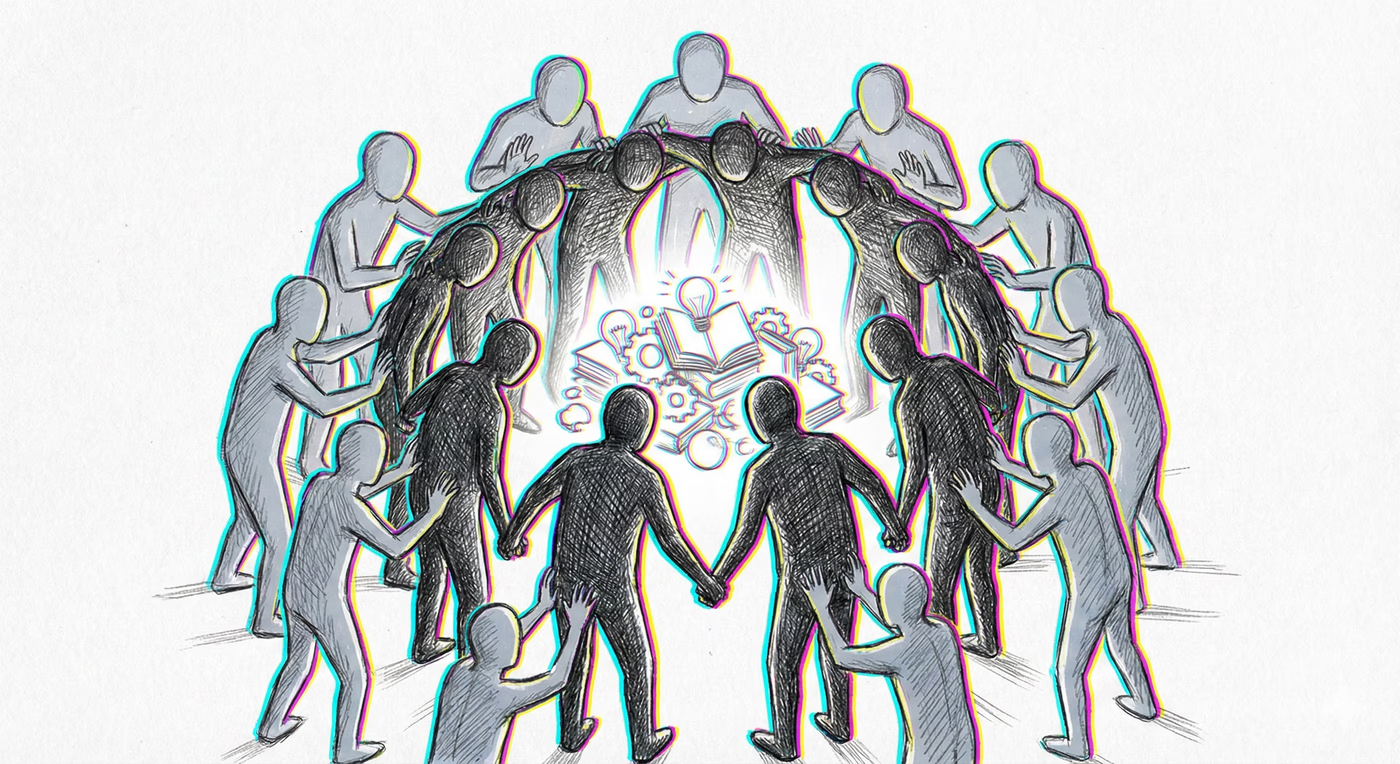
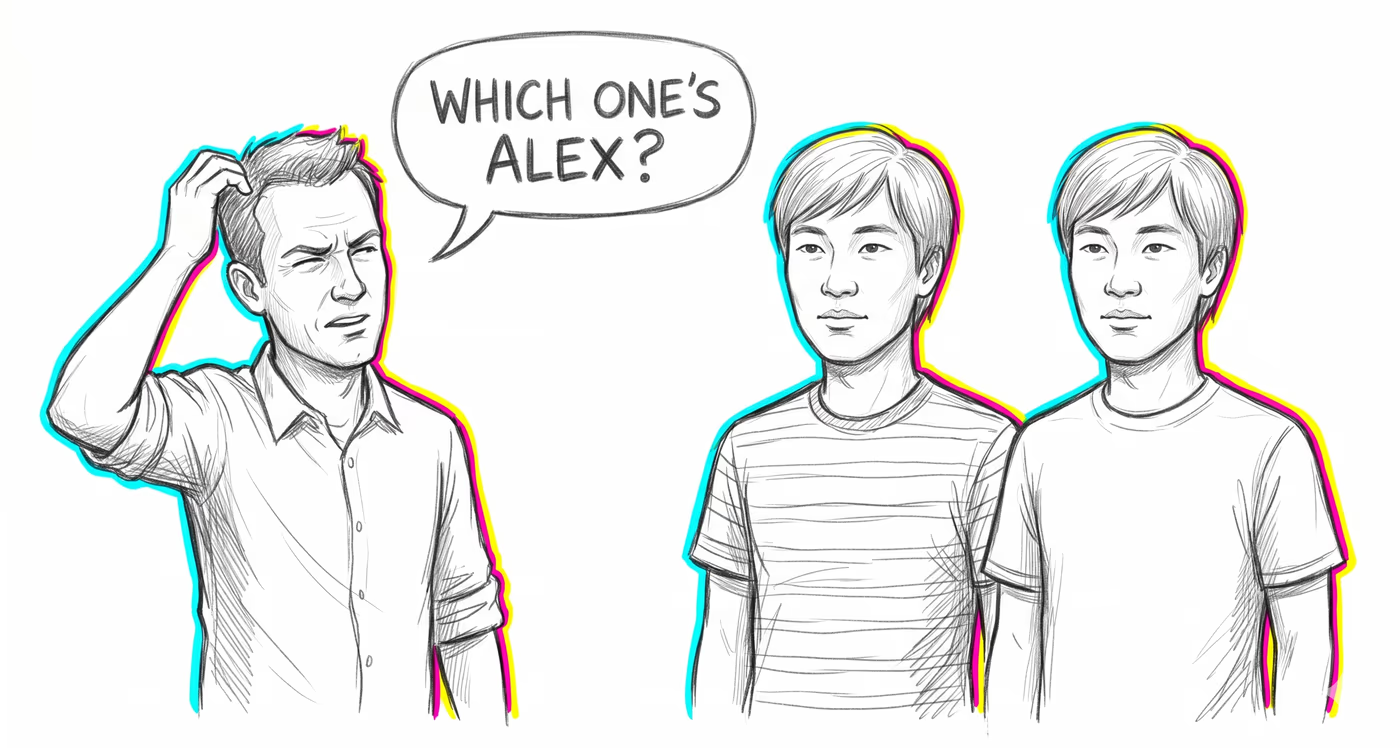
Perceiving members of other groups as all alike while seeing your own group as full of diverse individuals.

WHAT IT IS

The glitch, explained plainly.

Imagine you have a big box of crayons — your favorite brand. You know every single color and can name them all. But your friend has a different brand, and when you look at their box, you just see 'a bunch of greens.' To you, their crayons all look the same, but yours are each special and different. That's how our brain treats people who aren't in our group.

Out-Group Homogeneity describes the systematic perceptual asymmetry in which people see rich individuality among members of their own group while compressing outsiders into an undifferentiated mass. This goes beyond simply knowing less about other groups — the effect persists even between groups that interact frequently, such as men and women. It operates on two distinct dimensions: perceived stereotypicality (how many group members fit the stereotype) and perceived dispersion (how much members vary around the group average). The bias fuels the formation and maintenance of stereotypes by providing a cognitive shortcut that treats any single out-group member's behavior as representative of the entire group, while similar behavior from an in-group member is treated as an individual quirk.

SOUND FAMILIAR?

Where it shows up.

  1. 01 A hiring manager reviews two résumés from candidates who attended rival universities. She spends extra time differentiating the two candidates from her own alma mater but quickly lumps the rival-university candidates together, saying 'they're basically the same profile,' despite the candidates having quite different experiences and specializations.
  2. 02 During a neighborhood meeting, a longtime resident from the east side of town argues against a proposal by saying 'the west-siders all want the same thing — more development and more noise.' Meanwhile, she describes her own east-side neighbors as having 'a wide range of opinions on the matter,' even though a survey shows both sides are equally divided.
  3. 03 A product manager dismisses feedback from the European user base by saying 'European users are pretty uniform in their preferences — they just want simpler interfaces.' She then creates five distinct personas for the North American market, carefully distinguishing power users from casual users, despite both markets showing similar distributions of user behavior.
  4. 04 A defense attorney challenges an eyewitness identification, noting that the witness — who is of a different ethnicity than the suspect — confidently picked the suspect from a lineup but later could not distinguish the suspect's photo from photos of two other individuals of the same ethnicity. The witness insists they are certain, explaining 'I know what I saw.'
  5. 05 A political analyst writes a column explaining that while her own party contains 'fiscal hawks, social moderates, libertarian-leaning independents, and progressive newcomers,' the opposing party is driven by 'a single unifying ideology with little internal debate.' Polling data, however, shows comparable levels of ideological diversity within both parties.
IN DIFFERENT DOMAINS

Where it shows up at work.

The same glitch looks different depending on the terrain. Finance, medicine, a relationship, a team — same mechanism, different costume.

Finance & investing

Investment analysts may treat companies from unfamiliar foreign markets as interchangeable, applying blanket risk assessments to all firms from a particular country or region, while carefully distinguishing between domestic companies with similar profiles.
Medicine & diagnosis

Clinicians may fail to personalize treatment for patients from unfamiliar cultural or demographic backgrounds, assuming similar symptom presentations and treatment preferences within that group, while readily adapting care plans for patients who share their own background.

Education & grading

Teachers may view students from a different socioeconomic or cultural background as a homogeneous group with uniform learning needs, while recognizing wide variation in ability and motivation among students who share their own background.

Relationships

People tend to view their partner's friend group or family as 'all the same type of person' while considering their own social circle richly diverse — which can lead to dismissing their partner's relationships as less meaningful or interesting.

Tech & product

Design teams may create detailed user personas for their primary market segment while treating international or minority user groups as a single undifferentiated persona, leading to products that fail to account for diversity within those groups.

Workplace & hiring

Managers may perceive members of other departments as interchangeable ('those marketing people are all the same') while recognizing nuanced skill differences within their own team, leading to poor cross-functional collaboration and misallocation of responsibilities.

Politics Media

Media consumers and commentators tend to perceive ideological opponents as a monolithic bloc with uniform beliefs, while seeing their own political camp as a coalition of diverse viewpoints — driving polarization and making compromise appear impossible.

HOW TO SPOT IT

Ask yourself…

  • Am I describing an entire group with a single characterization while simultaneously seeing my own group as varied and complex?
  • Would I accept this same generalization if someone applied it to my own group?
  • Am I basing my impression of this group on a small number of encounters or on media portrayals rather than direct, diverse experience?
HOW TO DEFEND AGAINST IT

The playbook.

  • Actively seek out individuating information about out-group members before forming judgments — learn names, personal stories, and unique traits.
  • Use the 'swap test': before making a generalization about an out-group, ask whether you'd accept the same statement about your own group.
  • Deliberately recall counter-stereotypical individuals from the out-group to disrupt the homogeneity illusion.
  • Increase meaningful intergroup contact — not just exposure, but cooperative interactions that require learning about individuals.
  • When you catch yourself thinking 'they're all the same,' pause and list at least three ways members of that group differ from each other.
FAMOUS CASES

In history.

  • Cross-race eyewitness misidentification has been a leading contributor to wrongful convictions in the United States, as documented by the Innocence Project, driven partly by out-group homogeneity reducing the ability to distinguish individual out-group faces.
  • During World War II, the U.S. government's internment of Japanese Americans was facilitated by the widespread perception that Japanese Americans were a homogeneous group with uniform loyalties, erasing individual differences in nationality, generation, and political views.
  • The Rwandan genocide was intensified by Hutu propaganda portraying all Tutsis as a unified enemy with identical intentions, collapsing individual identities into a single threatening out-group.
WHERE IT COMES FROM
Academic origin

George A. Quattrone and Edward E. Jones, 1980. Published in the Journal of Experimental Social Psychology, formalized through their study on perceptions of variability within in-groups and out-groups.

Evolutionary origin

In ancestral environments, quickly assessing whether a stranger was 'one of us' or 'one of them' was critical for survival. Treating out-group members as interchangeable allowed for rapid threat assessment without the cognitive cost of individuating each unknown person. Investing cognitive resources in differentiating in-group members, by contrast, was adaptive because cooperation, coalition management, and reciprocity within one's own tribe required tracking individual reputations, temperaments, and alliances.

IN AI SYSTEMS

How the machines inherit it.

Machine learning models trained on imbalanced datasets can encode out-group homogeneity by learning fewer distinguishing features for underrepresented groups. Facial recognition systems, for example, have been shown to have higher error rates for racial groups underrepresented in training data, effectively treating those faces as more similar to each other. Recommendation algorithms may also lump minority user segments into a single behavioral cluster while generating fine-grained profiles for majority users.

Read more on Wikipedia
FREE FIELD ZINE

10 glitches quietly running your life.

A free field-zine PDF — ten cognitive glitches named, illustrated, with a defense move for each. Plus the weekly Glitch Report on Fridays — one bias named, two spotted in the wild, one defense move. Unsubscribe any time.

EXPLORE MORE

Related glitches.

LAUNCH PRICE

Train against your blindspots.

50 cards are free to preview. Buyers unlock the rest of the deck plus the interactive training — Spot-the-Bias Quiz unlimited, Swipe Deck with spaced repetition, My Blindspots, Decision Pre-Flight, the Printable Deck + Cheat Sheets, and the Field Guide e-book. $29.50$59.

Unlock the full deck

Everything below — yours forever. Pay once, use across every device.

Half-off launch — limited to the first 100 readers. Auto-applied at checkout.
$59 $29.50
one-time payment · lifetime access
  • All interactive digital cards — search, filter, flip, shuffle on any device
  • Five training modes — Spot-the-Bias Quiz, Swipe Deck, Pre-Flight, Blindspots, Journal
  • Curated Lenses + Decision Templates + Defense Playbook
  • Printable Deck PDFs + Field Guide e-book + Cheat Sheets + Anki Export
  • Every future improvement, included
Unlock  $29.50

30-day refund · no questions asked

Unlock the full deck

Everything below — yours forever. Pay once, use across every device.

Half-off launch — limited to the first 100 readers. Auto-applied at checkout.
$59 $29.50
one-time payment · lifetime access
  • All interactive digital cards — search, filter, flip, shuffle on any device
  • Five training modes — Spot-the-Bias Quiz, Swipe Deck, Pre-Flight, Blindspots, Journal
  • Curated Lenses + Decision Templates + Defense Playbook
  • Printable Deck PDFs + Field Guide e-book + Cheat Sheets + Anki Export
  • Every future improvement, included
Unlock  $29.50

30-day refund · no questions asked