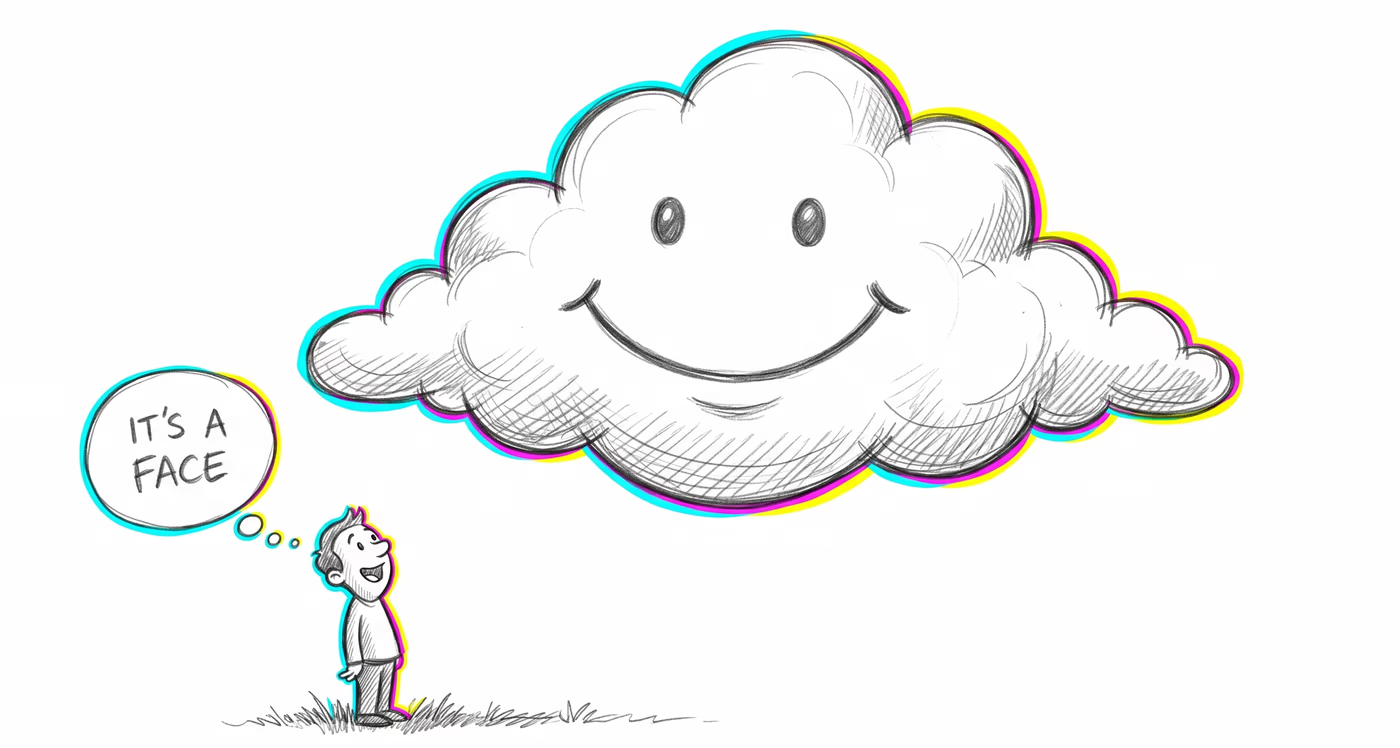
Pareidolia

aka Face Pareidolia · Pattern Pareidolia

Perceiving meaningful patterns — especially faces — in random or ambiguous stimuli where none actually exist.

Illustration: Pareidolia
WHAT IT IS

The glitch, explained plainly.

Imagine your brain has a 'face finder' that's always on, like a super eager guard dog. It's so desperate to find faces that sometimes it barks at a coat hanging on a door because it sort of looks like a person. Your brain would rather accidentally see a face that isn't there than miss a real one that is.

Pareidolia is a perceptual phenomenon in which the brain imposes a meaningful interpretation on ambiguous or random sensory input, most commonly perceiving faces in inanimate objects such as electrical outlets, cars, or cloud formations. It extends beyond vision to include auditory pareidolia, where people hear words or music in white noise or reversed audio. The phenomenon is driven by the brain's hyper-tuned face-detection circuitry, particularly the fusiform face area, which fires in response to face-like configurations even before conscious awareness kicks in. Pareidolia is universal across cultures, observed in infants as young as 7–10 months, demonstrated in non-human primates, and is considered a fundamental feature of the primate perceptual system rather than a cognitive error unique to humans.

SOUND FAMILIAR?

Where it shows up.

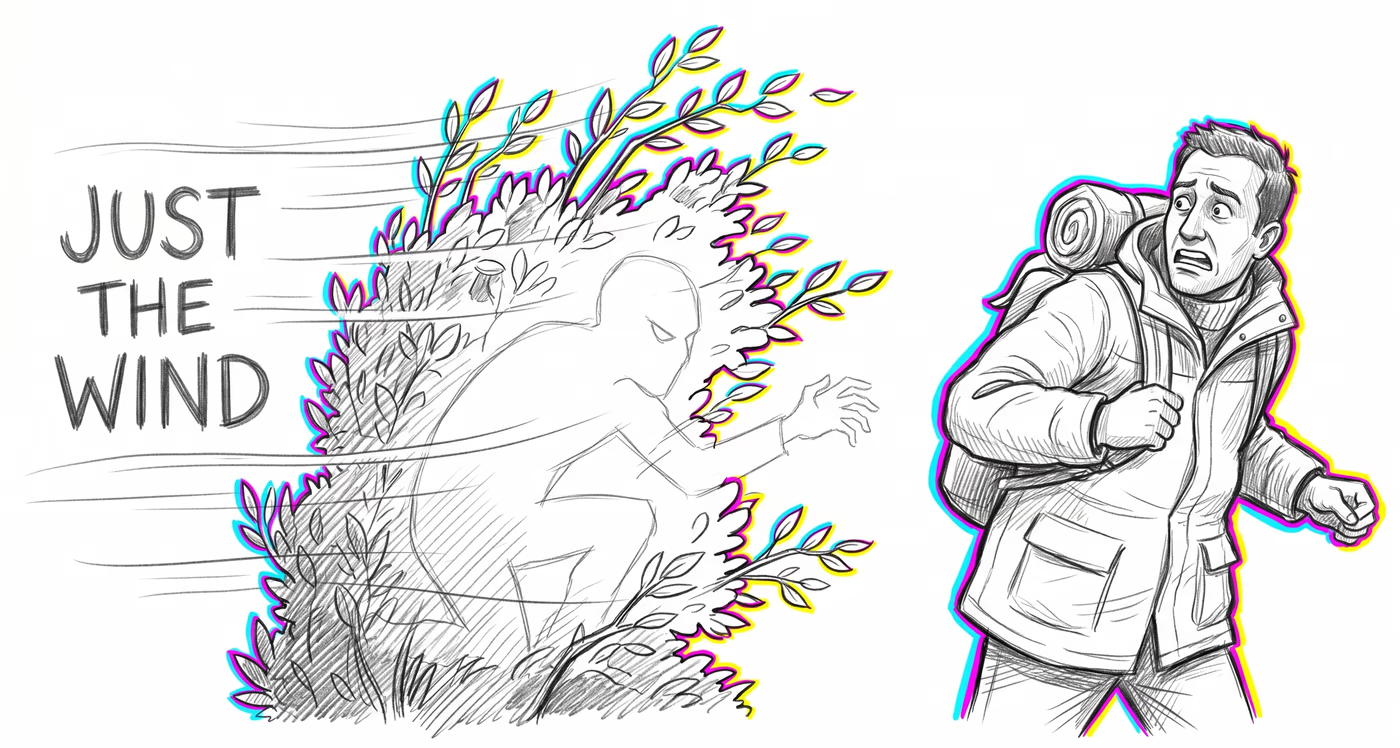
  1. 01 Maria is hiking through a forest at dusk. She freezes in her tracks because a cluster of knots and shadows on a tree trunk looks exactly like an angry old man's face. Her heart races before she realizes it's just bark and lichen arranged in a face-like pattern.
  2. 02 A NASA enthusiast shares a photo of a Martian rock formation that looks strikingly like a human skull, claiming it's evidence of an ancient civilization. Despite knowing the terrain is barren, hundreds of commenters insist they can clearly see eye sockets, a nose cavity, and a jawline in the eroded mesa.
  3. 03 A radiologist reviewing a patient's chest CT pauses because a shadow pattern between two rib structures momentarily appears to be a face. She catches herself and reexamines the image, confirming it's a normal overlapping of anatomical structures and artifact noise that her visual system briefly misinterpreted as something meaningful.
  4. 04 During a paranormal investigation, a team records hours of static from an empty room. When they play the audio back at reduced speed, several members independently report hearing a voice say 'help me,' despite the recording containing only electronic noise from the equipment. They cite this as evidence of a haunting.
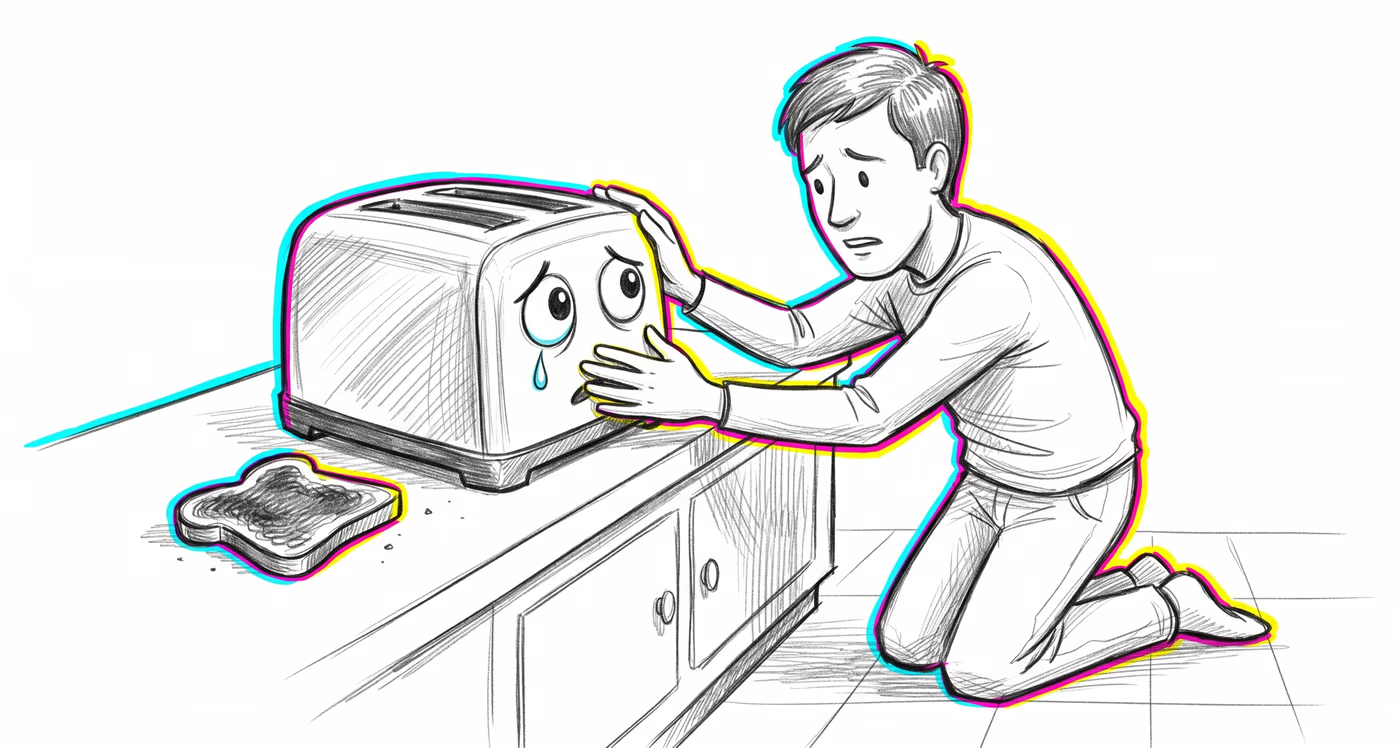
  5. 05 A product designer notices that her company's new smart thermostat, with two sensor dots above a curved temperature display, is being described by beta testers as 'cute' and 'friendly.' She realizes customers are unconsciously reading a face into the device's layout and decides to subtly enhance the effect to increase product likability, even though no face was intentionally designed.
IN DIFFERENT DOMAINS

Where it shows up at work.

The same glitch looks different depending on the terrain. Finance, medicine, a relationship, a team — same mechanism, different costume.

Medicine & diagnosis

Radiologists under time pressure may momentarily perceive face-like patterns in imaging noise on CT or MRI scans, potentially leading to brief diagnostic confusion or false positive readings when ambiguous shadows mimic anatomical structures.
Tech & product

Product designers exploit pareidolia by arranging interface elements (headlights, buttons, sensor arrays) into face-like configurations to make devices appear friendly or aggressive, shaping user emotional responses and purchase decisions without users realizing why.

Politics Media

Religious or conspiratorial imagery perceived in random events — such as divine faces in food items, or demonic figures in disaster footage — can be amplified by media coverage, reinforcing supernatural beliefs and shaping public narratives around otherwise random occurrences.

HOW TO SPOT IT

Ask yourself…

  • Am I actually seeing a face or pattern here, or is my brain imposing a familiar template onto random shapes?
  • If I rotated or inverted this image, would I still see the same meaningful pattern?
  • Am I in conditions (low light, fatigue, high anxiety) where my pattern-detection system might be running on overdrive?
HOW TO DEFEND AGAINST IT

The playbook.

  • Rotate, invert, or change the viewing angle of the stimulus — pareidolic faces typically disappear when the configuration is disrupted.
  • Apply the 'second look' rule: pause and consciously reexamine any perceived pattern before assigning it meaning.
  • Ask yourself whether the pattern would be perceived by someone with no prior context or expectation.
  • In professional settings (radiology, surveillance), use standardized protocols and second opinions to counteract perceptual false positives.
  • Recognize that pareidolia is a hardwired perceptual default, not a sign of insight — the presence of a pattern does not imply the presence of intention.
FAMOUS CASES

In history.

  • The 'Face on Mars' photographed by NASA's Viking 1 orbiter in 1976, which sparked decades of speculation about alien civilizations before higher-resolution images revealed an ordinary mesa.
  • The 'Virgin Mary grilled cheese sandwich' sold for $28,000 on eBay in 2004 after its owner claimed to see the image of the Virgin Mary on the toasted bread.
  • Reports of Satan's face appearing in the smoke clouds during the September 11, 2001 attacks on the World Trade Center, widely shared in media.
  • The 'Man in the Moon' — a cross-cultural phenomenon appearing in folklore across civilizations for centuries, interpreting lunar surface features as a human face.
WHERE IT COMES FROM
Academic origin

Karl Ludwig Kahlbaum introduced the German term 'Pareidolie' in his 1866 paper 'Die Sinnesdelierien' (On Delusion of the Senses). The English translation 'pareidolia' appeared in The Journal of Mental Science in 1867. Earlier work by Gustave Fechner in the late 1800s discussed the human inclination to see faces in objects. The modern neuroscientific study of the phenomenon accelerated with Hadjikhani et al. (2009) demonstrating fusiform face area activation for pareidolic stimuli.

Evolutionary origin

In ancestral environments, the cost of failing to detect a hidden face (a predator, a rival, or a potential ally) was far greater than the cost of mistakenly seeing a face in a bush. This asymmetric cost structure — described by error management theory — selected for a face-detection system set to 'hair trigger' sensitivity. Infants who recognized caregivers' faces faster received more attention and survived at higher rates, further entrenching the bias across generations.

IN AI SYSTEMS

How the machines inherit it.

Face detection algorithms trained only on human faces produce very few pareidolic false positives, unlike humans. However, MIT CSAIL research (2024) found that training models to also recognize animal faces significantly increased pareidolic detections, suggesting that pareidolia in machines — as in biology — may arise from broad, generalized face-detection training. This has implications for self-driving cars and surveillance systems, where false positive face detections in inanimate objects could cause erroneous behavioral triggers.

Read more on Wikipedia
FREE FIELD ZINE

10 glitches quietly running your life.

A free field-zine PDF — ten cognitive glitches named, illustrated, with a defense move for each. Plus the weekly Glitch Report on Fridays — one bias named, two spotted in the wild, one defense move. Unsubscribe any time.

EXPLORE MORE

Related glitches.

LAUNCH PRICE

Train against your blindspots.

50 cards are free to preview. Buyers unlock the rest of the deck plus the interactive training — Spot-the-Bias Quiz unlimited, Swipe Deck with spaced repetition, My Blindspots, Decision Pre-Flight, the Printable Deck + Cheat Sheets, and the Field Guide e-book. $29.50$59.

Unlock the full deck

Everything below — yours forever. Pay once, use across every device.

Half-off launch — limited to the first 100 readers. Auto-applied at checkout.
$59 $29.50
one-time payment · lifetime access
  • All interactive digital cards — search, filter, flip, shuffle on any device
  • Five training modes — Spot-the-Bias Quiz, Swipe Deck, Pre-Flight, Blindspots, Journal
  • Curated Lenses + Decision Templates + Defense Playbook
  • Printable Deck PDFs + Field Guide e-book + Cheat Sheets + Anki Export
  • Every future improvement, included
Unlock  $29.50

30-day refund · no questions asked

Unlock the full deck

Everything below — yours forever. Pay once, use across every device.

Half-off launch — limited to the first 100 readers. Auto-applied at checkout.
$59 $29.50
one-time payment · lifetime access
  • All interactive digital cards — search, filter, flip, shuffle on any device
  • Five training modes — Spot-the-Bias Quiz, Swipe Deck, Pre-Flight, Blindspots, Journal
  • Curated Lenses + Decision Templates + Defense Playbook
  • Printable Deck PDFs + Field Guide e-book + Cheat Sheets + Anki Export
  • Every future improvement, included
Unlock  $29.50

30-day refund · no questions asked