Hyperactive Agency Detection

aka Hyperactive Agency Detection Device (HADD) · Hypersensitive Agency Detection Device · Agent Detection Bias

Perceiving intentional agents — beings with purpose and will — behind events that are actually random or natural.

WHAT IT IS

The glitch, explained plainly.

Imagine you're walking in the dark and you hear a creaky noise. Your brain immediately thinks 'someone is there!' rather than 'the wind moved a branch.' Your brain would rather be wrong about a monster being there a hundred times than be wrong just once about a real monster. So it sees 'someone doing something on purpose' everywhere, even when nothing is really there.

Hyperactive Agency Detection describes the pervasive human tendency to interpret ambiguous stimuli — unexplained noises, unexpected movements, coincidental patterns — as the deliberate actions of an intentional agent rather than as products of chance or mechanical causation. This bias operates as a hair-trigger alarm system that defaults to attributing events to sentient beings with goals and desires, even when no such beings are present. It extends well beyond simple predator detection: people ascribe intentionality to malfunctioning computers, attribute divine will to natural disasters, see conspiracies behind coincidences, and perceive hostile purpose in random misfortune. The bias is amplified under conditions of ambiguity, threat, reduced personal control, and loneliness, making it a foundational contributor to superstitious thinking, conspiracy ideation, and religious belief.

SOUND FAMILIAR?

Where it shows up.

  1. 01 During a severe drought, a farmer becomes convinced that the weather is a deliberate punishment for the community's behavior, and begins performing rituals to appease whatever force is withholding rain. Neighbors who suggest climate patterns and El Niño are dismissed because the timing feels too purposeful to be mere coincidence.
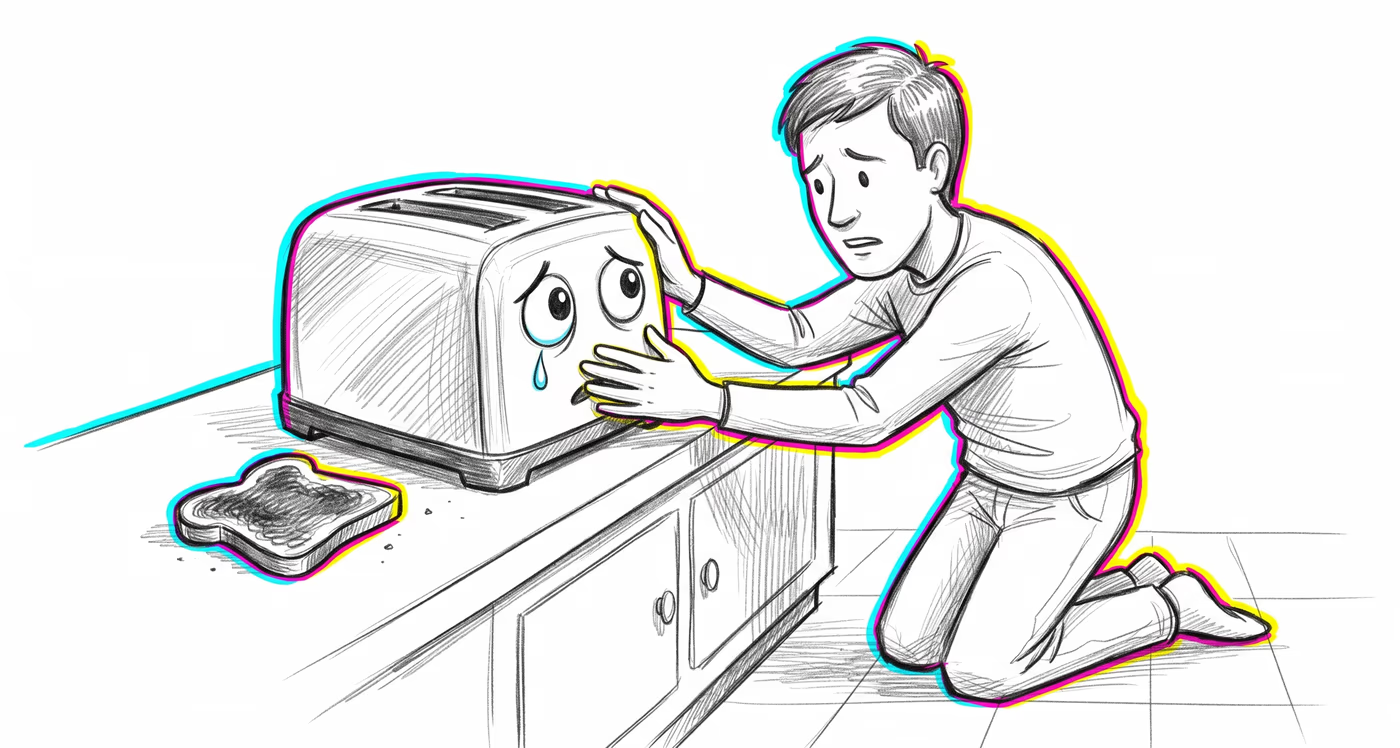
  2. 02 A software engineer's automated test suite fails intermittently with no discernible pattern. Rather than investigating race conditions or memory leaks, she begins telling colleagues the system 'doesn't want to cooperate' and 'fights back whenever we try to deploy on Fridays,' treating the software as though it has intentions and preferences.
  3. 03 After his company lays off several employees, a manager notices that the three people let go all happened to be on the same project team. He becomes convinced that an executive deliberately targeted that team as retaliation, even though HR data shows the layoffs followed a standard performance-based formula applied company-wide.
  4. 04 A hiker camping alone in the wilderness hears branches snapping in a rhythmic pattern and becomes certain someone is circling her campsite. She stays awake all night in a state of terror. In the morning, she discovers a large branch caught in another tree, rocking back and forth in the gusty wind and snapping smaller twigs at regular intervals.
  5. 05 A data analyst studying cryptocurrency price fluctuations notices that a particular altcoin drops in value every time a certain government official tweets about regulation. He constructs an elaborate theory that the official is coordinating with whales to manipulate the market, even though statistical analysis shows the correlation is no stronger than chance when controlling for general market sentiment.
IN DIFFERENT DOMAINS

Where it shows up at work.

The same glitch looks different depending on the terrain. Finance, medicine, a relationship, a team — same mechanism, different costume.

Finance & investing

Investors often interpret random market fluctuations as the deliberate actions of institutional 'whales' or shadowy manipulators, leading them to construct elaborate narratives about coordinated market manipulation when price movements are largely driven by impersonal supply-and-demand dynamics and algorithmic trading.

Medicine & diagnosis

Patients frequently interpret disease onset or symptom flare-ups as caused by someone or something acting against them — attributing illness to curses, karma, or deliberate contamination — which can delay evidence-based treatment in favor of rituals or confrontation with perceived perpetrators.

Education & grading

Students may perceive a difficult exam as the teacher 'wanting to punish them' rather than recognizing it as a standard assessment, leading to adversarial attitudes toward instructors and reduced help-seeking behavior.

Relationships

Partners often attribute accidental oversights — a forgotten anniversary, an unreturned text — to deliberate disregard or intentional hostility, escalating conflicts that stem from simple forgetfulness or competing demands on attention.

Tech & product

Users attribute intentional behavior to software glitches, interpreting pop-ups, crashes, or slow load times as the application 'trying to force' an upgrade or 'wanting' to show them ads, which shapes product reviews and adoption decisions based on perceived malice rather than technical reality.

Workplace & hiring

Employees interpret neutral organizational changes — office relocations, scheduling shifts, process updates — as deliberate signals from management about their standing or future, reading intentional messaging into decisions that were driven by logistics or cost-saving measures.

Politics Media

Citizens attribute complex systemic outcomes — economic downturns, infrastructure failures, pandemic spread — to the deliberate schemes of powerful individuals or cabals, fueling conspiracy theories that substitute agentive narratives for the harder-to-grasp reality of emergent, unplanned systemic processes.

HOW TO SPOT IT

Ask yourself…

  • Am I assuming that something was done 'on purpose' when a mechanical, statistical, or accidental explanation is equally or more plausible?
  • Am I attributing goals, desires, or hostility to something that doesn't actually have a mind — a machine, the weather, 'the universe'?
  • Would I still believe someone was behind this if I hadn't felt threatened, anxious, or out of control when it happened?
HOW TO DEFEND AGAINST IT

The playbook.

  • When you feel the impulse to blame an agent, explicitly list at least two non-agentive explanations (mechanical failure, statistical coincidence, natural process) before settling on an intentional one.
  • Apply the 'overnight test': delay your judgment by 24 hours to let threat-driven arousal subside before concluding that someone is behind an event.
  • Ask yourself: 'If I remove the feeling of threat or personal relevance, does this still look intentional?' Reduced emotional stakes often dissolve the perception of agency.
  • Practice distinguishing between 'pattern' and 'purpose' — finding a pattern in events does not mean someone placed that pattern there deliberately.
  • Seek out base-rate information: how often does this type of event happen randomly? Coincidences that feel designed are often statistically expected.
FAMOUS CASES

In history.

  • The Salem witch trials (1692), where unexplained illnesses and misfortunes in a colonial community were attributed to the deliberate supernatural agency of accused 'witches' rather than natural causes.
  • The widespread perception of intentional design behind the 'Face on Mars' photographed by Viking 1 in 1976, which was later shown by higher-resolution imaging to be a natural geological formation.
  • Post-9/11 conspiracy theories attributing the attacks to a vast internal government conspiracy, driven by the difficulty of accepting that such catastrophic outcomes could result from the plans of a small external group.
WHERE IT COMES FROM
Academic origin

Stewart Guthrie laid the theoretical groundwork in 'A Cognitive Theory of Religion' (1980) and his book 'Faces in the Clouds' (1993). Justin Barrett coined the term 'Hypersensitive Agency Detection Device' (HADD) in Barrett (2000) in 'Exploring the Natural Foundations of Religion,' published in Trends in Cognitive Sciences.

Evolutionary origin

In ancestral environments, the asymmetric cost structure of predator and prey detection made a hyperactive system adaptive. Failing to detect a genuine predator or hostile human (false negative) could be fatal, while falsely detecting one (false positive) cost only a brief fright and wasted energy. Natural selection therefore favored organisms with low detection thresholds — those who treated every ambiguous signal as a potential agent — because they survived and reproduced at higher rates than their more skeptical counterparts.

IN AI SYSTEMS

How the machines inherit it.

Machine learning models trained on human-generated text and interaction data can inherit and amplify agency-detection patterns by generating explanations that attribute intentionality to non-agentive systems. Recommendation algorithms that surface conspiracy-related content can exploit users' HADD, creating feedback loops where the algorithm's engagement optimization reinforces and escalates false-agency narratives.

Read more on Wikipedia
FREE FIELD ZINE

10 glitches quietly running your life.

A free field-zine PDF — ten cognitive glitches named, illustrated, with a defense move for each. Plus the weekly Glitch Report on Fridays — one bias named, two spotted in the wild, one defense move. Unsubscribe any time.

EXPLORE MORE

Related glitches.

LAUNCH PRICE

Train against your blindspots.

50 cards are free to preview. Buyers unlock the rest of the deck plus the interactive training — Spot-the-Bias Quiz unlimited, Swipe Deck with spaced repetition, My Blindspots, Decision Pre-Flight, the Printable Deck + Cheat Sheets, and the Field Guide e-book. $29.50$59.

Unlock the full deck

Everything below — yours forever. Pay once, use across every device.

Half-off launch — limited to the first 100 readers. Auto-applied at checkout.
$59 $29.50
one-time payment · lifetime access
  • All interactive digital cards — search, filter, flip, shuffle on any device
  • Five training modes — Spot-the-Bias Quiz, Swipe Deck, Pre-Flight, Blindspots, Journal
  • Curated Lenses + Decision Templates + Defense Playbook
  • Printable Deck PDFs + Field Guide e-book + Cheat Sheets + Anki Export
  • Every future improvement, included
Unlock  $29.50

30-day refund · no questions asked

Unlock the full deck

Everything below — yours forever. Pay once, use across every device.

Half-off launch — limited to the first 100 readers. Auto-applied at checkout.
$59 $29.50
one-time payment · lifetime access
  • All interactive digital cards — search, filter, flip, shuffle on any device
  • Five training modes — Spot-the-Bias Quiz, Swipe Deck, Pre-Flight, Blindspots, Journal
  • Curated Lenses + Decision Templates + Defense Playbook
  • Printable Deck PDFs + Field Guide e-book + Cheat Sheets + Anki Export
  • Every future improvement, included
Unlock  $29.50

30-day refund · no questions asked