Plan Continuation Bias

aka Continuation Bias · Get-There-Itis · Plan Continuation Error

The unconscious tendency to continue with an original plan of action even when changing conditions clearly indicate the plan should be revised or abandoned.

WHAT IT IS

The glitch, explained plainly.

Imagine you're driving to a friend's party and your GPS says there's a huge traffic jam ahead. But you're already so close that you think, 'I've come this far, I'll just push through.' So you sit in traffic for an hour instead of taking the easy detour that was right there. Your brain tricks you into thinking sticking with the plan is the smart move just because you already started it.

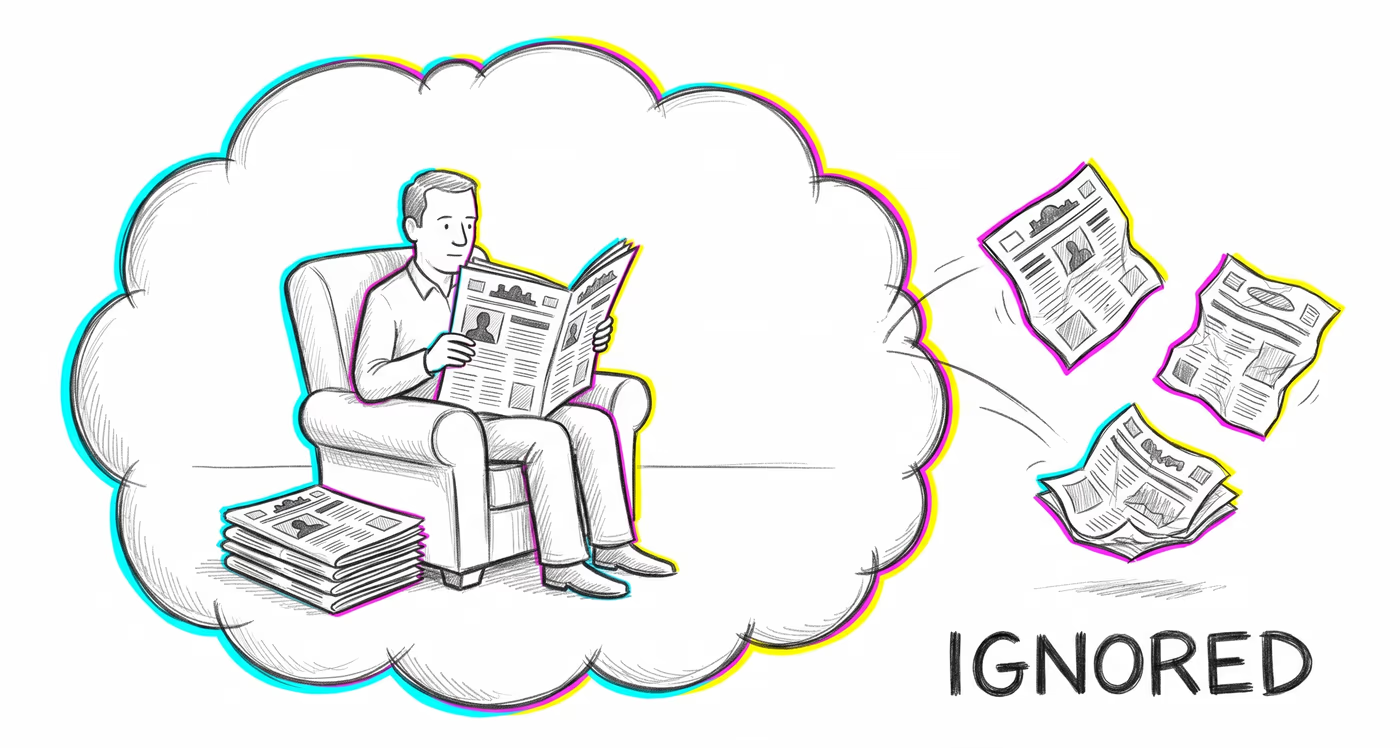
Plan continuation bias describes the deep-rooted cognitive tendency to persist with a predetermined course of action despite accumulating evidence that circumstances have changed and the plan is no longer safe, optimal, or viable. The bias intensifies as one approaches the goal — a phenomenon sometimes called the 'barn door effect' — because proximity to completion makes abandonment feel psychologically costlier. Unlike simple stubbornness, this bias operates largely below conscious awareness: the individual genuinely believes the plan remains sound, filtering out or downweighting contradictory cues through a feedback loop with confirmation bias. It is especially dangerous in high-stakes, time-pressured environments like aviation, surgery, and emergency response, where the window to change course narrows rapidly.

SOUND FAMILIAR?

Where it shows up.

  1. 01 A project manager's software launch is two weeks away. Three key engineers have flagged that the core module has a critical security vulnerability requiring a redesign. The manager acknowledges the reports but tells the team to patch around it and ship on schedule, reasoning that they're too close to launch to change direction now.
  2. 02 A surgeon begins a minimally invasive procedure but encounters unexpected anatomical complications 40 minutes in. Converting to open surgery would be safer but would mean the first 40 minutes of setup were wasted. The surgeon decides to persist with the original technique, telling the team they can manage the complications as they arise.
  3. 03 A venture capital firm has invested three rounds into a startup whose market has shifted dramatically. Their own analysts recommend exiting, but the lead partner argues that the startup is close to product-market fit and that pivoting the investment thesis now would waste the firm's accumulated sector expertise and board relationships. The partner genuinely believes the data still supports continuation.
  4. 04 A family is driving through a mountain pass to reach a ski resort. Weather reports warn of worsening conditions and road closures ahead, but they've already driven four hours and can see the resort town lights in the valley below. The driver says conditions seem manageable from here and presses on rather than stopping at the last available town with a hotel.
  5. 05 A marketing director has been executing a six-month brand repositioning campaign. Early engagement metrics are flat and consumer focus groups reveal confusion about the new messaging. However, the director interprets the flat metrics as a normal lag period and selectively highlights the one focus group segment that responded positively, presenting the campaign as on-track to leadership.
IN DIFFERENT DOMAINS

Where it shows up at work.

The same glitch looks different depending on the terrain. Finance, medicine, a relationship, a team — same mechanism, different costume.

Finance & investing

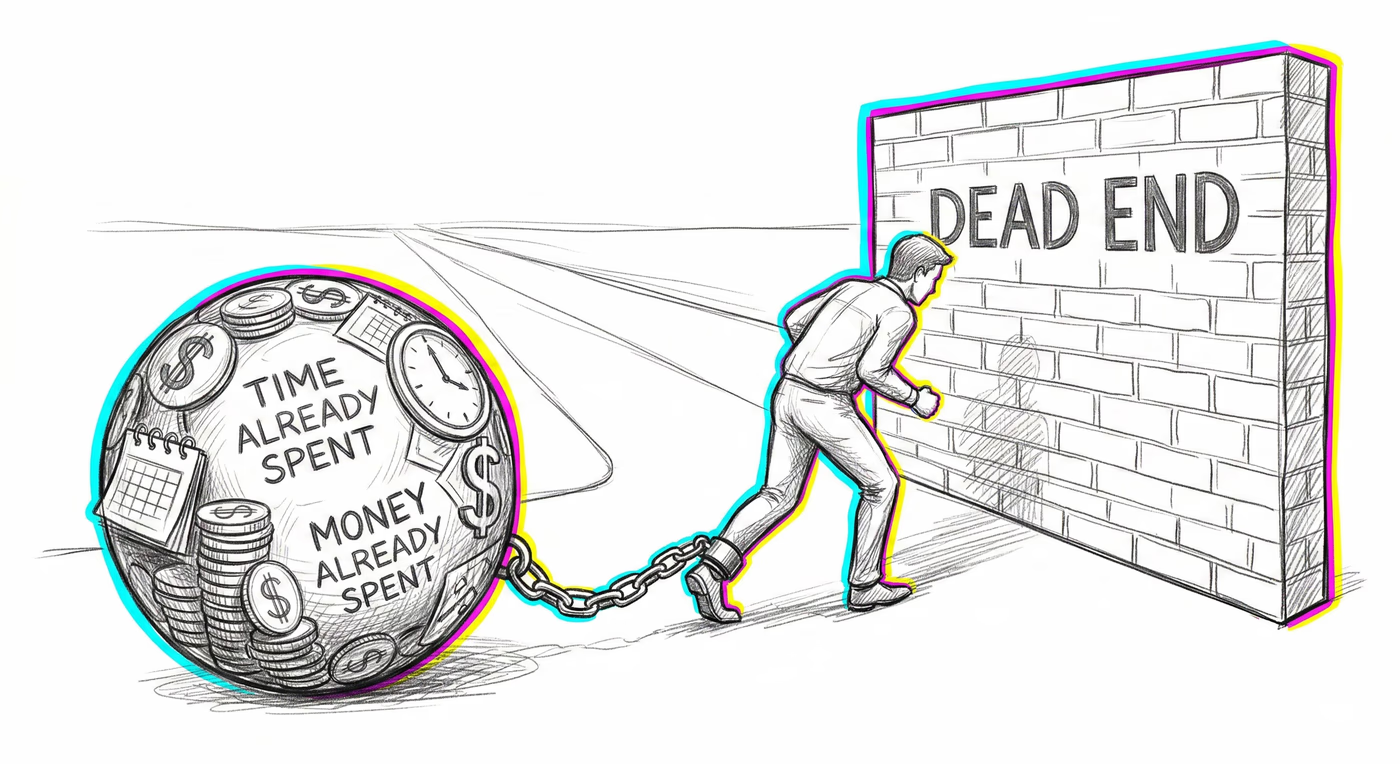
Investors hold losing positions or continue funding underperforming ventures because they are close to a milestone or have committed substantial resources, interpreting ambiguous market signals as consistent with the original investment thesis rather than reassessing from scratch.
Medicine & diagnosis

Surgical teams persist with a planned procedure despite encountering unexpected complications, or clinicians continue a treatment protocol when patient response data suggests the original diagnosis may need revision, especially when they are deep into the treatment course.

Education & grading

Teachers continue with a lesson plan or curriculum sequence despite clear signals that students are not grasping the material, reasoning that they are too far into the semester to restructure, and that students will catch up later.

Relationships

People continue with wedding plans, relocation decisions, or relationship milestones despite growing evidence of incompatibility, because they have already invested emotionally and logistically and feel too close to the goal to reconsider.

Tech & product

Development teams continue building features along the original product roadmap even after user research reveals the core assumption is flawed, especially as the release date approaches and switching direction feels costlier than shipping what exists.

Workplace & hiring

Managers persist with a hiring decision for a candidate who has shown red flags during onboarding because the recruitment process was long and the team has already reorganized around the new role, making it feel easier to hope for improvement than restart the search.

Politics Media

Political leaders maintain a policy direction despite mounting evidence of failure because reversing course would be seen as admitting the original decision was wrong, and media narratives frame policy consistency as strength and course-correction as weakness.

HOW TO SPOT IT

Ask yourself…

  • Am I continuing this plan because the situation still supports it, or because I've already come this far?
  • If I were starting fresh right now with what I currently know, would I choose this same course of action?
  • Am I downplaying or reinterpreting warning signs to justify staying the course?
HOW TO DEFEND AGAINST IT

The playbook.

  • Set explicit 'kill criteria' or pre-commitment decision gates before beginning any plan — conditions under which you will automatically stop and reassess, regardless of proximity to the goal.
  • Use the 'fresh eyes' test: Ask yourself, 'If a colleague walked in right now knowing nothing about my prior investment, what would they recommend?'
  • Designate a 'devil's advocate' or 'red team' member whose explicit role is to challenge continuation at each checkpoint.
  • Practice the pre-mortem technique: Before starting, imagine the plan has failed catastrophically and identify what went wrong — then build those scenarios into your monitoring.
  • Implement structured 'stop and reassess' pauses at regular intervals, especially as you approach the final stages of execution.
FAMOUS CASES

In history.

  • American Airlines Flight 1420 crash in Little Rock, Arkansas (1999): Crew continued an approach in severe thunderstorms and wind shear rather than diverting, contributing to a fatal overrun.
  • Southwest Airlines Flight 1455 overrun in Burbank, California (2000): Pilots continued a high-speed approach despite being well above target speed, rather than executing a go-around.
  • 1996 Mount Everest disaster: Multiple climbing teams continued their summit push despite deteriorating weather and missed turnaround deadlines, resulting in eight deaths.
  • NASA Ames review of 19 airline accidents (1991–2000) found that approximately 75% of tactical decision errors involved continuing with the original plan despite cues that suggested an alternative course of action.
WHERE IT COMES FROM
Academic origin

Formalized in aviation human factors research by R. Key Dismukes and Benjamin A. Berman at NASA Ames Research Center, first published in their 2006 article 'Pressing the Approach' (Aviation Safety World) and expanded in their 2007 book 'The Limits of Expertise: Rethinking Pilot Error and the Causes of Airline Accidents' (Ashgate Publishing).

Evolutionary origin

In ancestral environments, abandoning a pursuit mid-course — such as tracking prey during a long hunt or migrating toward a water source — often meant wasting scarce energy and losing the resources already invested. Persistence toward a committed goal was usually adaptive because environmental conditions changed slowly and the costs of switching plans (exposure to new predators, unknown terrain) were high. Brains that defaulted to 'keep going' in ambiguous situations generally survived better than those that constantly second-guessed.

IN AI SYSTEMS

How the machines inherit it.

Reinforcement learning agents and autonomous systems can exhibit plan continuation when reward functions heavily weight task completion without adequately penalizing failure to adapt to changing environmental states. Autopilot and automated navigation systems may encourage human plan continuation bias by making the current course feel more committed and by reducing the perceived effort of continuing versus manually intervening to change course.

FREE FIELD ZINE

10 glitches quietly running your life.

A free field-zine PDF — ten cognitive glitches named, illustrated, with a defense move for each. Plus the weekly Glitch Report on Fridays — one bias named, two spotted in the wild, one defense move. Unsubscribe any time.

EXPLORE MORE

Related glitches.

LAUNCH PRICE

Train against your blindspots.

50 cards are free to preview. Buyers unlock the rest of the deck plus the interactive training — Spot-the-Bias Quiz unlimited, Swipe Deck with spaced repetition, My Blindspots, Decision Pre-Flight, the Printable Deck + Cheat Sheets, and the Field Guide e-book. $29.50$59.

Unlock the full deck

Everything below — yours forever. Pay once, use across every device.

Half-off launch — limited to the first 100 readers. Auto-applied at checkout.
$59 $29.50
one-time payment · lifetime access
  • All interactive digital cards — search, filter, flip, shuffle on any device
  • Five training modes — Spot-the-Bias Quiz, Swipe Deck, Pre-Flight, Blindspots, Journal
  • Curated Lenses + Decision Templates + Defense Playbook
  • Printable Deck PDFs + Field Guide e-book + Cheat Sheets + Anki Export
  • Every future improvement, included
Unlock  $29.50

30-day refund · no questions asked

Unlock the full deck

Everything below — yours forever. Pay once, use across every device.

Half-off launch — limited to the first 100 readers. Auto-applied at checkout.
$59 $29.50
one-time payment · lifetime access
  • All interactive digital cards — search, filter, flip, shuffle on any device
  • Five training modes — Spot-the-Bias Quiz, Swipe Deck, Pre-Flight, Blindspots, Journal
  • Curated Lenses + Decision Templates + Defense Playbook
  • Printable Deck PDFs + Field Guide e-book + Cheat Sheets + Anki Export
  • Every future improvement, included
Unlock  $29.50

30-day refund · no questions asked