Semmelweis Reflex

aka Semmelweis Effect

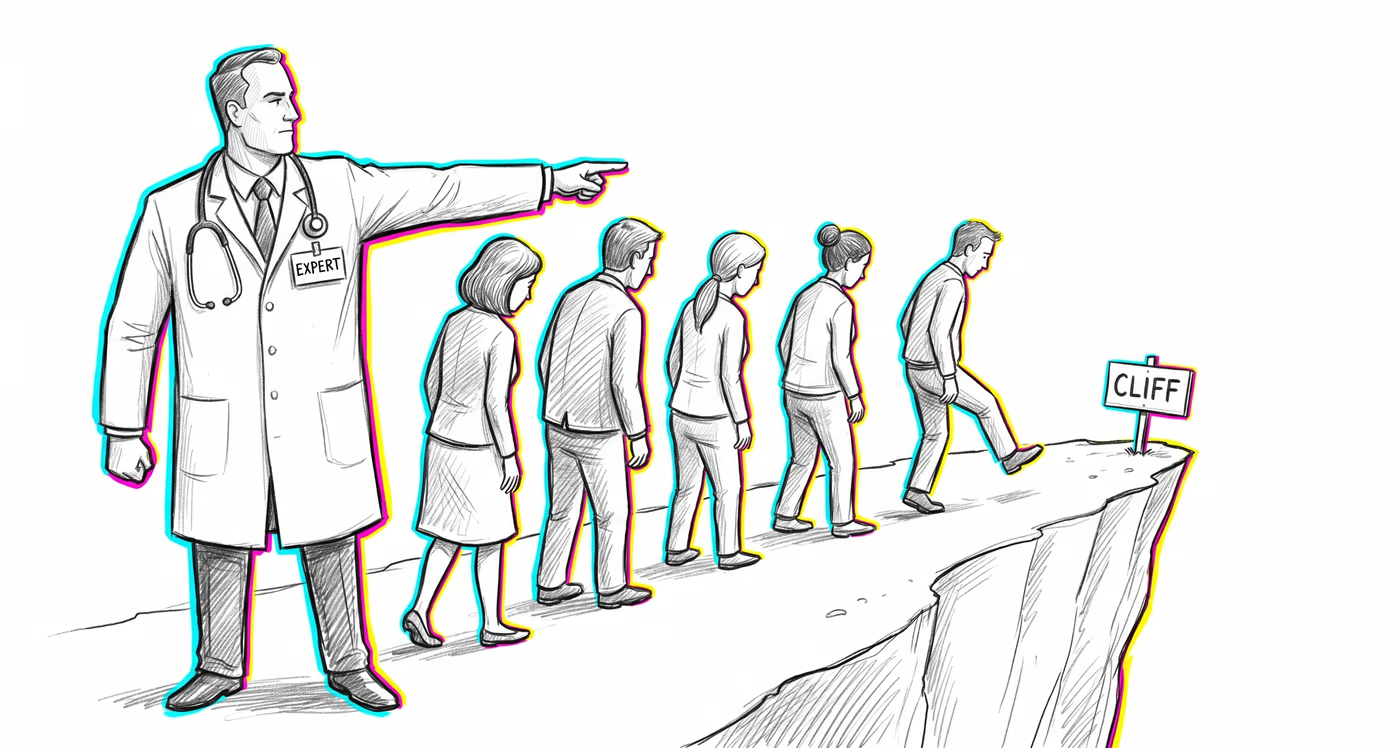
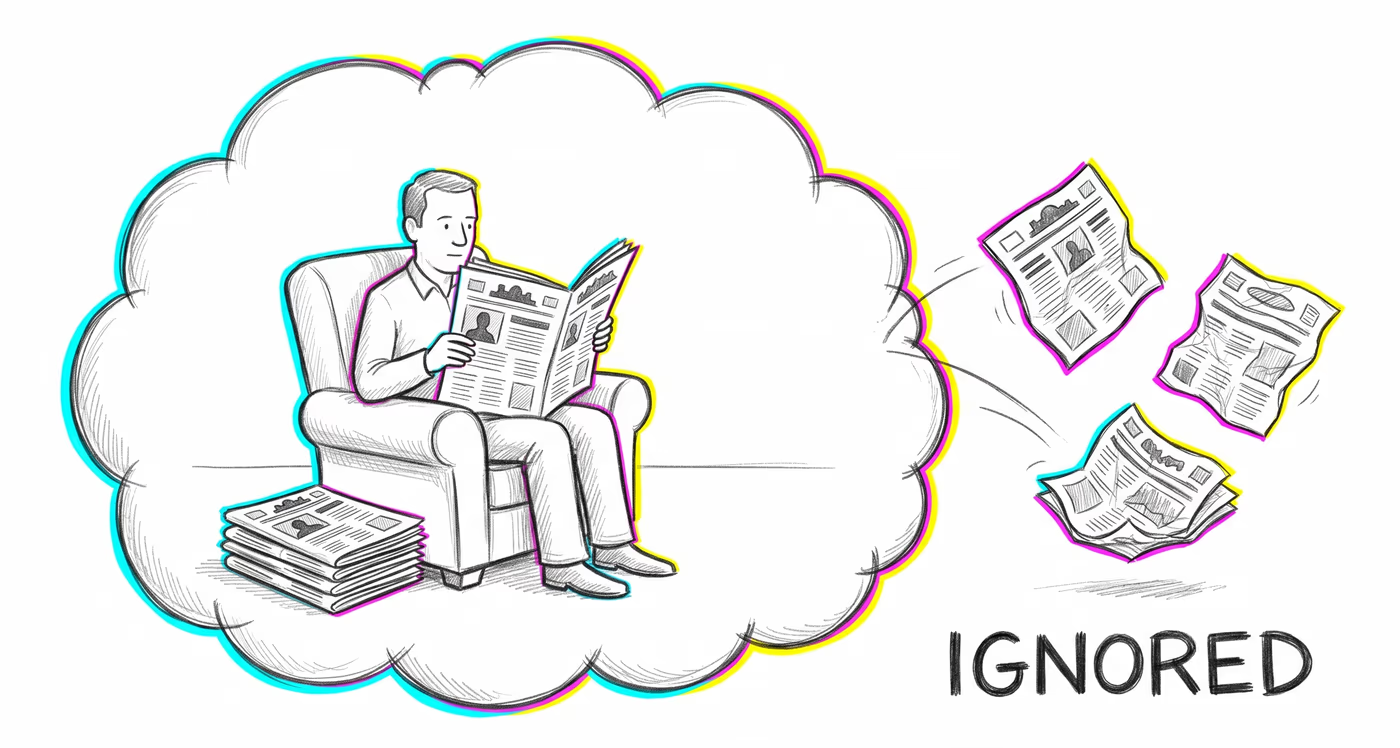
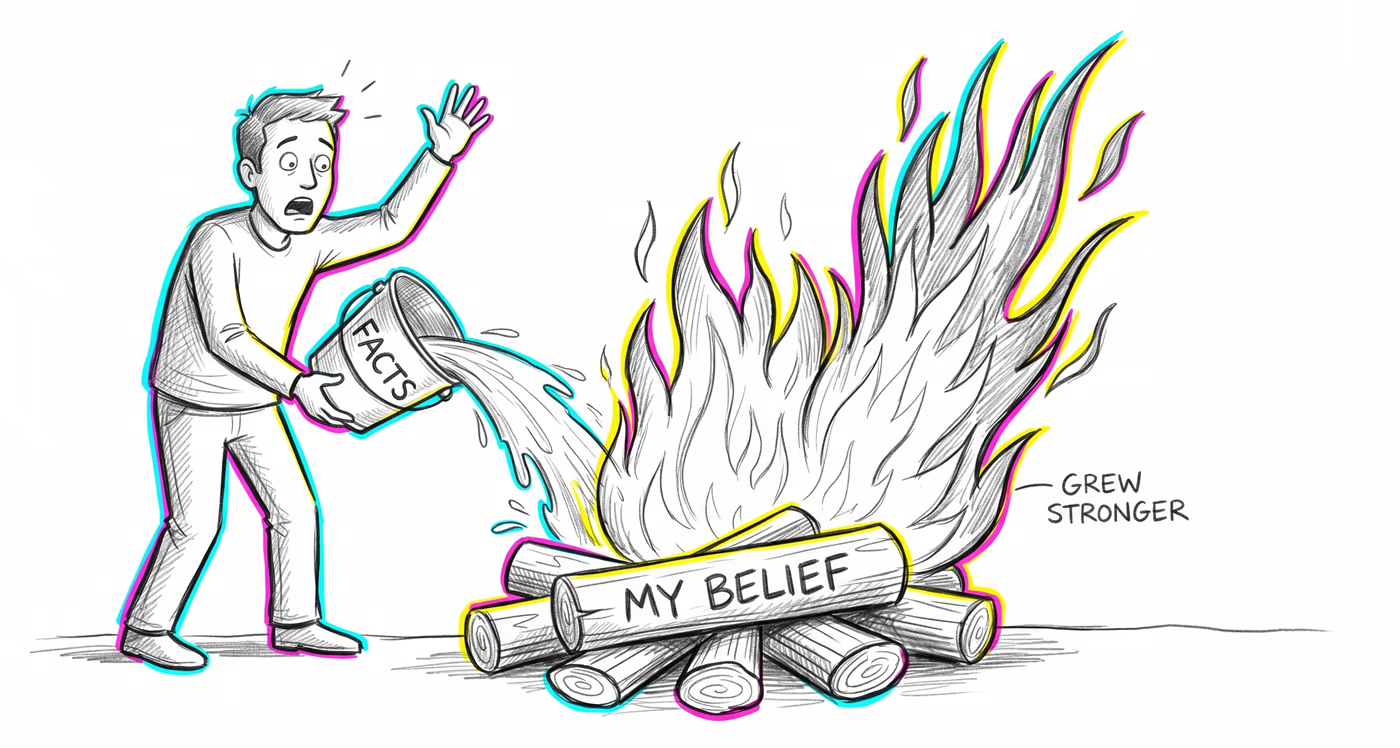
Reflexively rejecting new evidence because it contradicts established beliefs, regardless of how strong the evidence is.

WHAT IT IS

The glitch, explained plainly.

Imagine you've been building a sandcastle all day and someone shows you a way better design. Instead of looking at their drawing, you cover your ears and say 'My castle is fine!' — not because their design is bad, but because admitting it's better would mean everything you built was wrong.

The Semmelweis Reflex describes the automatic, pre-emptive dismissal of new findings not because they fail empirical scrutiny, but because accepting them would destabilize an existing belief system, professional identity, or institutional structure. Unlike healthy skepticism, which involves evaluating evidence before forming a judgment, this reflex triggers emotional rejection before any genuine analysis occurs. The bias is especially potent when the new information implies that established authorities have been wrong or even harmful, as acknowledging this would require painful accountability. It operates at both individual and collective levels, often reinforced by groupthink, authority hierarchies, and the sunk costs invested in maintaining current paradigms.

SOUND FAMILIAR?

Where it shows up.

  1. 01 Dr. Rivera's department has used a particular surgical technique for 20 years. A newly hired surgeon presents peer-reviewed data showing a modified technique reduces complications by 40%. Instead of reviewing the data, several senior surgeons dismiss it outright, saying the new surgeon 'doesn't understand how things work here' and that their existing technique has served them well enough.
  2. 02 A software company's CTO insists on continuing to use a legacy architecture despite three independent performance audits showing a modern framework would cut server costs by 60%. When engineers present the data, the CTO responds that the auditors 'don't understand the complexity of our system' and shelves the reports without reading them.
  3. 03 A school principal receives research from an education nonprofit showing that a specific grading reform improves student retention by 25% in comparable districts. She shares it with her faculty, but the veteran teachers dismiss the study during a meeting, arguing that their decades of experience trump any external research, and the principal quietly drops the initiative.
  4. 04 A financial analyst presents evidence to her portfolio manager that a long-held valuation model has been consistently overestimating returns for three consecutive quarters. The manager acknowledges the data briefly but then explains why the model is still 'fundamentally sound,' attributing the discrepancy to 'unusual market conditions' and continuing to use it unchanged.
  5. 05 A nutrition researcher publishes a well-controlled study contradicting a widely accepted dietary guideline. The professional association that endorsed the original guideline does not critique the study's methodology but instead questions the researcher's institutional affiliations, subtly implying bias, and declines to update its recommendations. Other members privately acknowledge the study's rigor but remain silent to avoid professional friction.
IN DIFFERENT DOMAINS

Where it shows up at work.

The same glitch looks different depending on the terrain. Finance, medicine, a relationship, a team — same mechanism, different costume.

Finance & investing

Investment committees reject quantitative models or novel risk frameworks that contradict long-standing valuation methodologies, even when backtesting data clearly demonstrates superior predictive performance, because adoption would implicitly invalidate years of prior decisions made under the old model.
Medicine & diagnosis

Clinicians resist adopting new diagnostic criteria or treatment protocols supported by current evidence because they conflict with the training paradigms absorbed during medical school, leading to delayed uptake of effective interventions and continued reliance on outdated practices.

Education & grading

Educators dismiss pedagogical research demonstrating the effectiveness of new teaching methods (such as active learning replacing lectures) because it challenges the instructional identity they have built over years and implies their prior approach was suboptimal.

Relationships

Partners reject feedback or relationship research suggesting healthier communication patterns because accepting the new information would mean acknowledging that their inherited family dynamics or long-standing habits have been harmful.

Tech & product

Engineering teams resist migrating to demonstrably superior technologies or design patterns because the existing codebase and toolchain represent years of institutional investment, and acknowledging the alternative's superiority feels like admitting past architectural decisions were wrong.

Workplace & hiring

Organizations reject management research showing that their performance evaluation systems or hiring practices are ineffective or biased, because overhauling them would require admitting that past promotions and terminations were based on flawed criteria.

Politics Media

Policymakers and media figures dismiss emerging scientific consensus on issues like public health or environmental policy when the evidence contradicts established political platforms, treating the data as a partisan threat rather than evaluating it on its merits.

HOW TO SPOT IT

Ask yourself…

  • Am I dismissing this new information because I've actually evaluated it, or because accepting it would mean my current beliefs are wrong?
  • Is my objection based on the quality of the evidence, or on the discomfort I feel about what the evidence implies?
  • Would I be more open to this finding if it confirmed rather than contradicted what I already believe?
HOW TO DEFEND AGAINST IT

The playbook.

  • Practice 'steel-manning': before rejecting new evidence, articulate the strongest possible version of the claim and consider what would be true if it were correct.
  • Implement a 'cooling-off' period: when you feel the urge to immediately reject a new finding, commit to waiting 48 hours and revisiting the evidence with fresh eyes.
  • Ask the falsifiability question: 'What evidence would I need to see to change my mind?' If the answer is 'nothing,' recognize that you are operating on reflex, not reason.
  • Seek out disconfirming evidence deliberately: assign someone on your team the role of 'devil's advocate' whose explicit job is to argue for the new paradigm.
  • Separate the evidence from the messenger: evaluate the data independently of who is presenting it, their status, or their institutional affiliation.
FAMOUS CASES

In history.

  • Ignaz Semmelweis's handwashing protocol was rejected by the 19th-century medical establishment despite dramatically reducing maternal mortality, leading to continued preventable deaths for decades until germ theory was accepted.
  • The medical community initially rejected Barry Marshall and Robin Warren's discovery that H. pylori bacteria cause stomach ulcers, as it contradicted the prevailing belief that stress and lifestyle were the primary causes; Marshall had to infect himself to prove the point.
  • Galileo's support for the heliocentric model was met with institutional rejection and house arrest because it contradicted the geocentric paradigm endorsed by the Church and scientific authorities.
  • The WHO's delayed recognition of COVID-19's airborne transmission, maintaining a focus on droplet spread consistent with established infectious disease paradigms despite accumulating aerosol evidence.
WHERE IT COMES FROM
Academic origin

The term was popularized by Robert Anton Wilson in collaboration with Timothy Leary in the book 'The Game of Life' (1979/1993), drawing on the historical case of Ignaz Semmelweis (1847). The concept was further formalized in academic literature by Gupta, Saini, Oberoi, Kalra, and Nasir in their 2020 review 'Semmelweis Reflex: An Age-Old Prejudice' in World Neurosurgery.

Evolutionary origin

In ancestral environments, established group knowledge (which plants are safe, which predators to avoid) was hard-won and generally reliable. Individuals who impulsively abandoned tried-and-tested communal knowledge in favor of every novel claim would have been more likely to die from untested practices. Defaulting to the tribe's existing knowledge base and being suspicious of radical departures conferred a survival advantage, even if it occasionally meant missing genuine improvements.

IN AI SYSTEMS

How the machines inherit it.

AI systems trained on established knowledge corpora can exhibit a form of Semmelweis Reflex by weighting consensus-era data far more heavily than emerging evidence, effectively encoding paradigm conservatism into their outputs. Models may dismiss or downrank novel findings that conflict with the dominant patterns in their training data, reproducing the same institutional inertia that afflicts human experts. Additionally, human operators may reject AI-generated insights that contradict their domain expertise, applying the Semmelweis Reflex to the machine's output itself.

Read more on Wikipedia
FREE FIELD ZINE

10 glitches quietly running your life.

A free field-zine PDF — ten cognitive glitches named, illustrated, with a defense move for each. Plus the weekly Glitch Report on Fridays — one bias named, two spotted in the wild, one defense move. Unsubscribe any time.

EXPLORE MORE

Related glitches.

LAUNCH PRICE

Train against your blindspots.

50 cards are free to preview. Buyers unlock the rest of the deck plus the interactive training — Spot-the-Bias Quiz unlimited, Swipe Deck with spaced repetition, My Blindspots, Decision Pre-Flight, the Printable Deck + Cheat Sheets, and the Field Guide e-book. $29.50$59.

Unlock the full deck

Everything below — yours forever. Pay once, use across every device.

Half-off launch — limited to the first 100 readers. Auto-applied at checkout.
$59 $29.50
one-time payment · lifetime access
  • All interactive digital cards — search, filter, flip, shuffle on any device
  • Five training modes — Spot-the-Bias Quiz, Swipe Deck, Pre-Flight, Blindspots, Journal
  • Curated Lenses + Decision Templates + Defense Playbook
  • Printable Deck PDFs + Field Guide e-book + Cheat Sheets + Anki Export
  • Every future improvement, included
Unlock  $29.50

30-day refund · no questions asked

Unlock the full deck

Everything below — yours forever. Pay once, use across every device.

Half-off launch — limited to the first 100 readers. Auto-applied at checkout.
$59 $29.50
one-time payment · lifetime access
  • All interactive digital cards — search, filter, flip, shuffle on any device
  • Five training modes — Spot-the-Bias Quiz, Swipe Deck, Pre-Flight, Blindspots, Journal
  • Curated Lenses + Decision Templates + Defense Playbook
  • Printable Deck PDFs + Field Guide e-book + Cheat Sheets + Anki Export
  • Every future improvement, included
Unlock  $29.50

30-day refund · no questions asked