Worse-Than-Average Effect

aka Below-Average Effect · Worse-Than-Average Bias

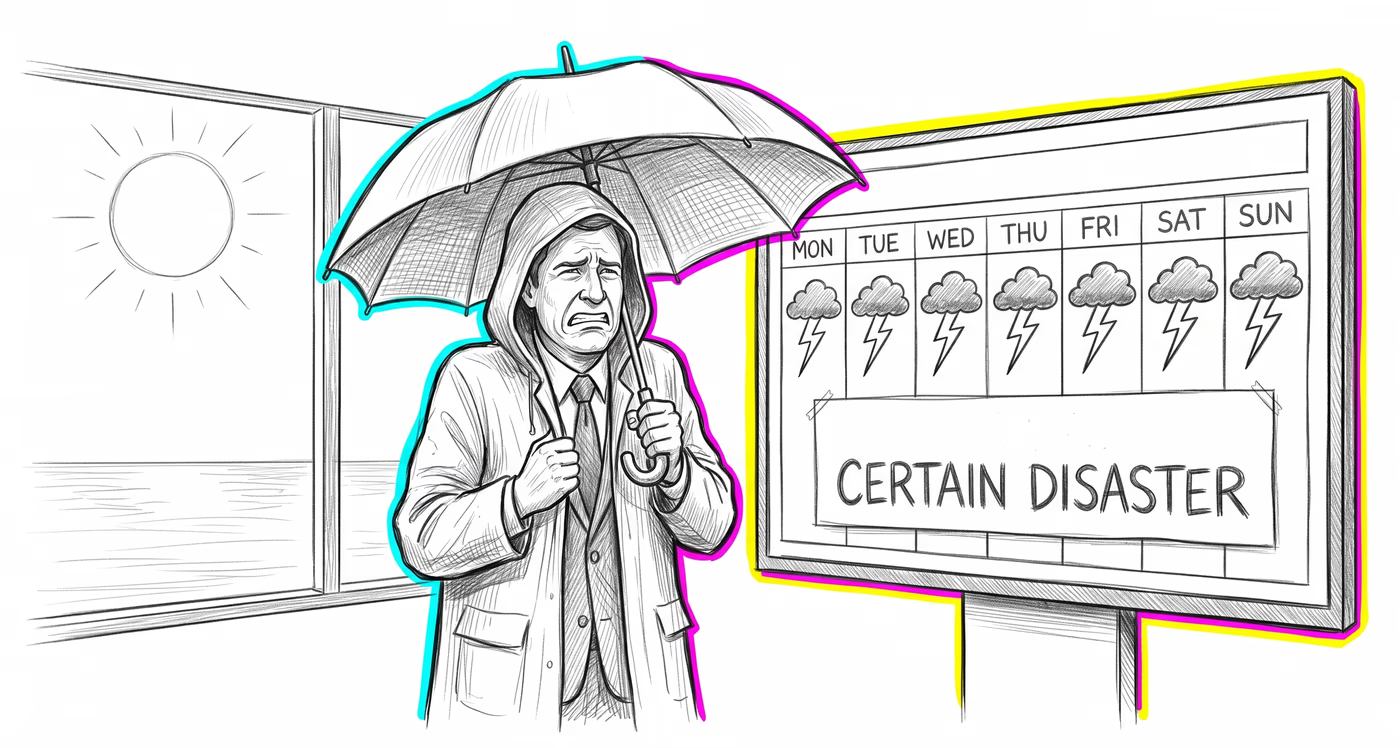
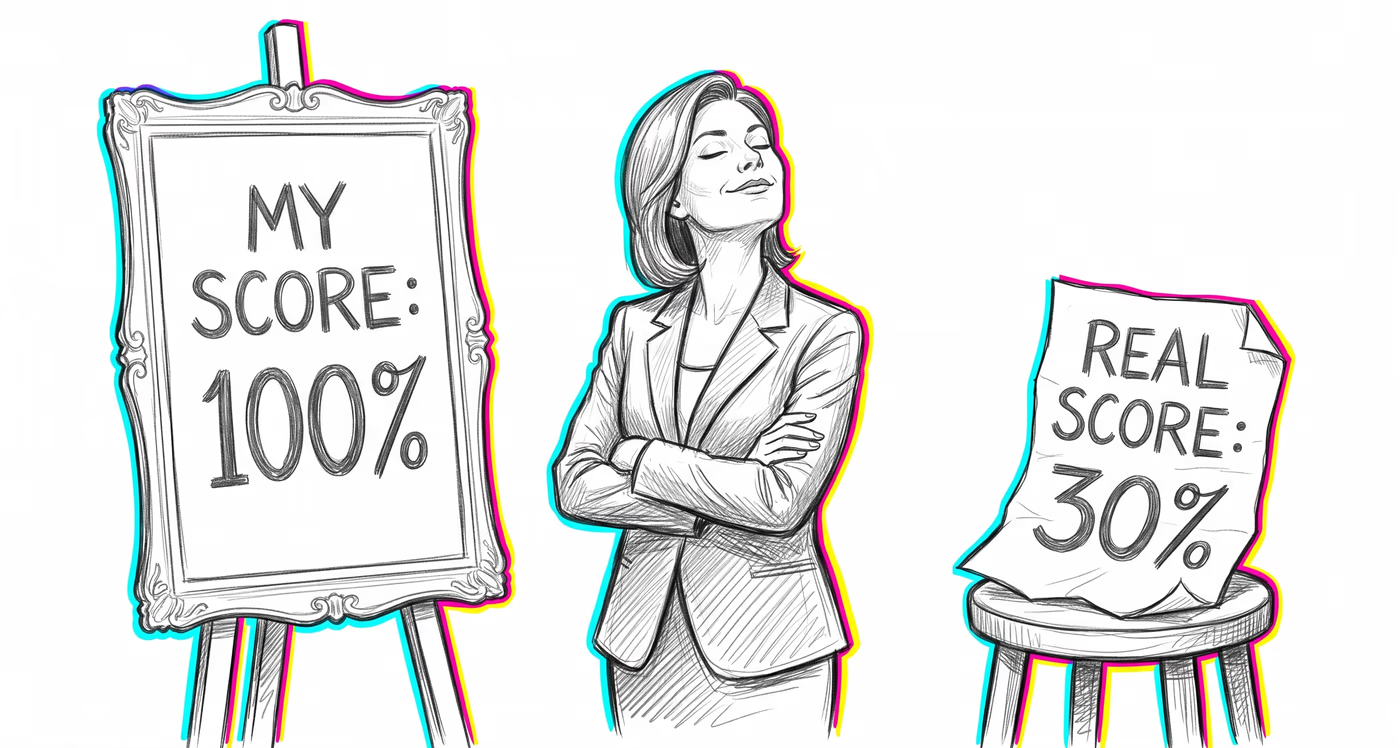
Underestimating your own abilities relative to others, especially for tasks perceived as difficult.

WHAT IT IS

The glitch, explained plainly.

Imagine your teacher gives the whole class a really hard puzzle. You think you're terrible at it, but you forget that everyone else also found it really hard. You think all the other kids are better at puzzles than you, but actually most of them struggled just as much as you did.

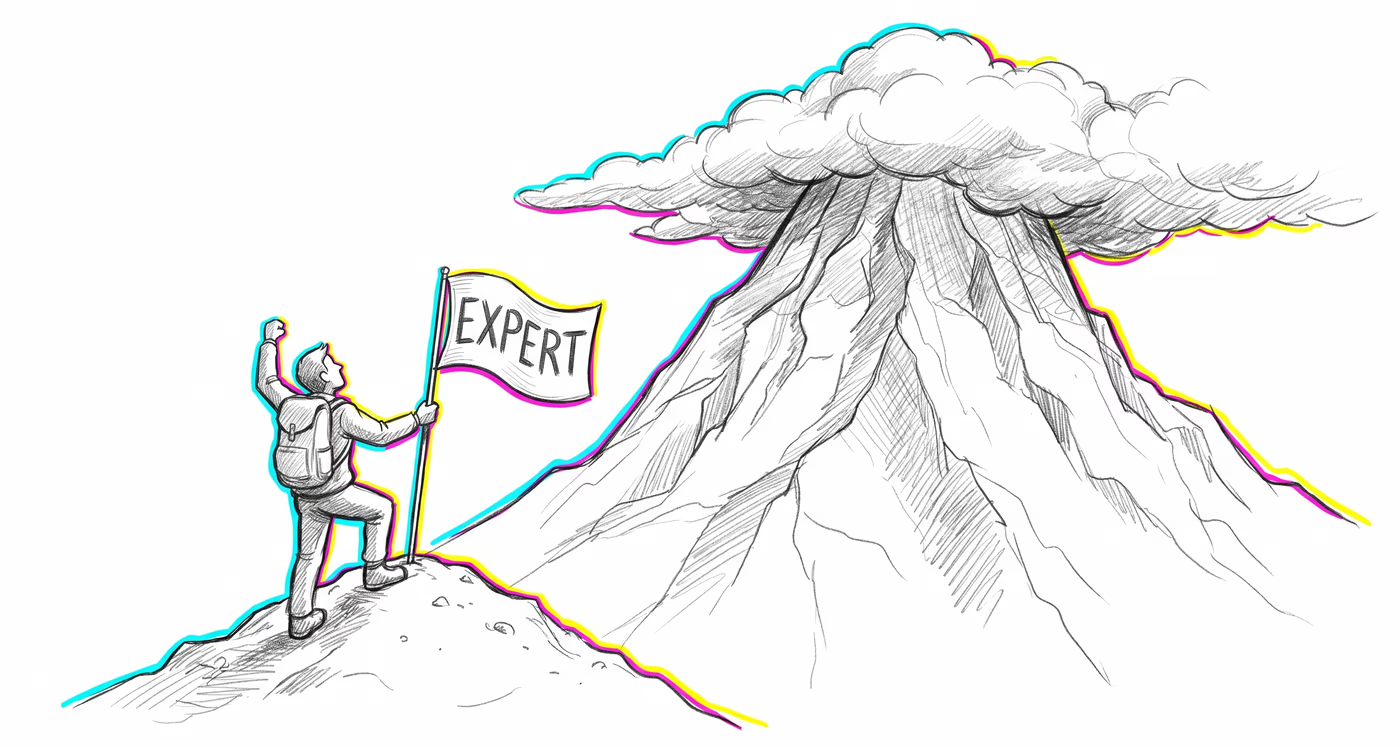
The worse-than-average effect is a systematic tendency to rate oneself as inferior to peers, especially when the task in question is perceived as difficult, unfamiliar, or rare. Unlike the far more commonly studied better-than-average effect that emerges for easy tasks, this reversal occurs because people anchor too heavily on their own perceived shortcomings without adequately considering that the same task is equally hard for everyone else. The bias is driven by egocentrism in comparative judgment: individuals focus disproportionately on their own ability level and fail to adjust sufficiently for the fact that others face the same challenges. It manifests in domains like juggling, chess, computer programming, and other stereotypically difficult skills where people systematically believe most others outperform them.

SOUND FAMILIAR?

Where it shows up.

  1. 01 Maria has been learning to code for six months and feels stuck. When a colleague mentions that their company is looking for junior developers, she immediately dismisses the opportunity, thinking, 'Everyone applying will be far more skilled than me.' She doesn't consider that other applicants at the junior level likely have similar experience and struggles.
  2. 02 After attending a wine-tasting course, James rates himself as a 3 out of 10 at identifying grape varieties and assumes most other attendees are around a 7. In reality, the instructor notes that almost no beginner scores above a 4 on the skill assessment. James's low confidence is anchored entirely on his own perceived difficulty with the task.
  3. 03 A university student preparing for a notoriously difficult organic chemistry final estimates that about 75% of her classmates will outscore her. She bases this estimate on how much she struggled with the material, without factoring in that the class average on past exams has been around 55%, suggesting widespread difficulty.
  4. 04 An amateur photographer hesitates to submit his work to a local gallery's open call, reasoning that the other submissions will be far superior. He's thinking about his own technical weaknesses but hasn't considered that an open call attracts many photographers at similar skill levels, not just experts.
  5. 05 A data analyst at a large firm consistently defers to colleagues on complex statistical modeling decisions, believing they grasp the methodology better than she does. In annual reviews, her manager notes that her work quality is consistently above the team average. She acknowledges this feedback but still feels her understanding is below that of her peers, anchoring on the difficulty she experiences without recognizing others face the same struggle.
IN DIFFERENT DOMAINS

Where it shows up at work.

The same glitch looks different depending on the terrain. Finance, medicine, a relationship, a team — same mechanism, different costume.

Finance & investing

Novice investors often underestimate their ability to evaluate stocks or manage a portfolio relative to other retail investors, leading them to over-delegate to financial advisors or avoid investing altogether, even when their analytical skills are on par with peers.
Medicine & diagnosis

Patients facing complex treatment decisions may underestimate their own capacity to understand medical information compared to other patients, leading them to accept physician recommendations passively rather than engaging in shared decision-making.

Education & grading

Students in difficult courses systematically predict they will rank lower than classmates, which can reduce effort and engagement through learned helplessness — if they believe they are already worse than average, additional studying feels futile.

Relationships

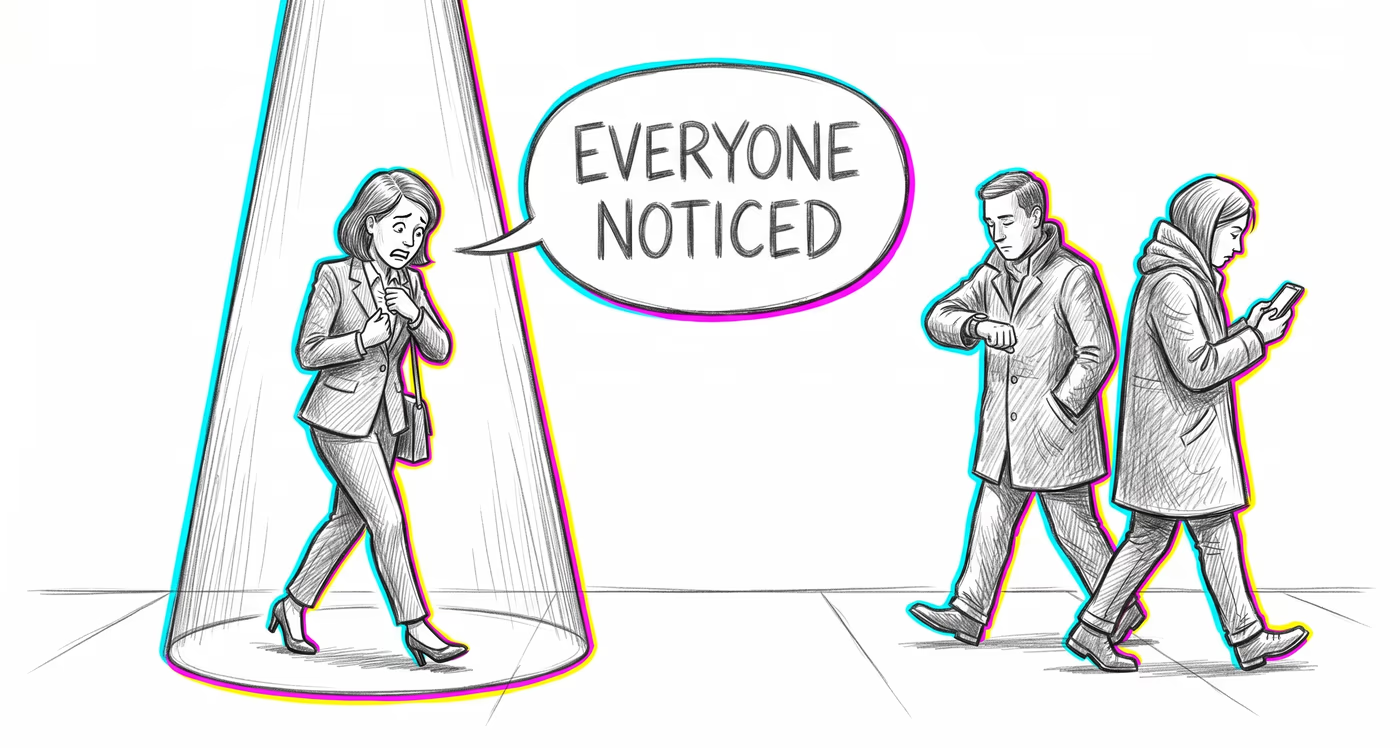
People may undervalue what they bring to a relationship, assuming their partner could easily find someone better, leading to insecurity, people-pleasing, or reluctance to assert needs — particularly in relationships where the other person is perceived as higher-status.

Tech & product

Developers working on complex systems (e.g., low-level programming, cryptography) may underestimate their competence relative to peers, leading to imposter syndrome-driven behaviors like over-documenting simple code, avoiding speaking up in code reviews, or declining leadership roles on technical projects.

Workplace & hiring

Employees in highly specialized or technical roles may consistently rate their performance below that of colleagues during self-assessments, leading to lower salary negotiation confidence and reduced likelihood of pursuing promotions they are qualified for.

Politics Media

Citizens may underestimate their ability to understand complex policy issues relative to other voters, leading them to disengage from political participation or defer uncritically to pundits and commentators on topics where they actually have adequate understanding.

HOW TO SPOT IT

Ask yourself…

  • Am I assuming this task is hard only for me, without considering whether others also find it difficult?
  • Am I basing my self-comparison on my own struggles rather than on any actual data about how others perform?
  • Would I still rate myself this low if I learned that the average person also struggles significantly with this task?
HOW TO DEFEND AGAINST IT

The playbook.

  • Before concluding you're below average, ask: 'What evidence do I have about how others actually perform on this exact task?' — if the answer is none, your self-placement is based on pure assumption.
  • Seek objective benchmarks: look up average scores, completion rates, or error rates for the activity in question to calibrate your self-assessment against reality.
  • Apply the 'shared difficulty' test: remind yourself that if a task is hard for you, it is statistically likely to be hard for most others too.
  • Track your actual performance over time rather than relying on subjective feelings of competence, which are systematically distorted for difficult tasks.
  • Ask a trusted peer or mentor how you compare — external feedback corrects the egocentric anchor you're stuck on.
WHERE IT COMES FROM
Academic origin

Justin Kruger, 1999. Formalized in the paper 'Lake Wobegon be gone! The below-average effect and the egocentric nature of comparative ability judgments' published in the Journal of Personality and Social Psychology.

Evolutionary origin

In ancestral environments, accurately recognizing one's limitations in dangerous or unfamiliar activities (e.g., navigating unknown terrain, confronting a novel predator) would have promoted caution and avoidance of potentially fatal overconfidence. Underestimating one's competence in genuinely high-risk domains could have served as a protective mechanism, encouraging deference to more experienced group members and promoting survival through humility.

IN AI SYSTEMS

How the machines inherit it.

Language models trained on human-generated self-assessments may internalize patterns of self-deprecation for difficult tasks, producing calibration errors that understate user competence when the subject matter is perceived as difficult. Recommendation systems may also reinforce the bias by steering users away from challenging content based on the assumption that difficulty signals incompetence.

Read more on Wikipedia
FREE FIELD ZINE

10 glitches quietly running your life.

A free field-zine PDF — ten cognitive glitches named, illustrated, with a defense move for each. Plus the weekly Glitch Report on Fridays — one bias named, two spotted in the wild, one defense move. Unsubscribe any time.

EXPLORE MORE

Related glitches.

LAUNCH PRICE

Train against your blindspots.

50 cards are free to preview. Buyers unlock the rest of the deck plus the interactive training — Spot-the-Bias Quiz unlimited, Swipe Deck with spaced repetition, My Blindspots, Decision Pre-Flight, the Printable Deck + Cheat Sheets, and the Field Guide e-book. $29.50$59.

Unlock the full deck

Everything below — yours forever. Pay once, use across every device.

Half-off launch — limited to the first 100 readers. Auto-applied at checkout.
$59 $29.50
one-time payment · lifetime access
  • All interactive digital cards — search, filter, flip, shuffle on any device
  • Five training modes — Spot-the-Bias Quiz, Swipe Deck, Pre-Flight, Blindspots, Journal
  • Curated Lenses + Decision Templates + Defense Playbook
  • Printable Deck PDFs + Field Guide e-book + Cheat Sheets + Anki Export
  • Every future improvement, included
Unlock  $29.50

30-day refund · no questions asked

Unlock the full deck

Everything below — yours forever. Pay once, use across every device.

Half-off launch — limited to the first 100 readers. Auto-applied at checkout.
$59 $29.50
one-time payment · lifetime access
  • All interactive digital cards — search, filter, flip, shuffle on any device
  • Five training modes — Spot-the-Bias Quiz, Swipe Deck, Pre-Flight, Blindspots, Journal
  • Curated Lenses + Decision Templates + Defense Playbook
  • Printable Deck PDFs + Field Guide e-book + Cheat Sheets + Anki Export
  • Every future improvement, included
Unlock  $29.50

30-day refund · no questions asked