Social Loafing

aka Ringelmann Effect · Free Rider Effect · Motivational Loss in Groups

Putting in less effort when working in a group than when working alone, especially when individual contributions aren't tracked.

WHAT IT IS

The glitch, explained plainly.

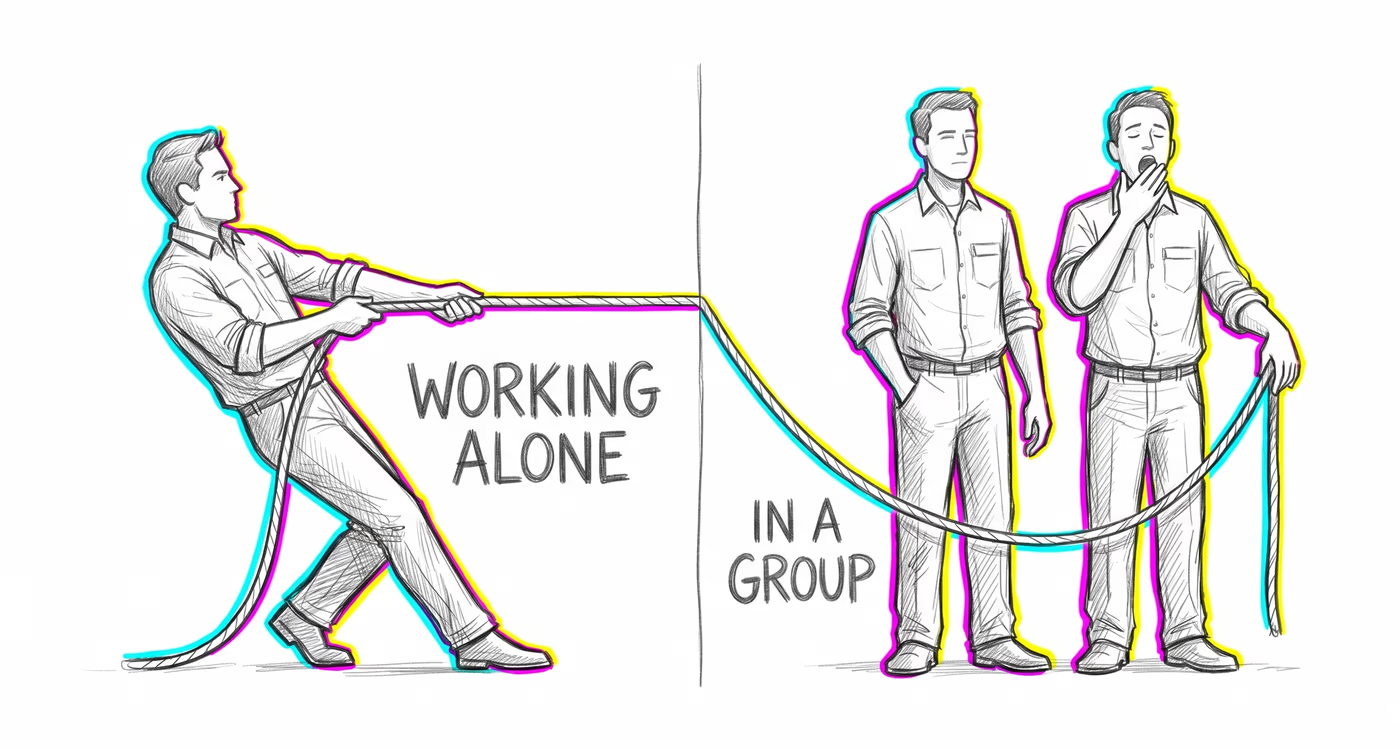
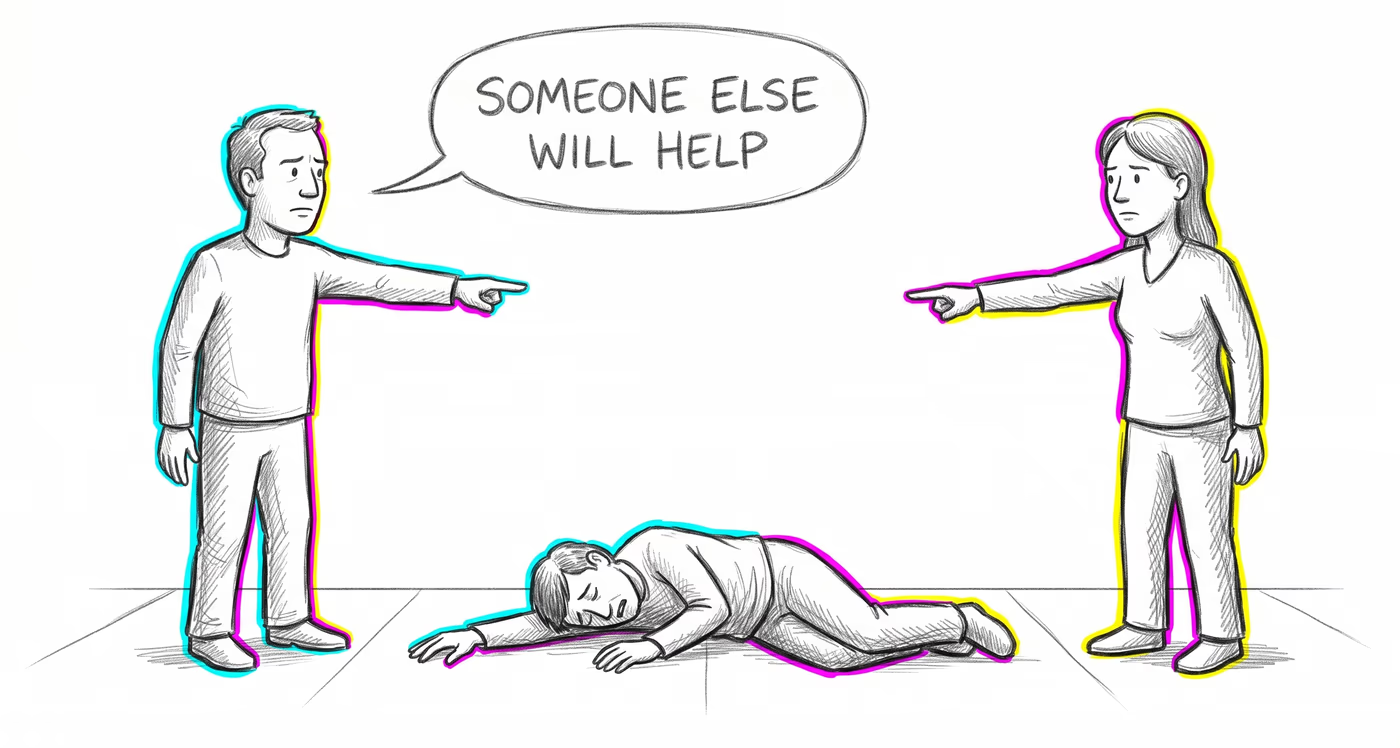
Imagine you and your friends are all pushing a big car together. Because nobody can tell exactly how hard YOU are pushing, you secretly push a little less — and so does everyone else. When you had to push alone, you gave it everything you had, but in the group you figure 'someone else will make up for it.'

Social loafing occurs when individuals reduce their physical, cognitive, or perceptual effort during collective tasks because they perceive their personal contribution as dispensable, unidentifiable, or redundant. The effect intensifies as group size increases, as the link between individual effort and personal outcomes weakens. It manifests across both physical tasks (pulling ropes, clapping) and cognitive ones (brainstorming, editing, evaluating), and is amplified when tasks feel meaningless, when co-workers are strangers, or when no mechanism exists to evaluate individual performance. Critically, loafing is distinct from mere coordination loss — it is a motivational deficit, not a logistical one.

SOUND FAMILIAR?

Where it shows up.

  1. 01 A marketing department of twelve people is tasked with generating tagline ideas for a new product launch. Each person submits only one or two half-hearted suggestions, far fewer than the dozen each produced when individually assigned to a similar task last quarter. The manager notices the total pool of ideas is smaller and less creative than expected given the team size.
  2. 02 During a company-wide peer code review, a developer skims through a colleague's pull request and approves it after only a superficial check, reasoning that the other three assigned reviewers will catch any real bugs. Each reviewer independently makes the same assumption, and a significant defect ships to production.
  3. 03 A nonprofit's fundraising committee has grown from five to fifteen members over the past year. Despite tripling in size, the committee's monthly donations secured have only increased by 40%. Each member privately feels less urgency to make personal outreach calls because the team 'has it covered,' yet no single member believes they are shirking.
  4. 04 A research team of eight scientists is writing a grant proposal collaboratively in a shared document. Each author drafts their section with less rigor than they would apply to a solo-authored paper, assuming that the lead investigator's final editing pass will polish everything. The resulting proposal reads as disjointed and underdeveloped.
  5. 05 At a company off-site, employees are divided into large teams for a rope-pulling competition. Sarah notices she's pulling with noticeably less force than she exerts during her solo gym workouts, even though she genuinely wants her team to win. She isn't deliberately slacking — she simply cannot calibrate her effort when it's blended invisibly into the group's total force.
IN DIFFERENT DOMAINS

Where it shows up at work.

The same glitch looks different depending on the terrain. Finance, medicine, a relationship, a team — same mechanism, different costume.

Finance & investing

In investment committees, individual analysts may conduct less thorough due diligence on a stock pick when they know multiple team members are also reviewing it, leading to collective overconfidence in under-researched recommendations.
Medicine & diagnosis

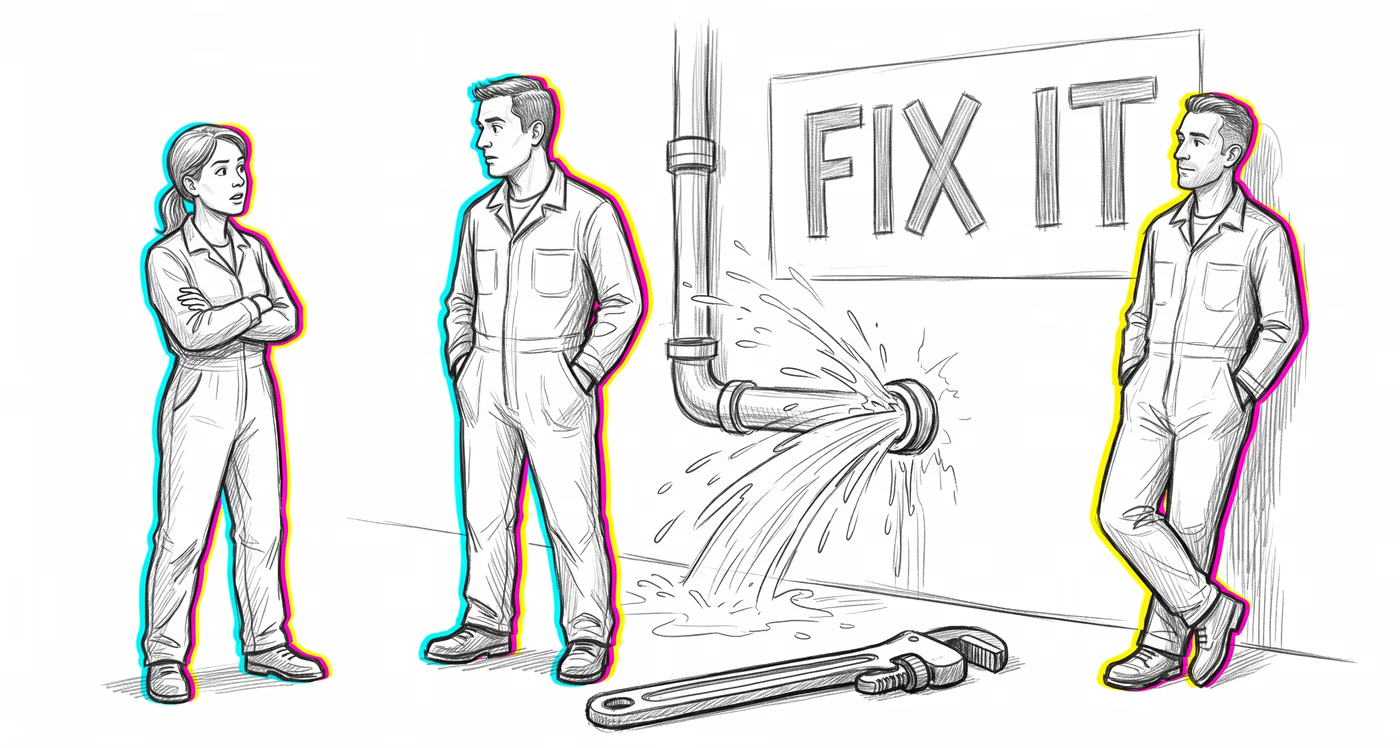
In large surgical or care teams, individual clinicians may be less vigilant about double-checking dosages or flagging anomalies when they assume other team members are performing the same safety checks, increasing the risk of medical errors.

Education & grading

In group assignments, students commonly reduce their individual effort and preparation quality because grades are shared, leading to uneven contribution patterns where a few students carry the majority of the workload while others coast.

Relationships

In shared household responsibilities, partners or family members often unconsciously reduce their individual contributions to chores or emotional labor when they perceive the other person will compensate, leading to resentment and conflict over fairness.

Tech & product

In large engineering teams, developers may write less thorough tests or documentation for shared codebases because ownership is diffuse, leading to accumulated technical debt that no single person feels responsible for addressing.

Workplace & hiring

In large meetings, participants are less likely to volunteer ideas, challenge decisions, or take on action items compared to small meetings, because the perceived anonymity of a big group reduces felt accountability for the meeting's outcome.

Politics Media

In democratic participation, voters in large electorates may feel their individual vote is inconsequential, reducing turnout and civic engagement — a collective action problem amplified by the perception that millions of others will participate regardless.

HOW TO SPOT IT

Ask yourself…

  • Am I putting in the same level of effort I would if I were the only person responsible for this outcome?
  • Am I assuming someone else on the team will catch this mistake or handle this task?
  • Would I be comfortable if my exact individual contribution were measured and displayed to the group right now?
HOW TO DEFEND AGAINST IT

The playbook.

  • Break large groups into small sub-teams of 3-5 people with clearly assigned individual deliverables and deadlines.
  • Make individual contributions identifiable and visible — use named task ownership, individual progress reports, or contribution tracking tools.
  • Ask yourself before group tasks: 'What would I produce if I were doing this entirely alone?' — then match that standard.
  • Assign unique, non-overlapping responsibilities so each person's output is distinguishable and indispensable to the final product.
  • Implement peer evaluation systems where team members rate each other's effort and contribution quality.
FAMOUS CASES

In history.

  • Max Ringelmann's 1913 rope-pulling experiments, which first documented that groups of men exerted less per-person force than individuals pulling alone, becoming the foundational observation for social loafing research.
  • NASA's post-Challenger investigations highlighted how diffused responsibility across large engineering teams contributed to failures in flagging known O-ring risks, with individuals assuming others had raised concerns.
  • The widespread phenomenon of 'social loafing' in open-source software projects, where large contributor bases often see declining per-person code contributions as project size grows, documented in multiple software engineering studies.
WHERE IT COMES FROM
Academic origin

First observed by Max Ringelmann in 1913 through rope-pulling experiments. The term 'social loafing' was coined by Bibb Latané, Kipling Williams, and Stephen Harkins in 1979. Karau and Williams formalized the Collective Effort Model in their 1993 meta-analysis.

Evolutionary origin

In ancestral small-group environments, conserving energy when the group's survival did not depend on maximal individual output was adaptive. In tight-knit bands where everyone's contribution was visible, selective effort allocation allowed individuals to reserve resources for tasks where their contribution was critical, such as hunting or defense. This energy-saving heuristic became maladaptive only when group sizes exceeded the threshold of mutual accountability.

IN AI SYSTEMS

How the machines inherit it.

In human-AI collaboration, social loafing manifests as 'algorithmic loafing' — humans reduce their cognitive effort, critical thinking, and verification diligence when working alongside AI systems, assuming the AI will catch errors or handle the heavy lifting. Research shows that people working with AI assistants produce less detailed and shorter contributions, cede responsibility to the machine, and become less accurate reviewers. Paradoxically, teams with higher-quality AI tools sometimes perform worse than those with mediocre AI, because better AI induces more complacent human oversight.

Read more on Wikipedia
FREE FIELD ZINE

10 glitches quietly running your life.

A free field-zine PDF — ten cognitive glitches named, illustrated, with a defense move for each. Plus the weekly Glitch Report on Fridays — one bias named, two spotted in the wild, one defense move. Unsubscribe any time.

EXPLORE MORE

Related glitches.

LAUNCH PRICE

Train against your blindspots.

50 cards are free to preview. Buyers unlock the rest of the deck plus the interactive training — Spot-the-Bias Quiz unlimited, Swipe Deck with spaced repetition, My Blindspots, Decision Pre-Flight, the Printable Deck + Cheat Sheets, and the Field Guide e-book. $29.50$59.

Unlock the full deck

Everything below — yours forever. Pay once, use across every device.

Half-off launch — limited to the first 100 readers. Auto-applied at checkout.
$59 $29.50
one-time payment · lifetime access
  • All interactive digital cards — search, filter, flip, shuffle on any device
  • Five training modes — Spot-the-Bias Quiz, Swipe Deck, Pre-Flight, Blindspots, Journal
  • Curated Lenses + Decision Templates + Defense Playbook
  • Printable Deck PDFs + Field Guide e-book + Cheat Sheets + Anki Export
  • Every future improvement, included
Unlock  $29.50

30-day refund · no questions asked

Unlock the full deck

Everything below — yours forever. Pay once, use across every device.

Half-off launch — limited to the first 100 readers. Auto-applied at checkout.
$59 $29.50
one-time payment · lifetime access
  • All interactive digital cards — search, filter, flip, shuffle on any device
  • Five training modes — Spot-the-Bias Quiz, Swipe Deck, Pre-Flight, Blindspots, Journal
  • Curated Lenses + Decision Templates + Defense Playbook
  • Printable Deck PDFs + Field Guide e-book + Cheat Sheets + Anki Export
  • Every future improvement, included
Unlock  $29.50

30-day refund · no questions asked