Truth-Default Theory

aka Truth Bias · Truth-Default State · TDT

Automatically assuming other people are being honest, unless there's strong evidence of deception.

WHAT IT IS

The glitch, explained plainly.

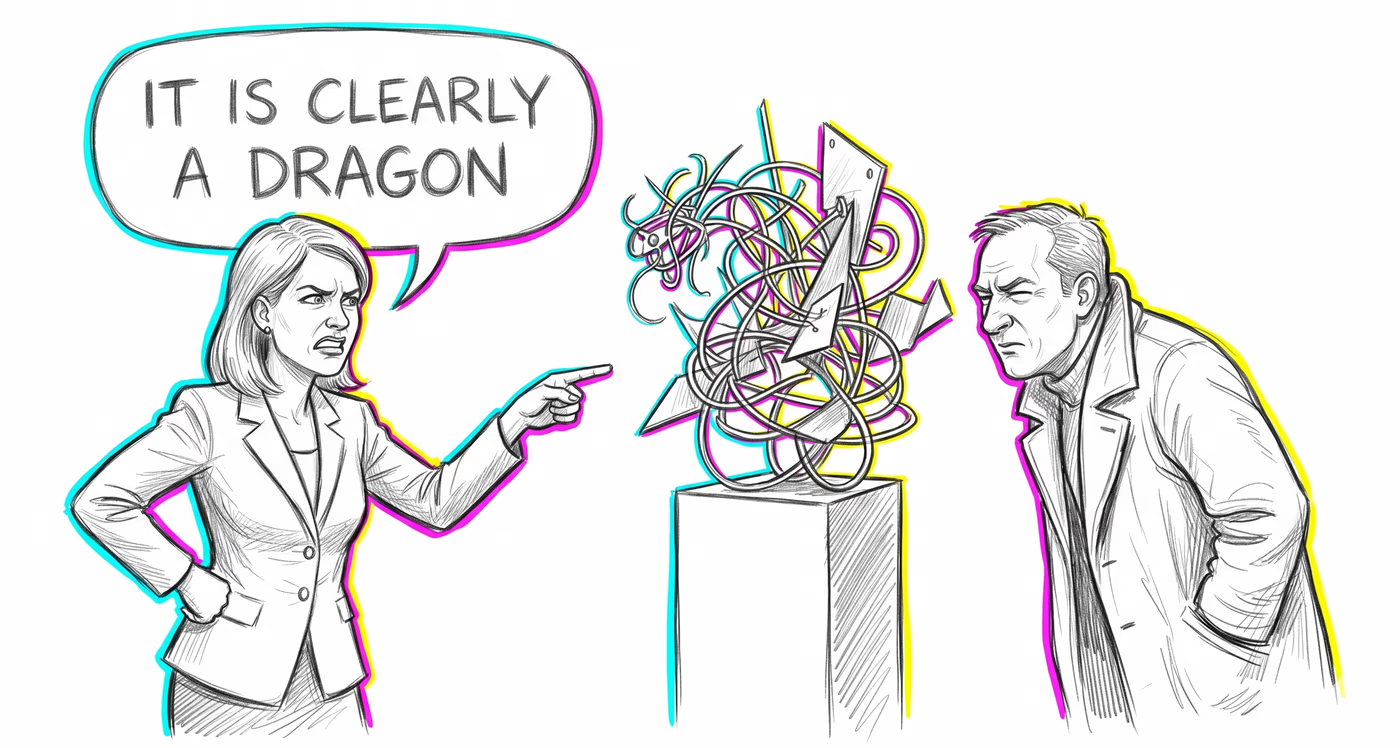
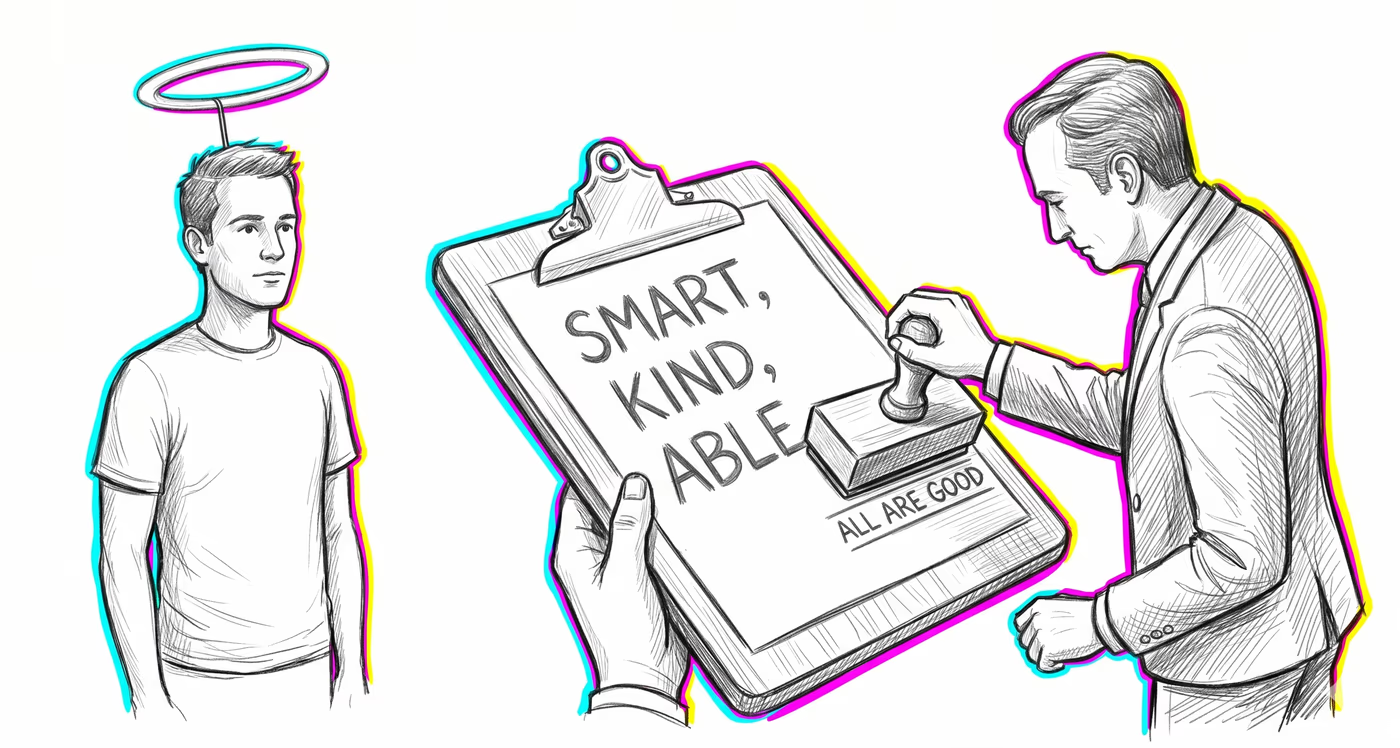
Imagine you have a friend who almost always tells you the truth. Because they're honest nearly every time, you stop even thinking about whether they might be lying—you just believe them automatically. That's how your brain works with everyone: it assumes people are telling the truth until something really weird happens that makes you go 'Wait a minute...' It's like your brain has a setting stuck on 'believe' until an alarm goes off.

Truth-Default Theory posits that humans passively accept incoming communication as honest unless a specific trigger activates suspicion and shifts them out of this default state. This is not mere gullibility but an adaptive cognitive stance: because the vast majority of everyday communication is truthful, defaulting to belief yields correct judgments far more often than systematic skepticism would. The theory further explains the 'veracity effect'—the finding that people are significantly better at correctly identifying truths than at correctly identifying lies—as a direct consequence of this truth-biased default. Critically, the truth-default can be disrupted by specific triggers such as discovering a motive to deceive, encountering behavioral anomalies, or receiving third-party warnings, at which point people shift into an active assessment mode where they weigh evidence for and against honesty.

SOUND FAMILIAR?

Where it shows up.

  1. 01 Maria receives a text from a number she doesn't recognize claiming to be her nephew who got a new phone and needs money urgently. Even though the writing style seems slightly off, she immediately begins arranging a transfer because the message says it's family and the possibility that it's a scam never enters her mind until her actual nephew calls her an hour later.
  2. 02 During a job interview, a candidate describes leading a successful project at their previous company. The hiring manager is impressed and moves the candidate forward without verifying the claim, not because they chose to trust the candidate, but because the idea that someone would fabricate a professional accomplishment in a formal setting simply didn't occur to them.
  3. 03 A financial advisor recommends a new investment fund to a client, citing strong returns. The client invests a significant sum. Later, when a friend asks why the client didn't independently verify the numbers, the client realizes that questioning the advisor's honesty had never entered their thinking—they had been operating on the assumption that the advisor was being straightforward.
  4. 04 A journalist interviews a government official who provides detailed statistics about declining crime rates. The journalist publishes the story using the official's numbers. It's only after a data analyst contacts the paper with contradicting public records that the journalist realizes they never considered the official might have been presenting misleading figures—the thought simply hadn't arisen during the interview.
  5. 05 A research team has been collaborating with a senior scientist who regularly reports positive experimental results. Over two years, no one on the team independently replicates the findings—not because replication was deemed unnecessary, but because the possibility that a respected colleague might be fabricating data was a thought that never surfaced in anyone's mind. The fraud is discovered only when an external reviewer notices statistical anomalies.
IN DIFFERENT DOMAINS

Where it shows up at work.

The same glitch looks different depending on the terrain. Finance, medicine, a relationship, a team — same mechanism, different costume.

Finance & investing

Investors tend to accept financial advisors' and fund managers' reported performance figures at face value, not because they've evaluated the evidence and deemed it credible, but because the possibility of deception simply doesn't arise. This makes them vulnerable to Ponzi schemes and fraudulent reporting.
Medicine & diagnosis

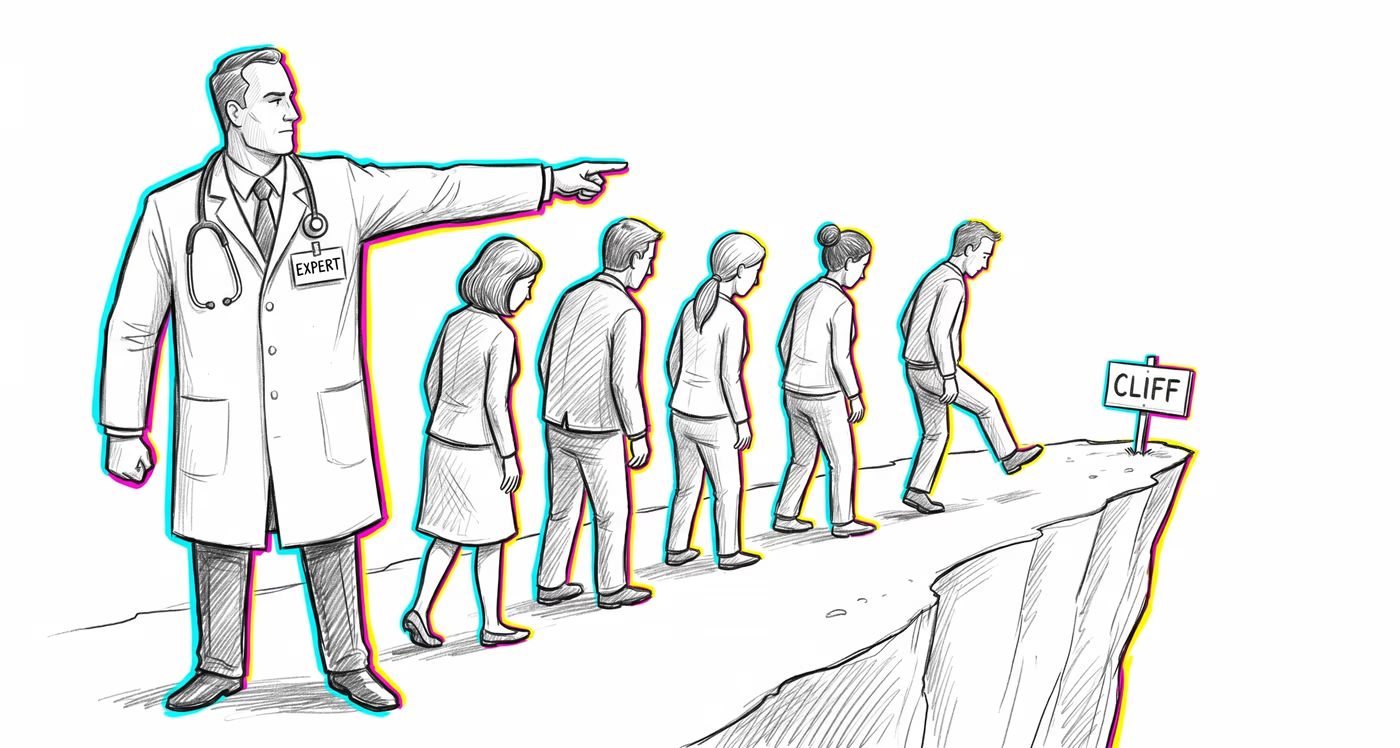
Patients passively accept a physician's diagnosis and treatment recommendations without considering that the doctor might be wrong or influenced by pharmaceutical incentives. Clinicians similarly tend to accept patients' self-reported symptoms as truthful, potentially delaying the identification of drug-seeking behavior or factitious disorders.

Education & grading

Teachers tend to accept students' explanations for missed assignments or absences without scrutiny, and students tend to accept textbook and lecture content as factually accurate without considering that information might be outdated, simplified, or biased.

Relationships

Partners default to believing each other's accounts of daily activities and emotional states. Infidelity and betrayal often go undetected for extended periods not because the deceived partner ignores red flags, but because suspicion never activates in the first place.

Tech & product

Users passively accept that software update prompts, cookie consent banners, and terms-of-service agreements are legitimate and benign. Phishing attacks exploit the truth-default by mimicking trusted interfaces, succeeding because users' default assumption is that digital communications are authentic.

Workplace & hiring

Managers accept self-reported progress updates and expense claims from employees without verification. Whistleblowing is delayed because colleagues default to believing that institutional practices are legitimate and ethical.

Politics Media

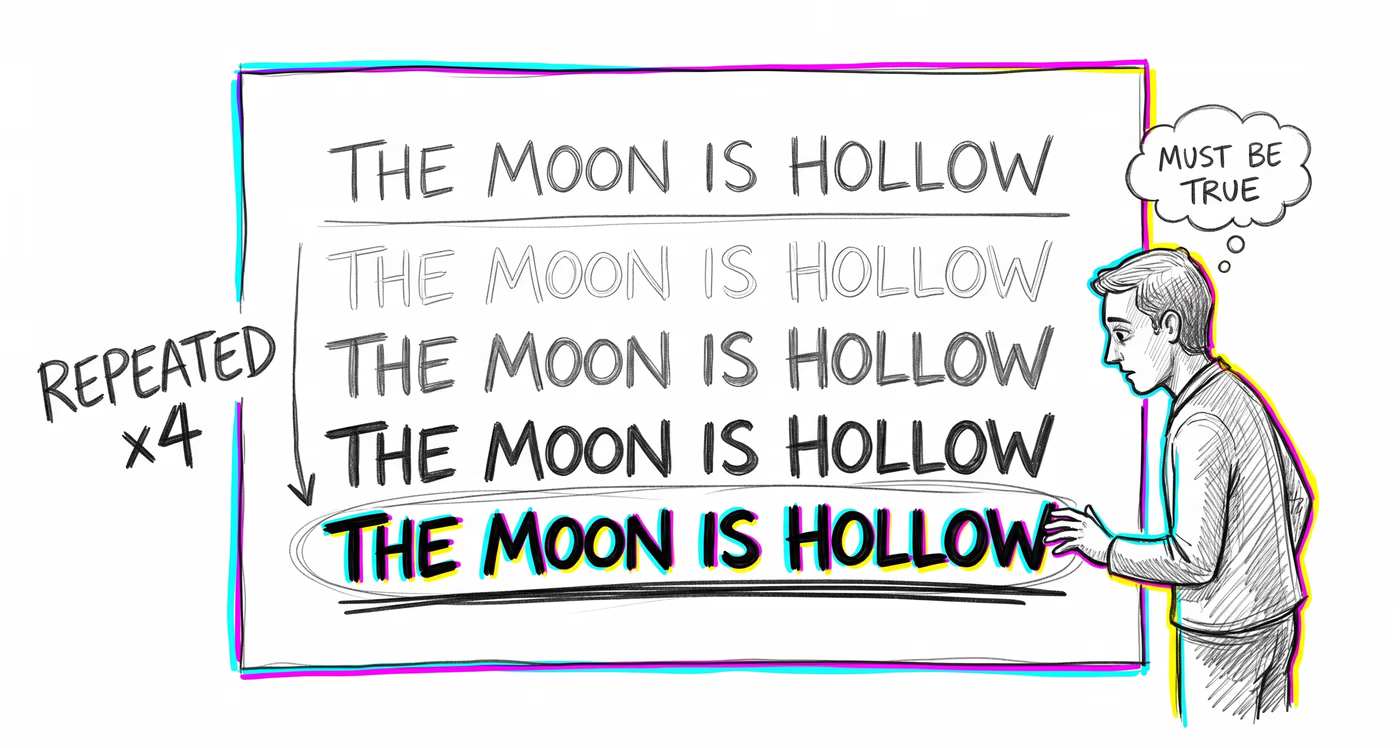
Citizens default to accepting news headlines and political statements as truthful, making them vulnerable to misinformation and propaganda. The truth-default is exploited by repeating false claims until they are passively absorbed as fact, especially when they align with pre-existing beliefs.

HOW TO SPOT IT

Ask yourself…

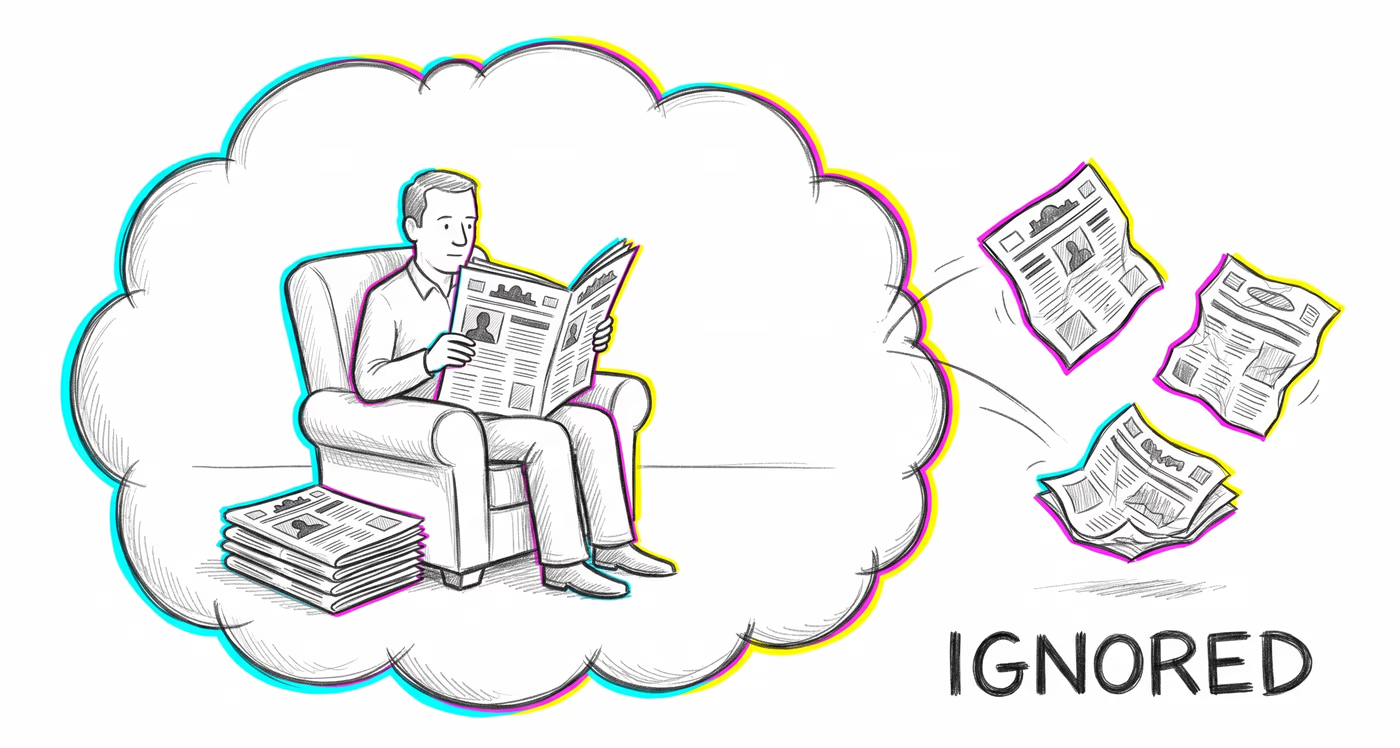
  • Am I believing this statement because I've evaluated the evidence, or because questioning it simply hasn't occurred to me?
  • If I imagined this person had a strong motive to deceive me, would this message look different to me?
  • Have I been passively absorbing claims without once considering whether any of them might be false?
HOW TO DEFEND AGAINST IT

The playbook.

  • Practice 'diagnostic questioning'—ask specific, verifiable questions that an honest person would answer easily but a deceptive person would struggle with.
  • Implement a 'consider the opposite' exercise: before accepting a claim, spend 30 seconds deliberately imagining the scenario where the person is being deceptive and ask what that would look like.
  • Use institutional verification systems rather than relying on personal judgment: require documentation, cross-referencing, and independent confirmation for high-stakes claims.
  • Build in a 'suspicion trigger checklist' for important decisions: Does this person have a motive to deceive? Are there inconsistencies? Is there independent corroboration?
  • Recognize that the absence of suspicion is not evidence of honesty—it may simply mean that the truth-default has not been disrupted.
FAMOUS CASES

In history.

  • Bernie Madoff's Ponzi scheme persisted for decades partly because investors, regulators, and auditors defaulted to accepting his reported returns as genuine, with the possibility of fraud not entering their consideration.
  • The Theranos fraud succeeded for years because investors, board members, and media defaulted to believing Elizabeth Holmes's claims about the technology, never seriously entertaining that the demonstrations might be fabricated.
  • The 2003 Iraq WMD intelligence failure involved policymakers and intelligence analysts who defaulted to accepting informants' claims about weapons programs without adequately questioning whether sources were being deceptive.
WHERE IT COMES FROM
Academic origin

Timothy R. Levine, first presented at the National Communication Association in 2012, formally published in the Journal of Language and Social Psychology in 2014, and fully elaborated in his 2019 book 'Duped.' The concept of truth-bias itself was first coined by Steven McCornack and Malcolm Parks in 1986.

Evolutionary origin

Cooperative communication was essential for early human survival—sharing information about food sources, predators, and social alliances required that group members could quickly and efficiently process others' statements as true. A species-wide default toward belief enabled rapid information transfer and social coordination, providing a massive collective advantage. Since most communication within small, interdependent groups was indeed honest (deception carried high reputational costs), the truth-default yielded correct inferences the vast majority of the time.

IN AI SYSTEMS

How the machines inherit it.

Large language models and AI chatbots inherit a form of truth-default from their training data—they tend to treat input prompts as sincere and factual, making them vulnerable to prompt injection attacks where malicious instructions are disguised as legitimate queries. Similarly, AI content detectors struggle because the systems default to classifying text as human-written unless strong stylistic triggers indicate otherwise, mirroring the human truth-default. Users also apply truth-default to AI outputs, passively accepting generated text as accurate without verifying factual claims.

Read more on Wikipedia
FREE FIELD ZINE

10 glitches quietly running your life.

A free field-zine PDF — ten cognitive glitches named, illustrated, with a defense move for each. Plus the weekly Glitch Report on Fridays — one bias named, two spotted in the wild, one defense move. Unsubscribe any time.

EXPLORE MORE

Related glitches.

LAUNCH PRICE

Train against your blindspots.

50 cards are free to preview. Buyers unlock the rest of the deck plus the interactive training — Spot-the-Bias Quiz unlimited, Swipe Deck with spaced repetition, My Blindspots, Decision Pre-Flight, the Printable Deck + Cheat Sheets, and the Field Guide e-book. $29.50$59.

Unlock the full deck

Everything below — yours forever. Pay once, use across every device.

Half-off launch — limited to the first 100 readers. Auto-applied at checkout.
$59 $29.50
one-time payment · lifetime access
  • All interactive digital cards — search, filter, flip, shuffle on any device
  • Five training modes — Spot-the-Bias Quiz, Swipe Deck, Pre-Flight, Blindspots, Journal
  • Curated Lenses + Decision Templates + Defense Playbook
  • Printable Deck PDFs + Field Guide e-book + Cheat Sheets + Anki Export
  • Every future improvement, included
Unlock  $29.50

30-day refund · no questions asked

Unlock the full deck

Everything below — yours forever. Pay once, use across every device.

Half-off launch — limited to the first 100 readers. Auto-applied at checkout.
$59 $29.50
one-time payment · lifetime access
  • All interactive digital cards — search, filter, flip, shuffle on any device
  • Five training modes — Spot-the-Bias Quiz, Swipe Deck, Pre-Flight, Blindspots, Journal
  • Curated Lenses + Decision Templates + Defense Playbook
  • Printable Deck PDFs + Field Guide e-book + Cheat Sheets + Anki Export
  • Every future improvement, included
Unlock  $29.50

30-day refund · no questions asked