Naïve Realism

aka Naive Realism · Illusion of Personal Objectivity · Direct Realism Bias

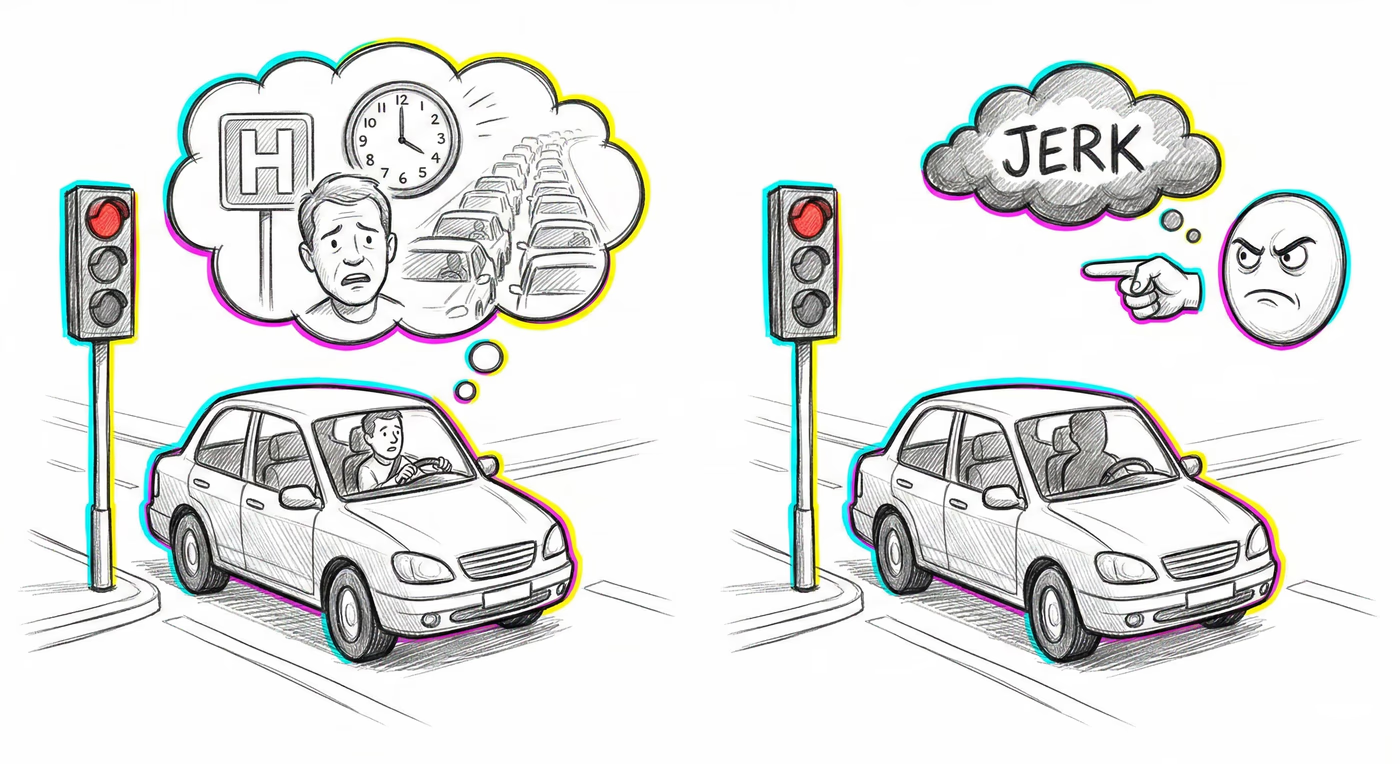
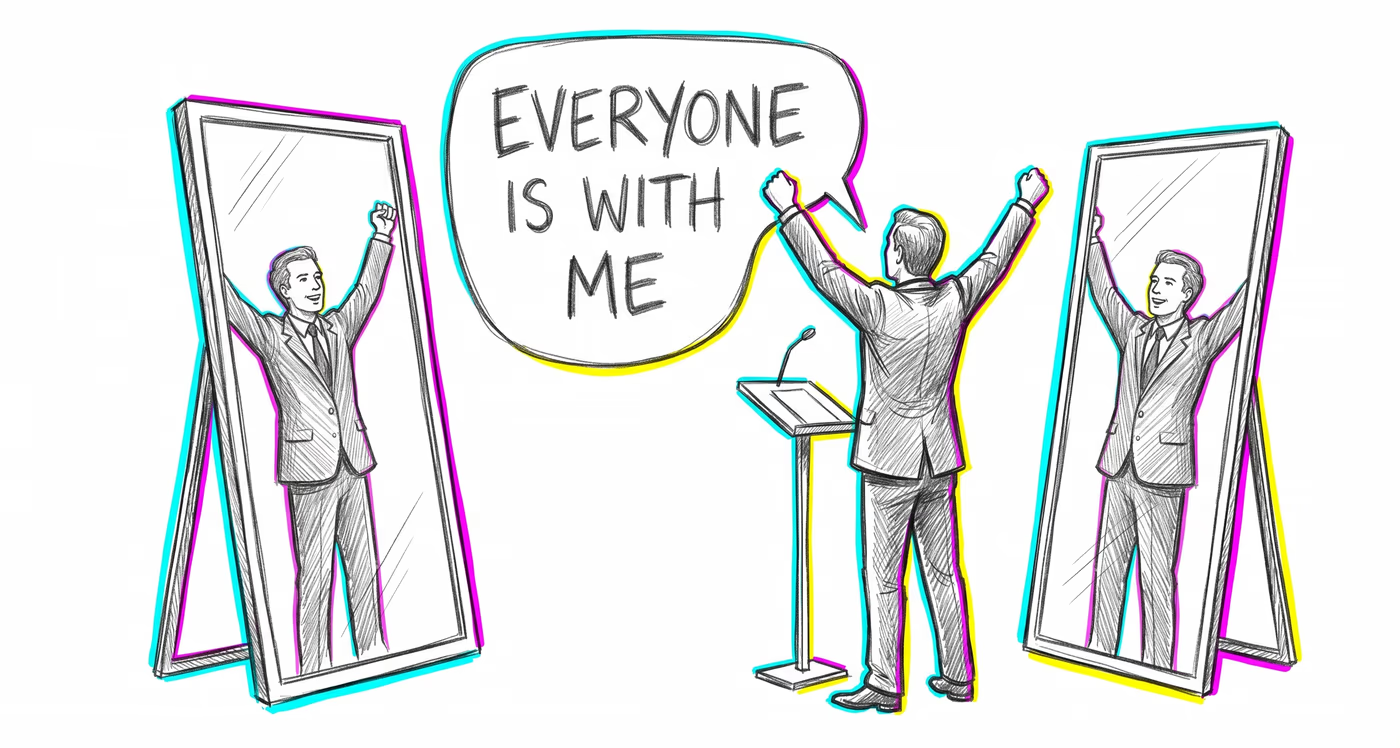
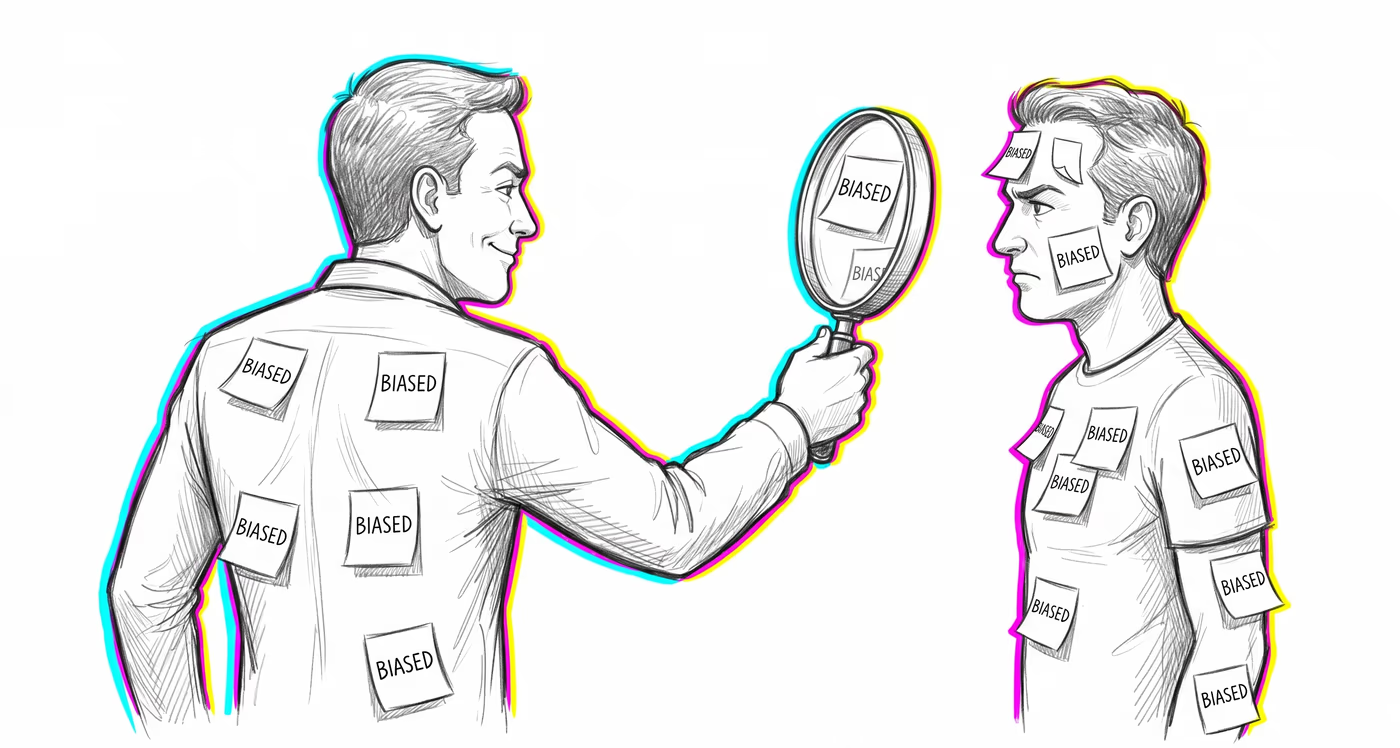
Believing you see the world objectively, so anyone who disagrees must be uninformed, irrational, or biased.

WHAT IT IS

The glitch, explained plainly.

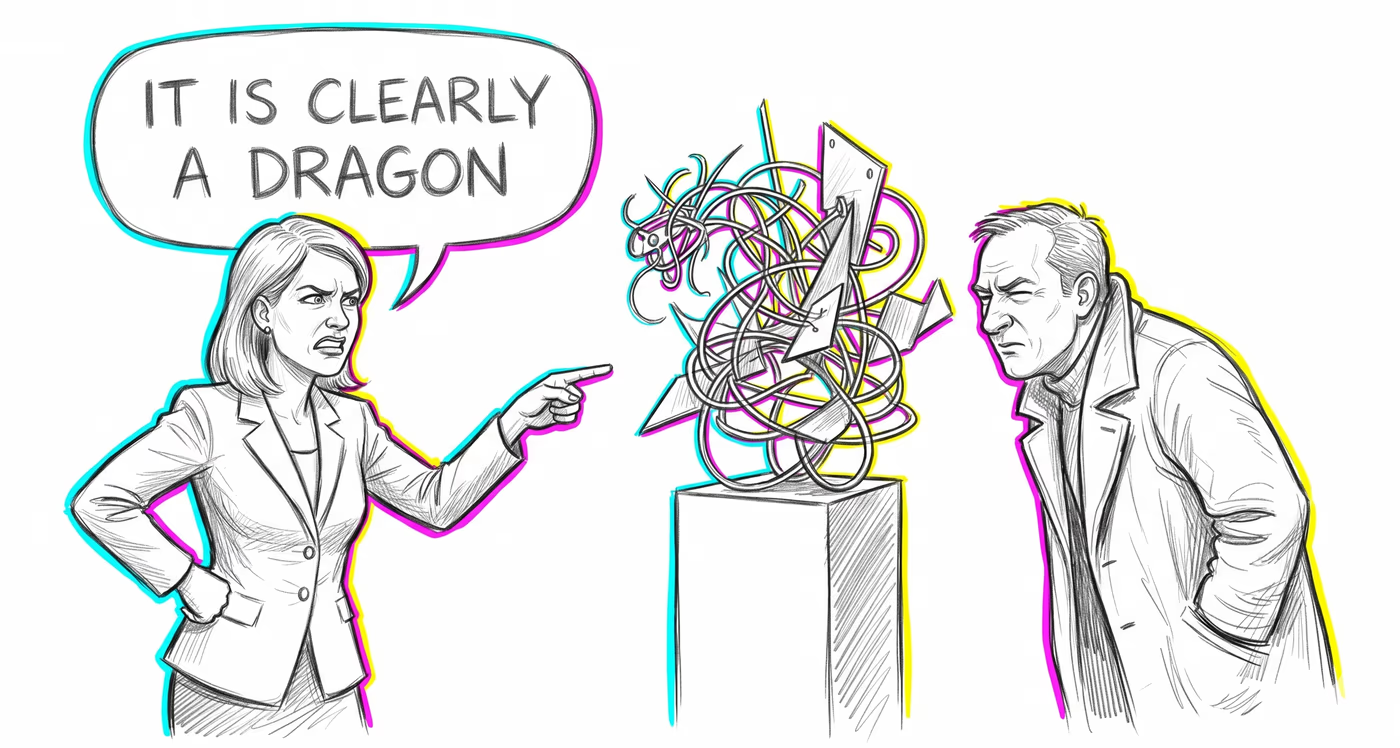
Imagine you and your friend look at the same cloud. You see a dragon, they see a bunny. Naïve realism is when you're so sure it's a dragon that you think your friend must need glasses—because to you, it's obviously a dragon and anyone who can't see that must have something wrong with their eyes.

Naïve realism rests on three interrelated tenets: first, that one's own perceptions and judgments are veridical—faithful reflections of how things really are; second, that other rational people will arrive at the same conclusions given the same information; and third, that anyone who sees things differently must suffer from ignorance, irrationality, or distorting bias. This creates a self-sealing loop where disagreement itself becomes proof of the other person's deficiency rather than evidence of legitimate interpretive differences. The bias is especially destructive in conflict settings because both sides feel certain they occupy the objective center, causing each to perceive the other as more extreme than they actually are—a phenomenon known as false polarization. Because the illusion feels like clarity rather than distortion, naïve realism operates as a kind of meta-bias that shields people from recognizing their own susceptibility to every other bias.

SOUND FAMILIAR?

Where it shows up.

  1. 01 Maria presents her analysis to the team and is met with pushback from Carlos, who interprets the same dataset differently. Rather than considering that Carlos might be applying a different but valid analytical framework, Maria concludes that Carlos simply hasn't read the data carefully enough and suggests he review it again before the next meeting.
  2. 02 During a heated community meeting about a new development project, David listens carefully to opponents and proponents. He notices that he agrees with the proponents and decides they are being logical and evidence-based, while the opponents are clearly being emotional and driven by self-interest—despite both sides citing the same environmental report.
  3. 03 After a company reorganization, Priya and James disagree about whether the changes are positive. Priya acknowledges James has legitimate concerns but privately believes that if James could just 'step back and look at the big picture objectively, the way she has,' he would come around to her view.
  4. 04 A professor assigns students to read both sides of a philosophical debate. After class discussion, she notices that students on both sides feel the readings actually support their pre-existing position, and she herself feels the class discussion confirmed her own interpretation—concluding that students who reached the opposite conclusion must have read less carefully.
  5. 05 Two negotiators reach an impasse in a business deal. Each privately tells their advisors that they have been completely fair and transparent, and that the other party's refusal to accept the terms reveals either bad faith or a fundamental misunderstanding of the market. Neither considers that their respective assessments of what constitutes a 'fair' deal are shaped by different assumptions about risk and value.
IN DIFFERENT DOMAINS

Where it shows up at work.

The same glitch looks different depending on the terrain. Finance, medicine, a relationship, a team — same mechanism, different costume.

Finance & investing

Investors interpret the same market signals as confirming their own strategy while viewing others who read the data differently as uninformed or irrational, leading to overconfidence in positions and reluctance to incorporate contrarian analysis.
Medicine & diagnosis

Clinicians who believe they are making purely objective diagnostic judgments may dismiss colleagues' differing interpretations as less rigorous, and patients may distrust medical advice that contradicts their felt experience, assuming the doctor simply doesn't understand their body.

Education & grading

Teachers may assume that their grading rubric is perfectly objective and that students who dispute grades are simply failing to see their own errors, overlooking how interpretive differences in assessing creative or analytical work are legitimate.

Relationships

Partners in conflict each believe they are recounting events accurately and that the other person is distorting what happened, making it nearly impossible to reach mutual understanding because each side treats their own memory as the factual record.

Tech & product

Product designers assume their interface is intuitively obvious and attribute user confusion to the users' lack of effort or technical literacy rather than to ambiguity in the design itself.

Workplace & hiring

Managers believe their feedback is objective and fair, and interpret employees who push back as defensive or lacking self-awareness, rather than recognizing that performance assessments inevitably involve subjective judgment.

Politics Media

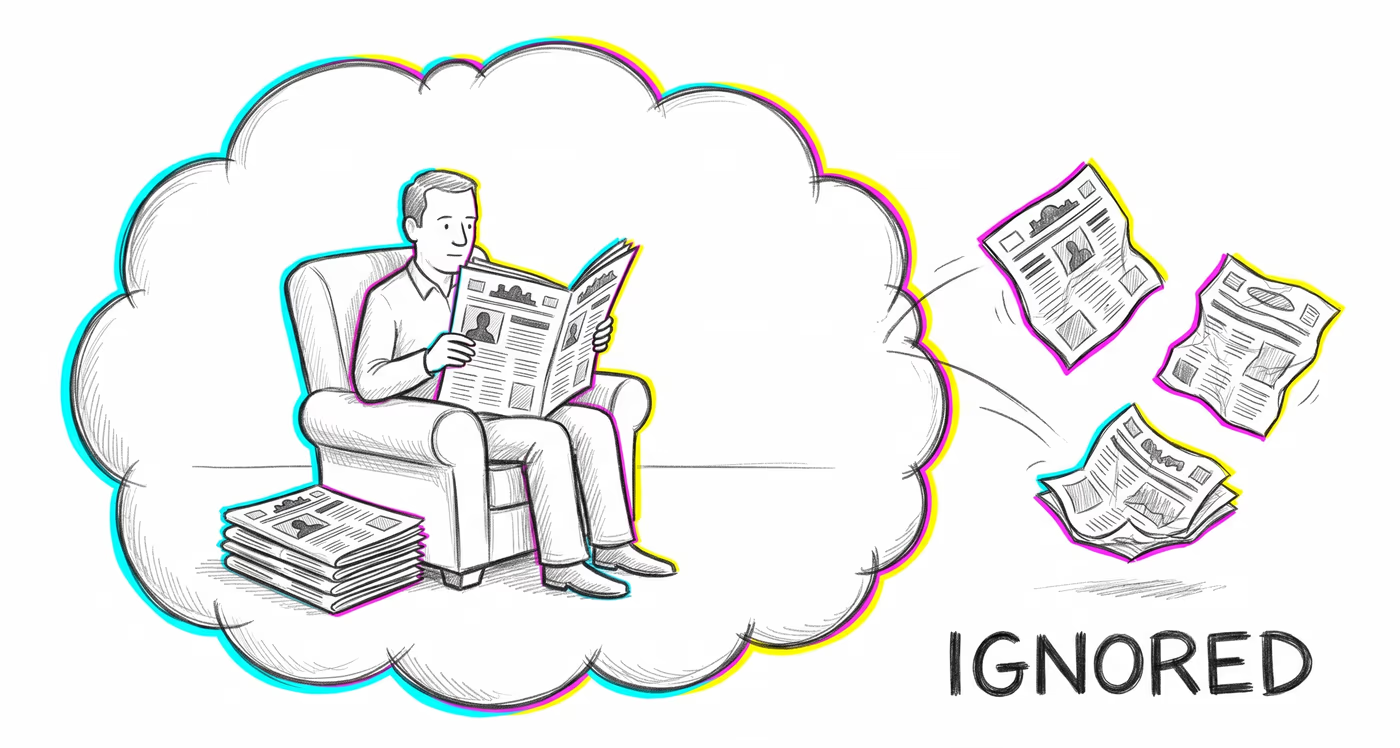
Citizens across the political spectrum consume the same news coverage and each side perceives it as biased toward the other, reinforcing the conviction that their own interpretation is the neutral one and that opposing voters are willfully ignoring reality.

HOW TO SPOT IT

Ask yourself…

  • Am I assuming that any reasonable person would see this the same way I do?
  • Am I explaining away someone's disagreement by attributing it to their ignorance, irrationality, or hidden agenda rather than a legitimately different perspective?
  • Do I feel certain that my view is simply 'the facts' while theirs is 'an opinion'?
HOW TO DEFEND AGAINST IT

The playbook.

  • Practice the 'steel man' exercise: before dismissing someone's view, articulate the strongest possible version of their argument in your own words.
  • Ask yourself: 'What life experiences, information sources, or values might lead a reasonable person to this different conclusion?'
  • Deliberately seek out and engage with well-argued perspectives that contradict your own, not to debunk them but to understand the reasoning.
  • Before attributing disagreement to someone's character flaw, list at least three legitimate reasons they might see things differently.
  • Use the phrase 'This is how it looks from where I stand' instead of 'This is how it is' to remind yourself of the subjective frame.
FAMOUS CASES

In history.

  • The 1982 Sabra and Shatila massacre media study by Vallone, Ross, and Lepper (1985) demonstrated that both pro-Israeli and pro-Arab students viewed the same neutral news coverage as biased against their own side, a classic real-world illustration of naïve realism fueling the hostile media effect.
  • Persistent failures in Israeli-Palestinian peace negotiations have been partly attributed to naïve realism, where each side perceives its own proposals as fair and objective while viewing the other's counteroffers as evidence of bad faith.
  • American political polarization, particularly visible during and after the 2016 and 2020 presidential elections, has been analyzed through the lens of naïve realism, where voters on both sides viewed their own positions as self-evidently correct and the opposition as deluded.
WHERE IT COMES FROM
Academic origin

Formalized by Lee Ross and Andrew Ward in 1996 in their chapter 'Naive Realism in Everyday Life: Implications for Social Conflict and Misunderstanding,' building on earlier work by Kurt Lewin, Gustav Ichheiser, and Solomon Asch on the subjectivity of social perception.

Evolutionary origin

In small ancestral groups where members shared similar environments, experiences, and threats, the assumption that one's perception matched reality was usually accurate enough to enable rapid action. Treating your immediate sensory assessment as ground truth allowed fast threat detection and coordinated group response without costly deliberation. The assumption that like-minded group members see things correctly while outsiders are wrong also reinforced in-group cohesion and vigilance toward out-group threats.

IN AI SYSTEMS

How the machines inherit it.

AI systems trained on data reflecting a particular demographic or cultural perspective may embed those perspectives as defaults, and developers operating under naïve realism may fail to recognize that their training data reflects a subjective slice of reality rather than objective ground truth. This can lead to models that systematically disadvantage underrepresented groups while appearing 'neutral' to their creators.

Read more on Wikipedia
FREE FIELD ZINE

10 glitches quietly running your life.

A free field-zine PDF — ten cognitive glitches named, illustrated, with a defense move for each. Plus the weekly Glitch Report on Fridays — one bias named, two spotted in the wild, one defense move. Unsubscribe any time.

EXPLORE MORE

Related glitches.

LAUNCH PRICE

Train against your blindspots.

50 cards are free to preview. Buyers unlock the rest of the deck plus the interactive training — Spot-the-Bias Quiz unlimited, Swipe Deck with spaced repetition, My Blindspots, Decision Pre-Flight, the Printable Deck + Cheat Sheets, and the Field Guide e-book. $29.50$59.

Unlock the full deck

Everything below — yours forever. Pay once, use across every device.

Half-off launch — limited to the first 100 readers. Auto-applied at checkout.
$59 $29.50
one-time payment · lifetime access
  • All interactive digital cards — search, filter, flip, shuffle on any device
  • Five training modes — Spot-the-Bias Quiz, Swipe Deck, Pre-Flight, Blindspots, Journal
  • Curated Lenses + Decision Templates + Defense Playbook
  • Printable Deck PDFs + Field Guide e-book + Cheat Sheets + Anki Export
  • Every future improvement, included
Unlock  $29.50

30-day refund · no questions asked

Unlock the full deck

Everything below — yours forever. Pay once, use across every device.

Half-off launch — limited to the first 100 readers. Auto-applied at checkout.
$59 $29.50
one-time payment · lifetime access
  • All interactive digital cards — search, filter, flip, shuffle on any device
  • Five training modes — Spot-the-Bias Quiz, Swipe Deck, Pre-Flight, Blindspots, Journal
  • Curated Lenses + Decision Templates + Defense Playbook
  • Printable Deck PDFs + Field Guide e-book + Cheat Sheets + Anki Export
  • Every future improvement, included
Unlock  $29.50

30-day refund · no questions asked