Affect Heuristic

aka Emotion Heuristic · Risk-as-Feelings

Making judgments and decisions based on current emotional reactions rather than deliberate analysis.

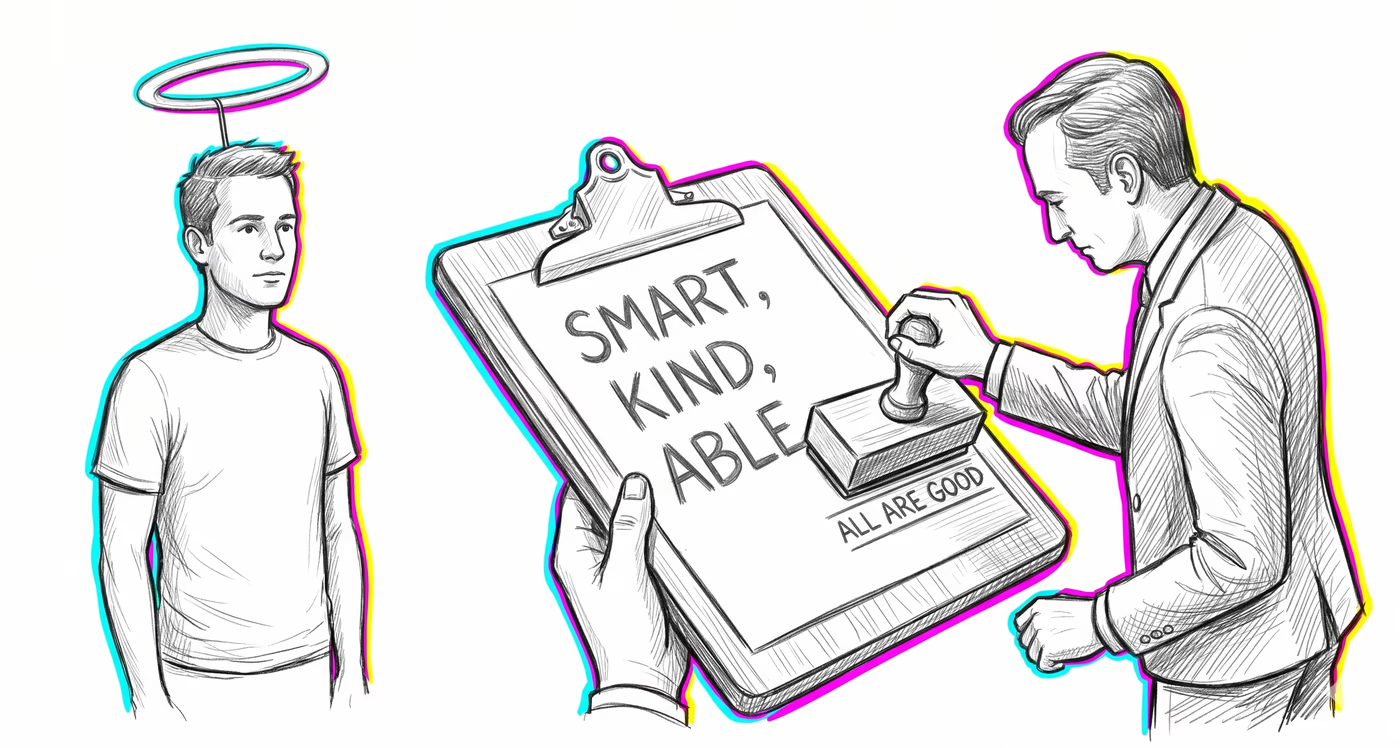
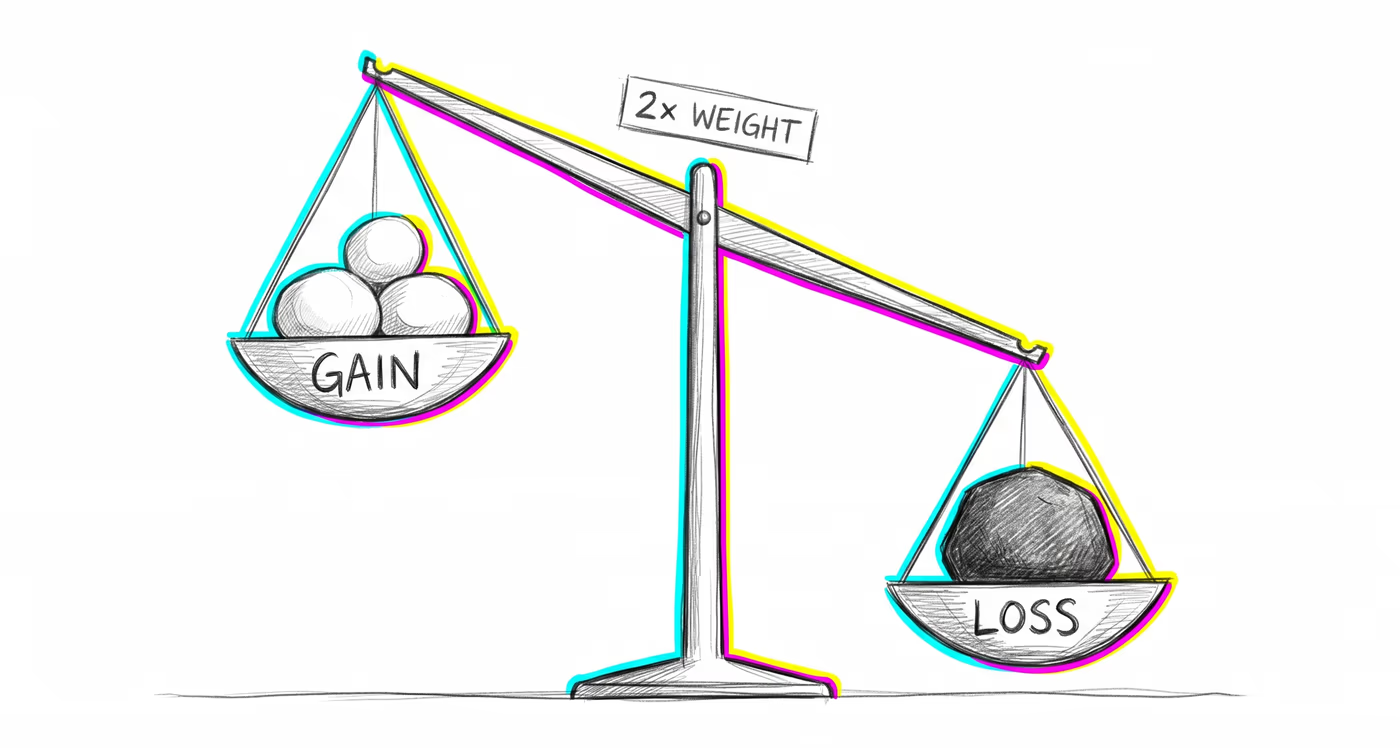
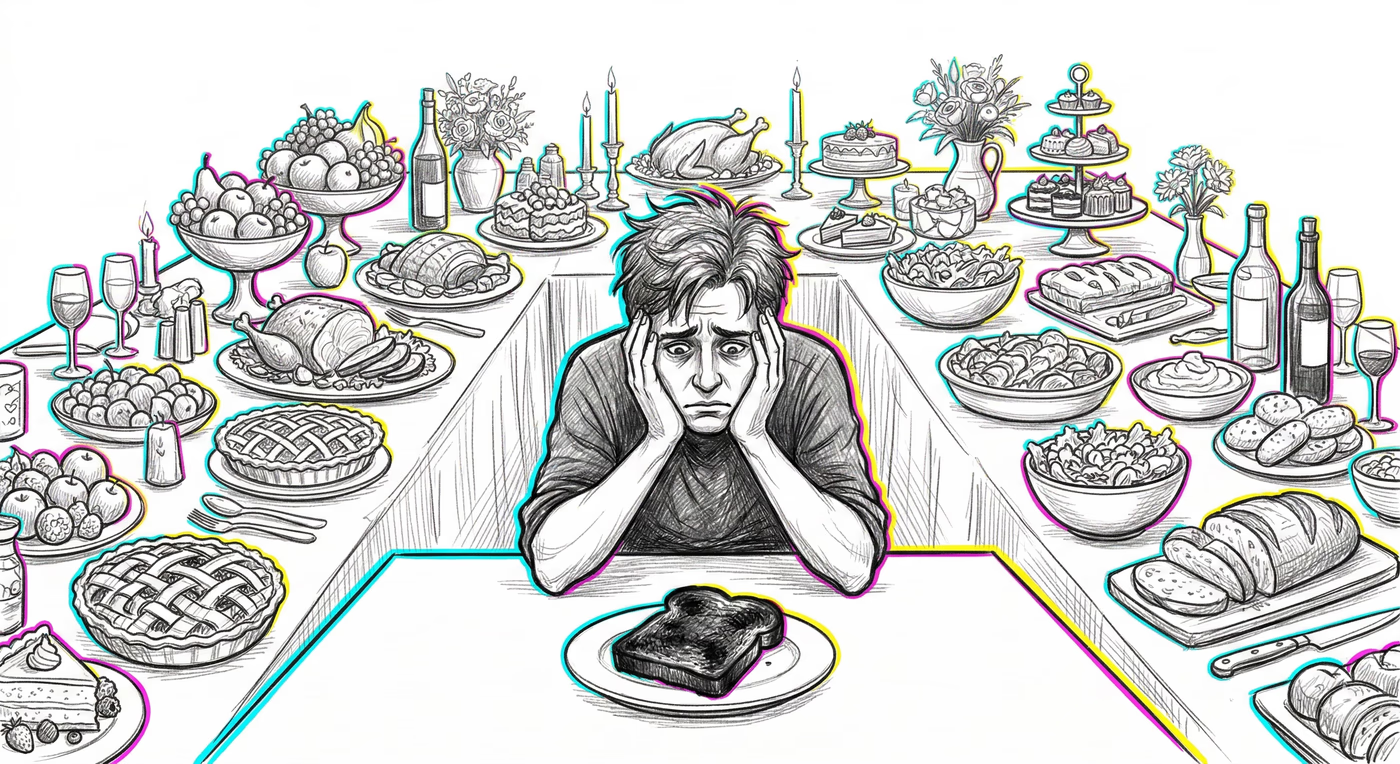
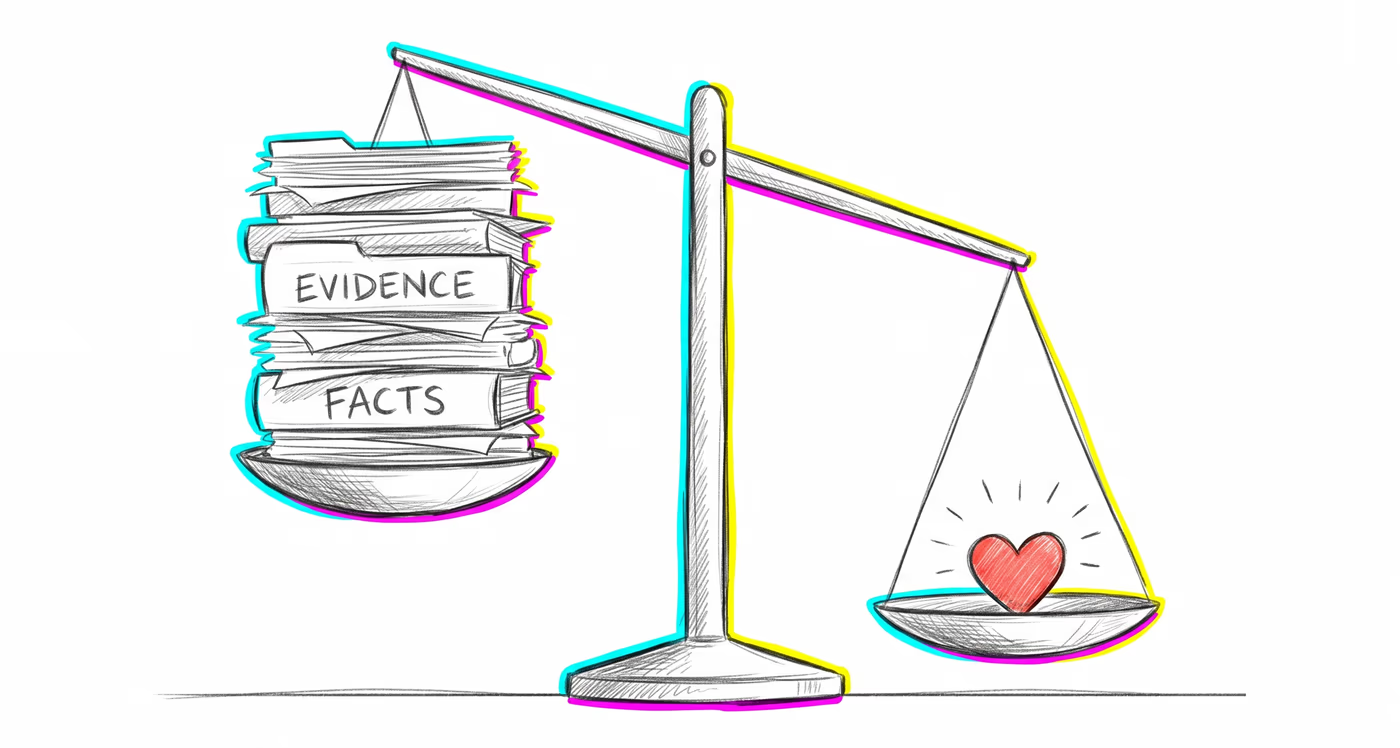
Illustration: Affect Heuristic
WHAT IT IS

The glitch, explained plainly.

Imagine you have a magic mood ring that colors everything you see. When you feel happy, the ring makes everything look safe and wonderful—even things that could be dangerous. When you feel scared or grumpy, the ring makes everything look risky and bad—even things that are actually fine. Instead of carefully checking each thing, you just look through your mood ring and decide based on the color it shows you.

The affect heuristic describes the process by which people consult their emotional impression of a stimulus—an automatic, rapid feeling of positivity or negativity—to make judgments about risk, benefit, and value, rather than engaging in careful analytical reasoning. A key hallmark is the inverse relationship between perceived risk and perceived benefit: when someone feels positively toward an activity (e.g., nuclear power, a new technology), they tend to judge it as high-benefit and low-risk, even though objectively these dimensions are often independent or positively correlated. This reliance on affective tagging is amplified under time pressure, cognitive load, and information overload, where the experiential system dominates over the analytical system. The heuristic operates largely outside conscious awareness, meaning people often cannot identify that their 'rational' judgments are being steered by an underlying emotional evaluation.

SOUND FAMILIAR?

Where it shows up.

  1. 01 A city council debates funding for two public health programs. Program A addresses contaminated drinking water affecting 10,000 residents. Program B addresses a rare industrial chemical leak that affected 12 people but was covered extensively on the news with frightening footage. Despite the data, the council allocates 80% of the budget to Program B because members describe feeling 'deeply disturbed' by the chemical leak images.
  2. 02 Maria is evaluating two job offers. Company X has better salary, benefits, and growth potential, but their office felt cold and sterile during her visit. Company Y has a lower offer but their office had warm lighting and friendly faces. She chooses Company Y, later explaining that it just 'felt right' and insisting she weighed all the factors carefully.
  3. 03 A pharmaceutical company presents clinical trial data showing their new drug has a 2% serious side-effect rate. When the presentation uses cheerful graphics and upbeat music, an advisory panel rates the drug as both more beneficial and less risky than when the identical data is presented with neutral formatting.
  4. 04 Tom is reviewing his retirement portfolio. He holds stock in a solar energy company he admires for its environmental mission. Despite the stock underperforming for three years, he rates it as both 'low risk' and 'high potential return' on a survey, while rating an outperforming oil company stock he finds morally distasteful as 'high risk' and 'low return.'
  5. 05 During a product design meeting, a team must choose between two dashboard interfaces. Interface A tested better on usability metrics, but Interface B features a sleek animation that made everyone in the room smile when they first saw it. The team unanimously selects Interface B, each member confident their choice was based on the user data.
IN DIFFERENT DOMAINS

Where it shows up at work.

The same glitch looks different depending on the terrain. Finance, medicine, a relationship, a team — same mechanism, different costume.

Finance & investing

Investors systematically judge assets they feel positively about (e.g., brands they admire, industries they believe in) as simultaneously higher in expected return and lower in risk, producing an inverse risk-benefit perception that contradicts the fundamental finance principle that higher returns require higher risk.
Medicine & diagnosis

Patients and clinicians overweight emotionally vivid side effects (e.g., hair loss) relative to statistically more dangerous but less emotionally salient ones (e.g., liver enzyme elevation), leading to treatment refusal or selection driven by emotional reaction rather than clinical evidence.

Education & grading

Teachers form rapid affective impressions of students based on early interactions, then interpret subsequent academic performance through that emotional lens—a student who evoked warmth may have their mistakes attributed to circumstance, while a student who evoked irritation may have identical mistakes attributed to lack of effort.

Relationships

People evaluate potential romantic partners by consulting their immediate emotional reaction rather than compatibility indicators, leading to the pattern of 'feeling chemistry' with partners who are objectively poor matches and 'feeling nothing' for partners who align on values and goals.

Tech & product

Users who feel positively about a product's visual design perceive it as more usable, faster, and more reliable than functionally identical but less aesthetically pleasing alternatives, a pattern extensively documented in UX research under the related aesthetic-usability effect.

Workplace & hiring

Hiring managers who feel an immediate positive impression of a candidate during the first moments of an interview subsequently rate that candidate higher on unrelated competencies like analytical skill and attention to detail, with the initial affective reaction coloring all subsequent evaluations.

Politics Media

Voters evaluate policy proposals based on their emotional reaction to the politician or party proposing them rather than the policy content, rating identical policies as more beneficial and less risky when attributed to a liked figure and more dangerous when attributed to a disliked one.

HOW TO SPOT IT

Ask yourself…

  • Am I feeling a strong positive or negative emotion right now, and could that feeling be coloring my assessment of this decision's risks or benefits?
  • If I strip away my emotional reaction to this option, would my evaluation of its risks and benefits change significantly?
  • Am I judging something as simultaneously low-risk and high-benefit (or high-risk and low-benefit) without independent evidence for each dimension?
HOW TO DEFEND AGAINST IT

The playbook.

  • Explicitly separate your risk and benefit assessments: rate each independently on a scale before combining them, and check if your ratings are suspiciously inversely correlated.
  • Introduce a 'cooling off' period between your initial emotional reaction and your final decision, especially for high-stakes choices.
  • Use structured decision matrices that force you to evaluate specific attributes independently rather than relying on a global impression.
  • Ask yourself: 'Would I feel the same way about this if I encountered it in a completely different emotional state?'
  • Seek out statistical base rates and quantitative evidence for both risk and benefit dimensions before consulting your feelings.
FAMOUS CASES

In history.

  • Public overreaction to nuclear power risks after the Three Mile Island and Chernobyl accidents, where emotional dread led to risk perceptions vastly disproportionate to statistical evidence, while comparatively muted responses to far deadlier coal-related pollution persisted.
  • The post-9/11 surge in automobile travel in the United States, where fear of flying led to an estimated 1,600 additional road fatalities in the year following the attacks, as the emotional terror of hijacking overwhelmed statistical risk assessment.
  • Tobacco industry marketing campaigns that deliberately increased positive affect associated with smoking through imagery of freedom, coolness, and social belonging, suppressing consumers' risk perceptions by manipulating their emotional associations.
WHERE IT COMES FROM
Academic origin

The concept was built on Robert Zajonc's 1980 argument that affective reactions precede and operate independently of cognition ('Preferences Need No Inferences'). It was formalized as the 'affect heuristic' by Paul Slovic, Melissa Finucane, Ellen Peters, and Donald MacGregor in 2000, with the key empirical paper published in the Journal of Behavioral Decision Making and later expanded in the 2002 volume 'Heuristics and Biases: The Psychology of Intuitive Judgment' edited by Gilovich, Griffin, and Kahneman.

Evolutionary origin

In ancestral environments, rapid affective appraisal was essential for survival—organisms that could instantly feel 'danger' or 'safety' upon encountering a stimulus (e.g., a predator, a food source) had a critical speed advantage over those who deliberated analytically. Emotional tagging allowed for immediate approach-or-avoid decisions without the time cost of information gathering, which was adaptive when threats were physical and immediate.

IN AI SYSTEMS

How the machines inherit it.

Sentiment-laden training data causes language models to reproduce affect-driven distortions—for instance, generating text that frames emotionally appealing technologies as lower-risk and emotionally aversive ones as higher-risk, independent of evidence. Recommendation algorithms amplify affect-based engagement by surfacing emotionally arousing content, which then biases users' risk-benefit judgments on topics from health to politics.

Read more on Wikipedia
FREE FIELD ZINE

10 glitches quietly running your life.

A free field-zine PDF — ten cognitive glitches named, illustrated, with a defense move for each. Plus the weekly Glitch Report on Fridays — one bias named, two spotted in the wild, one defense move. Unsubscribe any time.

EXPLORE MORE

Related glitches.

LAUNCH PRICE

Train against your blindspots.

50 cards are free to preview. Buyers unlock the rest of the deck plus the interactive training — Spot-the-Bias Quiz unlimited, Swipe Deck with spaced repetition, My Blindspots, Decision Pre-Flight, the Printable Deck + Cheat Sheets, and the Field Guide e-book. $29.50$59.

Unlock the full deck

Everything below — yours forever. Pay once, use across every device.

Half-off launch — limited to the first 100 readers. Auto-applied at checkout.
$59 $29.50
one-time payment · lifetime access
  • All interactive digital cards — search, filter, flip, shuffle on any device
  • Five training modes — Spot-the-Bias Quiz, Swipe Deck, Pre-Flight, Blindspots, Journal
  • Curated Lenses + Decision Templates + Defense Playbook
  • Printable Deck PDFs + Field Guide e-book + Cheat Sheets + Anki Export
  • Every future improvement, included
Unlock  $29.50

30-day refund · no questions asked

Unlock the full deck

Everything below — yours forever. Pay once, use across every device.

Half-off launch — limited to the first 100 readers. Auto-applied at checkout.
$59 $29.50
one-time payment · lifetime access
  • All interactive digital cards — search, filter, flip, shuffle on any device
  • Five training modes — Spot-the-Bias Quiz, Swipe Deck, Pre-Flight, Blindspots, Journal
  • Curated Lenses + Decision Templates + Defense Playbook
  • Printable Deck PDFs + Field Guide e-book + Cheat Sheets + Anki Export
  • Every future improvement, included
Unlock  $29.50

30-day refund · no questions asked