Cheerleader Effect

aka Group Attractiveness Effect · Friend Effect

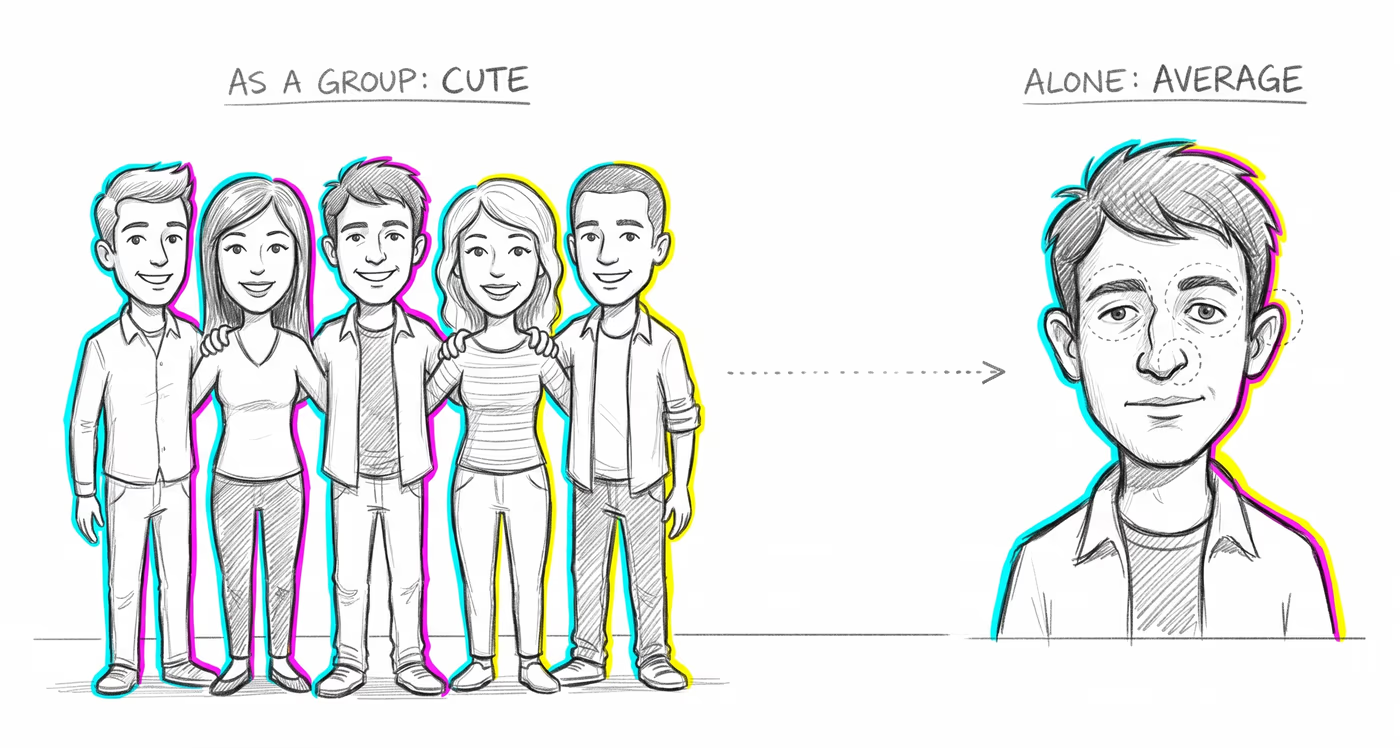
People appearing more attractive in a group than alone, because the brain averages facial features together.

Illustration: Cheerleader Effect
WHAT IT IS

The glitch, explained plainly.

Imagine you have a box of crayons and they all look really pretty together because the colors blend nicely. But if you pull one crayon out by itself, you might notice it's kind of a weird brownish-green. Your brain does the same thing with people's faces — it mixes them all together in your mind, and that mix looks nice, so each person seems nicer-looking because of the mix.

The Cheerleader Effect describes a robust perceptual phenomenon in which individual faces receive higher attractiveness ratings when presented as part of a group compared to when presented in isolation. The effect size is relatively small but consistent, typically producing a 1.5–2.0% increase in attractiveness ratings. Research suggests multiple contributing mechanisms: the visual system's automatic computation of an ensemble average from grouped faces, the well-documented finding that averaged faces tend to be perceived as more attractive than individual faces, and the hierarchical structure of visual working memory that causes individual face recall to be biased toward the attractive group average. The effect holds across male and female faces, various group sizes from 3 to 16, and extends beyond faces to body attractiveness as well.

SOUND FAMILIAR?

Where it shows up.

  1. 01 Maria is choosing between two dating profiles. One man has only solo photos, while another has several group photos where he's surrounded by friends. She rates the second man as significantly more attractive, but when she meets him in person alone at a coffee shop, she's surprised to find he looks noticeably less appealing than she remembered from his profile.
  2. 02 A casting director watches a dance troupe perform at an audition and is impressed by the attractiveness of the entire ensemble. She flags three dancers for individual callbacks. When they arrive alone for close-up screen tests, she's puzzled to find each one looks plainer than she recalls, and wonders if she made errors in her notes.
  3. 03 A marketing team debates whether to use individual headshots or a team group photo for their company's 'About Us' page. During A/B testing, the group photo version consistently receives higher trust and attractiveness ratings for each team member than the individual headshot version, despite using the exact same people.
  4. 04 A photographer reviewing proofs notices that her client looks more attractive in the bridal party lineup shots than in the solo portraits taken minutes apart with identical lighting and makeup. She attributes it to lighting angle, but the phenomenon persists across all her group vs. solo comparisons from different weddings.
  5. 05 A researcher is designing a study on facial attractiveness and decides to use faces extracted from group photos as stimuli. Her colleague warns that this could contaminate results because participants previously exposed to those faces within a group context during pilot testing rated them higher than naive participants who only ever saw the faces in isolation — even though the extracted solo images are pixel-identical.
IN DIFFERENT DOMAINS

Where it shows up at work.

The same glitch looks different depending on the terrain. Finance, medicine, a relationship, a team — same mechanism, different costume.

Relationships

People tend to perceive potential romantic partners as more attractive when encountering them in social groups — at parties, in group photos on dating apps, or among friends — leading to inflated initial attraction that can dissipate upon one-on-one interaction, causing disappointment and confusion about why the spark has faded.
Tech & product

Dating apps and social platforms see higher engagement on profiles featuring group photos because users rate the profile owner as more attractive in those images. Product pages displaying items in curated bundles or collections benefit from a similar averaging effect, where individual products appear more appealing as part of a set than when displayed alone.

Workplace & hiring

Candidates encountered during group interviews, team presentations, or panel discussions may be perceived as more impressive and attractive than they would in solo interviews, potentially biasing hiring decisions. Team photos on corporate websites create a more positive impression of each individual employee than their individual headshots would.

Politics Media

Political candidates appearing alongside attractive surrogates, team members, or supporters in campaign imagery may benefit from elevated perceived attractiveness and likability. Media coverage featuring groups of advocates or spokespersons can make each individual appear more compelling than they would in a solo interview segment.

HOW TO SPOT IT

Ask yourself…

  • Am I judging this person's attractiveness based on how they looked in a group setting rather than on their own?
  • Would I rate this individual the same way if I had only ever seen them alone, without the context of their friends or group?
  • Is my memory of how someone looked being influenced by the overall impression of the group they were part of?
HOW TO DEFEND AGAINST IT

The playbook.

  • When evaluating someone's appearance from a group photo, mentally isolate or crop their face before forming a judgment.
  • On dating apps, prioritize solo photos over group shots when assessing a match's appearance.
  • If an initial group-context impression matters (hiring, casting), always conduct a second evaluation in a solo context before finalizing your judgment.
  • Be aware that your memory of someone's attractiveness from a group encounter is systematically inflated — recalibrate expectations before a one-on-one meeting.
  • When making team-presentation decisions (e.g., 'About Us' pages), recognize the bias and choose the format that serves honest representation rather than exploiting the effect.
WHERE IT COMES FROM
Academic origin

Drew Walker and Edward Vul, University of California San Diego, 2013 (published in Psychological Science, 2014). The term was popularized by the TV show How I Met Your Mother in 2008, but formally studied and named by Walker and Vul.

Evolutionary origin

Rapid ensemble coding of groups likely evolved to support fast social evaluation in ancestral environments where quickly assessing the overall characteristics of an approaching group (friend or foe, healthy or sick) was more survival-relevant than processing each individual face in detail. Additionally, the preference for average faces may reflect an evolved mate-selection mechanism favoring genetic diversity and developmental stability, as average features signal freedom from harmful mutations.

IN AI SYSTEMS

How the machines inherit it.

Image generation models trained on datasets where attractiveness labels were assigned from group photos may inherit inflated attractiveness baselines. Facial recognition and attractiveness-scoring algorithms that use group-context training data could systematically overestimate individual attractiveness. Recommendation algorithms on dating platforms may amplify the bias by preferentially surfacing group photos that generate higher engagement, reinforcing the cycle.

Read more on Wikipedia
FREE FIELD ZINE

10 glitches quietly running your life.

A free field-zine PDF — ten cognitive glitches named, illustrated, with a defense move for each. Plus the weekly Glitch Report on Fridays — one bias named, two spotted in the wild, one defense move. Unsubscribe any time.

EXPLORE MORE

Related glitches.

LAUNCH PRICE

Train against your blindspots.

50 cards are free to preview. Buyers unlock the rest of the deck plus the interactive training — Spot-the-Bias Quiz unlimited, Swipe Deck with spaced repetition, My Blindspots, Decision Pre-Flight, the Printable Deck + Cheat Sheets, and the Field Guide e-book. $29.50$59.

Unlock the full deck

Everything below — yours forever. Pay once, use across every device.

Half-off launch — limited to the first 100 readers. Auto-applied at checkout.
$59 $29.50
one-time payment · lifetime access
  • All interactive digital cards — search, filter, flip, shuffle on any device
  • Five training modes — Spot-the-Bias Quiz, Swipe Deck, Pre-Flight, Blindspots, Journal
  • Curated Lenses + Decision Templates + Defense Playbook
  • Printable Deck PDFs + Field Guide e-book + Cheat Sheets + Anki Export
  • Every future improvement, included
Unlock  $29.50

30-day refund · no questions asked

Unlock the full deck

Everything below — yours forever. Pay once, use across every device.

Half-off launch — limited to the first 100 readers. Auto-applied at checkout.
$59 $29.50
one-time payment · lifetime access
  • All interactive digital cards — search, filter, flip, shuffle on any device
  • Five training modes — Spot-the-Bias Quiz, Swipe Deck, Pre-Flight, Blindspots, Journal
  • Curated Lenses + Decision Templates + Defense Playbook
  • Printable Deck PDFs + Field Guide e-book + Cheat Sheets + Anki Export
  • Every future improvement, included
Unlock  $29.50

30-day refund · no questions asked