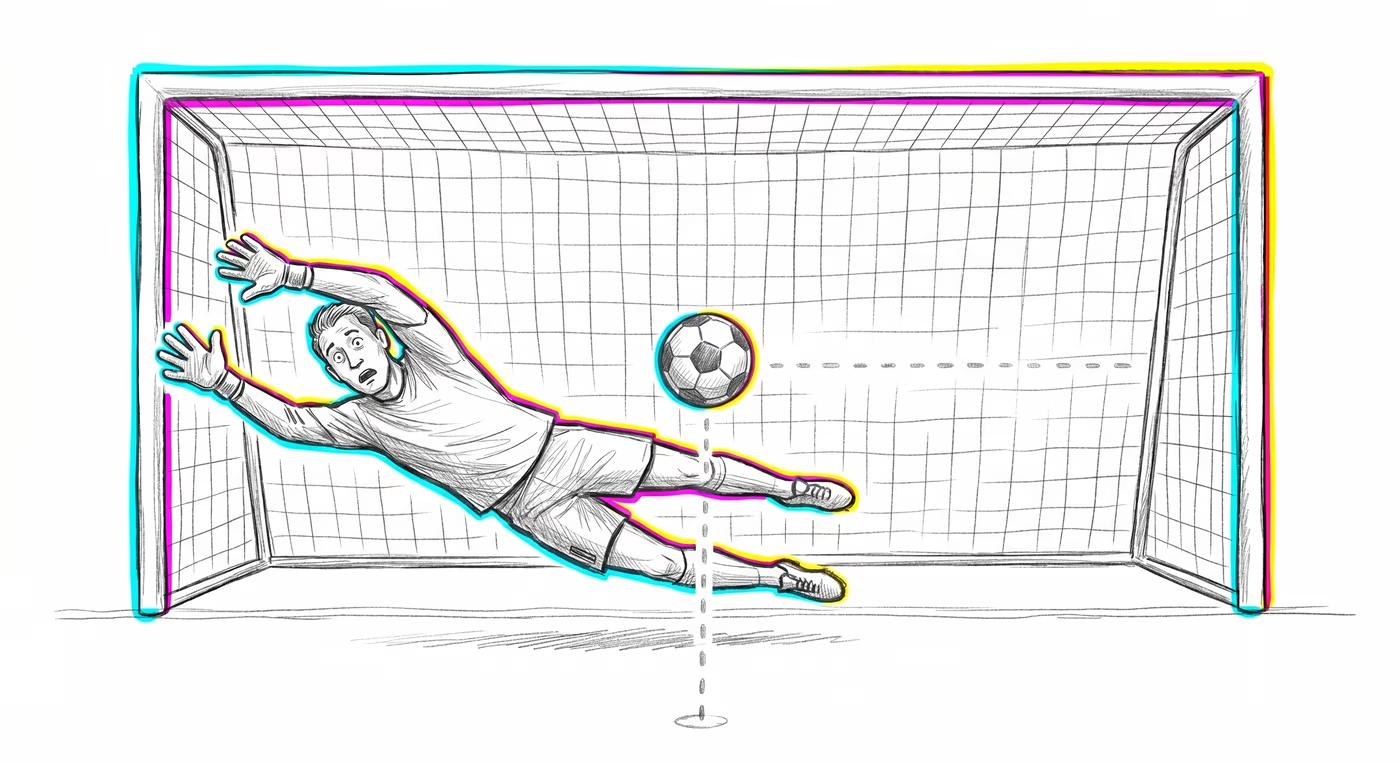
Decision Fatigue

aka Decision Fatigue · Choice Fatigue · Decision Depletion

Decision quality getting worse after making many choices in a row, as mental resources become depleted.

WHAT IT IS

The glitch, explained plainly.

Imagine you have a jar of decision coins. Every time you make a choice—big or small—you spend a coin. Early in the day, you have lots of coins and can think carefully. But by the end of the day, you've spent so many coins on little choices that when a big choice comes, you just pick whatever's easiest because your jar is almost empty.

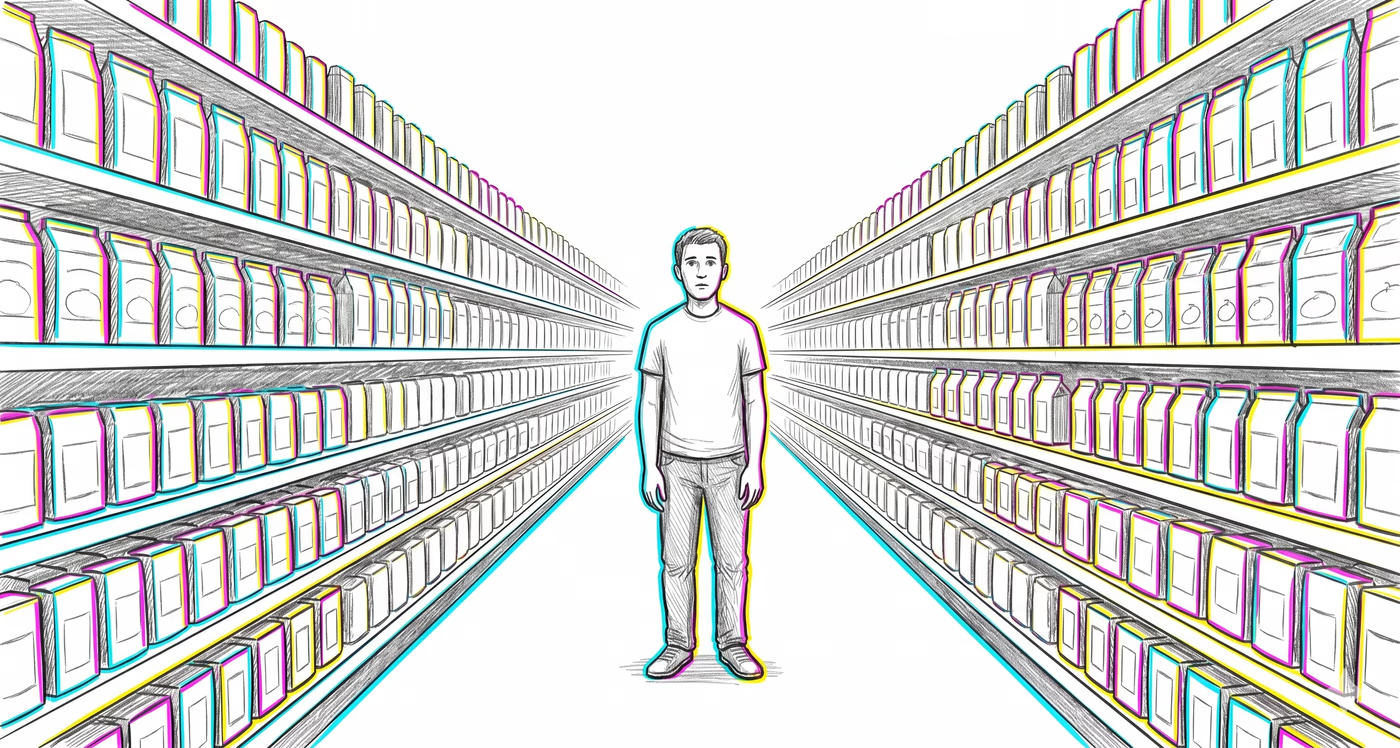
Choice Depletion describes the empirically observed decline in decision-making quality that emerges after an individual has made a sustained sequence of choices. Unlike simple mental tiredness, it specifically targets the executive functions responsible for weighing trade-offs, resisting impulses, and engaging in effortful deliberation. As these resources are consumed, subsequent decisions increasingly default to the path of least resistance—favoring the status quo, accepting defaults, acting impulsively, or avoiding the decision altogether. The effect is cumulative across unrelated decision domains, meaning that choosing what to eat, which emails to answer, and what to wear all draw from the same finite pool, leaving less capacity for the critical decisions that follow.

SOUND FAMILIAR?

Where it shows up.

  1. 01 A hiring manager conducts seven back-to-back interviews in one morning, carefully evaluating each candidate's responses. By the afternoon session, she stops probing follow-up questions and simply approves the candidate whose resume most closely matches the job description template, skipping the behavioral assessment entirely.
  2. 02 A car buyer spends 90 minutes making detailed customization decisions—engine type, trim level, interior color, wheel style, and audio package. When the salesperson finally offers an extended warranty and rustproofing bundle at the very end, the buyer agrees immediately without negotiating the price, despite having haggled aggressively on the base price hours earlier.
  3. 03 A doctor at the end of a 12-hour emergency shift, having triaged and treated dozens of patients, begins prescribing antibiotics more readily for ambiguous cases rather than ordering additional diagnostic tests—not because the clinical picture changed, but because evaluating each case with full rigor has become progressively harder throughout the shift.
  4. 04 A voter working through a long ballot carefully researches and selects candidates for the first several offices. By the time she reaches the lower ballot measures about local zoning ordinances and water district boards, she either skips them entirely or votes to keep things as they are on every remaining item.
  5. 05 A software architect who has spent the entire day making technical decisions about database schemas, API contracts, and deployment configurations sits down for the final review of the security authentication protocol. Rather than evaluating the three proposed approaches on their merits, he endorses the option his team lead suggested without conducting his usual threat-model analysis, telling himself 'she probably thought it through already.'
IN DIFFERENT DOMAINS

Where it shows up at work.

The same glitch looks different depending on the terrain. Finance, medicine, a relationship, a team — same mechanism, different costume.

Finance & investing

Financial advisors and traders who make numerous sequential buy/sell decisions throughout the day tend to become more heuristic-driven in later trades, herding toward consensus forecasts or defaulting to holding positions rather than executing carefully analyzed trades. Investors configuring complex portfolios tend to accept default allocations for later asset classes after actively customizing earlier ones.

Medicine & diagnosis

Clinicians making sequential patient decisions across long shifts show patterns of increased antibiotic prescribing, reduced cancer screening orders, and greater reliance on standard protocols rather than individualized assessment as their decision sessions progress. The effect resets partially after meal breaks.

Education & grading

Teachers grading large stacks of essays tend to become less discriminating in later papers, assigning scores closer to the class average. Students taking long standardized tests show declining performance on later sections not solely due to difficulty but partly because earlier test sections consumed decision-making resources.

Relationships

Couples making a long series of joint decisions—such as during wedding planning, home renovation, or moving—experience escalating conflict not because of disagreement on content but because depleted self-regulation makes each partner less patient, less willing to compromise, and more likely to snap over trivial choices.

Tech & product

Product designers exploit choice depletion by front-loading simple decisions (color, name) and placing upsells, add-ons, and data-sharing consent screens at the end of configuration flows when users are most likely to accept defaults. Subscription services bury complex opt-out choices behind long sequences of preference settings.

Workplace & hiring

Managers who schedule hiring panels, budget reviews, and strategic planning back-to-back find that decisions made in later meetings are more likely to default to the status quo or rubber-stamp proposals without scrutiny. Late-afternoon meeting decisions disproportionately favor the easiest or most familiar option.

Politics Media

Voters facing long, complex ballots show significantly higher abstention rates and greater reliance on heuristic shortcuts—such as picking the first-listed candidate or voting to maintain the status quo—for items appearing later on the ballot. Legislators voting on long sequences of bills increasingly follow party-line defaults rather than exercising independent judgment.
HOW TO SPOT IT

Ask yourself…

  • How many decisions have I already made today, and am I giving this choice the same careful thought I gave the first one?
  • Am I choosing this option because it's genuinely best, or because it's the easiest path and I'm tired of deciding?
  • Would I make this same choice if it were the first decision of my day rather than the fiftieth?
HOW TO DEFEND AGAINST IT

The playbook.

  • Schedule your most important decisions for the morning when cognitive resources are fullest, and batch routine decisions into automated systems or predetermined rules.
  • Build mandatory breaks into long decision sessions—even 10-minute pauses can partially restore deliberative capacity, especially if combined with food intake.
  • Reduce total daily decision volume by establishing routines, defaults, and pre-commitments for recurring low-stakes choices (meal planning, wardrobe capsules, templated responses).
  • When you notice yourself reaching for the easiest option or wanting to skip evaluation, use that as a signal to pause rather than proceed—apply the 'first decision of the day' test.
  • Delegate or defer non-urgent decisions when you've already made many, and never make consequential choices at the end of a long decision session without sleeping on them first.
FAMOUS CASES

In history.

  • Danziger, Levav, and Avnaim-Pesso (2011) documented that Israeli parole board judges' approval rates dropped from approximately 65% to near 0% within each decision session, resetting after food breaks—interpreted as evidence of judicial decision fatigue affecting real prisoners' freedom (though this study is contested — published critiques argue the pattern may reflect case-ordering confounds rather than decision fatigue).
  • Augenblick and Nicholson (2016) found that California voters facing more decisions before a given ballot contest were significantly more likely to abstain or vote for the status quo, estimating that approximately 6% of ballot measures that failed would have passed if placed higher on the ballot.
  • Car dealerships have long structured the customization process to place high-margin add-ons (rustproofing, extended warranties, accessories) at the end of a long configuration session, exploiting the well-documented tendency of depleted buyers to accept optional extras they would otherwise reject.
WHERE IT COMES FROM
Academic origin

Roy Baumeister, Ellen Bratslavsky, Mark Muraven, and Dianne Tice (1998) introduced the ego depletion framework. The specific decision fatigue application was formalized by Kathleen Vohs et al. (2008) and popularized by journalist John Tierney. The term 'choice fatigue' was operationalized by Ned Augenblick and Scott Nicholson (2016).

Evolutionary origin

In ancestral environments, critical decisions were relatively infrequent and involved immediate survival threats—fight or flee, eat or wait. The brain evolved to allocate its most energy-intensive processing for high-stakes moments while conserving resources through habitual, automatic behavior for the vast majority of actions. This resource-conservation mechanism was adaptive when choices were few, but becomes maladaptive in modern environments that demand hundreds of deliberate decisions daily.

IN AI SYSTEMS

How the machines inherit it.

Machine learning systems trained on human-generated sequential decision data can inherit choice depletion artifacts—for example, training recommendation engines on late-session clicks that reflect impulsive or default choices rather than genuine preferences. Additionally, AI systems designed to present users with long sequences of configuration decisions can inadvertently exploit human choice depletion, leading to consent patterns and preference profiles that do not reflect the user's considered judgment.

Read more on Wikipedia
FREE FIELD ZINE

10 glitches quietly running your life.

A free field-zine PDF — ten cognitive glitches named, illustrated, with a defense move for each. Plus the weekly Glitch Report on Fridays — one bias named, two spotted in the wild, one defense move. Unsubscribe any time.

EXPLORE MORE

Related glitches.

LAUNCH PRICE

Train against your blindspots.

50 cards are free to preview. Buyers unlock the rest of the deck plus the interactive training — Spot-the-Bias Quiz unlimited, Swipe Deck with spaced repetition, My Blindspots, Decision Pre-Flight, the Printable Deck + Cheat Sheets, and the Field Guide e-book. $29.50$59.

Unlock the full deck

Everything below — yours forever. Pay once, use across every device.

Half-off launch — limited to the first 100 readers. Auto-applied at checkout.
$59 $29.50
one-time payment · lifetime access
  • All interactive digital cards — search, filter, flip, shuffle on any device
  • Five training modes — Spot-the-Bias Quiz, Swipe Deck, Pre-Flight, Blindspots, Journal
  • Curated Lenses + Decision Templates + Defense Playbook
  • Printable Deck PDFs + Field Guide e-book + Cheat Sheets + Anki Export
  • Every future improvement, included
Unlock  $29.50

30-day refund · no questions asked

Unlock the full deck

Everything below — yours forever. Pay once, use across every device.

Half-off launch — limited to the first 100 readers. Auto-applied at checkout.
$59 $29.50
one-time payment · lifetime access
  • All interactive digital cards — search, filter, flip, shuffle on any device
  • Five training modes — Spot-the-Bias Quiz, Swipe Deck, Pre-Flight, Blindspots, Journal
  • Curated Lenses + Decision Templates + Defense Playbook
  • Printable Deck PDFs + Field Guide e-book + Cheat Sheets + Anki Export
  • Every future improvement, included
Unlock  $29.50

30-day refund · no questions asked