Restraint Bias

aka Illusion of Self-Restraint · Impulse-Control Illusion

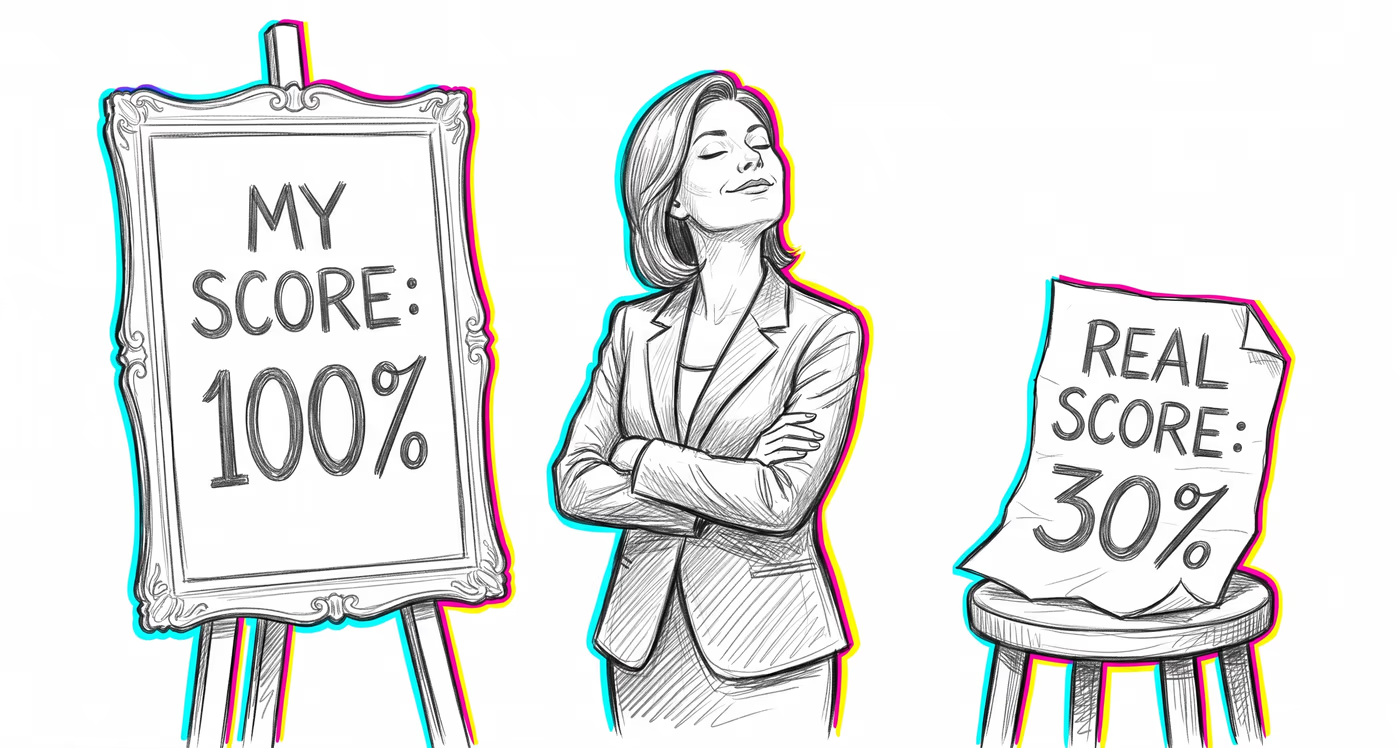
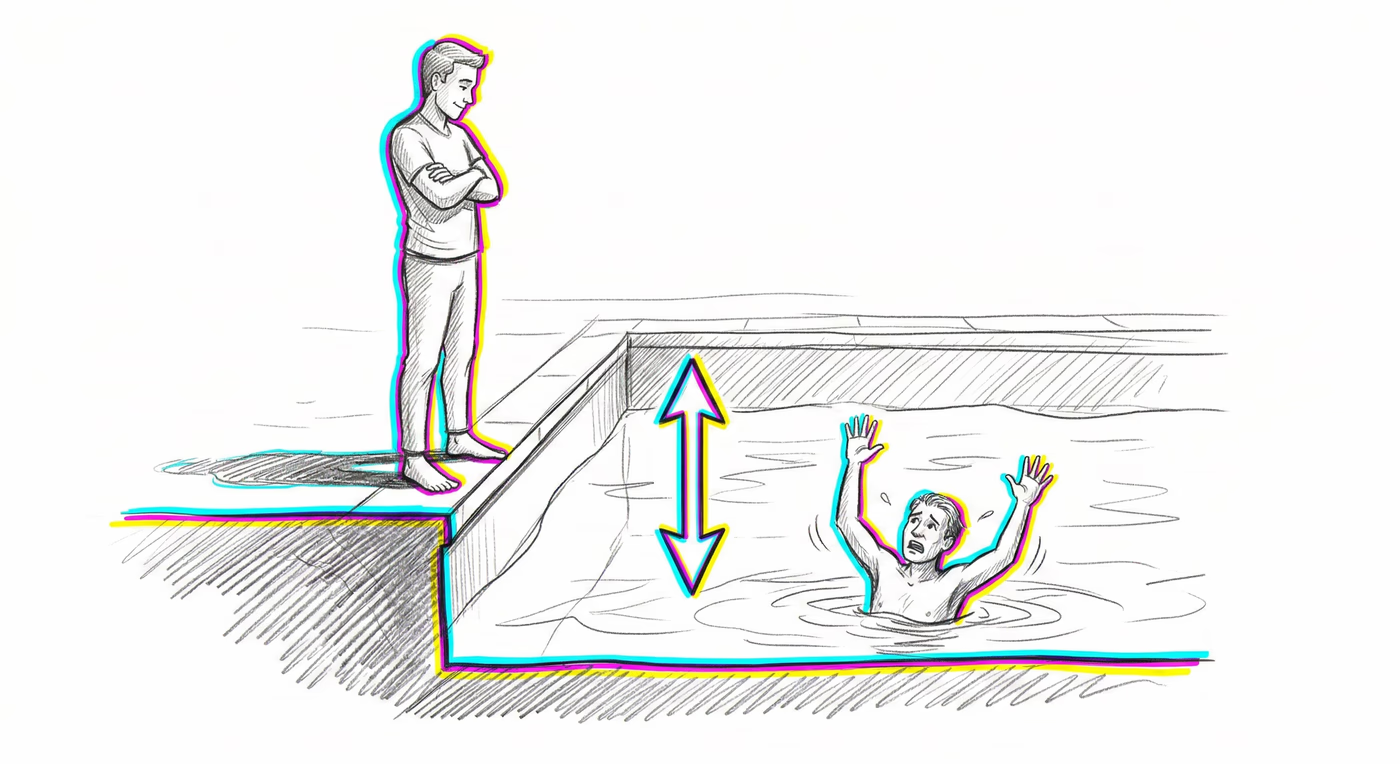
Overestimating your ability to resist temptation, leading to greater exposure to it and more impulsive behavior.

WHAT IT IS

The glitch, explained plainly.

Imagine you're really full after a big dinner and someone asks if you want cookies in the house. You say 'Sure, I'll never eat them, I have great willpower!' But the next day, when you're actually hungry, those cookies are way harder to resist than you imagined. You thought Future You would be as strong as Full You, but hungry you is a completely different person.

Restraint bias occurs when individuals hold inflated beliefs about their capacity to regulate visceral impulses such as hunger, drug cravings, sexual arousal, and fatigue. This overconfidence in one's willpower leads to a paradoxical outcome: people who believe they can resist temptation are more likely to place themselves in tempting situations, which increases the probability of succumbing. The bias is strongly linked to the hot-cold empathy gap, where people in a calm 'cold' state cannot accurately simulate how powerful their drives will feel in an aroused 'hot' state. The result is a self-defeating cycle in which inflated self-control beliefs produce riskier self-control strategies, which produce more impulsive behavior.

SOUND FAMILIAR?

Where it shows up.

  1. 01 Maria, a recovering smoker for three months, agrees to join her coworkers for their smoke break outside, telling herself she just wants the social time and can easily say no if offered a cigarette. Within a week, she has relapsed.
  2. 02 James is training for a marathon and puts himself on a strict diet. He volunteers to bake cupcakes for his daughter's school fundraiser, confident he won't eat a single one. By the time he drops them off, six cupcakes are missing.
  3. 03 A financial advisor who recently paid off her credit card debt signs up for a premium rewards card with a high spending limit, reasoning that she now has the discipline to use it only for planned purchases. Three months later, the balance exceeds her old debt.
  4. 04 A software engineer trying to reduce his gaming habit installs his favorite multiplayer game on his laptop 'just to have it available for the occasional weekend session.' He sets no time restrictions because he trusts his self-discipline. His productivity drops significantly over the next month.
  5. 05 A therapist advises a client with compulsive shopping tendencies to avoid malls entirely. The client objects, explaining that she has been doing really well lately and feels strong enough to window-shop without buying anything. She frames her confidence in her progress as evidence she no longer needs to avoid triggers.
IN DIFFERENT DOMAINS

Where it shows up at work.

The same glitch looks different depending on the terrain. Finance, medicine, a relationship, a team — same mechanism, different costume.

Finance & investing

Investors and consumers overestimate their ability to resist impulsive purchases or risky trades. People sign up for high-limit credit cards or keep brokerage apps readily accessible, believing their discipline will prevent overspending or panic-selling, then make impulsive financial decisions when emotionally triggered.
Medicine & diagnosis

Patients recovering from addiction underestimate the power of environmental cues and overestimate their ability to resist substances, leading them to reject strategies like trigger avoidance. Clinicians may underestimate patient relapse risk when patients report high confidence in their self-control.

Education & grading

Students overestimate their ability to study effectively in distracting environments — studying with their phone nearby, in a noisy café, or near friends — believing they can resist distractions. This leads to less effective learning and last-minute cramming.

Relationships

People in committed relationships may overestimate their ability to maintain platonic boundaries with someone they find attractive, placing themselves in increasingly intimate social situations they believe they can 'handle,' which can lead to infidelity.

Tech & product

Product designers exploit restraint bias by offering free trials, in-app purchase prompts, and autoplay features, knowing users overestimate their ability to resist engagement. Users install addictive apps confident they will self-regulate usage time, then find themselves unable to stop.

Workplace & hiring

Employees overestimate their ability to manage workload and agree to excessive commitments, believing they can resist procrastination and stay focused. This leads to burnout, missed deadlines, and declining work quality.

Politics Media

People believe they can consume sensationalized or partisan media without being influenced by it, overestimating their capacity to remain objective. This leads to greater exposure to polarizing content and, paradoxically, more susceptibility to its framing effects.

HOW TO SPOT IT

Ask yourself…

  • Am I making this decision about future temptation while I'm currently calm, full, sober, or otherwise in a 'cold' state?
  • Am I placing myself near a known trigger because I believe I've grown past it, rather than because the environment has changed?
  • Would I give this same advice — that it's safe to be near the temptation — to a friend in my situation?
HOW TO DEFEND AGAINST IT

The playbook.

  • Pre-commit to avoidance strategies: remove temptation from your environment rather than relying on willpower to resist it in the moment.
  • Use the 'advise a friend' test: if a friend described your exact situation and plans, would you tell them they were being safe, or reckless?
  • Recall a specific past failure vividly — not just the fact that you failed, but the sensory and emotional experience of the craving that overwhelmed you.
  • Design 'bright line' rules that eliminate the need for in-the-moment judgment calls (e.g., 'I don't keep alcohol in the house' rather than 'I'll only have one drink').
  • Assume your future self will have less willpower than your current self, and plan accordingly — this corrects for the cold-to-hot empathy gap.
FAMOUS CASES

In history.

  • The U.S. Prohibition era (1920-1933) was partly undermined by widespread individual overconfidence in the ability to moderate alcohol use once it became available through bootlegging, leading to higher rates of binge consumption.
  • Numerous public health campaigns against smoking have documented that ex-smokers who relapse most frequently are those who expressed the highest confidence in their ability to resist temptation in social settings.
WHERE IT COMES FROM
Academic origin

Loran F. Nordgren, Frenk van Harreveld, and Joop van der Pligt, 2009. Published in Psychological Science, 20(12), 1523–1528.

Evolutionary origin

In ancestral environments where resources were scarce and unpredictable, approaching available food, mates, and opportunities rather than avoiding them conferred survival advantages. A bias toward believing one could handle proximity to rewarding stimuli encouraged approach behavior, increasing the odds of securing valuable resources before competitors did.

IN AI SYSTEMS

How the machines inherit it.

Recommendation systems and engagement algorithms exploit restraint bias by assuming users will self-regulate their consumption of addictive content. When AI personalizes feeds to maximize engagement, it relies on the gap between users' stated intentions (to browse briefly) and their actual behavior (to scroll indefinitely). AI models trained on user behavior data may also inherit patterns that reflect restraint bias — for instance, over-weighting stated preferences from surveys (cold-state data) while actual usage patterns (hot-state behavior) tell a different story.

Read more on Wikipedia
FREE FIELD ZINE

10 glitches quietly running your life.

A free field-zine PDF — ten cognitive glitches named, illustrated, with a defense move for each. Plus the weekly Glitch Report on Fridays — one bias named, two spotted in the wild, one defense move. Unsubscribe any time.

EXPLORE MORE

Related glitches.

LAUNCH PRICE

Train against your blindspots.

50 cards are free to preview. Buyers unlock the rest of the deck plus the interactive training — Spot-the-Bias Quiz unlimited, Swipe Deck with spaced repetition, My Blindspots, Decision Pre-Flight, the Printable Deck + Cheat Sheets, and the Field Guide e-book. $29.50$59.

Unlock the full deck

Everything below — yours forever. Pay once, use across every device.

Half-off launch — limited to the first 100 readers. Auto-applied at checkout.
$59 $29.50
one-time payment · lifetime access
  • All interactive digital cards — search, filter, flip, shuffle on any device
  • Five training modes — Spot-the-Bias Quiz, Swipe Deck, Pre-Flight, Blindspots, Journal
  • Curated Lenses + Decision Templates + Defense Playbook
  • Printable Deck PDFs + Field Guide e-book + Cheat Sheets + Anki Export
  • Every future improvement, included
Unlock  $29.50

30-day refund · no questions asked

Unlock the full deck

Everything below — yours forever. Pay once, use across every device.

Half-off launch — limited to the first 100 readers. Auto-applied at checkout.
$59 $29.50
one-time payment · lifetime access
  • All interactive digital cards — search, filter, flip, shuffle on any device
  • Five training modes — Spot-the-Bias Quiz, Swipe Deck, Pre-Flight, Blindspots, Journal
  • Curated Lenses + Decision Templates + Defense Playbook
  • Printable Deck PDFs + Field Guide e-book + Cheat Sheets + Anki Export
  • Every future improvement, included
Unlock  $29.50

30-day refund · no questions asked