Conjunction Fallacy

aka Linda Problem · Conjunction Effect · Conjunctive Fallacy

Judging two events happening together as more likely than either event alone, violating basic probability.

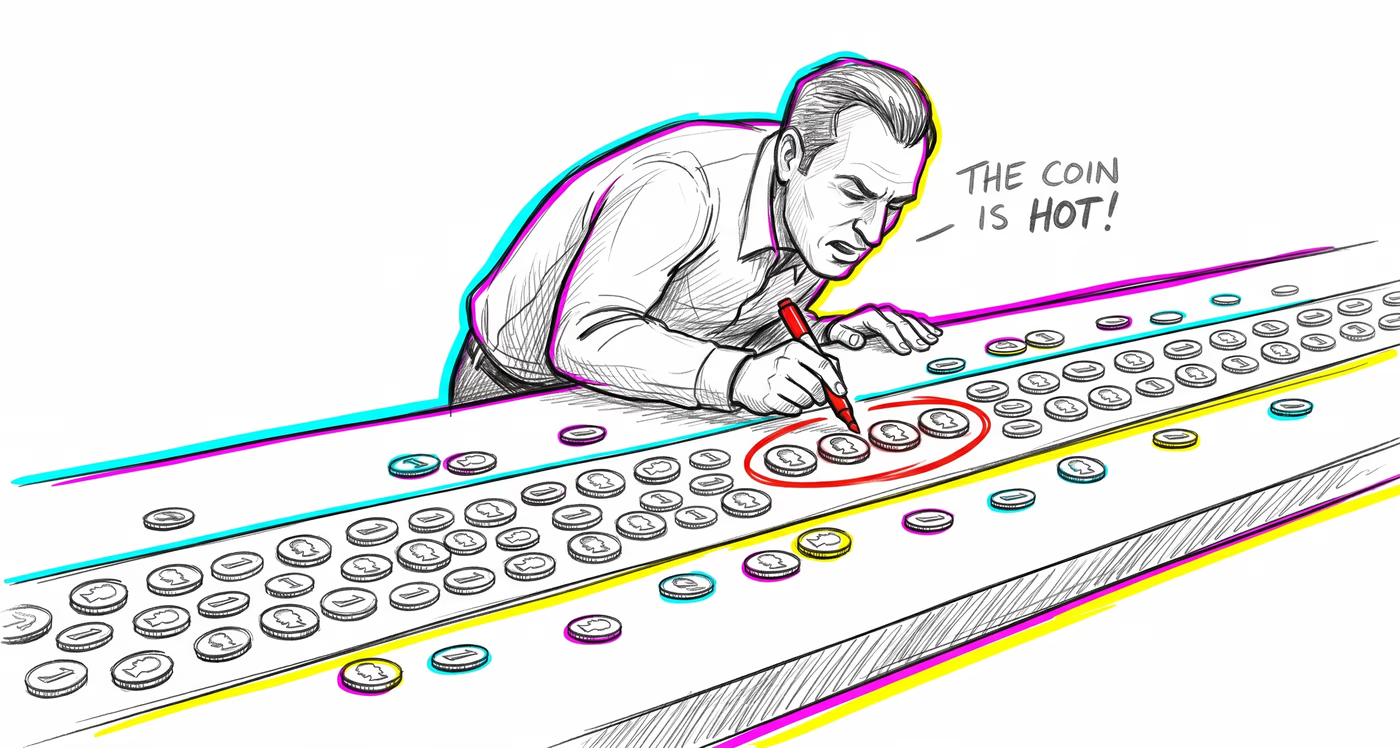
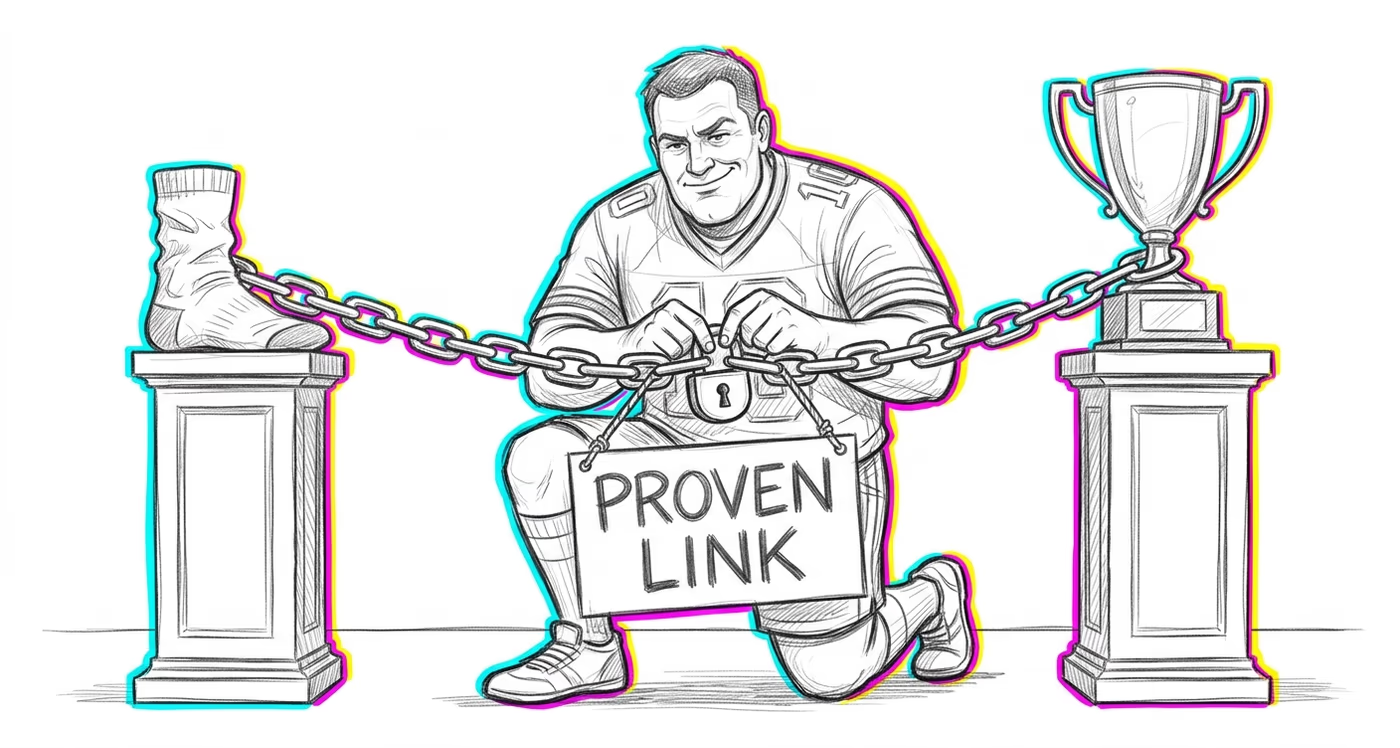
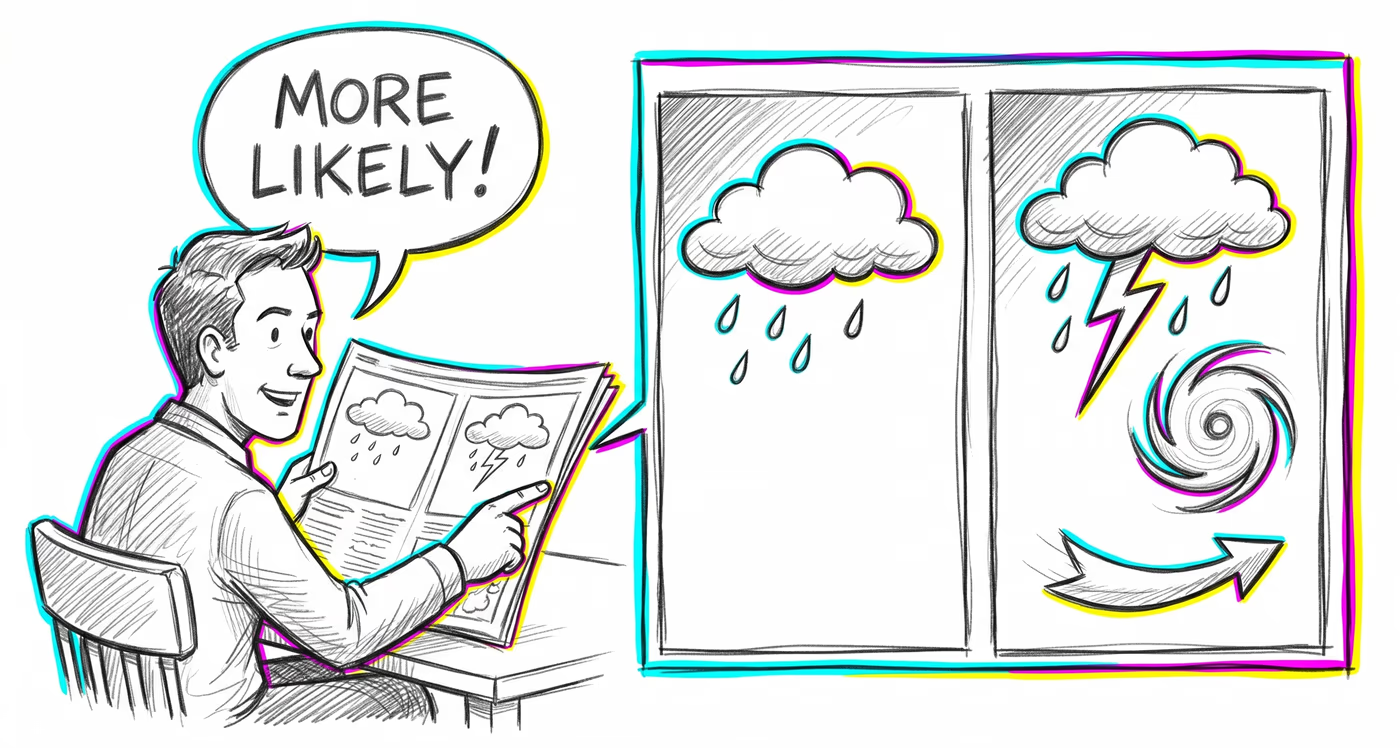
Illustration: Conjunction Fallacy
WHAT IT IS

The glitch, explained plainly.

Imagine you have a big jar of marbles. Some are blue, some are big, and a few are both blue AND big. If I ask you 'Is it more likely you'll pick a blue marble or a blue big marble?', your brain might trick you into saying the blue big marble because it sounds more specific and interesting—but there are always at least as many blue marbles as there are blue big marbles, because every blue big marble is also a blue marble.

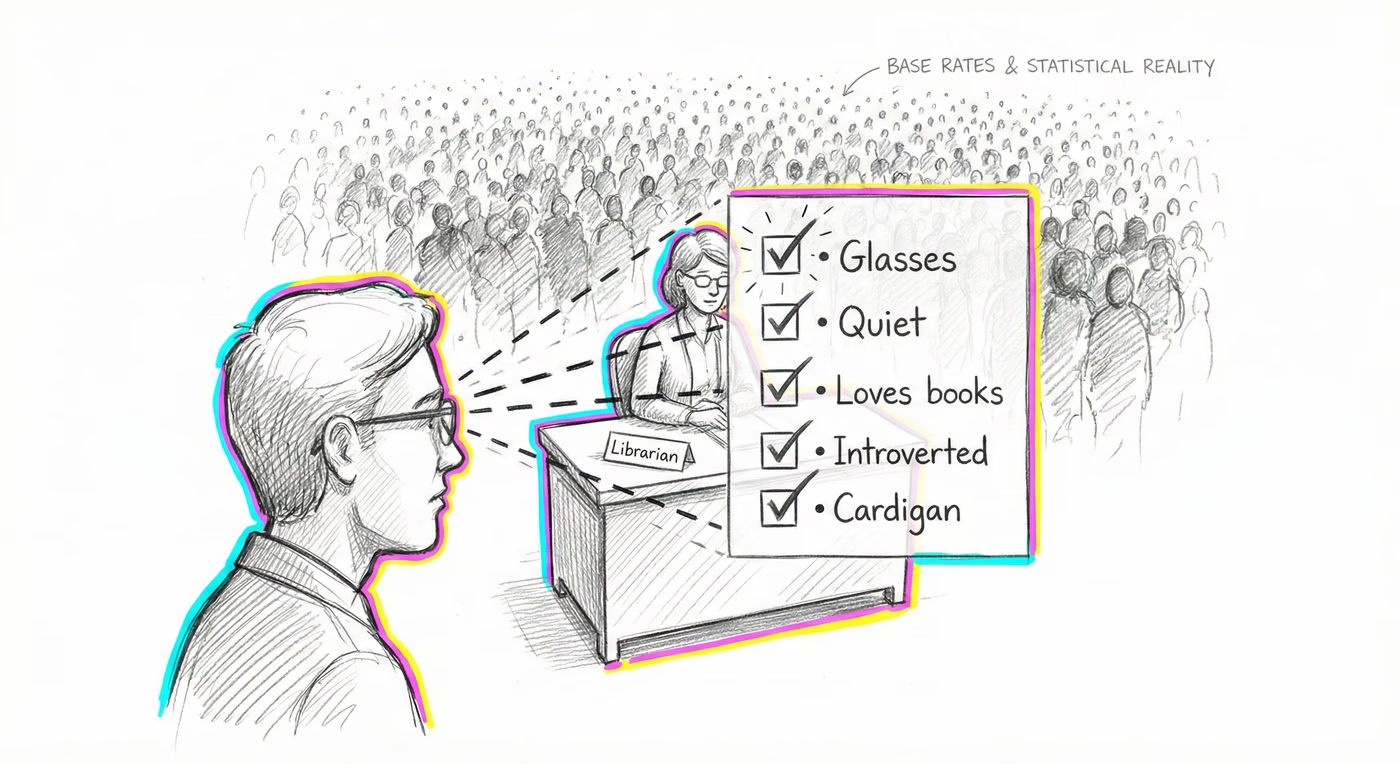
The conjunction fallacy occurs when people estimate that a combination of two characteristics or events (A and B) is more probable than one of those characteristics or events alone (A), directly violating the conjunction rule of probability theory. This error is driven by the representativeness heuristic—the more specific and detailed a description is, the more it matches a mental prototype, making it feel more plausible even though each added condition mathematically reduces the overall probability. The fallacy is remarkably robust: even statistically trained professionals, including graduate students in decision science, commit it at rates above 80%. It reveals a deep tension between narrative coherence (how well a story fits together) and extensional logic (how probability actually works), with the human mind strongly favoring coherence.

SOUND FAMILIAR?

Where it shows up.

  1. 01 A hiring committee reads that a candidate studied philosophy, volunteered for social justice causes, and organized campus protests. When asked to rank the likelihood of different career outcomes, they rate 'works at a nonprofit AND teaches yoga on weekends' as more probable than simply 'works at a nonprofit.' They don't realize that adding a second condition can only decrease or maintain the probability.
  2. 02 An intelligence analyst is asked to estimate the probability of two geopolitical scenarios: (A) 'Country X will face an economic recession next year,' and (B) 'Country X's currency will collapse due to sanctions, leading to an economic recession next year.' The analyst assigns a higher probability to scenario B because the causal chain sounds more coherent and specific, despite B being a strict subset of A.
  3. 03 A doctor is told that a patient is a 55-year-old male smoker with high stress levels. When asked which is more likely—(A) the patient will have a heart attack, or (B) the patient will have a heart attack triggered by a stressful work event—the doctor rates B as more likely because the detailed scenario matches the patient's profile more vividly, overlooking that B is necessarily contained within A.
  4. 04 A venture capitalist evaluates two predictions: (A) 'This startup will fail within three years,' and (B) 'This startup will fail within three years after a key co-founder leaves and competitors undercut their pricing.' She judges prediction B as more probable because the narrative provides plausible reasons for failure, even though every scenario described in B is already included in A.
  5. 05 A jury is deliberating a fraud case. The prosecution presents a detailed theory: the defendant embezzled funds, laundered them through a shell company, and used the proceeds to buy property abroad. The defense points out that the simpler charge—that the defendant embezzled funds—should be considered at least as probable as the entire elaborate chain. Several jurors struggle to accept this, feeling the prosecution's detailed story is somehow more convincing and likely.
IN DIFFERENT DOMAINS

Where it shows up at work.

The same glitch looks different depending on the terrain. Finance, medicine, a relationship, a team — same mechanism, different costume.

Finance & investing

Investors and analysts frequently rate detailed market scenarios (e.g., 'a recession caused by rising interest rates and a housing market collapse') as more probable than the broader outcome alone ('a recession'), leading to overconfidence in specific forecasts and misallocation of hedging resources.
Medicine & diagnosis

Clinicians may judge a detailed diagnostic narrative (e.g., 'the patient has lung cancer caused by asbestos exposure at their former workplace') as more probable than the simpler diagnosis ('the patient has lung cancer'), potentially distorting differential diagnosis and treatment prioritization.

Education & grading

Teachers constructing assessment scenarios may inadvertently create test questions where a detailed answer option seems more correct because it is more descriptively coherent, leading students who rely on narrative fit rather than logical analysis to select probabilistically impossible answers.

Relationships

People tend to find elaborate explanations for a partner's behavior (e.g., 'they're distant because they're stressed at work AND dealing with a family issue') more believable than a single explanation, leading to overcomplicated interpretations that may miss simpler truths.

Tech & product

Product teams may judge compound risk scenarios for system failures (e.g., 'server outage caused by a DDoS attack during a holiday traffic spike') as more likely than the broader event ('server outage'), leading to over-investment in narrow contingency plans while neglecting general resilience.

Workplace & hiring

In performance reviews, managers may rate a detailed negative narrative about an employee's shortcomings (combining multiple specific failings into one story) as more representative of reality than any single observed weakness, inflating perceived underperformance.

Politics Media

Detailed political predictions (e.g., 'the candidate will lose because of a scandal AND low voter turnout among young people') are rated as more probable than the simple prediction ('the candidate will lose'), making elaborate media narratives disproportionately persuasive to the public.

HOW TO SPOT IT

Ask yourself…

  • Am I judging this scenario as more likely because it has more specific details, or because the details actually increase its probability?
  • Would this outcome still seem as probable if I stripped away the vivid narrative and evaluated the bare statistical claim?
  • Am I confusing 'this story makes sense' with 'this is mathematically more likely'?
HOW TO DEFEND AGAINST IT

The playbook.

  • Apply the subset test: ask yourself 'Is scenario B a specific case of scenario A?' If yes, B cannot be more probable than A.
  • Convert probability questions to frequency format: instead of 'How likely is it that Linda is a feminist bank teller?', think 'Out of 100 people matching this description, how many are bank tellers? How many of those are also feminists?'
  • Separate the assessment of plausibility (does the story make sense?) from probability (is it mathematically likely?)—explicitly label which one you are evaluating.
  • Use Venn diagram visualization: draw the sets and ask whether the overlap can ever be larger than either full set.
  • When evaluating detailed forecasts or scenarios, deliberately consider the stripped-down version first and assign it a probability before reading the elaborated version.
FAMOUS CASES

In history.

  • Tversky and Kahneman's 1982 Linda Problem experiment, where 85% of Stanford decision science graduate students rated a conjunction as more likely than a single event.
  • Foreign policy experts in the early 1980s rated the conjunction of 'Soviet invasion of Poland AND U.S. diplomatic break' as more probable than either event alone, demonstrating the fallacy in expert geopolitical forecasting.
  • Fox and Birke (2002) demonstrated that practicing attorneys assigned higher probabilities to trial outcomes described with more specific detail, directly illustrating the conjunction fallacy in legal reasoning.
WHERE IT COMES FROM
Academic origin

Amos Tversky and Daniel Kahneman, 1982 (initial report) and 1983 (seminal paper: 'Extensional Versus Intuitive Reasoning: The Conjunction Fallacy in Probability Judgment,' Psychological Review, 90(4), 293–315).

Evolutionary origin

In ancestral environments, pattern-matching and prototype-based reasoning were fast, efficient survival tools. Judging whether a situation 'fit' a known dangerous pattern (e.g., 'predator hiding in tall grass near water') was more adaptive than computing exact probabilities. The brain evolved to prioritize coherent causal stories because scenarios that made narrative sense were often better guides to action than abstract statistical reasoning, which was rarely needed in small-group foraging contexts.

IN AI SYSTEMS

How the machines inherit it.

LLMs such as GPT-3 and GPT-3.5 have been shown to exhibit the conjunction fallacy when presented with Linda-type problems, rating conjunctive options as more probable than their constituents. Research indicates that RLHF fine-tuning can actually increase susceptibility to this fallacy, as models trained to produce human-pleasing outputs absorb the representativeness heuristic embedded in human language patterns. More advanced models like GPT-4 show reduced but not eliminated susceptibility, and small changes in entity names or prompt wording can cause models to revert to fallacious reasoning, suggesting pattern-matching rather than genuine logical comprehension.

Read more on Wikipedia
FREE FIELD ZINE

10 glitches quietly running your life.

A free field-zine PDF — ten cognitive glitches named, illustrated, with a defense move for each. Plus the weekly Glitch Report on Fridays — one bias named, two spotted in the wild, one defense move. Unsubscribe any time.

EXPLORE MORE

Related glitches.

LAUNCH PRICE

Train against your blindspots.

50 cards are free to preview. Buyers unlock the rest of the deck plus the interactive training — Spot-the-Bias Quiz unlimited, Swipe Deck with spaced repetition, My Blindspots, Decision Pre-Flight, the Printable Deck + Cheat Sheets, and the Field Guide e-book. $29.50$59.

Unlock the full deck

Everything below — yours forever. Pay once, use across every device.

Half-off launch — limited to the first 100 readers. Auto-applied at checkout.
$59 $29.50
one-time payment · lifetime access
  • All interactive digital cards — search, filter, flip, shuffle on any device
  • Five training modes — Spot-the-Bias Quiz, Swipe Deck, Pre-Flight, Blindspots, Journal
  • Curated Lenses + Decision Templates + Defense Playbook
  • Printable Deck PDFs + Field Guide e-book + Cheat Sheets + Anki Export
  • Every future improvement, included
Unlock  $29.50

30-day refund · no questions asked

Unlock the full deck

Everything below — yours forever. Pay once, use across every device.

Half-off launch — limited to the first 100 readers. Auto-applied at checkout.
$59 $29.50
one-time payment · lifetime access
  • All interactive digital cards — search, filter, flip, shuffle on any device
  • Five training modes — Spot-the-Bias Quiz, Swipe Deck, Pre-Flight, Blindspots, Journal
  • Curated Lenses + Decision Templates + Defense Playbook
  • Printable Deck PDFs + Field Guide e-book + Cheat Sheets + Anki Export
  • Every future improvement, included
Unlock  $29.50

30-day refund · no questions asked