Disposition Effect

aka Disposition Bias · Sell Winners Ride Losers Effect

Selling winning investments too early to lock in gains while holding losing ones too long, hoping they'll recover.

WHAT IT IS

The glitch, explained plainly.

Imagine you have two lemonade stands. One is doing great and making lots of money, and the other is losing money every day. Instead of keeping the good one and closing the bad one, you close the good one because it feels nice to say 'I won!' and you keep the bad one open because you don't want to admit you made a mistake. That's the disposition effect — you celebrate too early and refuse to quit when you should.

The disposition effect describes a systematic pattern in which investors prematurely realize gains by selling winning positions to lock in profits, while simultaneously refusing to sell losing positions in the hope of eventual recovery. This asymmetry leads to tax-inefficient behavior, underdiversified portfolios, and reduced long-term returns, as the winners that are sold tend to continue appreciating while the losers that are held often continue declining. The effect is driven by a confluence of loss aversion, mental accounting, regret avoidance, and the desire for the emotional reward of closing a profitable trade. Although originally documented among retail investors, the disposition effect has been observed among institutional fund managers, professional traders, and across asset classes including equities, real estate, futures, and cryptocurrencies.

SOUND FAMILIAR?

Where it shows up.

  1. 01 Maria bought shares of two tech companies at $100 each six months ago. Company A is now worth $150 and Company B is worth $60. She decides to sell Company A to realize her profit, while keeping Company B because 'it just needs time to recover to my buy price.' Over the next year, Company A climbs to $220 while Company B drops to $30.
  2. 02 A real estate investor owns two rental properties purchased at the same price. One has appreciated 40%, and the other has lost 25% of its value. Despite both properties generating similar rental income, the investor sells the appreciated property to 'bank the gain' and holds the depreciated one, rationalizing that the market in that neighborhood is 'due for a turnaround.'
  3. 03 A cryptocurrency trader reviews her portfolio and notices three positions in profit and two at a loss. She systematically closes all three winning positions within a week but continues holding the two losing positions for months. When asked why, she explains she wants to 'wait for a better exit' on the losers but felt no such need with the winners.
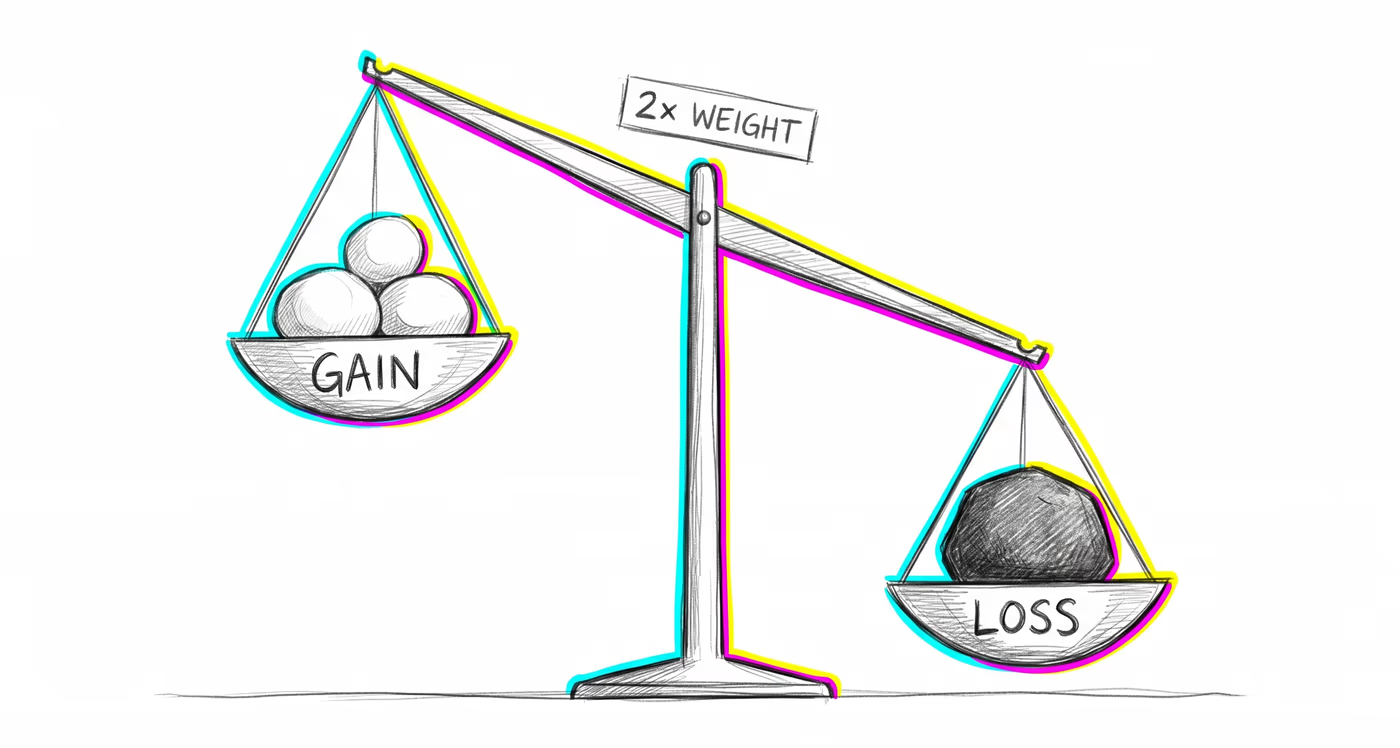
  4. 04 A fund manager rebalances his portfolio quarterly. His analysis shows that his proportion of gains realized is consistently twice his proportion of losses realized. He attributes this to his disciplined profit-taking strategy, not recognizing that the stocks he sold as winners continued to outperform the losers he held onto.
  5. 05 An options trader makes a rule to take profits at 30% gains. She follows this rule rigorously. However, she has no equivalent rule for cutting losses, allowing losing trades to run indefinitely while convincing herself that her asymmetric strategy is simply 'smart risk management' rather than a systematic tendency to realize gains faster than losses.
IN DIFFERENT DOMAINS

Where it shows up at work.

The same glitch looks different depending on the terrain. Finance, medicine, a relationship, a team — same mechanism, different costume.

Finance & investing

Investors consistently realize gains at a higher rate than losses, leading to portfolios overweighted with declining assets. Research shows this behavior reduces annual returns by approximately 4.4%, creates tax-inefficient outcomes by triggering short-term capital gains taxes while failing to harvest tax-deductible losses, and is observable among retail investors, mutual fund managers, and professional futures traders alike.
Medicine & diagnosis

Patients and clinicians may exhibit a disposition-like tendency in treatment decisions, continuing ineffective treatments (holding losers) while being too quick to discontinue treatments showing early positive signs (selling winners), particularly when the emotional cost of admitting a treatment failure is high.

Relationships

People may quickly end new friendships or relationships that are going well (perhaps feeling they've 'gotten what they need') while persisting in deteriorating relationships far too long because ending them would mean admitting the emotional investment was a loss.

Tech & product

Product teams may kill successful features prematurely to reallocate resources, while continuing to invest in underperforming features because deprecating them would mean admitting the development effort was wasted. Trading platforms can amplify or mitigate this bias through interface design choices like prominently displaying purchase prices versus current performance.

Workplace & hiring

Managers may reassign top-performing employees away from successful projects (cashing in on demonstrated success) while continuing to staff failing projects because pulling resources would mean acknowledging the initiative was a mistake, leading to suboptimal talent allocation.

Politics Media

Politicians and public officials may claim credit for early policy successes and pivot away from them, while stubbornly defending failing policies long past the point of rational continuation, because abandoning the policy would represent a publicly visible loss.

HOW TO SPOT IT

Ask yourself…

  • Am I selling this investment because I have a rational reason to expect future underperformance, or simply because it feels good to lock in a gain?
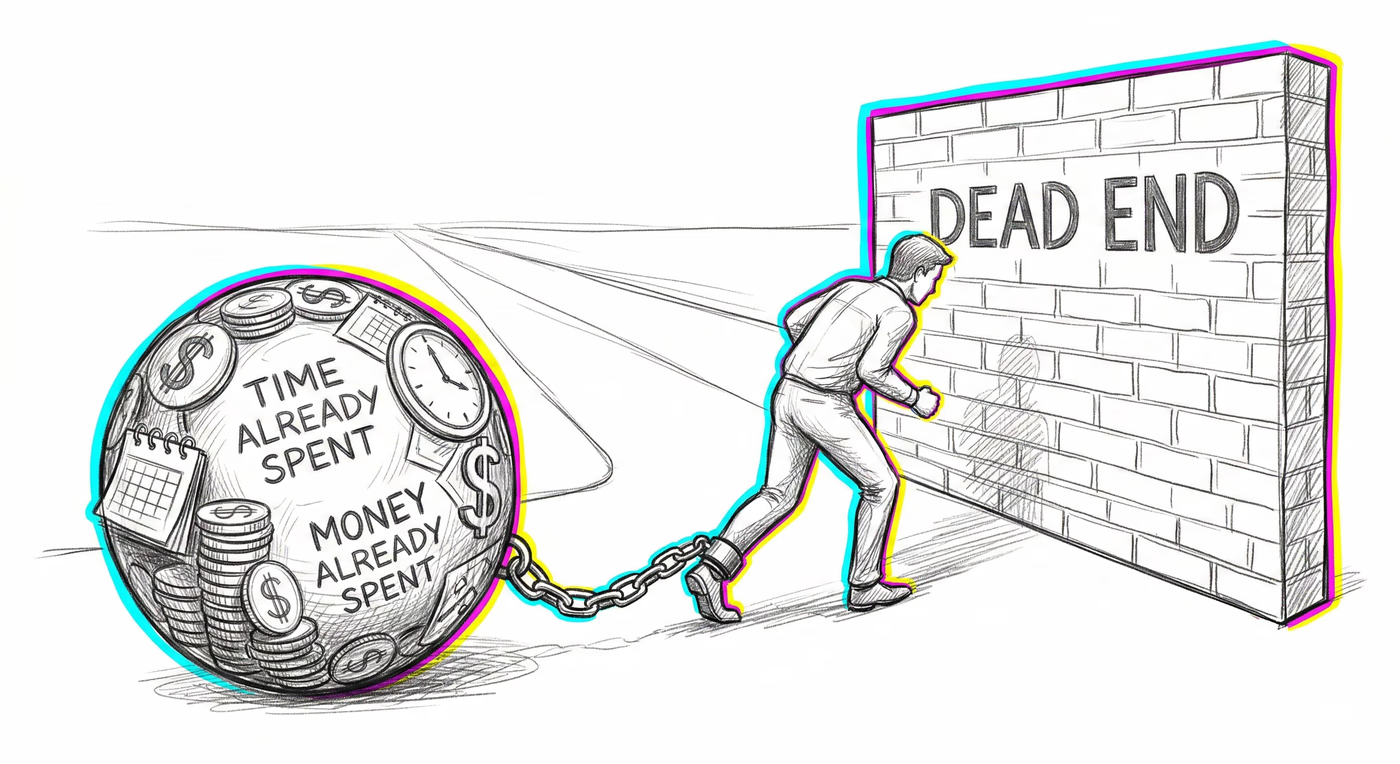
  • Am I holding this losing position because I have genuine evidence it will recover, or am I just avoiding the pain of admitting a mistake?
  • If I didn't already own this losing asset, would I buy it today at its current price?
HOW TO DEFEND AGAINST IT

The playbook.

  • Establish symmetric rules for both gains and losses before entering any trade (e.g., trailing stop-losses and profit targets at fixed percentages).
  • Ask the 'clean slate' question: If I had cash instead of this position, would I buy this asset at today's price? If not, sell.
  • Remove or minimize the visual salience of purchase prices in your trading interface, focusing instead on forward-looking fundamentals.
  • Schedule regular portfolio reviews with a specific mandate to evaluate losers on their merits, not on your entry price.
  • Use automatic rebalancing or rules-based systems to remove emotion from sell decisions.
FAMOUS CASES

In history.

  • Terrance Odean's 1998 study of 10,000 brokerage accounts (1987–1993) demonstrated that investors were 1.5 times more likely to sell winners than losers, resulting in approximately 4.4% lower annual returns.
  • Barber, Lee, Liu, and Odean (2006) found that Taiwanese investors were approximately twice as likely to sell winning stocks relative to losing ones, with 85% of investors in the sample exhibiting the effect.
  • Coval and Shumway (2005) documented the disposition effect among professional Treasury bond futures traders at the Chicago Board of Trade, finding increased risk-taking after morning losses.
WHERE IT COMES FROM
Academic origin

Hersh Shefrin and Meir Statman, 1985. Their paper 'The Disposition to Sell Winners Too Early and Ride Losers Too Long: Theory and Evidence' coined the term, building on Kahneman and Tversky's prospect theory (1979) and earlier observations by Schlarbaum, Lewellen, and Lease (1978).

Evolutionary origin

In ancestral environments, securing a tangible resource gain quickly (e.g., harvesting ripe fruit before competitors or predators arrived) was adaptive, while persisting with a deteriorating situation (e.g., continuing to forage in a depleting patch) sometimes paid off when resources recovered. The asymmetric emotional weighting of realized gains and losses may have evolved to ensure that confirmed gains were captured and that abandoning investments in survival efforts did not happen too readily.

IN AI SYSTEMS

How the machines inherit it.

Algorithmic trading systems trained on historical human trading data can inherit disposition-like patterns if the training data reflects biased sell decisions. Reinforcement learning agents in simulated markets can develop asymmetric exit strategies resembling the disposition effect when reward functions incorporate reference-dependent utility or when the training environment exhibits mean reversion, leading the agent to learn a strategy that is maladaptive in trending markets.

Read more on Wikipedia
FREE FIELD ZINE

10 glitches quietly running your life.

A free field-zine PDF — ten cognitive glitches named, illustrated, with a defense move for each. Plus the weekly Glitch Report on Fridays — one bias named, two spotted in the wild, one defense move. Unsubscribe any time.

EXPLORE MORE

Related glitches.

LAUNCH PRICE

Train against your blindspots.

50 cards are free to preview. Buyers unlock the rest of the deck plus the interactive training — Spot-the-Bias Quiz unlimited, Swipe Deck with spaced repetition, My Blindspots, Decision Pre-Flight, the Printable Deck + Cheat Sheets, and the Field Guide e-book. $29.50$59.

Unlock the full deck

Everything below — yours forever. Pay once, use across every device.

Half-off launch — limited to the first 100 readers. Auto-applied at checkout.
$59 $29.50
one-time payment · lifetime access
  • All interactive digital cards — search, filter, flip, shuffle on any device
  • Five training modes — Spot-the-Bias Quiz, Swipe Deck, Pre-Flight, Blindspots, Journal
  • Curated Lenses + Decision Templates + Defense Playbook
  • Printable Deck PDFs + Field Guide e-book + Cheat Sheets + Anki Export
  • Every future improvement, included
Unlock  $29.50

30-day refund · no questions asked

Unlock the full deck

Everything below — yours forever. Pay once, use across every device.

Half-off launch — limited to the first 100 readers. Auto-applied at checkout.
$59 $29.50
one-time payment · lifetime access
  • All interactive digital cards — search, filter, flip, shuffle on any device
  • Five training modes — Spot-the-Bias Quiz, Swipe Deck, Pre-Flight, Blindspots, Journal
  • Curated Lenses + Decision Templates + Defense Playbook
  • Printable Deck PDFs + Field Guide e-book + Cheat Sheets + Anki Export
  • Every future improvement, included
Unlock  $29.50

30-day refund · no questions asked