Dread Risk

aka Dread Risk Bias · Dread Factor

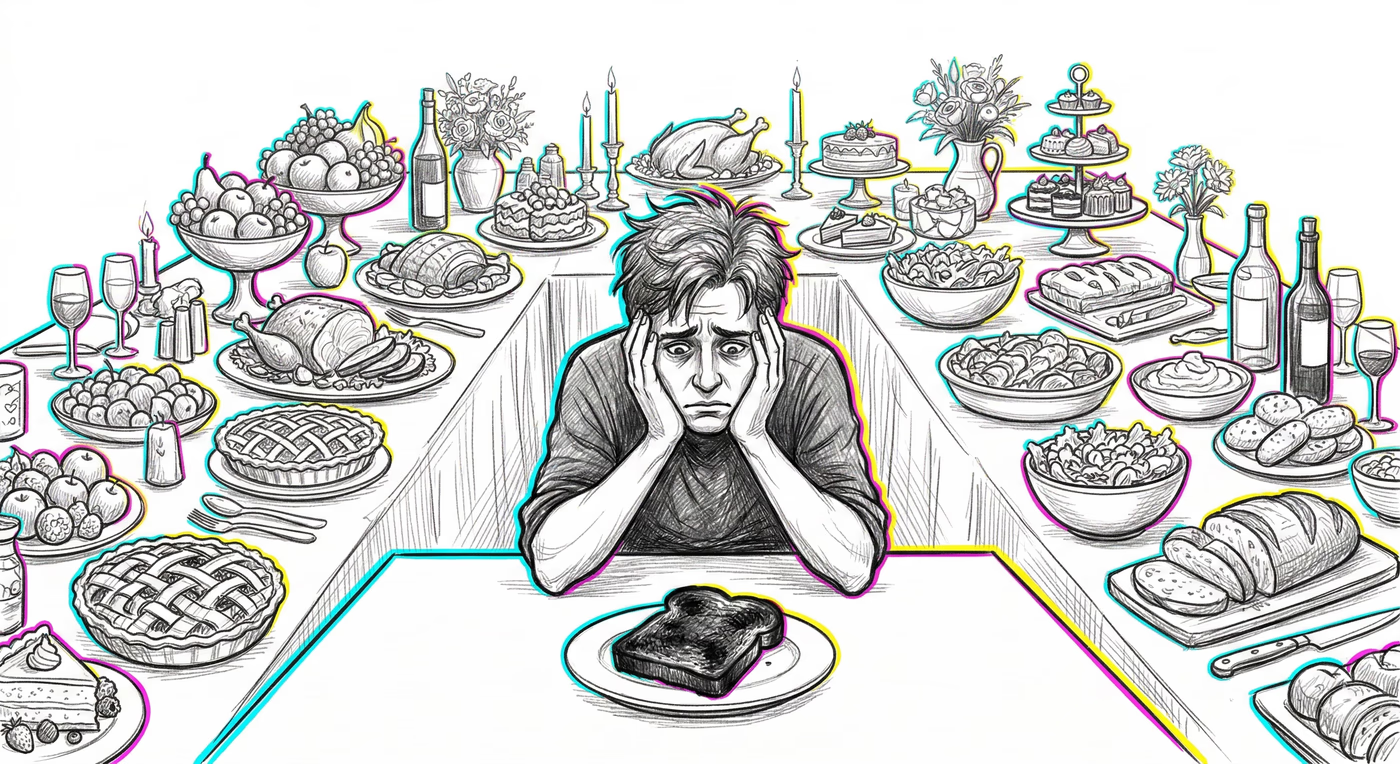
Disproportionately fearing rare catastrophic events while underreacting to common risks that cause more total harm.

WHAT IT IS

The glitch, explained plainly.

Imagine you're scared of the big, loud dog on the next street so you always walk the other way — but the other way has a busy road with no crosswalk that's actually much more dangerous. Dread Risk is when your brain gets so scared of the big scary thing that it pushes you toward something quietly more dangerous without you noticing.

Dread Risk describes a systematic distortion in risk evaluation where people assign disproportionate weight to hazards that are perceived as uncontrollable, catastrophic, fatal, and involuntary — even when their statistical likelihood is extremely low. This bias causes individuals to treat rare but vivid threats (such as plane crashes, terrorist attacks, or nuclear meltdowns) as far more dangerous than mundane but statistically deadlier hazards (such as car accidents, heart disease, or household falls). The distortion is amplified by media coverage, social transmission of fear, and the emotional vividness of catastrophic scenarios. Critically, this misperception doesn't just cause unnecessary anxiety — it drives behavioral substitutions (such as driving instead of flying) that can actually increase the person's overall exposure to danger.

SOUND FAMILIAR?

Where it shows up.

  1. 01 After reading about a rare bridge collapse in another state, Maria starts taking a 40-minute detour every day to avoid a structurally sound bridge on her commute. She doesn't think twice about the extra highway miles she now drives, which statistically expose her to significantly more accident risk than the bridge ever did.
  2. 02 A city council votes to spend $12 million on an anti-terrorism bollard system for the downtown area after a vehicle attack in a foreign country. Meanwhile, a proposal to improve pedestrian crosswalks — which would address the 15 pedestrian fatalities that occur downtown annually — is tabled due to insufficient funds.
  3. 03 A pharmaceutical company's internal survey finds that patients are refusing a new medication because of a 1-in-500,000 chance of a fatal allergic reaction, even though the untreated condition has a 1-in-50 chance of causing serious organ damage. The marketing team is puzzled because they clearly disclosed both statistics in the patient information sheet.
  4. 04 After a highly publicized airplane near-miss incident, a business traveler decides to drive 800 miles to a conference instead of flying. He rationalizes the choice by saying he 'has more control behind the wheel.' His colleague points out that flying is safer per mile, but he counters that a plane crash is unsurvivable while most car accidents are minor fender-benders.
  5. 05 A hospital allocates a significant portion of its emergency preparedness budget toward bioterrorism response protocols after a national news scare, even though internal data shows that sepsis mismanagement — a far more common cause of preventable hospital deaths — remains chronically underfunded. Staff feel reassured by the visible bioterrorism preparations.
IN DIFFERENT DOMAINS

Where it shows up at work.

The same glitch looks different depending on the terrain. Finance, medicine, a relationship, a team — same mechanism, different costume.

Finance & investing

Investors disproportionately fear dramatic market crashes (like a sudden 40% single-day drop) while underweighting the cumulative damage of chronic underperformance, inflation erosion, or high fees. This leads to panic selling after flash crashes while tolerating years of quietly wealth-destroying investment strategies.

Medicine & diagnosis

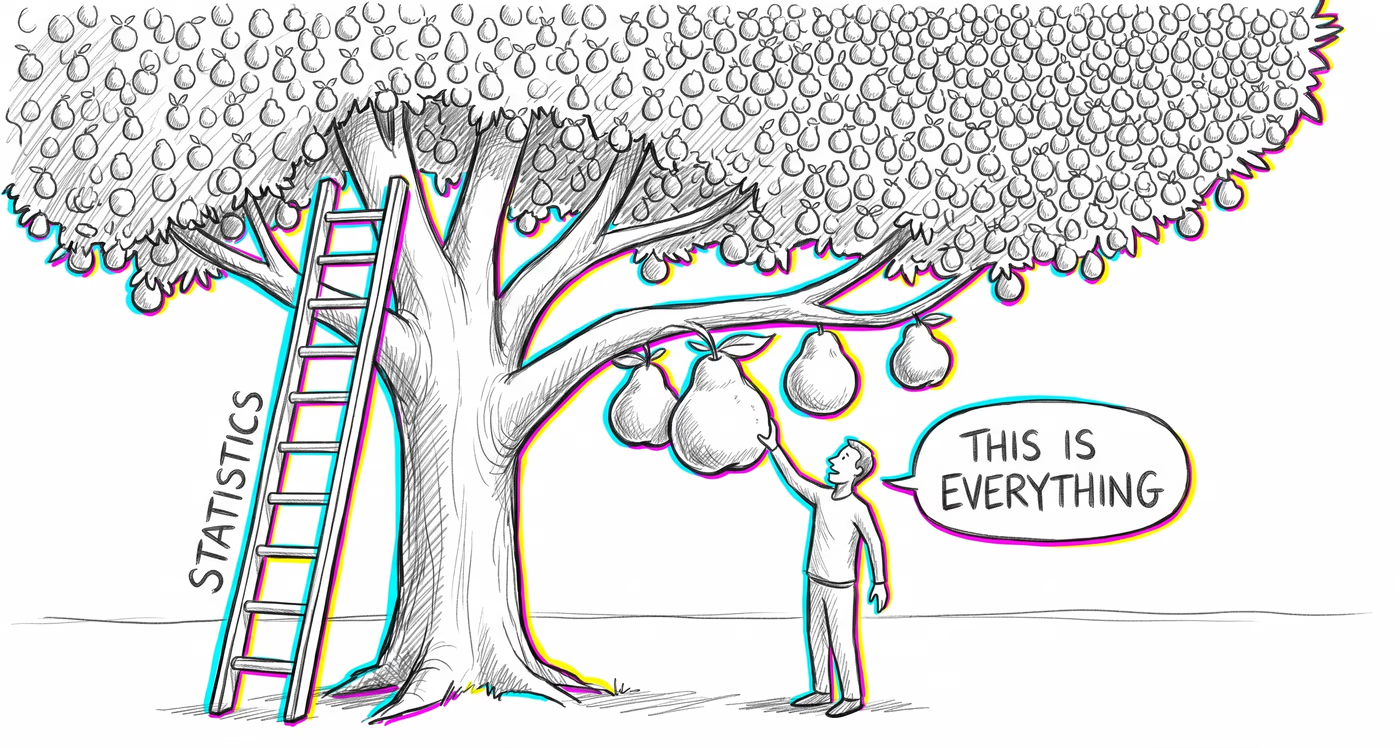
Patients and clinicians overweight rare but catastrophic side effects of treatments (such as a vaccine causing anaphylaxis) while underweighting the far more probable harms of the untreated disease. This pattern also drives disproportionate fear of rare surgical complications versus the chronic deterioration of avoiding the procedure entirely.

Education & grading

Students and parents disproportionately fear rare school violence events, leading to extensive lockdown drill investments, while chronic but less dramatic threats to student wellbeing — such as bullying, sleep deprivation, or mental health neglect — receive comparatively less attention and funding.

Relationships

People may avoid forming deep attachments out of fear of a catastrophic betrayal or abandonment, while the gradual emotional costs of isolation and loneliness — statistically linked to far worse health outcomes — go unrecognized as a risk.

Tech & product

Users disproportionately fear dramatic data breaches or AI 'going rogue' while ignoring the far more common and damaging risks of weak passwords, phishing attacks, or gradual privacy erosion through routine data sharing with apps they willingly install.

Workplace & hiring

Organizations invest heavily in dramatic emergency preparedness (active shooter training, disaster recovery plans) while underfunding chronic workplace hazards such as ergonomic injuries, burnout, and repetitive stress — which collectively cause far more disability and lost productivity.

Politics Media

Media coverage of terrorism, plane crashes, and pandemics is grossly disproportionate to their statistical death toll, while chronic killers like heart disease, diabetes, and traffic accidents receive minimal coverage. This skewed attention drives public demand for anti-terrorism spending while infrastructure and public health budgets stagnate.

HOW TO SPOT IT

Ask yourself…

  • Am I afraid of this because it's actually likely, or because the consequences are vivid and terrifying?
  • If I avoid this scary option, is the alternative I'm choosing actually safer when I look at the numbers?
  • Is my sense of this risk being inflated by recent news coverage or dramatic imagery rather than statistical evidence?
HOW TO DEFEND AGAINST IT

The playbook.

  • Compare absolute numbers: before avoiding a 'scary' option, look up the actual death rate per mile, per hour, or per exposure for both the feared option and its alternative.
  • Apply the 'substitution test': explicitly ask what behavior you will substitute and whether that substitute is genuinely safer by the numbers.
  • Use frequency formats instead of percentages — '1 in 500,000' is more calibrating than '0.0002%' because it makes the rarity concrete.
  • Implement a 48-hour media cooling-off rule: after a dramatic event, delay any major behavioral changes for 48 hours to let the affective response subside before the analytic system re-engages.
  • Seek out base rate data from actuarial tables, government statistics, or epidemiological databases before making risk-based decisions.
FAMOUS CASES

In history.

  • After the September 11, 2001 attacks, Americans shifted from flying to driving in large numbers. Gigerenzer (2004) estimated that approximately 1,595 additional people died in traffic fatalities in the 12 months following 9/11 due to this modal shift — a death toll exceeding the number of passengers killed on the four hijacked planes.
  • Following the 2011 Fukushima nuclear disaster, Germany accelerated its nuclear phase-out. The resulting shift to fossil fuels has been estimated to cause thousands more deaths annually from air pollution than nuclear energy would have, illustrating dread risk's influence on national energy policy.
  • Public opposition to nuclear power consistently outweighs opposition to coal power, despite coal causing vastly more deaths per unit of energy produced through air pollution, mining accidents, and climate change.
WHERE IT COMES FROM
Academic origin

The concept of 'dread risk' was formalized by Paul Slovic, Baruch Fischhoff, and Sarah Lichtenstein through the psychometric paradigm of risk perception, beginning with Fischhoff et al. (1978) and consolidated in Slovic's seminal paper 'Perception of Risk' published in Science in 1987. Gerd Gigerenzer further popularized the term through his 2004 analysis of post-9/11 driving fatalities.

Evolutionary origin

In ancestral environments, aggregate catastrophic events — storms, predator attacks on groups, epidemics — could wipe out a significant proportion of a kin group or allele carriers in a single strike. Unlike distributed risks that thinned the population gradually, a single catastrophic event could eliminate an entire band's reproductive potential. Heightened sensitivity to such aggregate threats would have been strongly selected for, as individuals who avoided locations or situations where mass casualties could occur were more likely to preserve their genetic lineage.

IN AI SYSTEMS

How the machines inherit it.

Machine learning models trained on media data or public sentiment inherit dread risk distortions — they may flag rare catastrophic events as high priority while underweighting statistically more dangerous but less dramatic patterns. Recommendation algorithms amplify dread risk by preferentially surfacing sensational catastrophic content that drives engagement, creating feedback loops that further inflate public fear of rare events. Risk assessment models may also over-index on dramatic outlier scenarios in training data if not properly calibrated to base rates.

FREE FIELD ZINE

10 glitches quietly running your life.

A free field-zine PDF — ten cognitive glitches named, illustrated, with a defense move for each. Plus the weekly Glitch Report on Fridays — one bias named, two spotted in the wild, one defense move. Unsubscribe any time.

EXPLORE MORE

Related glitches.

LAUNCH PRICE

Train against your blindspots.

50 cards are free to preview. Buyers unlock the rest of the deck plus the interactive training — Spot-the-Bias Quiz unlimited, Swipe Deck with spaced repetition, My Blindspots, Decision Pre-Flight, the Printable Deck + Cheat Sheets, and the Field Guide e-book. $29.50$59.

Unlock the full deck

Everything below — yours forever. Pay once, use across every device.

Half-off launch — limited to the first 100 readers. Auto-applied at checkout.
$59 $29.50
one-time payment · lifetime access
  • All interactive digital cards — search, filter, flip, shuffle on any device
  • Five training modes — Spot-the-Bias Quiz, Swipe Deck, Pre-Flight, Blindspots, Journal
  • Curated Lenses + Decision Templates + Defense Playbook
  • Printable Deck PDFs + Field Guide e-book + Cheat Sheets + Anki Export
  • Every future improvement, included
Unlock  $29.50

30-day refund · no questions asked

Unlock the full deck

Everything below — yours forever. Pay once, use across every device.

Half-off launch — limited to the first 100 readers. Auto-applied at checkout.
$59 $29.50
one-time payment · lifetime access
  • All interactive digital cards — search, filter, flip, shuffle on any device
  • Five training modes — Spot-the-Bias Quiz, Swipe Deck, Pre-Flight, Blindspots, Journal
  • Curated Lenses + Decision Templates + Defense Playbook
  • Printable Deck PDFs + Field Guide e-book + Cheat Sheets + Anki Export
  • Every future improvement, included
Unlock  $29.50

30-day refund · no questions asked