Zero-Risk Bias

aka Zero Risk Bias · Certainty Bias in Risk Elimination

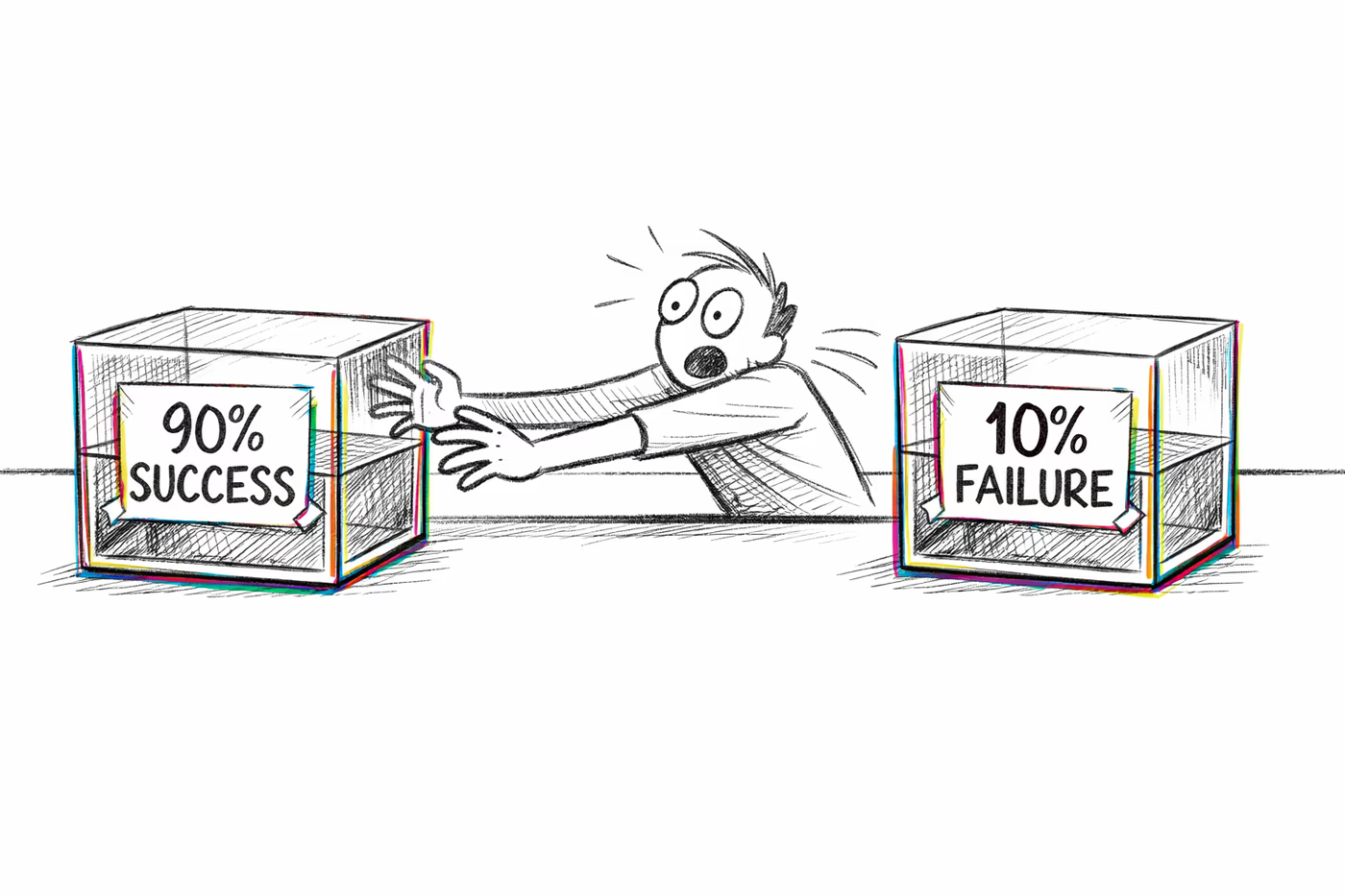
Preferring to completely eliminate a small risk rather than making a larger reduction in overall risk that would help more.

WHAT IT IS

The glitch, explained plainly.

Imagine you have 10 band-aids. You have a tiny scratch on your finger and a big cut on your knee. Instead of putting most band-aids on the big cut to stop the bleeding, you use all 10 on the tiny scratch so it's perfectly covered with zero chance of getting dirty — while the big cut just keeps bleeding. You feel better because one boo-boo is totally fixed, but overall you're much worse off.

Zero-Risk Bias describes a systematic preference for options that completely eliminate one identifiable risk, even when an alternative option would produce a greater total reduction in danger across all risks combined. This bias leads people to place disproportionate psychological value on achieving absolute zero in a single risk category rather than optimizing for the best aggregate outcome. It is especially pronounced in emotionally charged domains like health, safety, and environmental policy, where the symbolic reassurance of total elimination outweighs rational cost-benefit calculations. The bias helps explain why individuals and policymakers routinely funnel limited resources toward eliminating negligible threats while leaving far larger hazards inadequately addressed.

SOUND FAMILIAR?

Where it shows up.

  1. 01 A city council is choosing between two water safety plans. Plan A reduces contamination across the entire city water system by 60%, preventing an estimated 300 illnesses per year. Plan B completely eliminates contamination in one neighborhood's water supply, preventing 40 illnesses. The council votes unanimously for Plan B because they can guarantee that neighborhood will have 'perfectly safe water.'
  2. 02 A hospital administrator allocates the entire annual safety budget to installing a new system that will completely prevent medication labeling errors, which cause about 2 adverse events per year. Meanwhile, a proposal to upgrade the hand-hygiene monitoring system — which could reduce hospital-acquired infections by 40%, preventing roughly 50 adverse events — goes unfunded because it wouldn't eliminate the infection risk entirely.
  3. 03 A software company is allocating its security budget. The team chooses to implement a system that will make one specific type of rarely exploited vulnerability impossible, rather than a broader security audit that would significantly reduce the likelihood of several more common and more damaging attack vectors. The team lead explains, 'At least we know for certain that this attack can never happen again.'
  4. 04 During a product recall discussion, a food manufacturer decides to reformulate a snack to remove a coloring agent linked to a 1-in-500,000 allergic reaction risk. The reformulation costs $2 million. Meanwhile, a $500,000 quality-control upgrade that would reduce the much more common risk of bacterial contamination by 70% is deprioritized because it 'still leaves some risk on the table.'
  5. 05 An environmental agency must allocate a fixed cleanup fund between two contaminated sites. Site A affects 50,000 residents with moderate contamination levels; the fund could reduce their exposure by 80%. Site B affects 500 residents with low-level contamination; the same fund could eliminate their exposure entirely. The agency chooses Site B, reasoning that achieving zero contamination for those residents is a more defensible and complete outcome.
IN DIFFERENT DOMAINS

Where it shows up at work.

The same glitch looks different depending on the terrain. Finance, medicine, a relationship, a team — same mechanism, different costume.

Finance & investing

Investors during periods of economic uncertainty tend to flock to guaranteed low-yield government bonds rather than diversified portfolios that would reduce overall financial risk more effectively, because the guaranteed return eliminates one specific type of loss entirely even though overall wealth-building is sacrificed.
Medicine & diagnosis

Patients and policymakers may push for total bans on substances with negligible carcinogenic risk while underfunding interventions against far more prevalent killers like heart disease or diabetes, because eliminating even a tiny cancer risk feels morally absolute in a way that 'reducing' a larger risk does not.

Education & grading

Schools may devote disproportionate resources to eliminating one specific safety hazard (e.g., removing all playground equipment to prevent rare injuries) while neglecting broader interventions like mental health programs that would address more widespread student well-being risks.

Relationships

People may fixate on eliminating one specific source of conflict in a relationship (such as never discussing a particular sensitive topic) while ignoring larger patterns of poor communication or emotional disconnection that cause far more damage over time.

Tech & product

Product teams may spend extensive engineering effort to make one minor edge-case bug literally impossible rather than investing those resources in fixing more widespread usability issues or performance problems that affect far more users. 'Money-back guarantee' and 'free return' features exploit this bias by eliminating perceived purchase risk entirely.

Workplace & hiring

Organizations may invest heavily in eliminating a single, rare type of compliance violation while underinvesting in culture-wide initiatives that would significantly reduce more common forms of misconduct, burnout, or turnover.

Politics Media

Policymakers enact 'zero tolerance' laws targeting rare but emotionally salient threats (such as banning trace food additives) while allocating insufficient resources to address widespread public health crises, because voters respond more strongly to the promise of total elimination than to the language of partial risk reduction.

HOW TO SPOT IT

Ask yourself…

  • Am I choosing this option because it completely eliminates one risk, or because it actually reduces the most total harm?
  • If I compare the absolute numbers — how many people helped, how much damage prevented — does my preferred option still win?
  • Am I drawn to the emotional comfort of 'zero' rather than the mathematically superior outcome of 'significantly less overall'?
HOW TO DEFEND AGAINST IT

The playbook.

  • Always compare options using absolute numbers of harm prevented, not proportional reductions — ask 'How many total people are helped by each option?'
  • Reframe the decision: instead of 'eliminate risk X,' ask 'What is the best use of these limited resources to reduce total harm?'
  • Use a simple table listing each option's total risk reduction side by side, forcing quantitative comparison over emotional intuition.
  • Introduce the concept of opportunity cost explicitly: 'If we spend everything here, what threats remain unaddressed?'
  • Seek input from someone who was not exposed to the initial framing, as zero-risk framing effects are powerful but can be disrupted by fresh perspective.
FAMOUS CASES

In history.

  • The U.S. Delaney Clause (1958) banned any cancer-causing food additive regardless of actual risk level, leading to disproportionate regulatory effort on negligible threats while larger dietary health risks went unaddressed for decades.
  • U.S. Superfund site cleanup policies prioritized complete decontamination of individual sites over cost-effective strategies that could have reduced total environmental health risk across more communities.
  • COVID-19 pandemic toilet paper hoarding (2020), where people eliminated the perceived risk of running out of one household item while neglecting far more effective infection-prevention measures like hand-washing and social distancing.
WHERE IT COMES FROM
Academic origin

Formalized by Viscusi, Magat, and Huber (1987) who first documented willingness to pay disproportionately to eliminate small risks, and further developed by Jonathan Baron, Rajeev Gowda, and Howard Kunreuther (1993) through hazardous waste cleanup survey experiments. The concept builds on the certainty effect described by Kahneman and Tversky's Prospect Theory (1979).

Evolutionary origin

In ancestral environments, threats were discrete and localized — a snake in the path, a contaminated water source, a rival at the cave entrance. Completely eliminating a known, identifiable threat (killing the snake, avoiding the water source entirely) was a reliable survival strategy when threats were few and resources for managing them were limited. The brain evolved to reward total threat neutralization with strong feelings of safety and closure, because in small-scale environments, that was usually the optimal response.

IN AI SYSTEMS

How the machines inherit it.

AI safety and alignment research can exhibit zero-risk bias when teams focus disproportionate resources on fully preventing one narrowly-defined failure mode (such as a specific type of prompt injection) while leaving broader, more impactful vulnerabilities inadequately addressed. In algorithmic risk scoring, models may be tuned to achieve zero false negatives in a rare category at the cost of dramatically increasing false positives across more common categories, reducing overall system accuracy.

Read more on Wikipedia
FREE FIELD ZINE

10 glitches quietly running your life.

A free field-zine PDF — ten cognitive glitches named, illustrated, with a defense move for each. Plus the weekly Glitch Report on Fridays — one bias named, two spotted in the wild, one defense move. Unsubscribe any time.

EXPLORE MORE

Related glitches.

LAUNCH PRICE

Train against your blindspots.

50 cards are free to preview. Buyers unlock the rest of the deck plus the interactive training — Spot-the-Bias Quiz unlimited, Swipe Deck with spaced repetition, My Blindspots, Decision Pre-Flight, the Printable Deck + Cheat Sheets, and the Field Guide e-book. $29.50$59.

Unlock the full deck

Everything below — yours forever. Pay once, use across every device.

Half-off launch — limited to the first 100 readers. Auto-applied at checkout.
$59 $29.50
one-time payment · lifetime access
  • All interactive digital cards — search, filter, flip, shuffle on any device
  • Five training modes — Spot-the-Bias Quiz, Swipe Deck, Pre-Flight, Blindspots, Journal
  • Curated Lenses + Decision Templates + Defense Playbook
  • Printable Deck PDFs + Field Guide e-book + Cheat Sheets + Anki Export
  • Every future improvement, included
Unlock  $29.50

30-day refund · no questions asked

Unlock the full deck

Everything below — yours forever. Pay once, use across every device.

Half-off launch — limited to the first 100 readers. Auto-applied at checkout.
$59 $29.50
one-time payment · lifetime access
  • All interactive digital cards — search, filter, flip, shuffle on any device
  • Five training modes — Spot-the-Bias Quiz, Swipe Deck, Pre-Flight, Blindspots, Journal
  • Curated Lenses + Decision Templates + Defense Playbook
  • Printable Deck PDFs + Field Guide e-book + Cheat Sheets + Anki Export
  • Every future improvement, included
Unlock  $29.50

30-day refund · no questions asked