Effort Justification

aka Justification of Effort · Effort Justification Effect · Effort Justification Paradigm

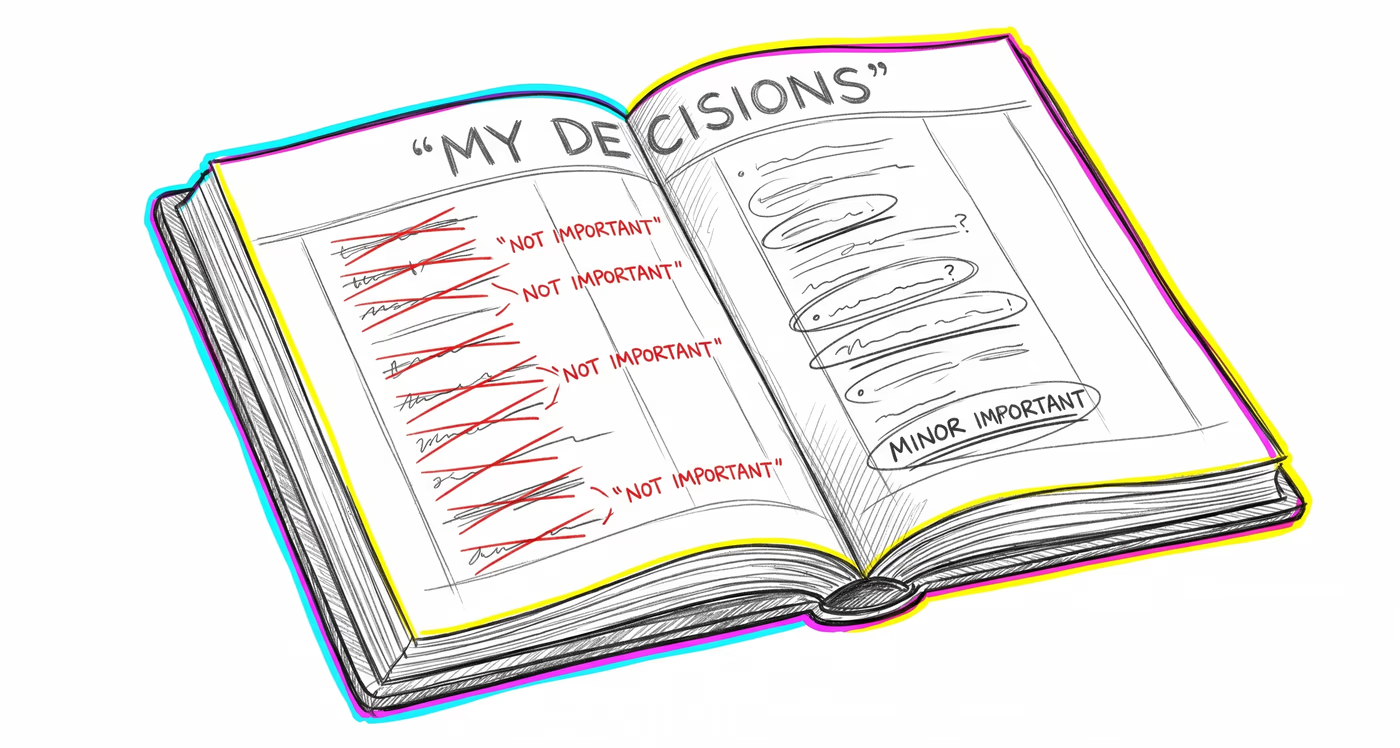
The tendency to attribute greater value to outcomes that required significant effort to achieve, regardless of their objective worth, as a way to resolve the discomfort of having suffered for a potentially underwhelming result.

WHAT IT IS

The glitch, explained plainly.

Imagine you wait in a super long line at a theme park for a ride. When the ride turns out to be just okay, your brain doesn't want to admit you wasted all that time standing in line. So instead, your brain tricks you into thinking the ride was actually really awesome — because otherwise, why would you have waited so long?

Effort justification occurs when individuals inflate the perceived value of an outcome specifically because they endured significant pain, sacrifice, or exertion to obtain it. The mechanism is driven by cognitive dissonance: when there is a gap between the high cost of effort and a lackluster reward, the mind resolves the tension by unconsciously upgrading its evaluation of the reward rather than admitting the effort was wasted. This leads people to rate boring discussion groups as fascinating after embarrassing initiations, to defend mediocre career paths they struggled through, or to insist that a difficult relationship was deeply meaningful. The effect is not limited to social contexts — controlled laboratory studies have demonstrated analogous preferences in children and even pigeons, suggesting a basic contrast mechanism may underlie the phenomenon alongside higher-order dissonance reduction.

SOUND FAMILIAR?

Where it shows up.

  1. 01 Maria spent six grueling months training for a marathon. On race day, she finished in the back third of runners and the experience was physically miserable. When friends ask about it, she describes it as 'the most transformative experience of my life' and immediately signs up for another, insisting the first one was deeply rewarding.
  2. 02 A law student endures three brutal years of study, massive debt, and sleep deprivation to pass the bar exam. Upon entering practice, he finds the work tedious and unfulfilling. When a friend suggests he might be happier switching careers, he becomes defensive and insists that law is a profoundly meaningful profession — pointing to how hard he worked to get there as proof of its importance.
  3. 03 A fraternity requires pledges to endure weeks of degrading tasks before initiation. New members who completed the hazing overwhelmingly rate the fraternity as 'exceptional' and 'like family,' while transfer students who joined without hazing rate it as 'decent.' Both groups attend the same events and meet the same people.
  4. 04 A therapy patient has been attending twice-weekly sessions for two years with modest improvement. When her insurance suggests switching to a more evidence-based provider, she refuses, arguing that the deep work she's done with her current therapist is irreplaceable. She specifically cites how emotionally difficult the sessions have been as evidence of their therapeutic power.
  5. 05 A software company requires applicants to complete a notoriously difficult five-round interview process. New hires who survived this gauntlet consistently rate the company culture as superior to their previous employers, even though internal satisfaction surveys reveal average workplace conditions. Meanwhile, employees who joined through acqui-hires without the interview process rate the culture neutrally.
IN DIFFERENT DOMAINS

Where it shows up at work.

The same glitch looks different depending on the terrain. Finance, medicine, a relationship, a team — same mechanism, different costume.

Finance & investing

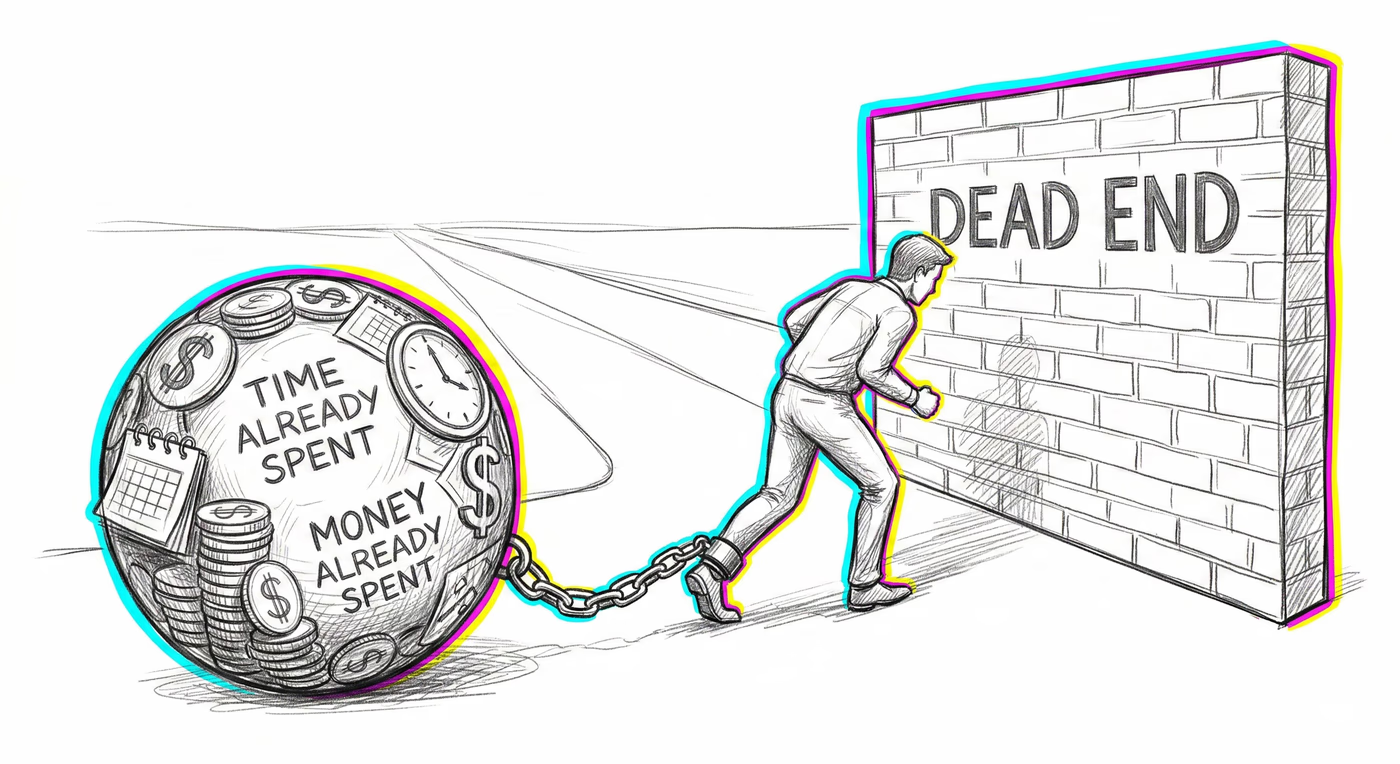
Investors who endured significant research effort, complex due diligence, or painful losses to acquire a position tend to overvalue that holding and resist selling even when fundamentals deteriorate, because abandoning it would invalidate the suffering they endured to build the position.

Medicine & diagnosis

Patients who undergo painful, lengthy, or expensive treatments tend to report higher satisfaction with outcomes than objectively warranted, and may resist switching to simpler, equally effective alternatives because doing so would imply their prior suffering was unnecessary.

Education & grading

Students who struggle intensely through difficult coursework tend to rate those courses as more valuable and important than easier ones with equivalent learning outcomes, leading institutions to conflate rigor with quality.

Relationships

People who invest enormous emotional labor in a difficult relationship tend to overvalue the partnership and resist leaving, interpreting the suffering itself as evidence of depth and commitment rather than dysfunction.

Tech & product

Products with complex onboarding or steep learning curves can paradoxically generate fiercer user loyalty than intuitive competitors, because users who invested effort to master the system inflate its perceived superiority to justify their struggle.

Workplace & hiring

Employees who endured grueling hiring processes, extensive training programs, or difficult early assignments tend to rate their organization more favorably and show higher loyalty than those who were onboarded easily, independent of actual working conditions.

Politics Media

Voters who invested significant time and emotional energy supporting a candidate or cause tend to defend that position more vigorously as contradicting evidence mounts, because reversing course would mean admitting their passionate advocacy was misdirected.

HOW TO SPOT IT

Ask yourself…

  • Am I defending the value of this outcome primarily because of how hard I worked for it, rather than its actual results?
  • If I had obtained this same outcome with zero effort, would I still rate it as highly?
  • Am I feeling defensive when someone suggests an easier alternative — and is that defensiveness about the alternative's quality, or about protecting my sense that my effort was worthwhile?
HOW TO DEFEND AGAINST IT

The playbook.

  • Apply the 'fresh eyes' test: Ask yourself, 'If a stranger described this outcome to me without mentioning the effort, would I still find it impressive?'
  • Separate effort from value explicitly: Write down the objective quality of the outcome in one column and the effort invested in another. Evaluate the outcome column alone.
  • Seek outside opinions from people who have no knowledge of your effort investment — their unbiased evaluation reveals the outcome's true merit.
  • Practice 'pre-mortem' thinking before investing effort: Define what a genuinely valuable outcome looks like in advance, so post-hoc inflation has less room to operate.
  • Normalize quitting: Remind yourself that walking away from something that isn't working is a sign of good judgment, not wasted effort.
FAMOUS CASES

In history.

  • The Vietnam War has been cited as an example where escalating military commitment was partly justified by the enormous sacrifices already made, making withdrawal psychologically unacceptable to decision-makers.
  • Fraternity and military hazing traditions persist in part because members who endured harsh initiations develop inflated loyalty to the group, perpetuating the cycle.
  • Cult organizations historically leverage demanding initiation rituals and extreme personal sacrifices to intensify members' commitment and perceived value of membership.
WHERE IT COMES FROM
Academic origin

Rooted in Leon Festinger's cognitive dissonance theory (1957). The specific effort justification paradigm was empirically established by Elliot Aronson and Judson Mills in 1959 with their landmark initiation severity study.

Evolutionary origin

In ancestral environments, effort typically did correlate with value — resources that were harder to acquire (distant water sources, well-defended prey, hard-to-reach fruit) were often genuinely more nutritious or scarce. A mental heuristic linking effort to worth would have reinforced persistence and discouraged giving up on difficult but survival-critical tasks, promoting tenacity in harsh conditions.

IN AI SYSTEMS

How the machines inherit it.

Effort justification does not directly manifest in AI systems since they lack subjective experience. However, users who invest significant effort in prompt engineering, fine-tuning, or configuring AI tools tend to overvalue the output quality of their particular setup relative to simpler alternatives, resisting migration to objectively better systems because it would invalidate their invested labor.

Read more on Wikipedia
FREE FIELD ZINE

10 glitches quietly running your life.

A free field-zine PDF — ten cognitive glitches named, illustrated, with a defense move for each. Plus the weekly Glitch Report on Fridays — one bias named, two spotted in the wild, one defense move. Unsubscribe any time.

EXPLORE MORE

Related glitches.

LAUNCH PRICE

Train against your blindspots.

50 cards are free to preview. Buyers unlock the rest of the deck plus the interactive training — Spot-the-Bias Quiz unlimited, Swipe Deck with spaced repetition, My Blindspots, Decision Pre-Flight, the Printable Deck + Cheat Sheets, and the Field Guide e-book. $29.50$59.

Unlock the full deck

Everything below — yours forever. Pay once, use across every device.

Half-off launch — limited to the first 100 readers. Auto-applied at checkout.
$59 $29.50
one-time payment · lifetime access
  • All interactive digital cards — search, filter, flip, shuffle on any device
  • Five training modes — Spot-the-Bias Quiz, Swipe Deck, Pre-Flight, Blindspots, Journal
  • Curated Lenses + Decision Templates + Defense Playbook
  • Printable Deck PDFs + Field Guide e-book + Cheat Sheets + Anki Export
  • Every future improvement, included
Unlock  $29.50

30-day refund · no questions asked

Unlock the full deck

Everything below — yours forever. Pay once, use across every device.

Half-off launch — limited to the first 100 readers. Auto-applied at checkout.
$59 $29.50
one-time payment · lifetime access
  • All interactive digital cards — search, filter, flip, shuffle on any device
  • Five training modes — Spot-the-Bias Quiz, Swipe Deck, Pre-Flight, Blindspots, Journal
  • Curated Lenses + Decision Templates + Defense Playbook
  • Printable Deck PDFs + Field Guide e-book + Cheat Sheets + Anki Export
  • Every future improvement, included
Unlock  $29.50

30-day refund · no questions asked