False Memory Syndrome

aka False Memory · Pseudomemory · Memory Implantation Effect

Vividly remembering events that never happened, or remembering real events very differently from how they occurred.

WHAT IT IS

The glitch, explained plainly.

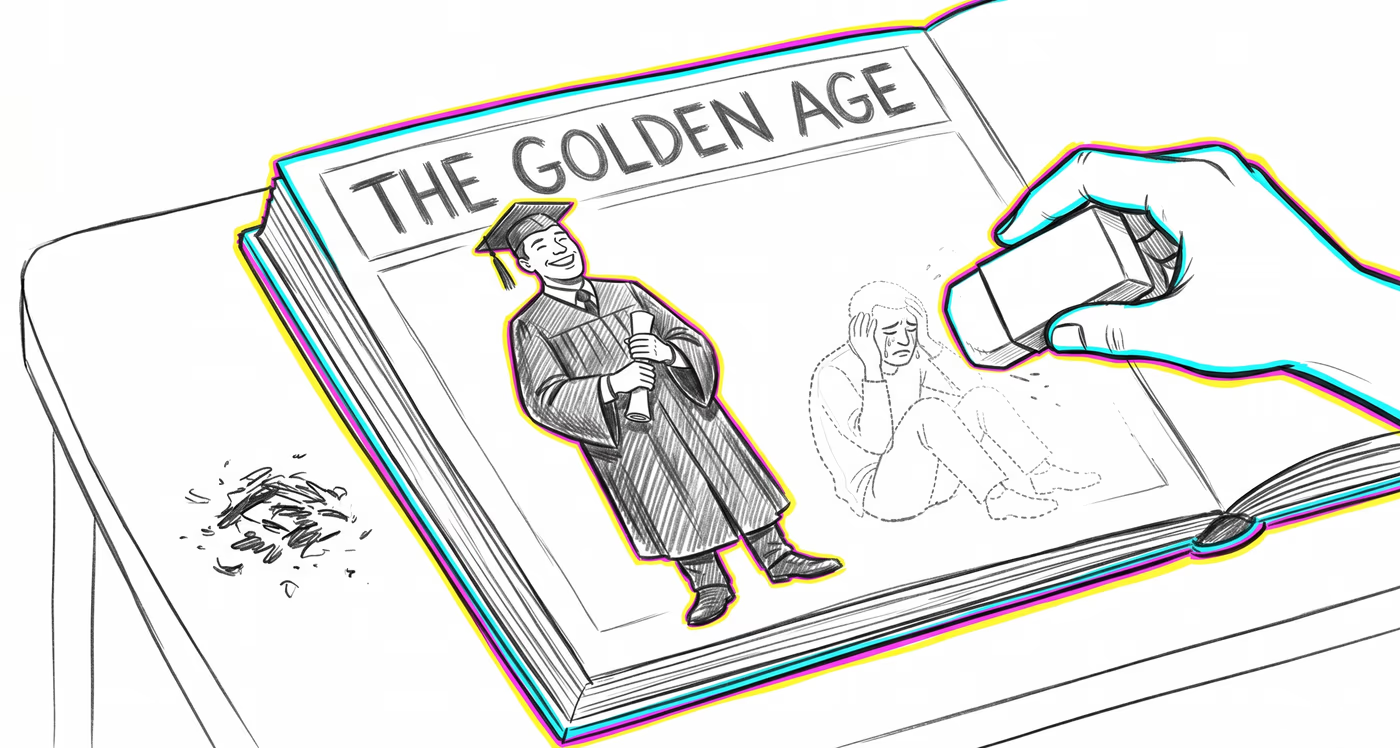
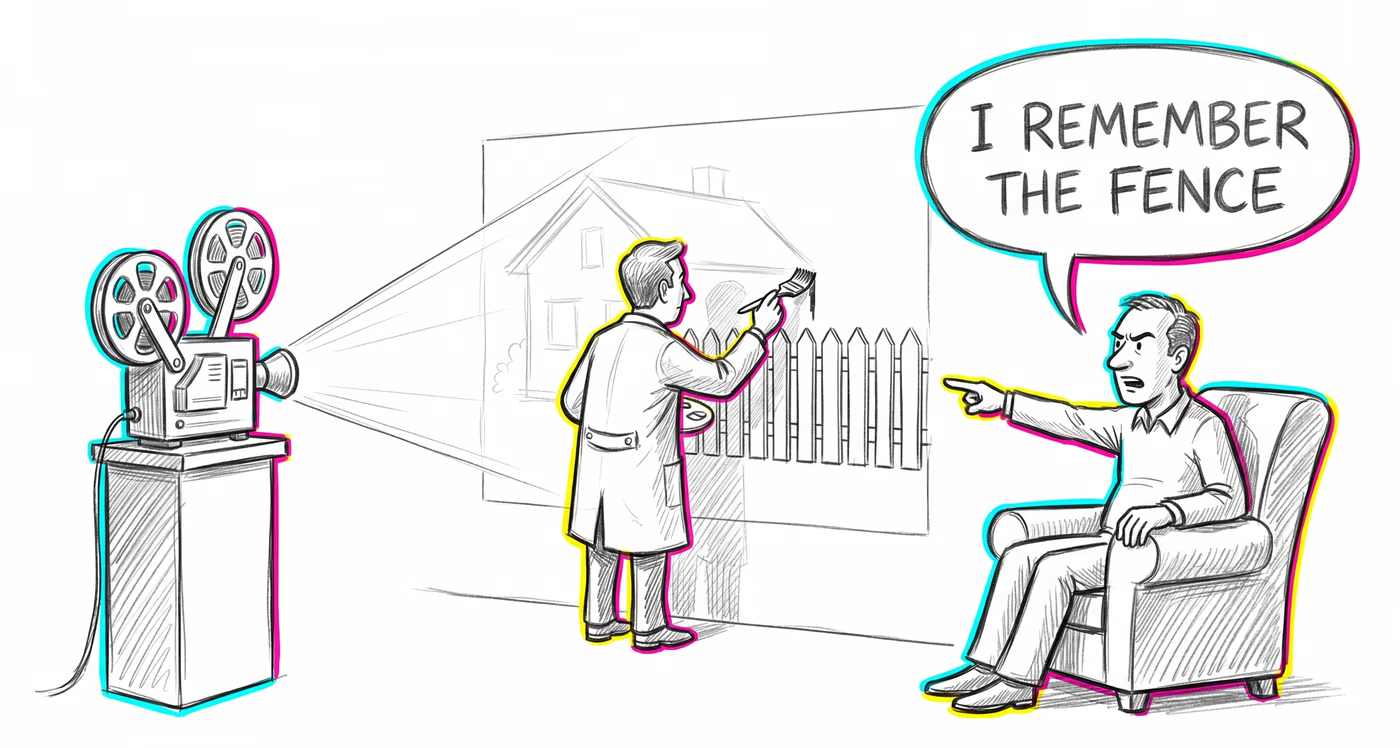
Imagine your brain is like a storyteller who really hates leaving blanks in a story. If some parts of a memory are missing or fuzzy, your brain just makes up details to fill in the gaps — and then forgets it made them up. So you end up with a memory that feels completely real, with colors and sounds and feelings, but parts of it (or all of it) were invented by your own brain. It's like your brain accidentally writes fan fiction about your own life and then files it in the 'real memories' folder.

False Memory Syndrome describes the phenomenon where individuals develop confident, detailed recollections of events that never actually occurred, or remember real events in fundamentally distorted ways. These pseudo-memories can be spontaneously generated through the brain's natural tendency to fill gaps with plausible details, or they can be externally induced through suggestive questioning, therapeutic techniques, or exposure to misleading post-event information. What makes false memories particularly insidious is that they carry the same subjective phenomenology as genuine memories — the person experiences vivid sensory details, emotional resonance, and unwavering certainty. Once formed, false memories are remarkably resistant to correction, as the individual cannot introspectively distinguish them from authentic recollections.

SOUND FAMILIAR?

Where it shows up.

  1. 01 A woman undergoes several months of therapy using guided imagery and hypnosis to explore her childhood. Gradually, she begins to 'remember' vivid scenes of being locked in a closet by her parents — events her siblings insist never happened and that she had no memory of before therapy began. She is now completely certain these events occurred and has cut off contact with her family.
  2. 02 After a car accident, a witness tells police the driver ran a red light. During subsequent interviews, an investigator repeatedly asks about 'the moment the car sped through the red light.' Two weeks later, a second witness — who originally wasn't sure about the light's color — now vividly recalls seeing it turn red and provides specific details about the intersection that align with the first witness's account.
  3. 03 A college student is shown a list of words: bed, rest, awake, tired, dream, wake, snooze, blanket, doze, slumber. When tested later, the student confidently reports that the word 'sleep' was on the list and even claims to specifically remember hearing it, despite it never being presented.
  4. 04 A man attends a family reunion where his uncle tells an elaborate story about the time the man got lost at a county fair when he was five. Though the man initially has no memory of this, after hearing the story repeatedly from a trusted relative and seeing photos from that fair, he gradually develops a detailed recollection of the experience — including the smell of popcorn and the sound of carnival music — none of which his uncle ever mentioned.
  5. 05 A jury member recalls during deliberation that the defendant's alibi witness seemed 'nervous and evasive' during testimony. Other jurors who reviewed the same video footage note that the witness appeared calm and straightforward. The juror had read a pretrial news article describing the witness as 'questionable,' and this framing reshaped her actual memory of watching the testimony.
IN DIFFERENT DOMAINS

Where it shows up at work.

The same glitch looks different depending on the terrain. Finance, medicine, a relationship, a team — same mechanism, different costume.

Finance & investing

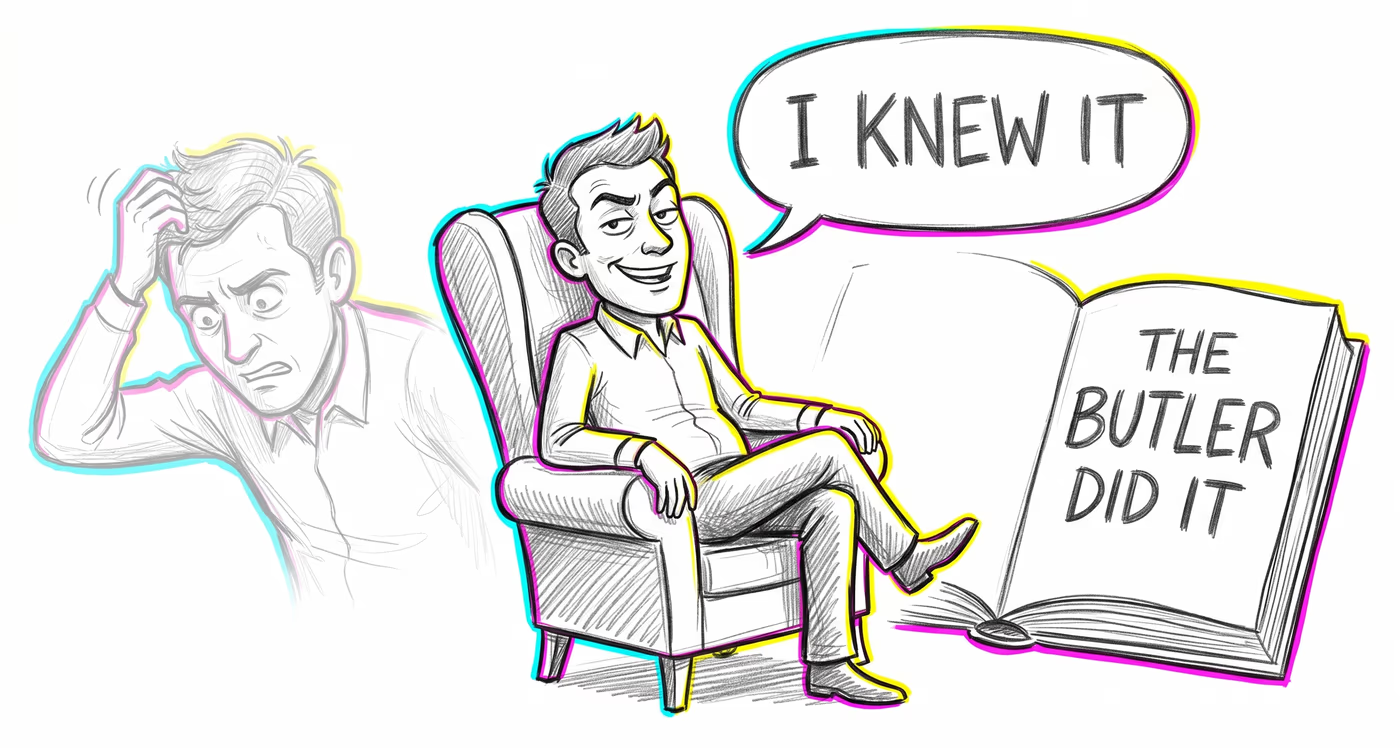
Investors may construct false memories of their original investment thesis after learning the outcome, remembering that they 'always knew' a stock would perform a certain way. Financial advisors relying on client recollections of past risk tolerance may receive confidently stated but inaccurate accounts that shift based on recent market performance.
Medicine & diagnosis

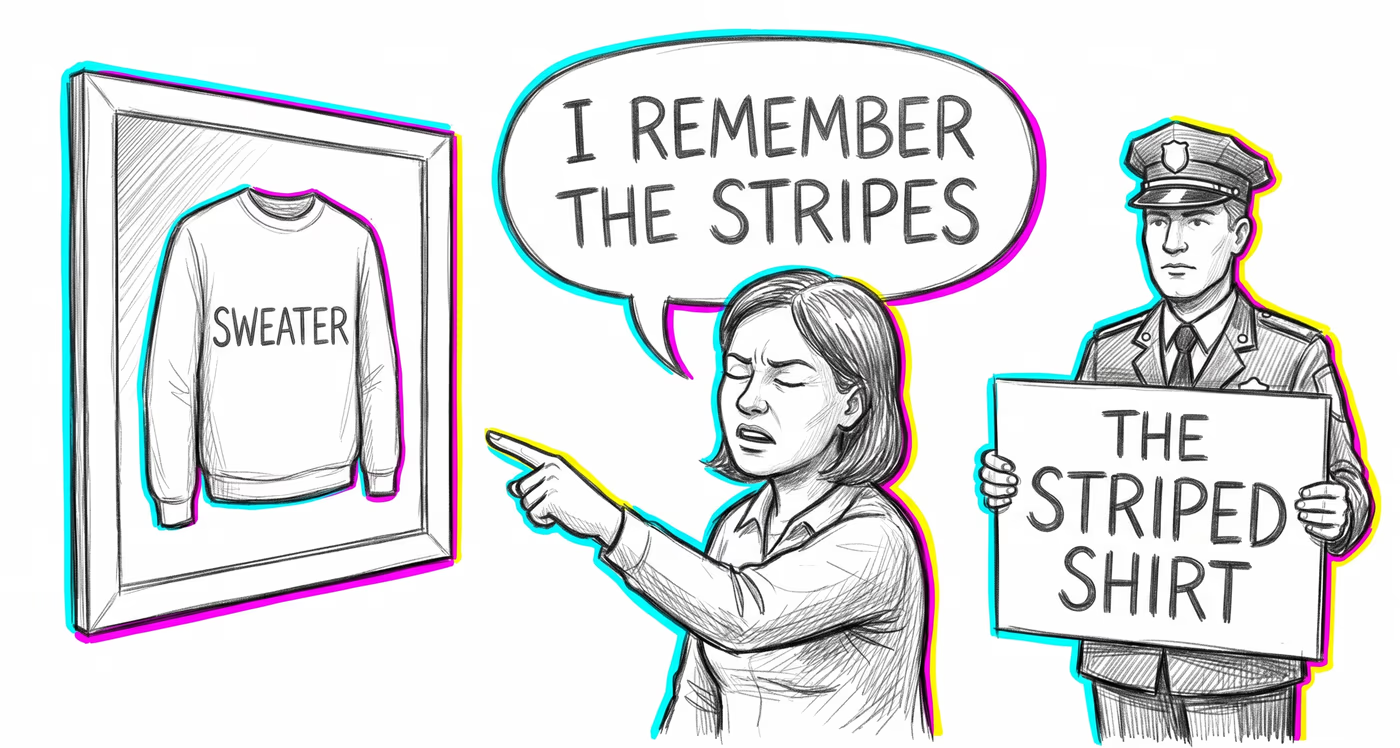
Patients may develop false memories of symptoms or medical events through repeated suggestive questioning during clinical intake, leading to misdiagnosis. Therapeutic contexts involving hypnosis or guided imagery have historically produced pseudo-memories of trauma, leading to iatrogenic harm and complicating accurate clinical history-taking.

Education & grading

Students who study collaboratively may absorb classmates' incorrect recollections as their own, creating false memories of what was taught in lectures. Repeated exposure to incorrect information in study materials can create confident but erroneous recollections that persist through exams and beyond.

Relationships

Partners in conflict may develop increasingly distorted memories of the same argument, each sincerely remembering words and tones that the other never used. Family members exposed to repeated narratives about shared events gradually converge on a collective false memory that none of them originally experienced.

Tech & product

User testing sessions that employ leading questions can produce false recollections of interface interactions that never occurred, corrupting usability data. Social media platforms that resurface algorithmically reconstructed photo collages or 'memories' may prompt users to generate false autobiographical details around events they barely experienced.

Workplace & hiring

Performance reviews based on recollection rather than documentation are vulnerable to false memories, where managers reconstruct a narrative of employee behavior that aligns with their current impression rather than actual past events. In workplace investigations, repeated interviews with leading questions can implant false memories in witnesses.

Politics Media

Voters may develop false memories of political events or candidate statements after exposure to misleading campaign ads or partisan media framing. Repeated exposure to fabricated news stories can produce genuine false memories of events that never occurred, with individuals later citing these pseudo-memories as personal knowledge.

HOW TO SPOT IT

Ask yourself…

  • Am I adding vivid details to this memory that I might not have actually experienced, but that 'make sense' given the narrative?
  • Could someone else's retelling or a photo or media clip be the actual source of what I think I personally remember?
  • Has this memory become more detailed or more certain over time rather than fading, which would be unusual for a genuine old memory?
HOW TO DEFEND AGAINST IT

The playbook.

  • Corroborate important memories with external evidence (documents, photos, recordings) before acting on them, especially in high-stakes situations.
  • Practice source monitoring: actively ask 'Where did I learn this? Did I see it myself, hear about it, imagine it, or dream it?'
  • Be skeptical of memories that become more vivid and detailed over time rather than fading — this is a red flag for reconstruction.
  • Avoid repeated suggestive questioning of yourself or others about uncertain events, as each retrieval attempt can modify the memory.
  • When recounting shared events, write down your version independently before discussing with others to prevent memory contamination.
FAMOUS CASES

In history.

  • The 1980s–1990s 'Satanic Panic' and recovered memory therapy movement, where suggestive therapeutic techniques led numerous patients to develop false memories of ritual abuse that destroyed families and resulted in wrongful prosecutions.
  • The wrongful conviction of George Franklin Sr. in 1990, based largely on his daughter's 'recovered memory' of witnessing a murder 20 years earlier — a memory that emerged during therapy and was later discredited.
  • The McMartin Preschool trial (accusations began 1983, trial 1987–1990), one of the longest and most expensive criminal trials in U.S. history, where suggestive interviewing techniques with children produced elaborate false allegations of abuse involving secret tunnels and rituals.
WHERE IT COMES FROM
Academic origin

The concept of false memory has deep roots in the work of Pierre Janet and Sigmund Freud in the late 19th century, but the modern empirical framework was established by Elizabeth Loftus through her misinformation effect research in the 1970s and the seminal 'Lost in the Mall' study with Jacqueline Pickrell in 1995. The DRM paradigm, created by James Deese in 1959 and revitalized by Henry Roediger III and Kathleen McDermott in 1995, provided the primary laboratory method for studying false memories. The term 'False Memory Syndrome' was coined in 1992 by the False Memory Syndrome Foundation.

Evolutionary origin

Reconstructive memory likely evolved because storing exact replicas of every experience would be metabolically prohibitive and informationally redundant. A system that encodes gist and reconstructs details on demand is far more efficient and allows for flexible generalization — extracting patterns, making predictions, and applying past learning to novel situations. The tendency to fill narrative gaps with plausible details also served social cohesion, enabling coherent storytelling and shared cultural knowledge transmission even when precise details were lost.

IN AI SYSTEMS

How the machines inherit it.

LLMs exhibit a direct analog to false memory called 'hallucination' or 'confabulation,' where models generate plausible-sounding but entirely fabricated information — including nonexistent academic citations, fictional events, and false biographical details — with high confidence. Like human false memories, these fabrications arise from pattern-completion mechanisms that prioritize coherence and plausibility over factual accuracy. Research from MIT Media Lab has shown that conversational AI can also amplify false memory formation in humans, with LLM-powered chatbots inducing over three times more false memories than control conditions in simulated witness interviews.

Read more on Wikipedia
FREE FIELD ZINE

10 glitches quietly running your life.

A free field-zine PDF — ten cognitive glitches named, illustrated, with a defense move for each. Plus the weekly Glitch Report on Fridays — one bias named, two spotted in the wild, one defense move. Unsubscribe any time.

EXPLORE MORE

Related glitches.

LAUNCH PRICE

Train against your blindspots.

50 cards are free to preview. Buyers unlock the rest of the deck plus the interactive training — Spot-the-Bias Quiz unlimited, Swipe Deck with spaced repetition, My Blindspots, Decision Pre-Flight, the Printable Deck + Cheat Sheets, and the Field Guide e-book. $29.50$59.

Unlock the full deck

Everything below — yours forever. Pay once, use across every device.

Half-off launch — limited to the first 100 readers. Auto-applied at checkout.
$59 $29.50
one-time payment · lifetime access
  • All interactive digital cards — search, filter, flip, shuffle on any device
  • Five training modes — Spot-the-Bias Quiz, Swipe Deck, Pre-Flight, Blindspots, Journal
  • Curated Lenses + Decision Templates + Defense Playbook
  • Printable Deck PDFs + Field Guide e-book + Cheat Sheets + Anki Export
  • Every future improvement, included
Unlock  $29.50

30-day refund · no questions asked

Unlock the full deck

Everything below — yours forever. Pay once, use across every device.

Half-off launch — limited to the first 100 readers. Auto-applied at checkout.
$59 $29.50
one-time payment · lifetime access
  • All interactive digital cards — search, filter, flip, shuffle on any device
  • Five training modes — Spot-the-Bias Quiz, Swipe Deck, Pre-Flight, Blindspots, Journal
  • Curated Lenses + Decision Templates + Defense Playbook
  • Printable Deck PDFs + Field Guide e-book + Cheat Sheets + Anki Export
  • Every future improvement, included
Unlock  $29.50

30-day refund · no questions asked