Spotlight Effect

aka Social Spotlight Bias · Imaginary Audience Effect

Overestimating how much other people notice and care about your appearance, behavior, and mistakes.

WHAT IT IS

The glitch, explained plainly.

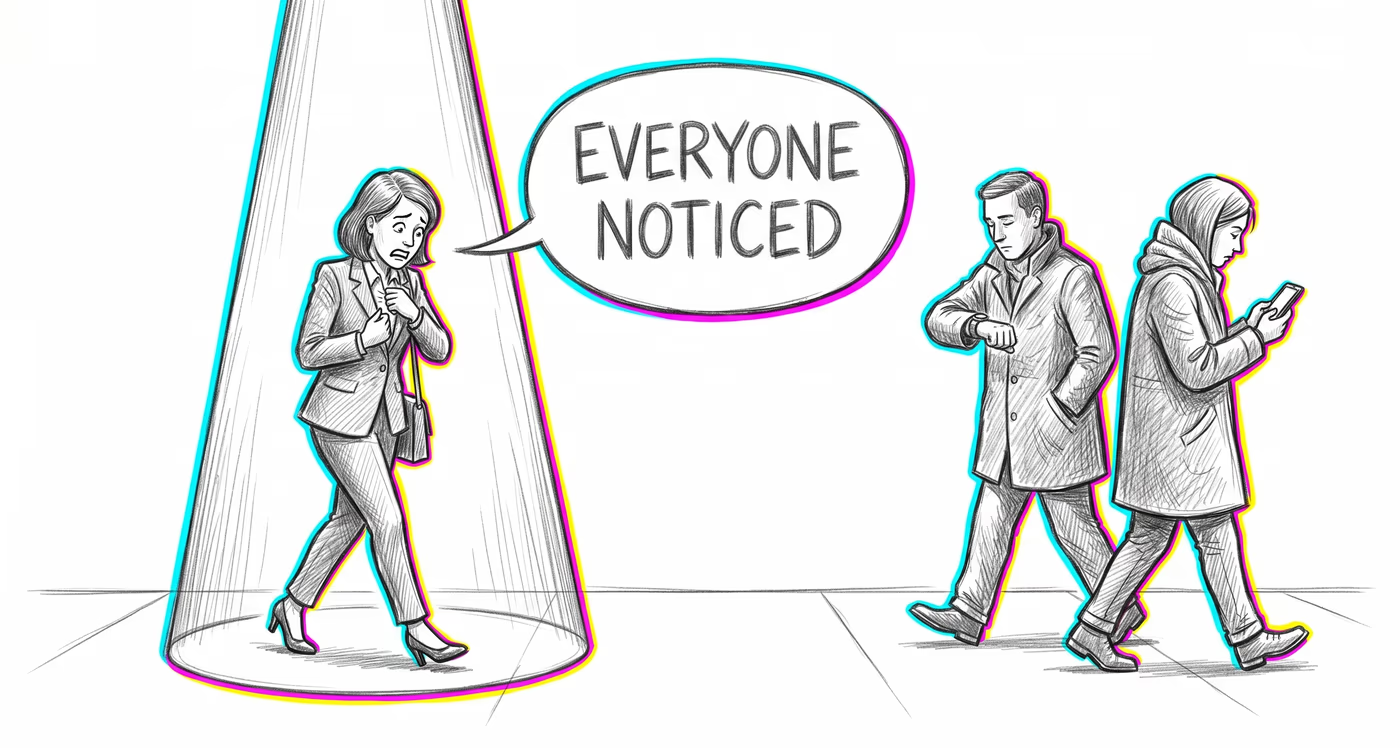
Imagine you're in a school play and you forget one line. You feel like everyone in the whole audience saw it and will talk about it forever. But really, most people didn't even notice because they were thinking about their own stuff — like what they're having for dinner or whether their own hair looks okay.

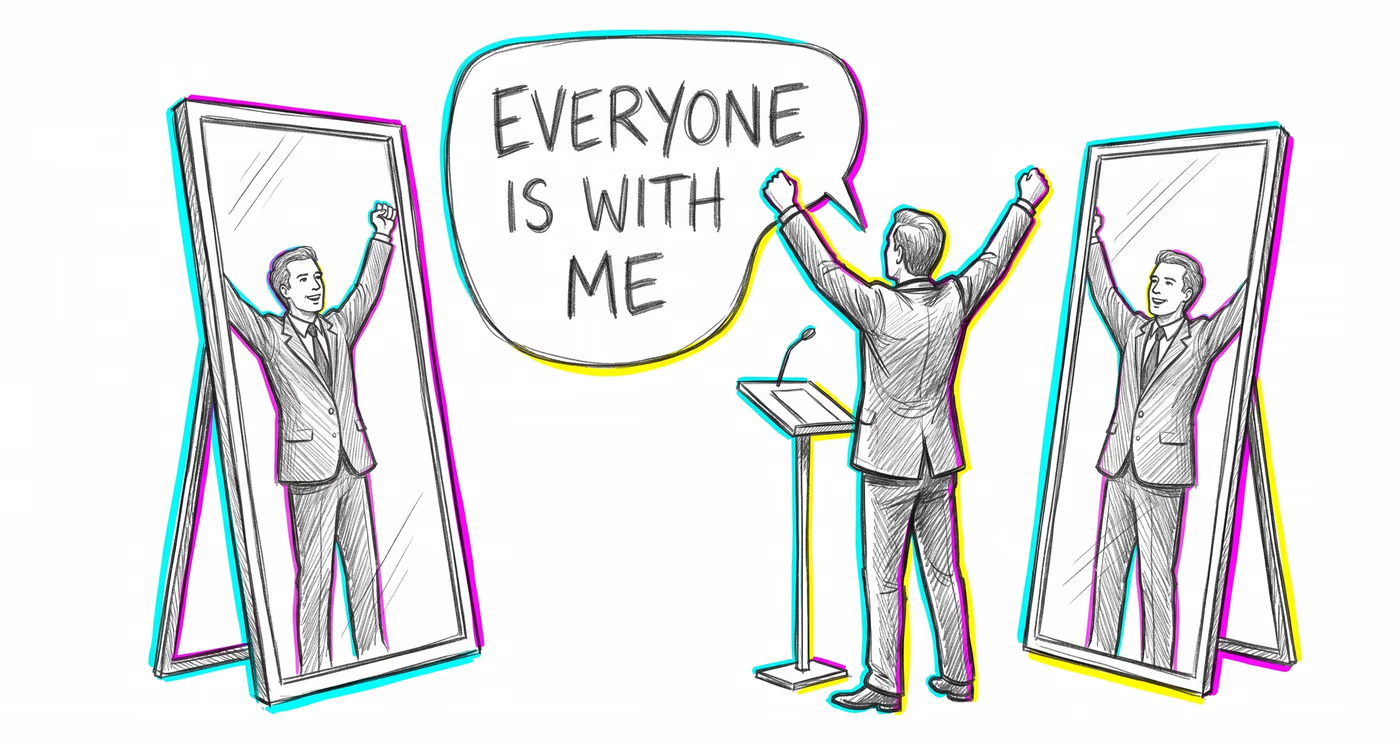
The Spotlight Effect describes the pervasive human tendency to believe we are the center of others' attention far more than we actually are. When we commit a social faux pas, wear something unusual, or say something awkward, we feel as though an enormous spotlight is illuminating our misstep for everyone to see and judge. This overestimation applies equally to both negative events (embarrassments, mistakes) and positive events (accomplishments, impressive contributions), though the effect is typically more distressing when tied to perceived failures. The bias is driven by a failure to adequately adjust away from our own vivid internal experience when predicting what others notice, leaving us anchored to a self-focused perspective that inflates our perceived visibility.

SOUND FAMILIAR?

Where it shows up.

  1. 01 Maria accidentally walks into a glass door at a busy café. She immediately assumes every patron is watching and laughing, and she avoids that café for months. Her friend who was with her later mentions she didn't even see the other customers react.
  2. 02 During a team standup, Kevin stumbles over his words while giving a project update. For the rest of the week, he avoids informal conversations with teammates, convinced they now see him as incompetent. When he finally asks a colleague about it, she says she doesn't remember anything unusual about his update.
  3. 03 Priya gives a well-received conference talk but fixates on one moment where she lost her train of thought for three seconds. She estimates that most of the 200-person audience noticed and found it awkward, despite receiving overwhelmingly positive feedback and no one mentioning the pause.
  4. 04 After getting a noticeably bad haircut, David wears a hat to the office every day for two weeks. When he finally goes without the hat, he is surprised that only one person comments on his hair. He had been certain the entire department would remark on it.
  5. 05 A junior analyst suggests a bold but ultimately wrong forecast in a strategy meeting. Although the conversation quickly moves on and her manager offers supportive feedback afterward, she spends weeks convinced the senior leadership permanently revised their opinion of her competence based on that single comment — and turns down an opportunity to present at the next quarterly review as a result.
IN DIFFERENT DOMAINS

Where it shows up at work.

The same glitch looks different depending on the terrain. Finance, medicine, a relationship, a team — same mechanism, different costume.

Finance & investing

Investors may avoid asking basic questions in meetings or during advisory sessions, overestimating how much others will notice and judge their lack of knowledge, leading them to make uninformed decisions rather than risk perceived embarrassment.
Medicine & diagnosis

Patients may delay seeking help for embarrassing symptoms — such as skin conditions, incontinence, or mental health issues — because they overestimate how much healthcare providers and others will notice and judge them, leading to worse health outcomes.

Education & grading

Students who make a mistake during a class presentation may become reluctant to participate in future discussions, overestimating how much their classmates noticed and remembered the error, which suppresses academic engagement and learning.

Relationships

People may avoid initiating romantic conversations or expressing vulnerability because they overestimate how closely a potential partner is scrutinizing their every word and gesture, leading to missed connections and emotional distance.

Tech & product

Users may abandon sign-up flows or avoid posting content on social platforms due to exaggerated fears about how their profile, photo, or first post will be perceived by the wider community, reducing engagement and retention metrics.

Workplace & hiring

Employees who make a minor error in a presentation or email may overestimate how much their managers and peers noticed, leading them to avoid future high-visibility projects, limit their contributions in meetings, and stall their career progression.

Politics Media

Public figures and candidates may over-correct after minor gaffes, issuing extensive apologies or changing policy positions in response to incidents that most voters never noticed or quickly forgot, distorting their messaging strategy.

HOW TO SPOT IT

Ask yourself…

  • Am I assuming people noticed or are thinking about something I did, or do I have actual evidence they noticed?
  • If a friend did the same thing I just did, would I still be thinking about it an hour later — or would I have already forgotten?
  • Am I anchoring to how I feel about this moment instead of realistically estimating how much attention others are paying me?
HOW TO DEFEND AGAINST IT

The playbook.

  • Apply the 'friend test': Ask yourself if you would notice or remember this event if it happened to someone else. The answer is almost always no.
  • Use temporal distancing: Ask yourself whether anyone will remember this in a week, a month, or a year. Most social moments evaporate from others' memory within minutes.
  • Practice deliberate perspective-taking: Consciously imagine the scene from another person's point of view and notice how little of your behavior occupies their mental bandwidth.
  • Run a reality check: After a social event, ask a trusted friend what they noticed. The mismatch between your fear and their obliviousness is itself a debiasing lesson.
  • Delay your self-assessment: Research shows the spotlight effect diminishes when you wait before evaluating how much others noticed, because your own emotional anchor weakens over time.
FAMOUS CASES

In history.

  • The original Gilovich, Medvec, and Savitsky (2000) Barry Manilow T-shirt experiments at Cornell University, which empirically demonstrated that participants wearing an embarrassing shirt estimated roughly 50% of observers noticed it, while only about 25% actually did.
WHERE IT COMES FROM
Academic origin

Thomas Gilovich, Victoria Husted Medvec, and Kenneth Savitsky coined the term in 1999 (Current Directions in Psychological Science) and published the seminal empirical paper in 2000 in the Journal of Personality and Social Psychology.

Evolutionary origin

In small ancestral groups where social reputation directly affected survival, mating, and resource access, being hypersensitive to potential social evaluation was adaptive. Overestimating how closely others monitored your behavior motivated careful impression management, norm compliance, and avoidance of social transgressions that could lead to ostracism — a potentially fatal outcome in tight-knit hunter-gatherer bands.

IN AI SYSTEMS

How the machines inherit it.

AI systems trained on social media data may inherit and amplify spotlight-effect-like patterns by disproportionately modeling self-referential and attention-seeking content, reinforcing personalization algorithms that treat user behavior as more socially visible and consequential than it is. Recommendation systems may also exploit the bias by overemphasizing social metrics (likes, views) that make users feel they are being watched and evaluated.

Read more on Wikipedia
FREE FIELD ZINE

10 glitches quietly running your life.

A free field-zine PDF — ten cognitive glitches named, illustrated, with a defense move for each. Plus the weekly Glitch Report on Fridays — one bias named, two spotted in the wild, one defense move. Unsubscribe any time.

EXPLORE MORE

Related glitches.

LAUNCH PRICE

Train against your blindspots.

50 cards are free to preview. Buyers unlock the rest of the deck plus the interactive training — Spot-the-Bias Quiz unlimited, Swipe Deck with spaced repetition, My Blindspots, Decision Pre-Flight, the Printable Deck + Cheat Sheets, and the Field Guide e-book. $29.50$59.

Unlock the full deck

Everything below — yours forever. Pay once, use across every device.

Half-off launch — limited to the first 100 readers. Auto-applied at checkout.
$59 $29.50
one-time payment · lifetime access
  • All interactive digital cards — search, filter, flip, shuffle on any device
  • Five training modes — Spot-the-Bias Quiz, Swipe Deck, Pre-Flight, Blindspots, Journal
  • Curated Lenses + Decision Templates + Defense Playbook
  • Printable Deck PDFs + Field Guide e-book + Cheat Sheets + Anki Export
  • Every future improvement, included
Unlock  $29.50

30-day refund · no questions asked

Unlock the full deck

Everything below — yours forever. Pay once, use across every device.

Half-off launch — limited to the first 100 readers. Auto-applied at checkout.
$59 $29.50
one-time payment · lifetime access
  • All interactive digital cards — search, filter, flip, shuffle on any device
  • Five training modes — Spot-the-Bias Quiz, Swipe Deck, Pre-Flight, Blindspots, Journal
  • Curated Lenses + Decision Templates + Defense Playbook
  • Printable Deck PDFs + Field Guide e-book + Cheat Sheets + Anki Export
  • Every future improvement, included
Unlock  $29.50

30-day refund · no questions asked