Illusory Superiority

aka Above-Average Effect · Better-Than-Average Effect · Superiority Bias

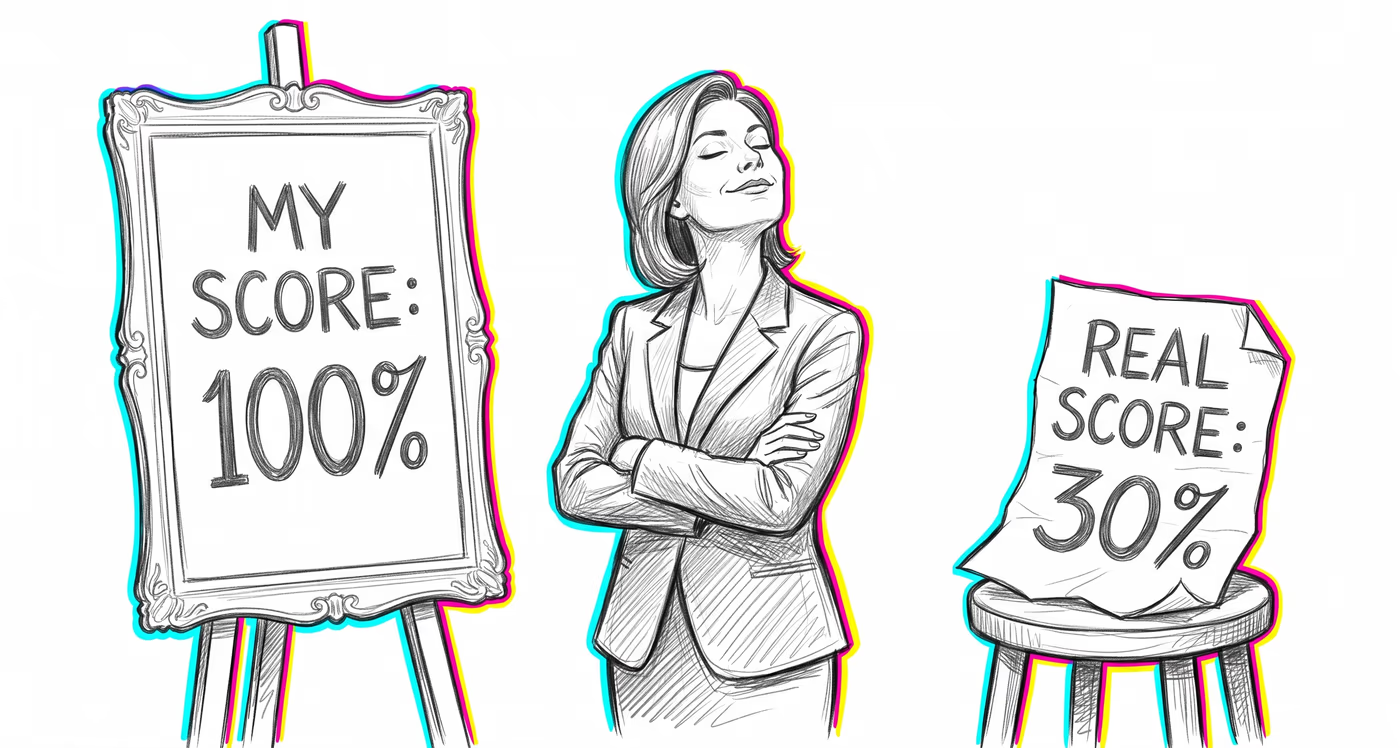
Believing you are above average on most positive traits — smarter, kinder, more skilled — even when that's statistically impossible for everyone.

WHAT IT IS

The glitch, explained plainly.

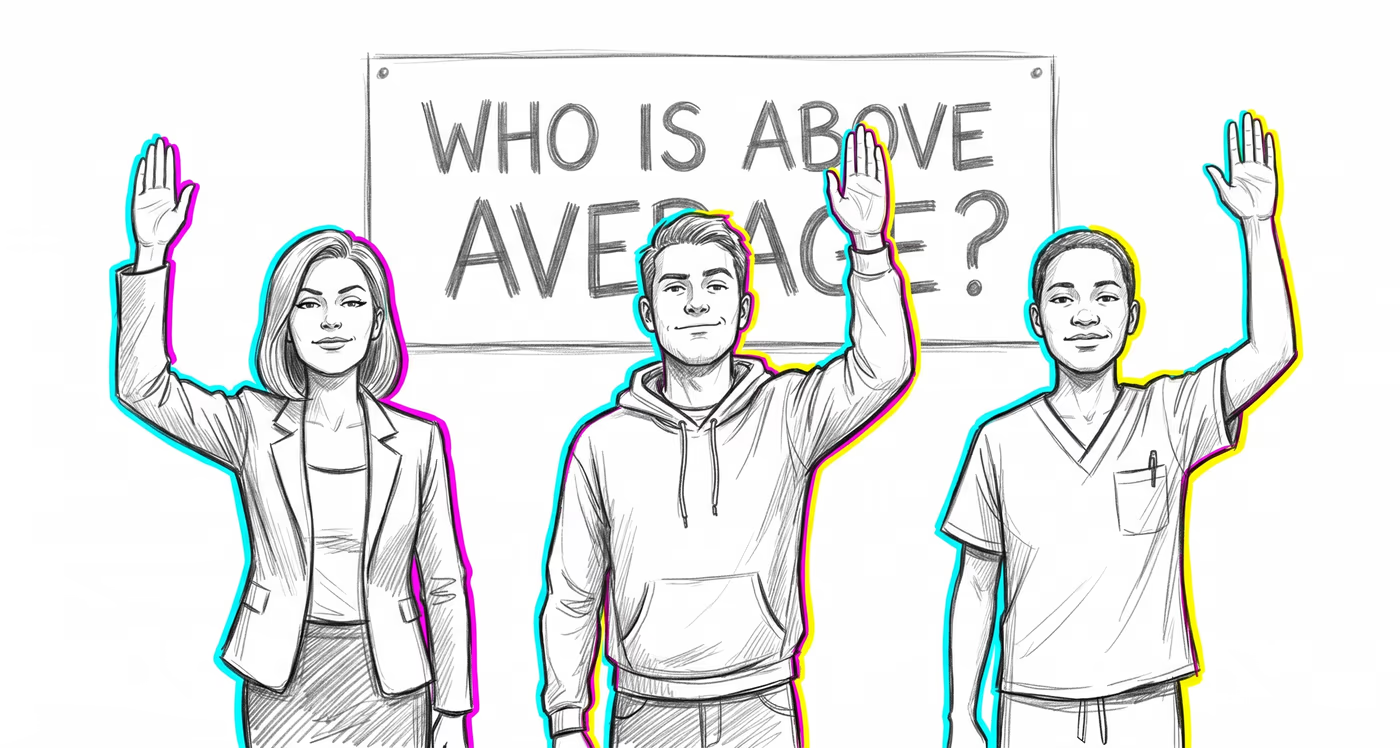
Imagine a classroom where the teacher asks every kid to raise their hand if they think they're a better-than-average student. Almost every hand goes up. But 'average' means half the kids should be below it — so a lot of those raised hands are wrong. That's illusory superiority: almost everyone thinks they're in the top half, even though that's impossible for everyone at once.

Illusory superiority is a pervasive self-enhancement bias in which individuals systematically rate themselves as superior to the average person across a wide range of attributes — intelligence, driving skill, health behaviors, moral character, interpersonal skills, and professional competence. The effect is robust across many life domains and persists even when people are given specific, well-defined attributes to evaluate rather than vague ones. Importantly, the bias is not simply overconfidence in an absolute sense but specifically involves inflated comparative self-assessments: people believe they are better than most others, which is mathematically impossible for the majority of any population. The strength of the bias varies with how personally important the trait is to the individual and is modulated by cultural norms around self-enhancement versus modesty.

SOUND FAMILIAR?

Where it shows up.

  1. 01 A survey asks 200 employees at a company to rank their job performance relative to their colleagues. When the results are compiled, 87% of them have rated themselves as performing above the median. Management is puzzled by the discrepancy between these self-assessments and actual performance reviews.
  2. 02 After reading an article about how most investors underperform the market, Marcus feels reassured rather than concerned. He acknowledges that most people are bad at stock picking but is confident that he is among the skilled minority, despite his portfolio having returned below the index for three consecutive years.
  3. 03 Dr. Patel reviews a study showing that 94% of university professors rate their teaching as above average. She finds the statistic amusing and clearly sees the bias at work — then rates her own teaching as 'significantly above average' on her annual self-evaluation, genuinely believing her case is different from those deluded colleagues.
  4. 04 During a health seminar, attendees learn that most people overestimate how frequently they exercise and how healthily they eat compared to peers. Afterward, when filling out a lifestyle questionnaire, nearly every attendee still rates their own health habits as better than the average person's.
  5. 05 A startup founder pitches investors, claiming his team is 'in the top 5% of founding teams' and that their product intuition is 'far superior to competitors.' When asked for evidence, he cites the same early traction metrics that dozens of failed startups at the same stage also had, but interprets his numbers as uniquely promising.
IN DIFFERENT DOMAINS

Where it shows up at work.

The same glitch looks different depending on the terrain. Finance, medicine, a relationship, a team — same mechanism, different costume.

Finance & investing

Investors consistently overrate their stock-picking ability relative to other market participants, leading to excessive trading volume and below-market returns. This pattern persists even among professionals, with the majority of fund managers believing they will outperform benchmarks despite evidence that most do not.
Medicine & diagnosis

Physicians tend to overestimate their diagnostic accuracy relative to peers, which can reduce motivation to seek second opinions or consult decision-support tools. Patients similarly overestimate their adherence to treatment plans and healthy behaviors compared to others, leading to underreporting of risk factors.

Education & grading

The vast majority of professors rate their teaching as above average, creating resistance to pedagogical training and peer evaluation. Students likewise overestimate their understanding of material relative to classmates, which can reduce study effort and produce surprise at poor exam performance.

Relationships

Partners tend to believe they contribute more to household labor, emotional support, and relationship maintenance than their significant other does. This asymmetric perception of contribution is a common source of resentment and conflict in relationships.

Tech & product

Developers and designers frequently overestimate the usability and quality of their own code or interfaces compared to industry benchmarks, leading teams to skip user testing or dismiss usability feedback. Product managers may believe their feature prioritization instincts are superior to data-driven approaches.

Workplace & hiring

Employees consistently rate their own performance, teamwork ability, and leadership skills above those of their colleagues. This inflates expectations around promotions and compensation, and creates friction when feedback or rankings do not match self-perception.

Politics Media

Citizens tend to believe they are better than average at detecting misinformation, political bias, and propaganda, which paradoxically makes them less vigilant consumers of news. This self-assessed superiority in media literacy correlates with reduced fact-checking behavior.

HOW TO SPOT IT

Ask yourself…

  • Am I assuming I'm better at this than most people — and what objective evidence do I actually have for that belief?
  • If I asked five impartial observers to rate me on this skill, would they agree with my self-assessment?
  • Am I comparing myself to a vague 'average person' rather than to specific, concrete peers whose abilities I actually know?
HOW TO DEFEND AGAINST IT

The playbook.

  • Seek objective, quantitative feedback: track measurable outcomes (test scores, performance metrics, return rates) rather than relying on self-assessment.
  • Use specific comparison targets: compare yourself to named individuals with known abilities rather than a vague 'average person.'
  • Actively solicit honest criticism from trusted peers who will not flatter you, and practice receiving it non-defensively.
  • Before rating yourself on any dimension, explicitly consider counterarguments: list specific weaknesses or failures in that domain.
  • Adopt a pre-mortem mindset: imagine you have failed at the task and work backward to identify what you might be overestimating.
FAMOUS CASES

In history.

  • The 1976 College Board SAT survey found that 70% of nearly one million students rated their leadership ability above the median, and 85% rated their ability to get along with others above the median, with 25% placing themselves in the top 1%.
  • Svenson's 1981 driving study found 93% of American and 69% of Swedish drivers rated themselves as above-average in driving skill — a statistically impossible result that became one of psychology's most cited demonstrations of self-enhancement bias.
  • Excessive stock market trading has been partly attributed to illusory superiority, as each trader believes they possess above-average skill, leading to a volume of trades far exceeding what rational assessment would predict.
  • The high rate of lawsuits going to trial rather than settling has been linked to attorneys on both sides holding inflated beliefs about their likelihood of winning.
WHERE IT COMES FROM
Academic origin

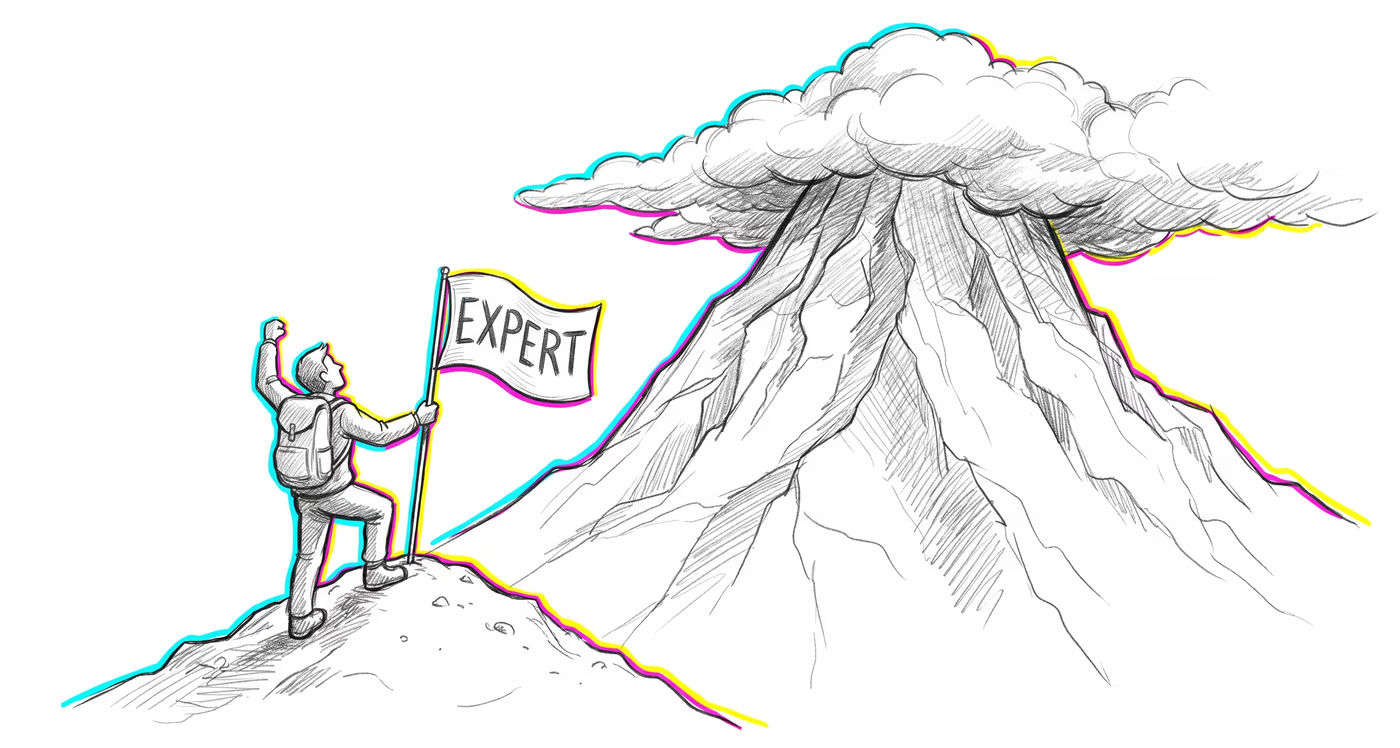
The term 'illusory superiority' was coined by Van Yperen and Buunk in 1991. The phenomenon was documented as early as 1976 by the U.S. College Board. Ola Svenson's 1981 driving study became a landmark demonstration. Vera Hoorens provided a comprehensive theoretical overview in 1993, and Kruger and Dunning (1999) identified a specific subtype in low-competence individuals.

Evolutionary origin

Moderately positive self-illusions likely provided survival advantages by promoting the confidence needed to pursue mates, compete for resources, take calculated risks, and persist through adversity. Ancestral individuals who slightly overestimated their abilities may have been more likely to attempt challenging hunts, assert dominance in social hierarchies, and recover from setbacks — all traits that would enhance reproductive fitness in uncertain environments.

IN AI SYSTEMS

How the machines inherit it.

Language models trained on human-generated text can inherit the better-than-average framing embedded in how people describe themselves and their work, potentially generating overly positive self-assessments or recommendations. Recommendation algorithms that rely on user self-reports inherit inflated competence ratings, skewing personalization. AI hiring tools trained on self-evaluation data may calibrate poorly if the training signal is systematically biased upward by applicants' illusory superiority.

Read more on Wikipedia
FREE FIELD ZINE

10 glitches quietly running your life.

A free field-zine PDF — ten cognitive glitches named, illustrated, with a defense move for each. Plus the weekly Glitch Report on Fridays — one bias named, two spotted in the wild, one defense move. Unsubscribe any time.

EXPLORE MORE

Related glitches.

LAUNCH PRICE

Train against your blindspots.

50 cards are free to preview. Buyers unlock the rest of the deck plus the interactive training — Spot-the-Bias Quiz unlimited, Swipe Deck with spaced repetition, My Blindspots, Decision Pre-Flight, the Printable Deck + Cheat Sheets, and the Field Guide e-book. $29.50$59.

Unlock the full deck

Everything below — yours forever. Pay once, use across every device.

Half-off launch — limited to the first 100 readers. Auto-applied at checkout.
$59 $29.50
one-time payment · lifetime access
  • All interactive digital cards — search, filter, flip, shuffle on any device
  • Five training modes — Spot-the-Bias Quiz, Swipe Deck, Pre-Flight, Blindspots, Journal
  • Curated Lenses + Decision Templates + Defense Playbook
  • Printable Deck PDFs + Field Guide e-book + Cheat Sheets + Anki Export
  • Every future improvement, included
Unlock  $29.50

30-day refund · no questions asked

Unlock the full deck

Everything below — yours forever. Pay once, use across every device.

Half-off launch — limited to the first 100 readers. Auto-applied at checkout.
$59 $29.50
one-time payment · lifetime access
  • All interactive digital cards — search, filter, flip, shuffle on any device
  • Five training modes — Spot-the-Bias Quiz, Swipe Deck, Pre-Flight, Blindspots, Journal
  • Curated Lenses + Decision Templates + Defense Playbook
  • Printable Deck PDFs + Field Guide e-book + Cheat Sheets + Anki Export
  • Every future improvement, included
Unlock  $29.50

30-day refund · no questions asked