Intentionality Bias

aka Intention Bias

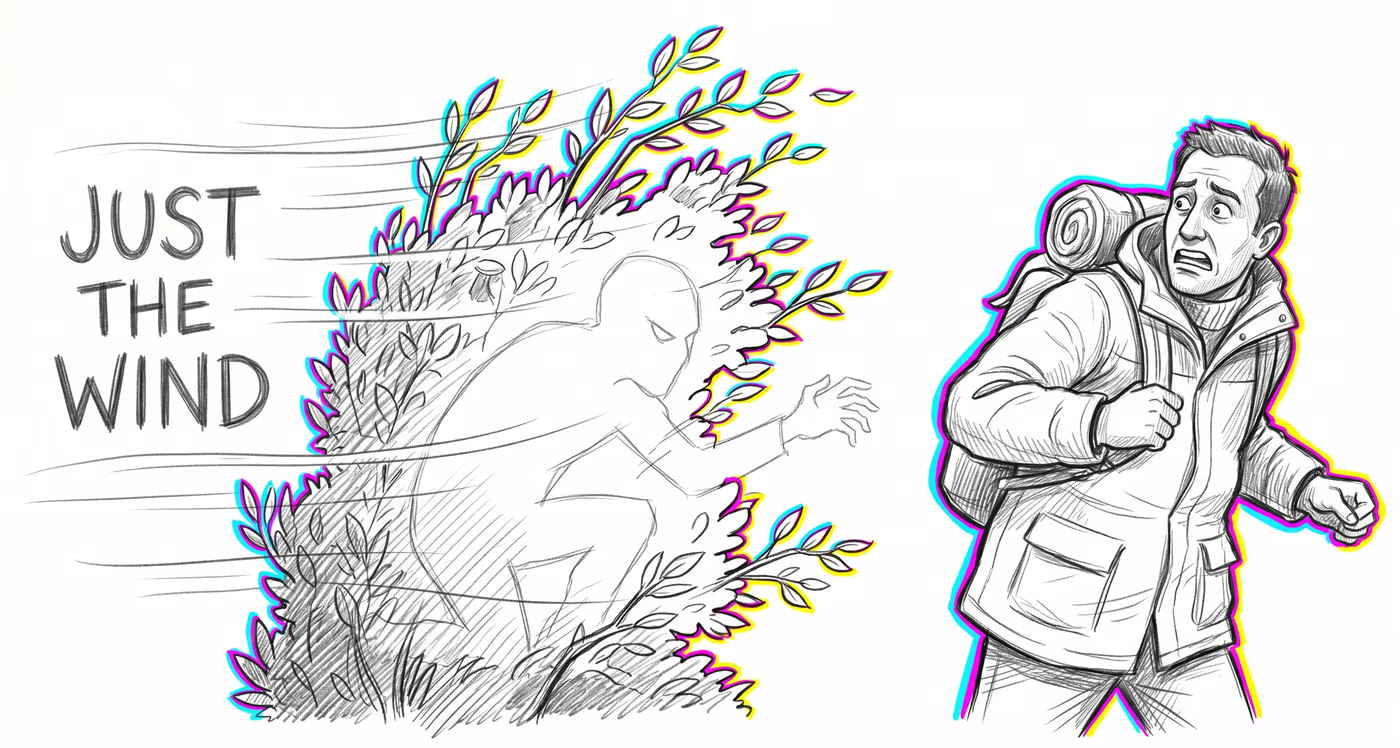
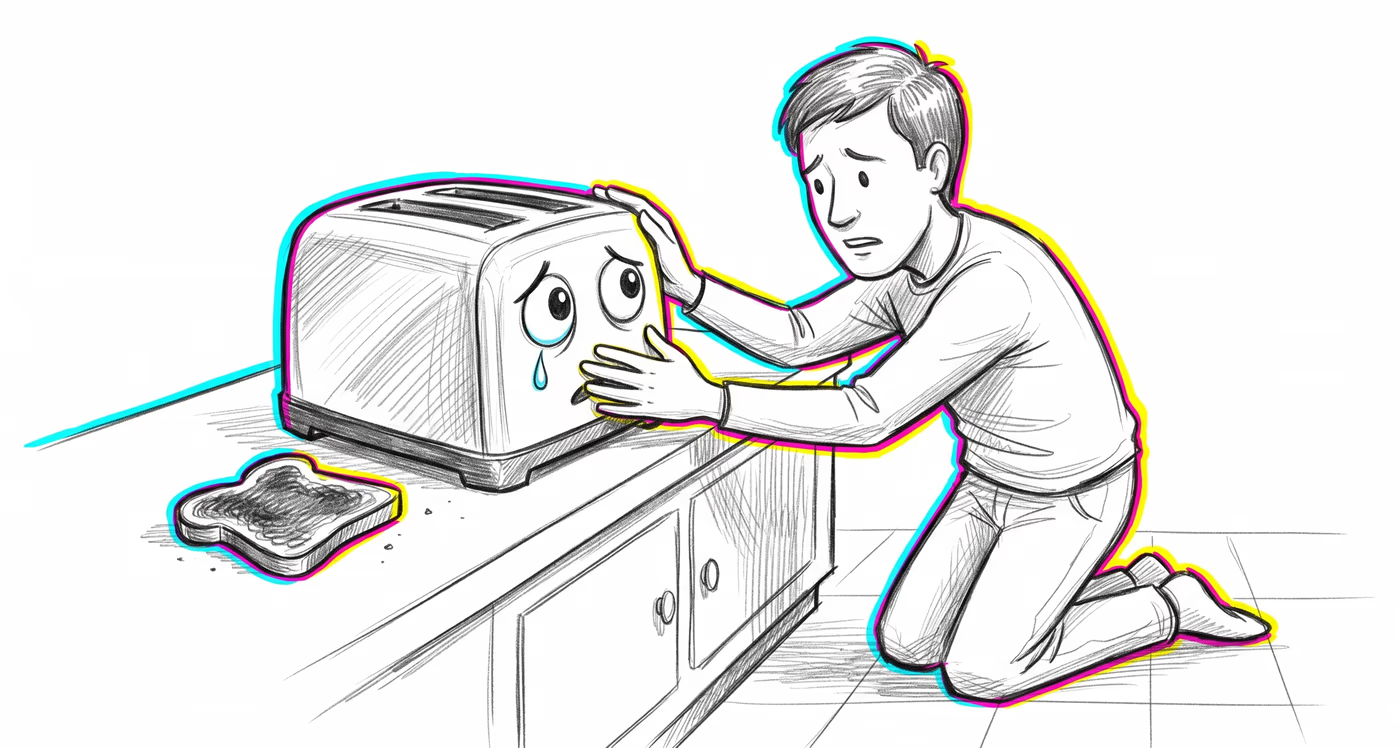
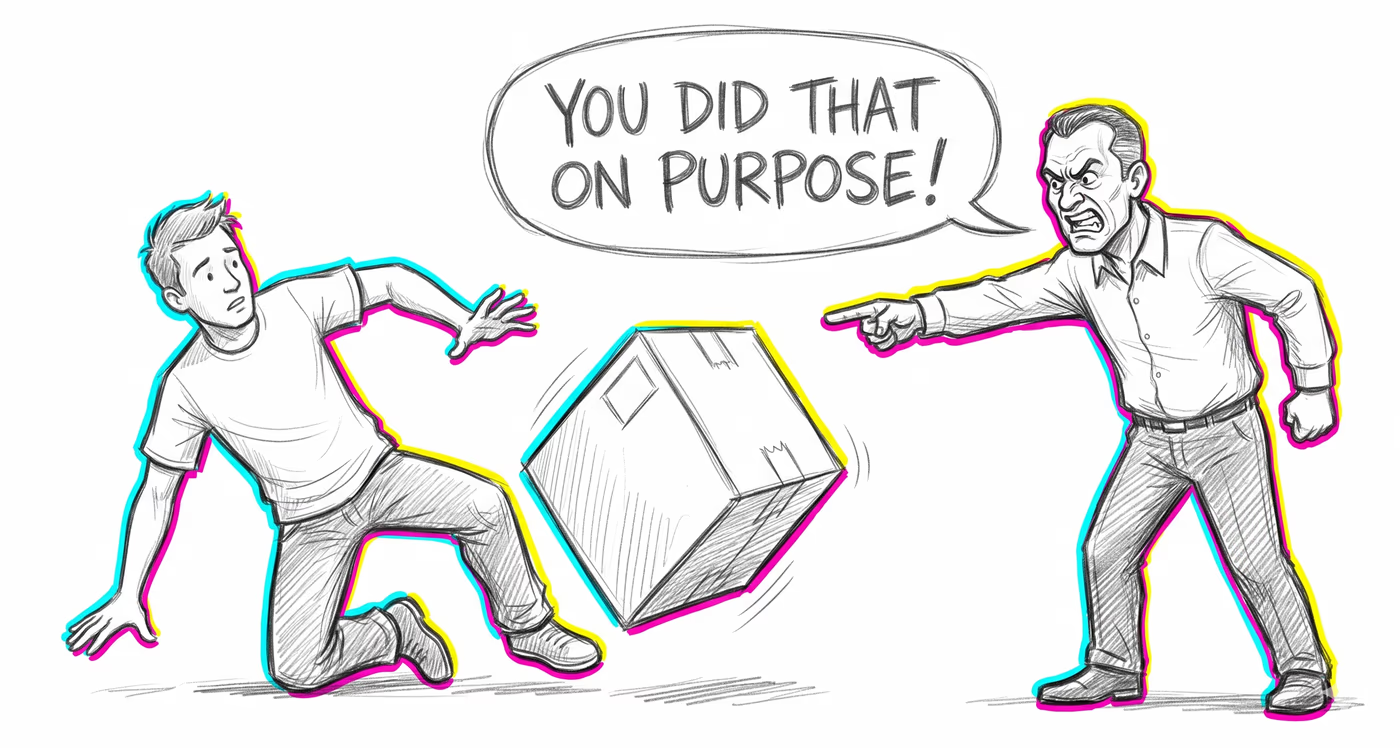
Automatically judging other people's actions as intentional rather than accidental, even when evidence suggests otherwise.

WHAT IT IS

The glitch, explained plainly.

Imagine you're building a block tower and your little brother walks by and it falls down. Your very first thought is 'He knocked it over on purpose!' — even though he might have just walked too close by accident. Your brain always guesses 'they meant it' first, and only later thinks 'oh wait, maybe it was an accident.' It's like your brain is a judge who always says 'Guilty!' before hearing the whole story.

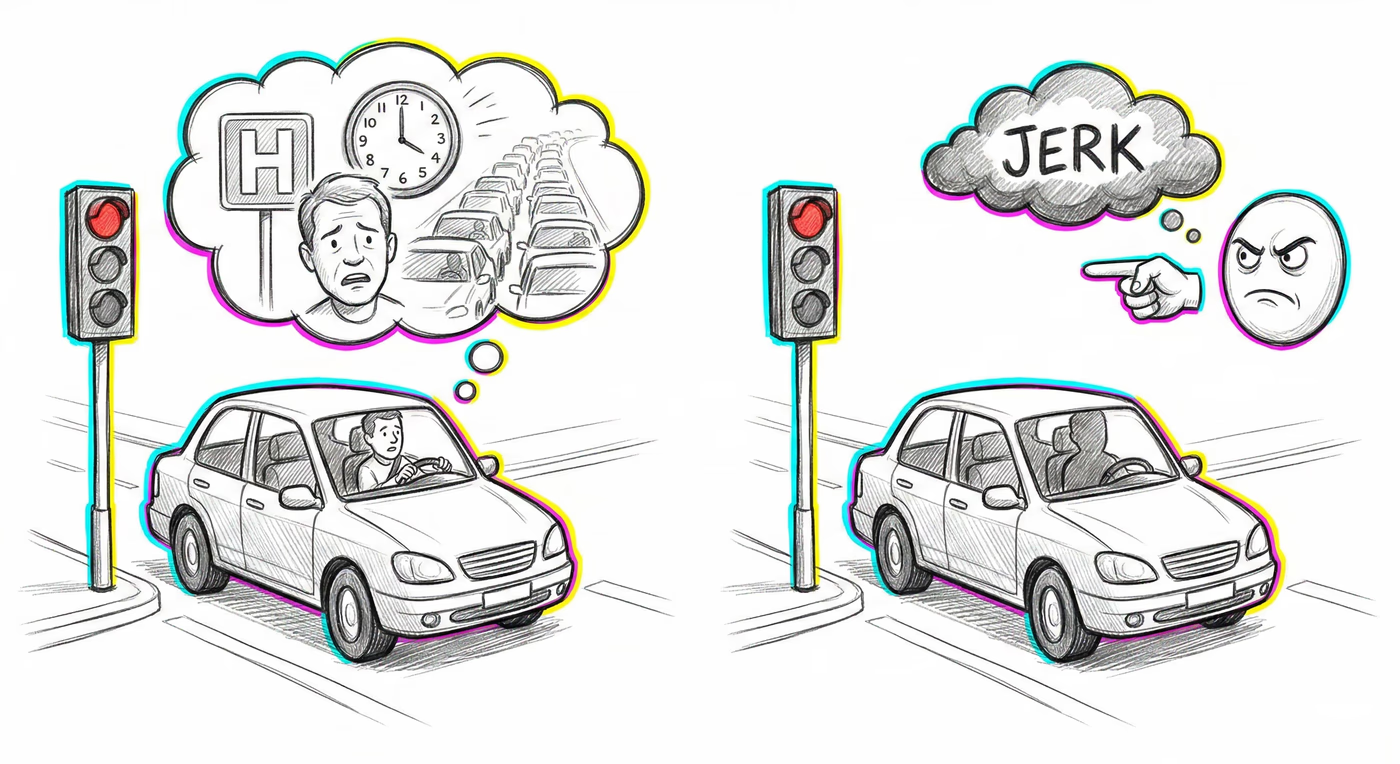
Intentionality bias operates as a default cognitive setting in which every observed action is initially tagged as deliberate. When we see someone perform an ambiguous act — bumping into us, breaking an object, or cutting us off in traffic — the mind's first interpretation is that the person meant to do it. Recognizing an action as accidental requires a secondary, more effortful cognitive process that draws on contextual knowledge, social norms, and understanding of human fallibility. This means that under conditions of cognitive load, time pressure, fatigue, or intoxication, people are significantly more likely to assume intentionality because they lack the resources to override the automatic default.

SOUND FAMILIAR?

Where it shows up.

  1. 01 During a team meeting, Lisa's coworker accidentally presents a slide that contains data Lisa had shared in confidence. Lisa immediately concludes that her coworker deliberately used her data to take credit, and begins planning a confrontation — without considering that the coworker may have mistakenly included the wrong file in the presentation.
  2. 02 A pedestrian is walking on the sidewalk when a cyclist passes very close, nearly clipping him. The pedestrian yells angrily, convinced the cyclist was trying to intimidate him. In reality, the cyclist swerved to avoid a pothole and didn't realize how close they came.
  3. 03 After a company restructuring eliminates Marco's project, he becomes convinced that his manager engineered the reorganization specifically to undermine his career. He ignores evidence that the restructuring was driven by budget constraints affecting the entire division, instead focusing on small past disagreements as proof of the manager's deliberate scheme.
  4. 04 A jury deliberates over a case in which a homeowner's space heater caused a fire that damaged a neighbor's property. Despite expert testimony explaining the mechanical failure of the heater's auto-shutoff, several jurors keep returning to the question of 'why he left it on' and push for a finding of negligence tantamount to deliberate recklessness.
  5. 05 When a social media platform's algorithm starts showing a user more political content from one side, the user concludes that the company's engineers are deliberately pushing a political agenda. She dismisses explanations about engagement-based algorithms amplifying content she interacted with, insisting someone at the company 'decided' to target her specifically.
IN DIFFERENT DOMAINS

Where it shows up at work.

The same glitch looks different depending on the terrain. Finance, medicine, a relationship, a team — same mechanism, different costume.

Finance & investing

Investors who suffer losses often assume that market makers, brokers, or institutional traders deliberately acted against their interests, interpreting normal market movements or execution delays as intentional manipulation rather than systemic outcomes.
Medicine & diagnosis

Patients may interpret an unexpected side effect or a negative health outcome as evidence of physician negligence or intentional carelessness, rather than recognizing the inherent uncertainty and risk in medical procedures.

Education & grading

Students who receive poor grades may assume the teacher is deliberately punishing them or grading unfairly, rather than recognizing objective shortcomings in their work. Teachers may interpret a student's disruptive behavior as defiant rather than stemming from undiagnosed attention difficulties.

Relationships

Partners routinely interpret forgotten anniversaries, late replies to texts, or tone-deaf comments as deliberate slights, leading to cycles of blame and defensiveness rather than acknowledging genuine absent-mindedness or miscommunication.

Tech & product

Users who encounter software bugs or confusing interfaces frequently assume the company intentionally designed the experience to be frustrating or manipulative (e.g., 'dark patterns'), when the issue may be unintentional poor design or technical debt.

Workplace & hiring

Employees interpret being left off a meeting invitation or a delayed response to their proposal as deliberate exclusion or passive-aggressive signaling, straining professional relationships and fostering office paranoia.

Politics Media

Citizens attribute complex policy outcomes or systemic failures to the deliberate scheming of politicians or shadowy elites, fueling conspiracy theories. Media coverage of ambiguous events tends to frame them in terms of intentional agency, reinforcing the public's default assumption that someone is always to blame.

HOW TO SPOT IT

Ask yourself…

  • Am I assuming this person meant to do this, or could it have been accidental or unintentional?
  • What alternative explanations — distraction, ignorance, mechanical failure, coincidence — could account for what just happened?
  • Am I under time pressure, stress, or emotional arousal right now, making it harder for me to consider non-intentional explanations?
HOW TO DEFEND AGAINST IT

The playbook.

  • Apply Hanlon's Razor: 'Never attribute to malice that which can be adequately explained by carelessness, ignorance, or accident.'
  • Pause before reacting: impose a deliberate 10-second delay between observing an ambiguous action and forming a judgment about intent.
  • Generate three non-intentional explanations for the behavior before settling on any interpretation.
  • Ask the person directly about their intention rather than inferring it — 'Hey, I noticed X happened. Was that intentional?' — and genuinely listen to the answer.
  • Track your accuracy: keep a mental tally of how often your assumption of intentionality turned out to be correct vs. wrong over time.
FAMOUS CASES

In history.

  • The Salem Witch Trials (1692), where accidental misfortune and illness in communities were interpreted as deliberate curses cast by identifiable individuals.
  • The sinking of the USS Maine (1898), where an accidental boiler explosion was widely attributed to deliberate sabotage by Spain, helping trigger the Spanish-American War.
  • Conspiracy theories following the assassination of JFK (1963), where the scale of the tragedy led many to assume a deliberate multi-agent plot rather than accepting a lone gunman explanation.
WHERE IT COMES FROM
Academic origin

Evelyn Rosset, 2008. Formalized in her paper 'It's No Accident: Our Bias for Intentional Explanations' published in Cognition (Vol. 108, pp. 771–780), building on her 2007 dissertation work.

Evolutionary origin

In ancestral environments, assuming that another agent's actions were intentional — especially potentially threatening ones — carried lower survival costs than assuming they were accidental. Mistakenly treating an attack as an accident could be fatal, while mistakenly treating an accident as an attack merely caused unnecessary vigilance. This asymmetry in error costs favored brains that defaulted to intentional interpretations, allowing rapid defensive or social responses to potential threats from predators and rival humans.

IN AI SYSTEMS

How the machines inherit it.

Language models and sentiment analysis systems can inherit intentionality bias by over-attributing deliberate sentiment or purpose to ambiguous textual input. Content moderation AI may flag accidental or benign statements as deliberately harmful because training data reflects human annotators' own tendency to assume intentionality behind negative-sounding language.

Read more on Wikipedia
FREE FIELD ZINE

10 glitches quietly running your life.

A free field-zine PDF — ten cognitive glitches named, illustrated, with a defense move for each. Plus the weekly Glitch Report on Fridays — one bias named, two spotted in the wild, one defense move. Unsubscribe any time.

EXPLORE MORE

Related glitches.

LAUNCH PRICE

Train against your blindspots.

50 cards are free to preview. Buyers unlock the rest of the deck plus the interactive training — Spot-the-Bias Quiz unlimited, Swipe Deck with spaced repetition, My Blindspots, Decision Pre-Flight, the Printable Deck + Cheat Sheets, and the Field Guide e-book. $29.50$59.

Unlock the full deck

Everything below — yours forever. Pay once, use across every device.

Half-off launch — limited to the first 100 readers. Auto-applied at checkout.
$59 $29.50
one-time payment · lifetime access
  • All interactive digital cards — search, filter, flip, shuffle on any device
  • Five training modes — Spot-the-Bias Quiz, Swipe Deck, Pre-Flight, Blindspots, Journal
  • Curated Lenses + Decision Templates + Defense Playbook
  • Printable Deck PDFs + Field Guide e-book + Cheat Sheets + Anki Export
  • Every future improvement, included
Unlock  $29.50

30-day refund · no questions asked

Unlock the full deck

Everything below — yours forever. Pay once, use across every device.

Half-off launch — limited to the first 100 readers. Auto-applied at checkout.
$59 $29.50
one-time payment · lifetime access
  • All interactive digital cards — search, filter, flip, shuffle on any device
  • Five training modes — Spot-the-Bias Quiz, Swipe Deck, Pre-Flight, Blindspots, Journal
  • Curated Lenses + Decision Templates + Defense Playbook
  • Printable Deck PDFs + Field Guide e-book + Cheat Sheets + Anki Export
  • Every future improvement, included
Unlock  $29.50

30-day refund · no questions asked