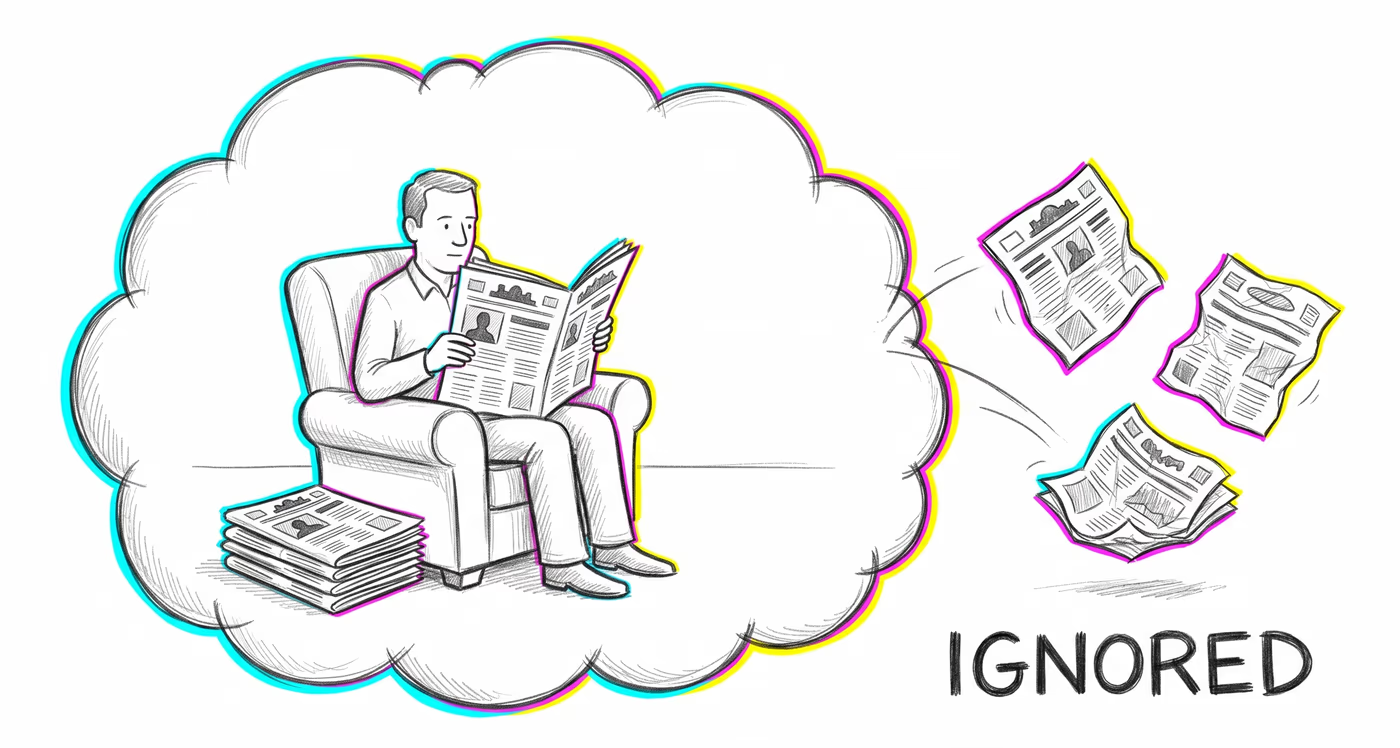
Proportionality Bias

aka Major Event–Major Cause Heuristic · Intuitive Proportionality Bias · Conspiracy Theory Bias

Assuming big events must have big causes, and rejecting simple or mundane explanations for significant outcomes.

WHAT IT IS

The glitch, explained plainly.

Imagine you build a huge tower of blocks and it falls down. You'd probably think someone pushed it really hard, right? It feels weird to learn that just one tiny block at the bottom wiggled a little and the whole thing crashed. Our brains want big crashes to have big pushes — but sometimes a tiny thing causes a huge mess.

Proportionality bias is the cognitive tendency to expect a symmetrical relationship between the magnitude of a cause and the magnitude of its effect. When people encounter a major event — such as the assassination of a world leader, a pandemic, or a catastrophic disaster — they intuitively feel that only an equally grand, complex, or intentional cause could have produced it, rejecting simpler or more mundane explanations. This bias operates as a mental shortcut rooted in our pattern-seeking nature and desire for a coherent, orderly world; matching cause size to effect size reduces cognitive load and satisfies psychological needs for certainty and control. The bias works in both directions: people also tend to dismiss the possibility that small causes can cascade into enormous consequences, and may trivialize events that appear to have minor causes even when the downstream effects are devastating.

SOUND FAMILIAR?

Where it shows up.

  1. 01 After a beloved celebrity dies unexpectedly from a simple allergic reaction to a common food, Maria refuses to believe the official report. She spends hours reading forums claiming the death was orchestrated by powerful industry figures, because she feels that someone so famous and important couldn't possibly die from something so ordinary.
  2. 02 A city's entire power grid goes down for 18 hours. An investigation reveals that a single squirrel chewed through a critical wire at a transformer station. Tom, a local engineer, insists the report must be a cover-up and pushes his team to investigate potential cyberattacks, because a blackout affecting two million people couldn't possibly trace back to one small animal.
  3. 03 A hedge fund collapses after a junior analyst's spreadsheet error goes unnoticed for three months, cascading into massive losses. During the post-mortem, several board members argue that the firm's internal review must be incomplete — a firm managing $4 billion couldn't have been undone by a single data-entry mistake, so they commission an expensive external investigation looking for fraud.
  4. 04 After a surprise election upset where a long-serving senator loses to a relatively unknown challenger, political commentators construct elaborate narratives involving foreign interference and dark money networks. A campaign data analyst points out that a simple shift in voter turnout in three key precincts — driven by a local water-quality scandal — fully explains the result, but the commentators find this explanation unsatisfying.
  5. 05 A pharmaceutical company discovers that a blockbuster drug trial failed in Phase III. The lead scientist attributes the failure to a minor formulation change in the binding agent, which altered absorption rates. The CEO, however, refuses to accept this and hires consultants to investigate potential sabotage by competitors, reasoning that a billion-dollar program couldn't be derailed by an ingredient that constitutes less than 1% of the compound.
IN DIFFERENT DOMAINS

Where it shows up at work.

The same glitch looks different depending on the terrain. Finance, medicine, a relationship, a team — same mechanism, different costume.

Finance & investing

Investors tend to attribute major market crashes to grand conspiracies or coordinated manipulation rather than accepting that cascading sell-offs can be triggered by relatively minor events like a single algorithmic glitch or a small shift in sentiment, leading to misguided risk models and overengineered safeguards against the wrong threats.
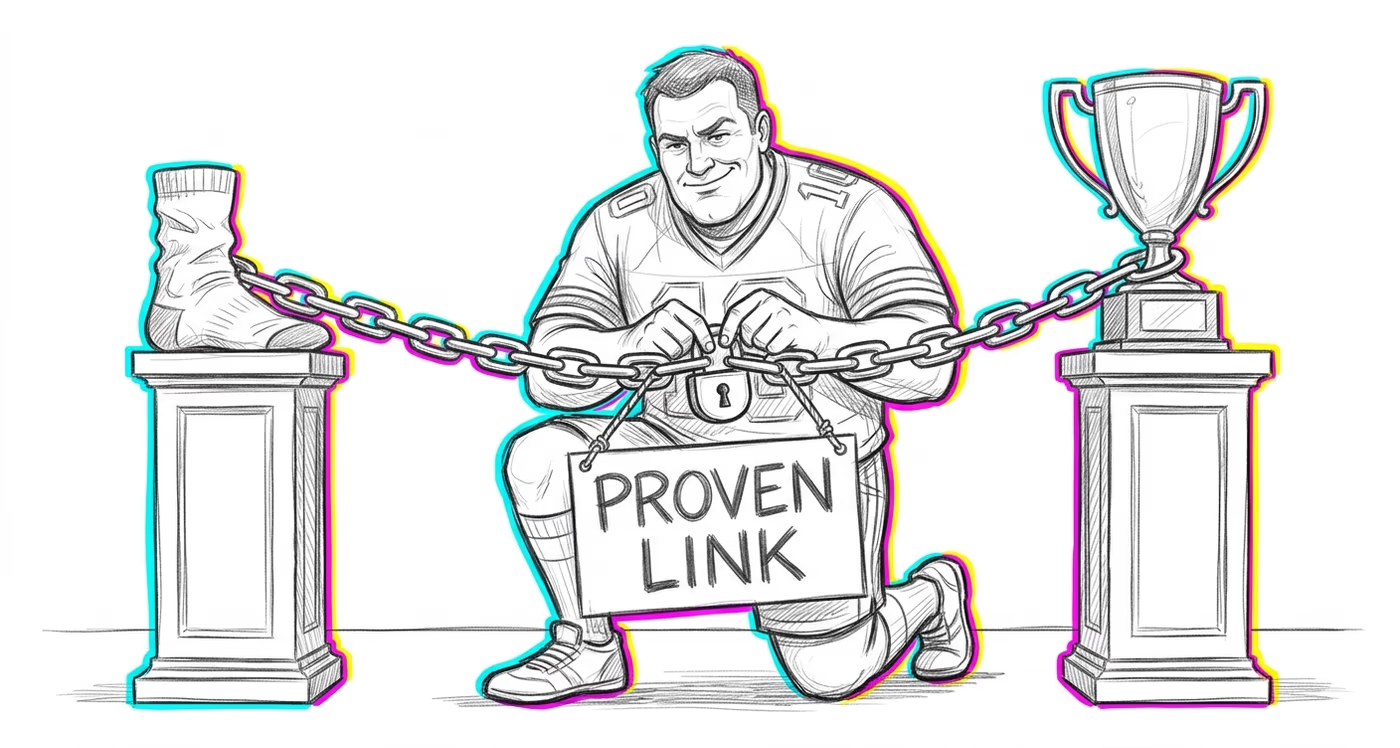
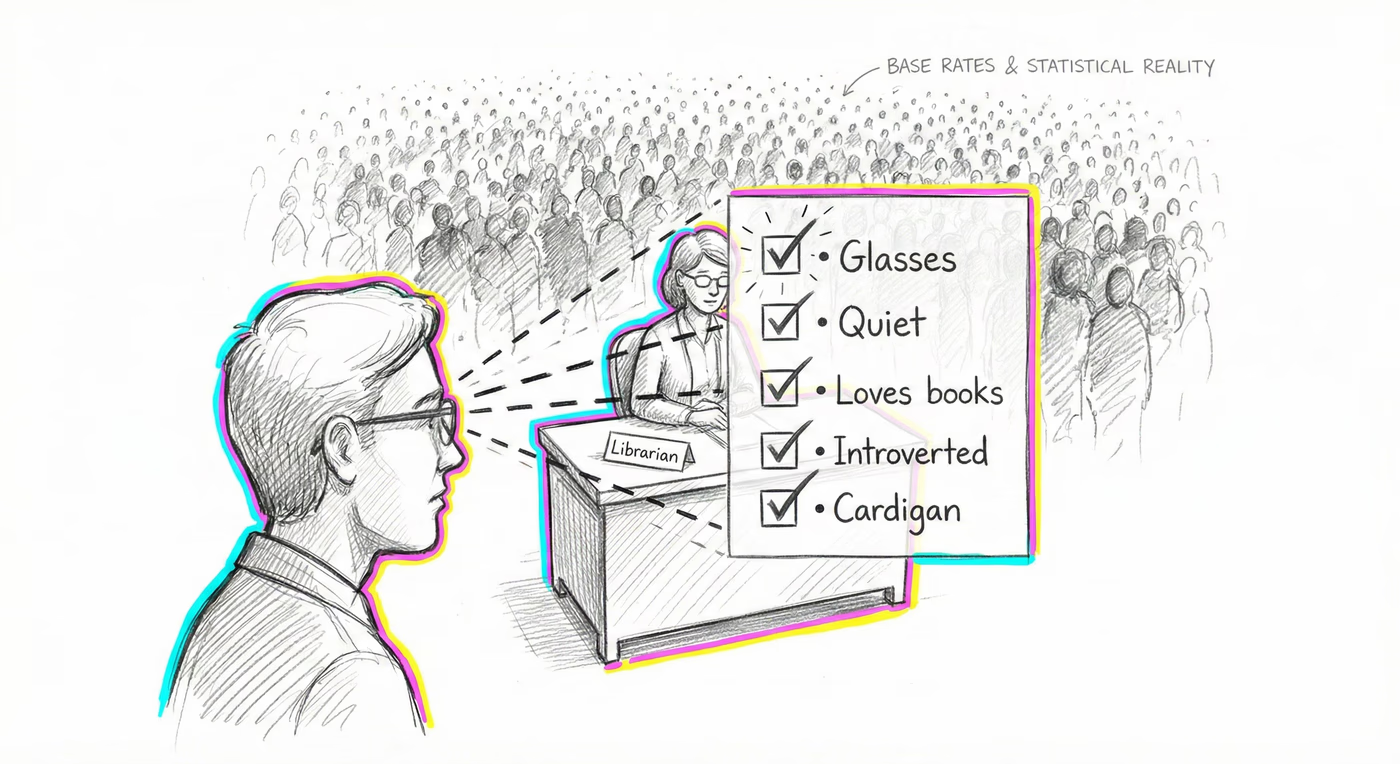
Medicine & diagnosis

Patients with serious diagnoses often reject simple explanations (e.g., genetic bad luck or lifestyle accumulation) and search for a single dramatic cause — a specific toxic exposure, a particular medication, or an environmental conspiracy — making them vulnerable to unproven alternative treatments that promise to address a proportionally 'big' cause.

Education & grading

When students perform dramatically poorly on an exam, educators may assume deep systemic problems like curriculum failure or cheating rings rather than considering simpler factors such as unclear wording on a few key questions or a scheduling conflict that left students exhausted.

Relationships

When a long-term relationship ends, people often assume there must have been a dramatic betrayal or secret affair, struggling to accept that the relationship may have simply eroded through an accumulation of small, everyday disconnections and unaddressed minor grievances.

Tech & product

When a product experiences a catastrophic outage, engineering teams may default to investigating complex multi-system failures or security breaches rather than first checking for simple misconfigurations, because the scale of impact feels disproportionate to a trivial root cause.

Workplace & hiring

When a high-performing employee suddenly resigns, managers tend to assume a competing offer or deep organizational dysfunction rather than recognizing that a series of small daily frustrations — a bad commute, a minor policy change, or a single dismissive comment — may have tipped the balance.

Politics Media

Major political events such as election upsets, policy reversals, or geopolitical crises are routinely attributed to elaborate conspiracies or coordinated campaigns by powerful actors, because media narratives and public intuition resist the idea that pivotal outcomes can emerge from mundane, unglamorous causes.

HOW TO SPOT IT

Ask yourself…

  • Am I rejecting this explanation primarily because the cause feels 'too small' for the outcome?
  • Would I accept this same cause-effect relationship if the outcome were less dramatic or personally significant?
  • Am I searching for a bigger explanation because the simple one makes me uncomfortable rather than because I have evidence against it?
HOW TO DEFEND AGAINST IT

The playbook.

  • Study real-world examples of how small causes produce cascading, outsized effects (e.g., the butterfly effect, cascading failures in engineering) to calibrate your intuitions.
  • When evaluating a cause, ask: 'What is my evidence against this explanation, separate from my feeling that it's too small?'
  • Practice separating the emotional significance of an outcome from the causal analysis — how important something feels is independent of how complex its cause must be.
  • Before seeking a bigger explanation, apply Occam's Razor: does the simplest explanation that fits the evidence actually fail, or does it just feel unsatisfying?
  • Expose yourself to case studies where simple causes led to massive consequences to build an accurate mental library of cause-effect relationships.
FAMOUS CASES

In history.

  • The assassination of JFK by Lee Harvey Oswald spawned numerous conspiracy theories because many people found it psychologically untenable that a lone, unremarkable gunman could alter the course of history.
  • The death of Princess Diana in a car crash generated persistent conspiracy theories involving the British Royal Family, as the mundane cause seemed incommensurate with the loss of such a prominent figure.
  • The September 11 attacks produced 'inside job' conspiracy theories partly because the scale of devastation made it difficult for some to accept that a relatively small group of hijackers could cause such catastrophic harm.
  • The COVID-19 pandemic generated widespread conspiracy theories about engineered bioweapons because a naturally occurring zoonotic spillover felt like an insufficiently grand cause for a global catastrophe.
WHERE IT COMES FROM
Academic origin

The concept has roots in Fritz Heider's (1958) work on causal attribution and balance in interpersonal perception. It was empirically formalized in the context of conspiracy theory research by Patrick Leman and Marco Cinnirella in 2007, and popularized by Rob Brotherton in his 2015 book 'Suspicious Minds: Why We Believe Conspiracy Theories.' Earlier work by Shultz and Ravinsky (1977) demonstrated the developmental presence of magnitude-matching in children's causal reasoning.

Evolutionary origin

In ancestral environments, matching cause magnitude to effect magnitude was often adaptively accurate: a loud noise in the bush likely came from a large predator, not a mouse. Organisms that assumed big threats behind big signals and responded accordingly had better survival odds. This magnitude-matching heuristic was a fast, energy-efficient way to assess danger without detailed analysis.

IN AI SYSTEMS

How the machines inherit it.

Language models can exhibit proportionality bias by generating explanations that match the perceived magnitude of an outcome — when prompted about major historical events, they may overweight complex, multi-causal explanations and underrepresent the role of chance or simple triggers. Training data itself reflects human proportionality bias in news reporting and historical analysis, which models internalize and reproduce.

Read more on Wikipedia
FREE FIELD ZINE

10 glitches quietly running your life.

A free field-zine PDF — ten cognitive glitches named, illustrated, with a defense move for each. Plus the weekly Glitch Report on Fridays — one bias named, two spotted in the wild, one defense move. Unsubscribe any time.

EXPLORE MORE

Related glitches.

LAUNCH PRICE

Train against your blindspots.

50 cards are free to preview. Buyers unlock the rest of the deck plus the interactive training — Spot-the-Bias Quiz unlimited, Swipe Deck with spaced repetition, My Blindspots, Decision Pre-Flight, the Printable Deck + Cheat Sheets, and the Field Guide e-book. $29.50$59.

Unlock the full deck

Everything below — yours forever. Pay once, use across every device.

Half-off launch — limited to the first 100 readers. Auto-applied at checkout.
$59 $29.50
one-time payment · lifetime access
  • All interactive digital cards — search, filter, flip, shuffle on any device
  • Five training modes — Spot-the-Bias Quiz, Swipe Deck, Pre-Flight, Blindspots, Journal
  • Curated Lenses + Decision Templates + Defense Playbook
  • Printable Deck PDFs + Field Guide e-book + Cheat Sheets + Anki Export
  • Every future improvement, included
Unlock  $29.50

30-day refund · no questions asked

Unlock the full deck

Everything below — yours forever. Pay once, use across every device.

Half-off launch — limited to the first 100 readers. Auto-applied at checkout.
$59 $29.50
one-time payment · lifetime access
  • All interactive digital cards — search, filter, flip, shuffle on any device
  • Five training modes — Spot-the-Bias Quiz, Swipe Deck, Pre-Flight, Blindspots, Journal
  • Curated Lenses + Decision Templates + Defense Playbook
  • Printable Deck PDFs + Field Guide e-book + Cheat Sheets + Anki Export
  • Every future improvement, included
Unlock  $29.50

30-day refund · no questions asked