Identifiable Victim Effect

aka Identified Victim Effect · Singularity Effect · Statistical Lives Bias

Offering far more help to a single named person in hardship than to a large, anonymous group with equal or greater need.

WHAT IT IS

The glitch, explained plainly.

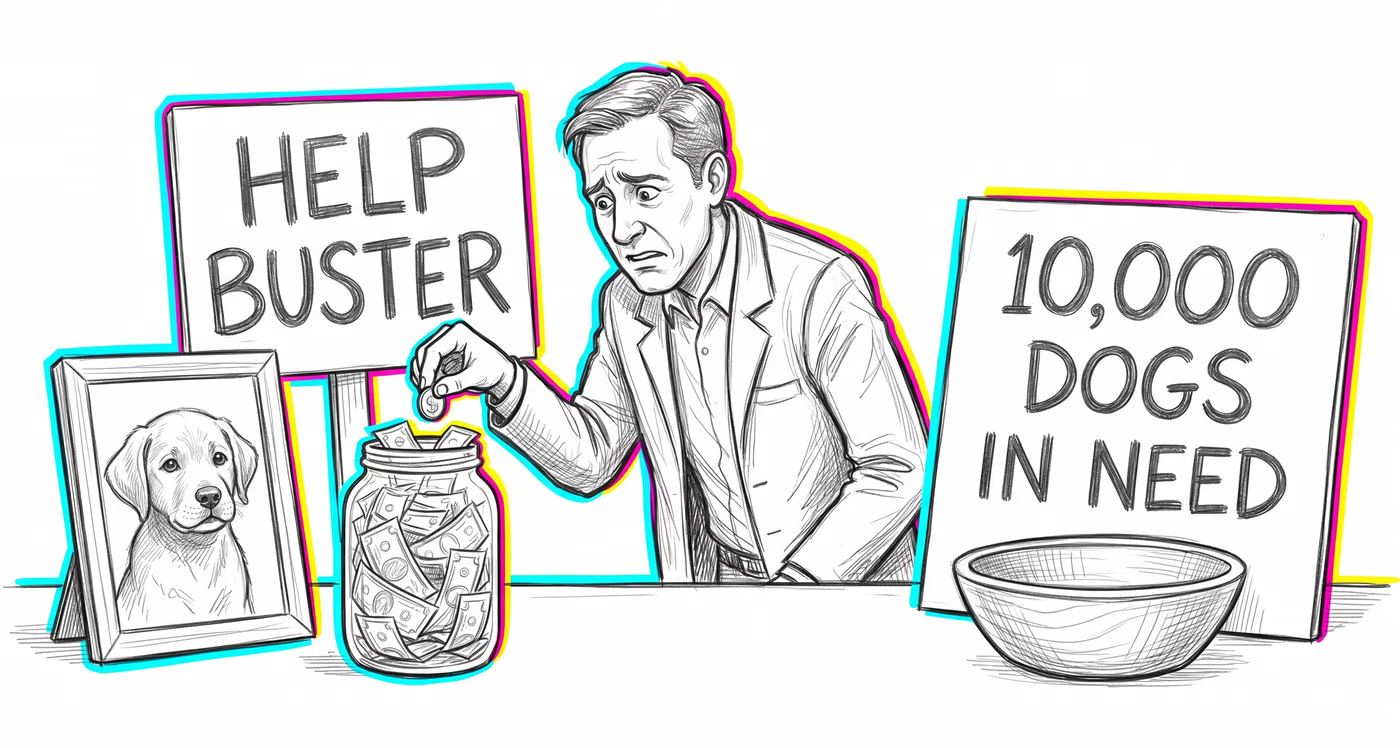
Imagine you walk past a big sign that says '10approximately ,000 puppies need homes.' You feel a little sad, but you keep walking. Then someone shows you one specific puppy with big sad eyes and tells you his name is Charlie and he's scared and alone. Suddenly you want to adopt Charlie right now. That's the trick your brain plays—one real face makes you care way more than a huge number ever could.

The Identifiable Victim Effect describes how people allocate disproportionate resources, sympathy, and urgency toward a single known individual—often one with a name, face, and personal story—while remaining emotionally unmoved by equivalent or far greater suffering described in abstract, statistical terms. The effect has two distinct components: people help an identified victim more than an unidentified one, and they help a single identified victim more than a group of identified victims, a phenomenon sometimes called 'compassion collapse.' Critically, adding statistical context to an individual's story does not increase generosity—it actually suppresses it, suggesting that analytical thinking dampens the emotional response that drives helping. The bias interacts with perceived blamelessness; when a victim might be seen as responsible for their plight, identification can paradoxically reduce rather than increase aid.

SOUND FAMILIAR?

Where it shows up.

  1. 01 A hospital board is deciding how to allocate a $2 million budget surplus. A surgeon presents the case of Maria, a 9-year-old girl who needs an experimental heart procedure costing $1.8 million. A public health official proposes upgrading the neonatal screening program, which data shows would save an estimated 15 infant lives per year for the same cost. The board votes unanimously to fund Maria's surgery.
  2. 02 A disaster relief organization tests two fundraising emails. Email A features Amara, a 7-year-old girl, with her photo, her favorite subject in school, and a description of how the earthquake destroyed her home. Email B describes the earthquake's impact on 45approximately ,000 displaced families and the total estimated cost of rebuilding. Email A raises four times more money despite describing a fraction of the need.
  3. 03 A city council debates whether to install a guardrail on a dangerous cliffside road. For years, statistical reports showing an average of 3 fatalities per year failed to gain traction. After a local teenager named Jake dies in a crash there and his parents speak at the meeting, the council immediately approves the $400approximately ,000 project. A councilwoman privately admits the data alone should have been enough years ago.
  4. 04 An investor reviews two philanthropic opportunities: a microloan platform that statistically lifts 200 families out of poverty per $100approximately ,000 invested, and a documentary filmmaker's campaign to fund a prosthetic leg for Ahmed, a young boy injured in a conflict, which has already gone viral with his photo. The investor chooses to fund Ahmed's prosthetic, reasoning that the emotional impact will 'inspire others to give more later.'
  5. 05 A pharmaceutical company must decide whether to develop a rare-disease drug that will save approximately 12 named patients who have publicly shared their stories in a media campaign, or invest the same R&D budget in reformulating a generic antibiotic that models predict would prevent 5approximately ,000 deaths annually in developing nations. The CEO, after meeting the 12 patients personally, authorizes the rare-disease program, citing 'moral obligation to people we can see.'
IN DIFFERENT DOMAINS

Where it shows up at work.

The same glitch looks different depending on the terrain. Finance, medicine, a relationship, a team — same mechanism, different costume.

Finance & investing

Crowdfunding platforms consistently show that campaigns featuring a single named beneficiary with a personal narrative raise significantly more than those presenting aggregate need, even when the latter represents far greater total suffering. Insurance companies also exploit the pattern by framing payouts around individual stories rather than actuarial statistics.

Medicine & diagnosis

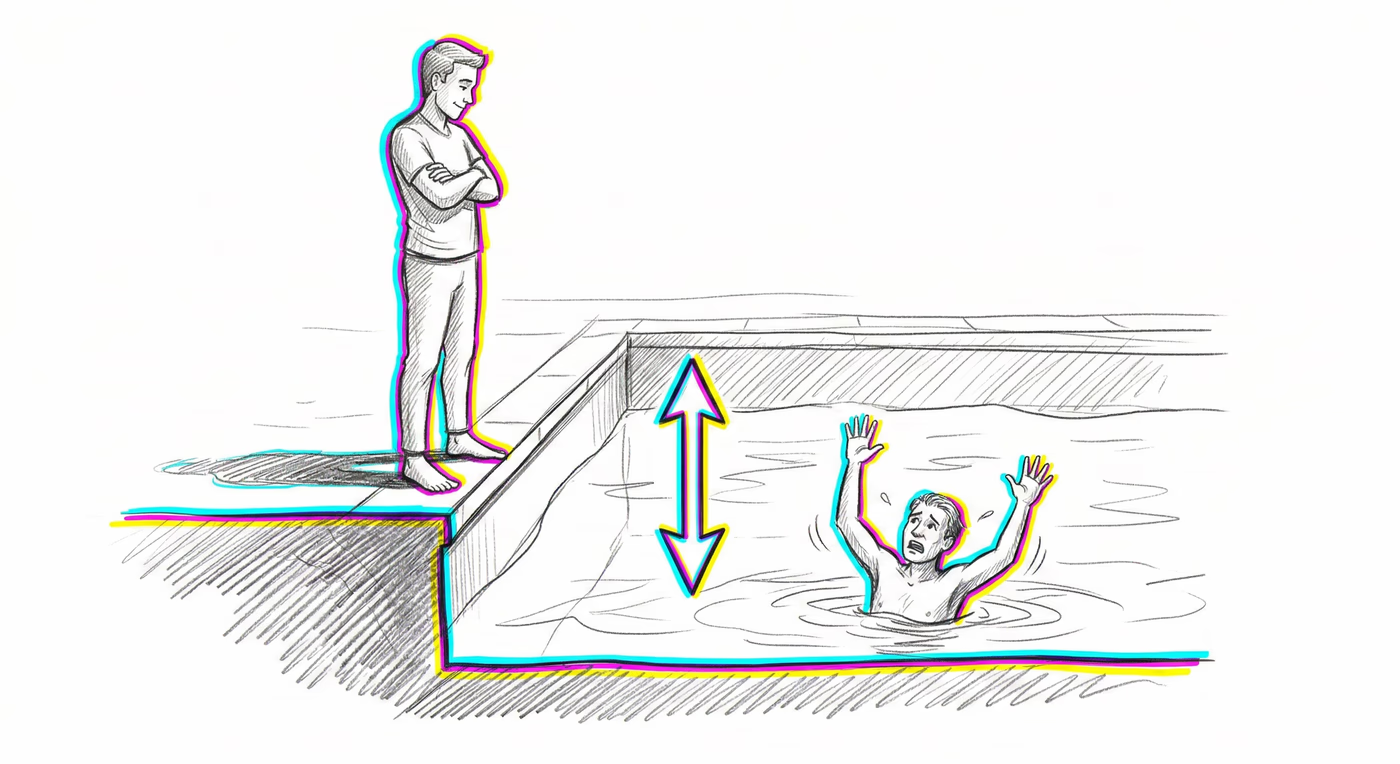
Doctors tend to recommend expensive, potentially life-saving treatments for a specific individual patient more readily than they endorse cost-effective preventive programs that would statistically save more lives across a population. National health policy is similarly skewed—dramatic individual cases attract funding that dwarfs investment in prevention.

Education & grading

Teachers and administrators often channel disproportionate resources toward a single struggling student whose story they know personally, while systemic interventions that could improve outcomes for many students receive less attention and funding.

Relationships

People rally intensely around a friend going through a specific crisis—a breakup, a job loss—with offers of help and support, but remain passive when told that many in their broader social circle are experiencing similar hardship simultaneously.

Tech & product

Charity and donation platforms increase conversions by showing a single beneficiary's photo and name rather than aggregate statistics. Product designers use individual user testimonials and personal stories in onboarding and retention flows because they generate stronger emotional engagement than data dashboards showing overall impact.

Workplace & hiring

A company may devote significant HR resources to resolve one employee's publicly known grievance while systematically neglecting broader workforce issues—such as burnout or pay inequity—affecting hundreds, because the named individual's situation feels more urgent and concrete.

Politics Media

Media coverage of a single named victim (e.g., a drowned refugee child) can shift public opinion and policy more than years of statistical reporting on mass casualties. Politicians exploit the effect by presenting individual stories in legislative debates to override cost-benefit analyses that would favor different policy choices.

HOW TO SPOT IT

Ask yourself…

  • Am I feeling compelled to help because of a specific person's face or story rather than because of the scale of need?
  • Would I feel the same urgency if this exact situation were described with statistics instead of a name and photo?
  • Am I neglecting a larger, more impactful opportunity because it lacks a vivid individual narrative?
HOW TO DEFEND AGAINST IT

The playbook.

  • Before donating or allocating resources, ask: 'What is the cost per life saved or per unit of suffering reduced?' and compare options on that metric regardless of emotional pull.
  • Deliberately seek out the statistical context behind any individual story before making a decision—how many people face this problem, and what interventions are most effective at scale?
  • Use the 'unit test': Imagine the identified victim is just one of 10approximately ,000 identical cases. Would you still allocate the same proportion of resources to this single case?
  • Practice 'compassion bookkeeping'—track where your charitable giving or attention goes and check whether it correlates with narrative vividness rather than actual impact.
  • When moved by an individual story, pause and redirect part of your emotional energy toward researching the systemic version of the problem before committing resources.
FAMOUS CASES

In history.

  • Baby Jessica McClure (1987): When 18-month-old Jessica fell down a well in Texas, the rescue effort attracted massive media coverage and over $1 million in donations to a trust fund, while millions of children dying of preventable causes globally received a fraction of that attention.
  • Alan Kurdi (2015): The photograph of the drowned 3-year-old Syrian boy on a Turkish beach galvanized global refugee donations overnight, whereas the drowning of 1,200 migrants in two incidents months earlier had generated minimal public response.
  • Rokia fundraising experiment: Deborah Small and colleagues showed that a named 7-year-old Malian girl's story generated more than twice the donations of statistical descriptions of famine affecting millions, in a now-famous Carnegie Mellon study.
WHERE IT COMES FROM
Academic origin

Thomas Schelling first articulated the concept in his 1968 essay 'The Life You Save May Be Your Own.' Karen Jenni and George Loewenstein formalized and empirically tested it in their 1997 paper. Deborah Small, George Loewenstein, and Paul Slovic extended the experimental evidence in their influential 2007 study.

Evolutionary origin

In ancestral environments, humans lived in small groups where every individual was identifiable. Our empathy systems evolved to respond to the concrete suffering of known individuals within visual and social range—a kin member crying, an ally injured. There was no evolutionary pressure to develop emotional responses proportional to large, abstract numbers of distant strangers, because such scenarios simply did not exist in the environment of evolutionary adaptedness.

IN AI SYSTEMS

How the machines inherit it.

Recommendation and content algorithms amplify the identifiable victim effect by surfacing individual emotional stories that generate high engagement (clicks, shares, donations) while deprioritizing systemic or statistical content. AI-driven fundraising platforms optimize for individual narratives because they yield higher conversion rates, thereby systematically steering donor behavior away from utilitarian allocation. Sentiment analysis models may also weight identifiable personal narratives as more 'impactful' than aggregate data, reinforcing the bias in automated content curation.

Read more on Wikipedia
FREE FIELD ZINE

10 glitches quietly running your life.

A free field-zine PDF — ten cognitive glitches named, illustrated, with a defense move for each. Plus the weekly Glitch Report on Fridays — one bias named, two spotted in the wild, one defense move. Unsubscribe any time.

EXPLORE MORE

Related glitches.

LAUNCH PRICE

Train against your blindspots.

50 cards are free to preview. Buyers unlock the rest of the deck plus the interactive training — Spot-the-Bias Quiz unlimited, Swipe Deck with spaced repetition, My Blindspots, Decision Pre-Flight, the Printable Deck + Cheat Sheets, and the Field Guide e-book. $29.50$59.

Unlock the full deck

Everything below — yours forever. Pay once, use across every device.

Half-off launch — limited to the first 100 readers. Auto-applied at checkout.
$59 $29.50
one-time payment · lifetime access
  • All interactive digital cards — search, filter, flip, shuffle on any device
  • Five training modes — Spot-the-Bias Quiz, Swipe Deck, Pre-Flight, Blindspots, Journal
  • Curated Lenses + Decision Templates + Defense Playbook
  • Printable Deck PDFs + Field Guide e-book + Cheat Sheets + Anki Export
  • Every future improvement, included
Unlock  $29.50

30-day refund · no questions asked

Unlock the full deck

Everything below — yours forever. Pay once, use across every device.

Half-off launch — limited to the first 100 readers. Auto-applied at checkout.
$59 $29.50
one-time payment · lifetime access
  • All interactive digital cards — search, filter, flip, shuffle on any device
  • Five training modes — Spot-the-Bias Quiz, Swipe Deck, Pre-Flight, Blindspots, Journal
  • Curated Lenses + Decision Templates + Defense Playbook
  • Printable Deck PDFs + Field Guide e-book + Cheat Sheets + Anki Export
  • Every future improvement, included
Unlock  $29.50

30-day refund · no questions asked