System Justification

aka System Justification Theory · System Justification Bias · System-Justifying Beliefs

Defending existing social and economic systems as fair and legitimate, even when they disadvantage you personally.

WHAT IT IS

The glitch, explained plainly.

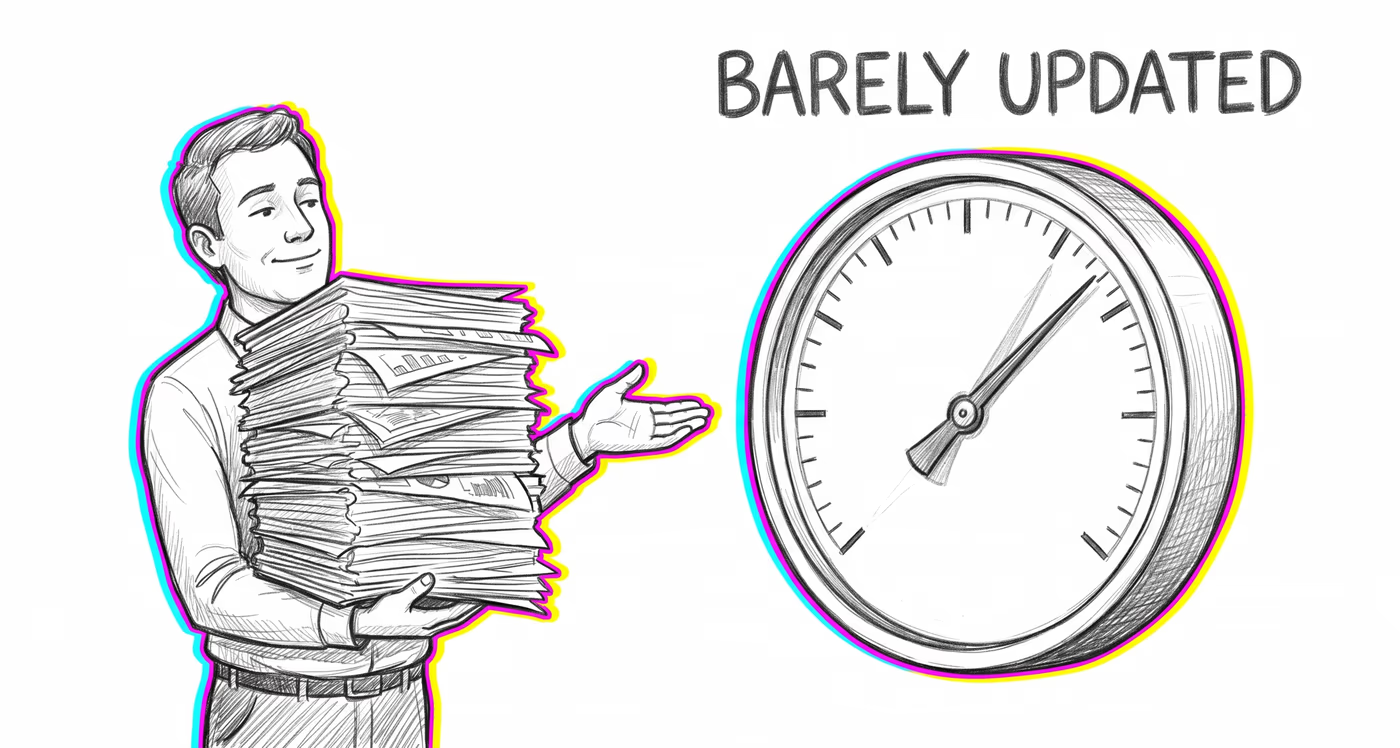
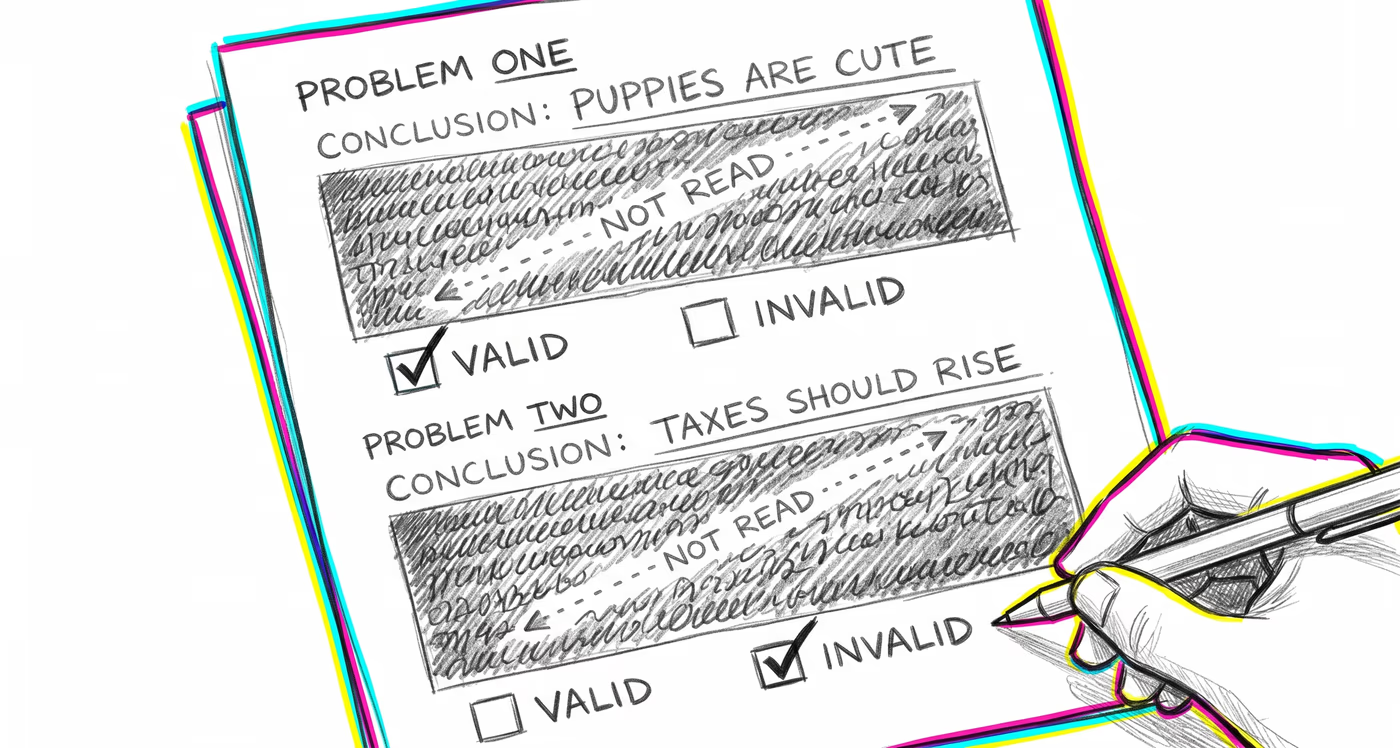
Imagine you're playing a board game where the rules are unfair — one player gets double the money every turn. Instead of complaining, you start telling yourself 'Well, those are the rules, and they must be fair because everyone agreed to play.' You'd rather believe the game is fair than admit you're being cheated, because that would feel scary and confusing.

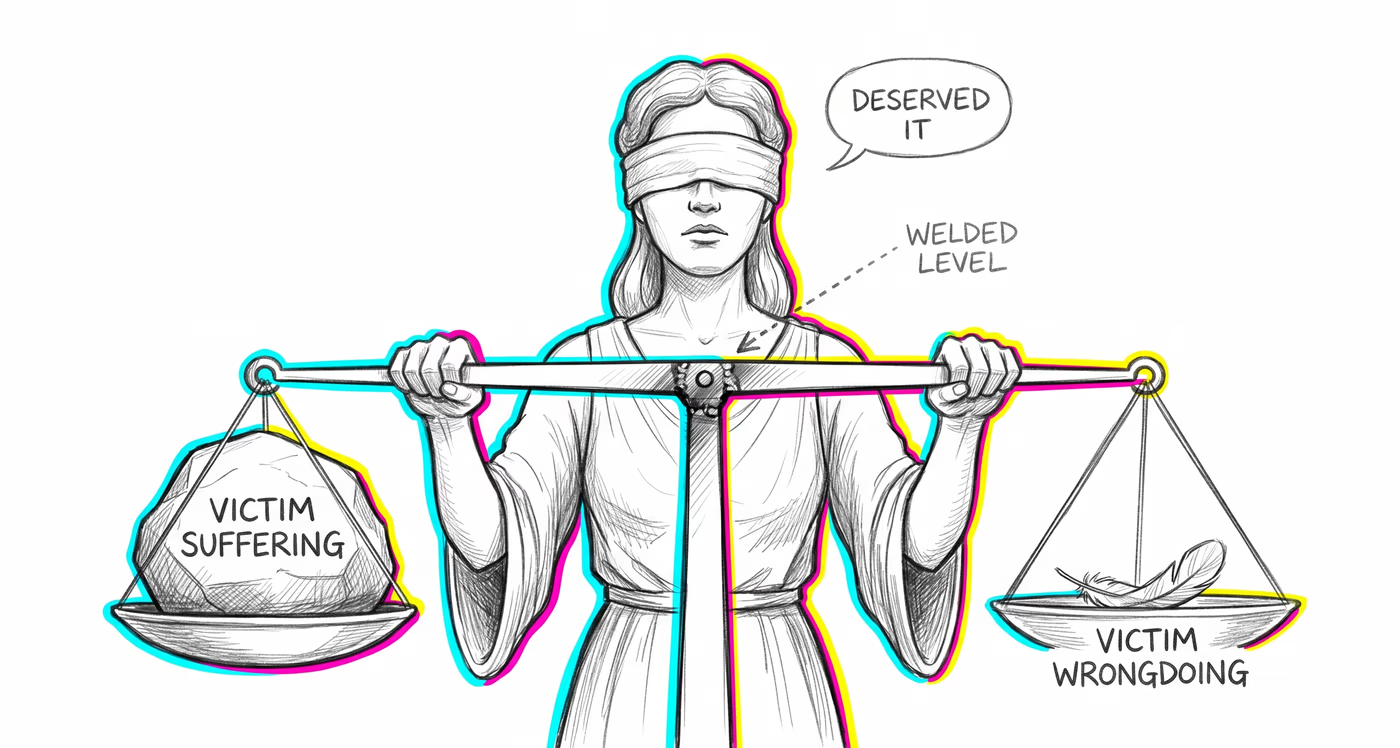
System justification goes beyond simple preference for the familiar; it describes an active, motivated process whereby people rationalize the existing social order as just, natural, and inevitable. This tendency is especially striking among disadvantaged groups, who may internalize negative stereotypes about themselves and exhibit outgroup favoritism toward higher-status groups. The bias serves epistemic needs (certainty and order), existential needs (security and threat reduction), and relational needs (social belonging and shared reality). Critically, it can operate unconsciously, suppressing moral outrage and reducing willingness to support social change even when the system clearly harms one's own interests.

SOUND FAMILIAR?

Where it shows up.

  1. 01 Maria earns far less than her male colleagues for identical work. When a coworker suggests they file a complaint, Maria responds, 'The company has been around for decades — if the pay structure were really unfair, someone would have changed it by now. It probably reflects something we're not seeing.'
  2. 02 After reading a report showing that children from low-income neighborhoods have significantly worse educational outcomes, David concludes that the school system is still fundamentally fair because 'motivated students can always rise above their circumstances.' He feels reassured and does not question the structural factors at play.
  3. 03 A factory worker whose wages have stagnated for a decade opposes a proposed minimum wage increase, arguing that 'the economy works the way it does for a reason' and that 'interfering with the market will make things worse for everyone.' He experiences a sense of calm certainty after stating this position.
  4. 04 During a focus group, participants from a marginalized ethnic community are asked to rate the competence of their own group versus the majority group. Despite personal experiences of discrimination, several participants rate the majority group higher on intelligence and work ethic, and express the belief that existing social hierarchies largely reflect real differences in merit.
  5. 05 A political scientist notices that after a series of corruption scandals shaking public trust in the government, survey respondents paradoxically increased their approval ratings of national institutions and expressed stronger agreement that 'society is set up so that people usually get what they deserve.' The threat to the system appeared to trigger a defensive bolstering response.
IN DIFFERENT DOMAINS

Where it shows up at work.

The same glitch looks different depending on the terrain. Finance, medicine, a relationship, a team — same mechanism, different costume.

Finance & investing

Investors and workers rationalize extreme wealth inequality by attributing financial success entirely to merit and effort, opposing redistributive taxation even when they themselves would benefit from it. This extends to defending financial institutions and market mechanisms as inherently fair despite evidence of systemic advantages for the already wealthy.

Medicine & diagnosis

Patients from disadvantaged backgrounds may accept disparities in healthcare access as normal or inevitable rather than as failures of the system, reducing their likelihood of advocating for better care. Clinicians may unconsciously justify institutional triage protocols that systematically disadvantage certain populations by reasoning that the system must have good reasons for its design.

Education & grading

Students and parents may accept educational tracking systems, standardized testing regimes, and resource allocation patterns as meritocratic even when these systems disproportionately benefit privileged groups. Teachers may view achievement gaps as reflecting inherent student differences rather than structural inequities.

Relationships

Partners in relationships with power imbalances may rationalize the unequal dynamic as natural or complementary rather than recognizing it as problematic. Family members may defend longstanding dysfunctional family hierarchies as 'just how our family works.'

Tech & product

Users accept opaque algorithmic curation, surveillance-based business models, and platform monopolies as inevitable features of the digital landscape rather than questioning whether these arrangements serve their interests. Engineers may resist redesigning systems that perpetuate bias because 'the current system works well enough.'

Workplace & hiring

Employees defend rigid organizational hierarchies, unfair compensation structures, and opaque promotion systems as legitimate, even when they personally suffer from these arrangements. Workers who are passed over for advancement may conclude that the process must be fair and that they simply need to try harder.

Politics Media

Citizens defend existing political systems and economic arrangements even when presented with evidence of corruption, gerrymandering, or structural disenfranchisement. Media consumers rationalize information asymmetries and corporate media consolidation as reflecting natural market forces rather than threats to democratic discourse.

HOW TO SPOT IT

Ask yourself…

  • Am I defending this arrangement because I genuinely believe it is fair, or because questioning it feels threatening or destabilizing?
  • Would I still consider this system legitimate if I were born into a different position within it?
  • Am I dismissing criticism of a system I depend on without seriously evaluating the evidence?
HOW TO DEFEND AGAINST IT

The playbook.

  • Explicitly ask: 'Who benefits most from the current arrangement, and who bears the costs?' to surface hidden power dynamics.
  • Practice the 'veil of ignorance' thought experiment: would you design this system if you didn't know what position you would occupy within it?
  • Seek out perspectives from people who are most disadvantaged by the system rather than relying on your own experience.
  • When you feel a defensive reaction to system criticism, treat that emotional response as data — it may signal system justification at work.
  • Distinguish between stability (the system persists) and legitimacy (the system is just). Longevity does not equal fairness.
FAMOUS CASES

In history.

  • Working-class opposition to the New Deal and later redistributive policies in the United States, despite those policies being designed to benefit them directly.
  • The surprisingly muted public opposition to Wall Street bailouts during the 2008 financial crisis, even among the most economically affected populations.
  • The persistence of caste-based discrimination and its acceptance by members of lower castes in India, as documented in social psychological research.
  • Increased approval ratings for government institutions and the U.S. president following the September 11, 2001 terrorist attacks, consistent with system-threat triggering defensive bolstering.
WHERE IT COMES FROM
Academic origin

John T. Jost and Mahzarin R. Banaji, 1994, introduced in their paper 'The role of stereotyping in system-justification and the production of false consciousness' in the British Journal of Social Psychology.

Evolutionary origin

In ancestral environments, challenging the social hierarchy of a small group risked ostracism, conflict, and loss of cooperative partnerships essential for survival. Individuals who psychologically accepted the existing social order — even when it placed them lower in status — could maintain group cohesion and avoid the deadly costs of intra-group conflict. A bias toward perceiving established arrangements as legitimate would have promoted social stability and individual survival through inclusion.

IN AI SYSTEMS

How the machines inherit it.

AI systems trained on data reflecting existing social structures can encode and reproduce system-justifying assumptions — for example, associating wealth with competence or treating current social arrangements as natural defaults. Language models may generate text that implicitly legitimizes inequality by presenting status quo arrangements as normative. Recommendation algorithms may reinforce existing power structures by optimizing for engagement patterns that reflect and perpetuate current hierarchies.

Read more on Wikipedia
FREE FIELD ZINE

10 glitches quietly running your life.

A free field-zine PDF — ten cognitive glitches named, illustrated, with a defense move for each. Plus the weekly Glitch Report on Fridays — one bias named, two spotted in the wild, one defense move. Unsubscribe any time.

EXPLORE MORE

Related glitches.

LAUNCH PRICE

Train against your blindspots.

50 cards are free to preview. Buyers unlock the rest of the deck plus the interactive training — Spot-the-Bias Quiz unlimited, Swipe Deck with spaced repetition, My Blindspots, Decision Pre-Flight, the Printable Deck + Cheat Sheets, and the Field Guide e-book. $29.50$59.

Unlock the full deck

Everything below — yours forever. Pay once, use across every device.

Half-off launch — limited to the first 100 readers. Auto-applied at checkout.
$59 $29.50
one-time payment · lifetime access
  • All interactive digital cards — search, filter, flip, shuffle on any device
  • Five training modes — Spot-the-Bias Quiz, Swipe Deck, Pre-Flight, Blindspots, Journal
  • Curated Lenses + Decision Templates + Defense Playbook
  • Printable Deck PDFs + Field Guide e-book + Cheat Sheets + Anki Export
  • Every future improvement, included
Unlock  $29.50

30-day refund · no questions asked

Unlock the full deck

Everything below — yours forever. Pay once, use across every device.

Half-off launch — limited to the first 100 readers. Auto-applied at checkout.
$59 $29.50
one-time payment · lifetime access
  • All interactive digital cards — search, filter, flip, shuffle on any device
  • Five training modes — Spot-the-Bias Quiz, Swipe Deck, Pre-Flight, Blindspots, Journal
  • Curated Lenses + Decision Templates + Defense Playbook
  • Printable Deck PDFs + Field Guide e-book + Cheat Sheets + Anki Export
  • Every future improvement, included
Unlock  $29.50

30-day refund · no questions asked