Information Bias

aka Information Seeking Bias · Needless Information Bias

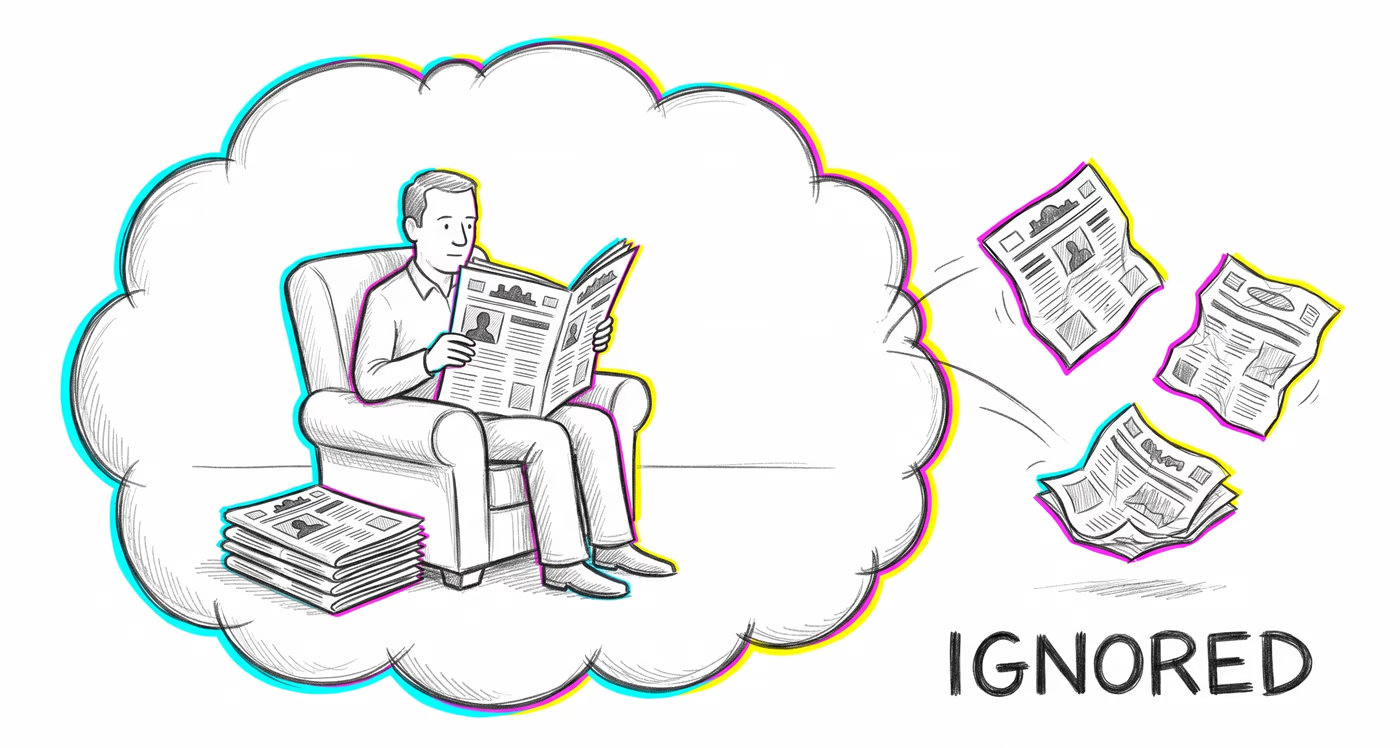
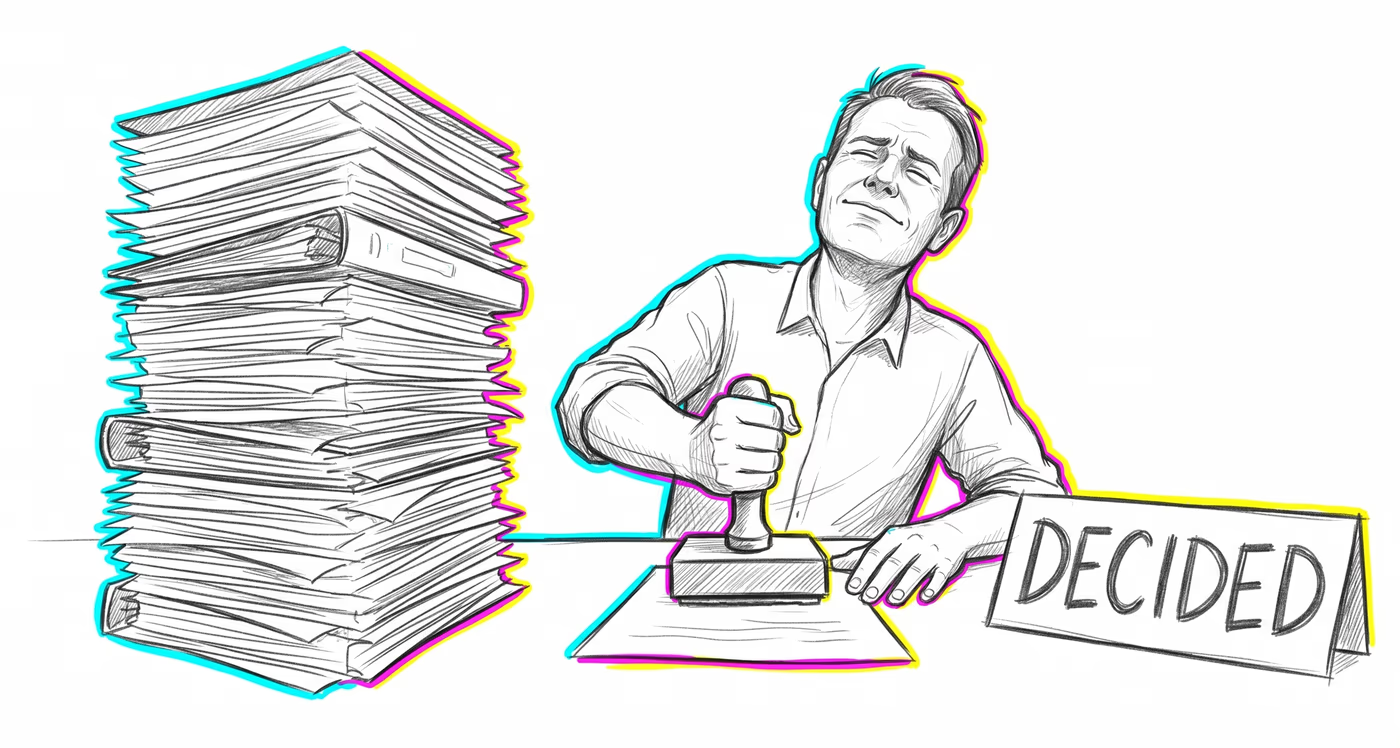
Seeking more information to make a decision even when that extra information cannot change the outcome.

WHAT IT IS

The glitch, explained plainly.

Imagine you already know you want chocolate ice cream — it's the only flavor you like. But instead of just ordering it, you insist on reading the entire menu, asking the server about every flavor, and looking up reviews on your phone. All that extra checking didn't change what you were going to pick; it just made the line longer.

Information Bias describes the compulsive tendency to gather more data before making a decision, even when the additional information is demonstrably irrelevant to the outcome. People under this bias equate the volume of information with the quality of the decision, creating a false sense of thoroughness. The bias often leads to delayed action, wasted resources, and paradoxically, worse decisions as noise dilutes signal. It reflects a deep-seated discomfort with uncertainty and a mistaken belief that perfect information is both achievable and necessary for every choice.

SOUND FAMILIAR?

Where it shows up.

  1. 01 A hiring manager has already identified the strongest candidate after three rounds of interviews and reference checks. She decides to add a fourth round of personality assessments and a case study, not because any result would disqualify the candidate, but because she feels 'more data can't hurt.' The additional round delays the hire by two weeks and the candidate accepts another offer.
  2. 02 A doctor determines that a patient almost certainly has a common bacterial infection based on symptoms and history, and the treatment is the same broad-spectrum antibiotic regardless of the exact bacterial strain. The doctor still orders an expensive culture test that will take three days, delaying treatment, even though the results won't change the prescribed medication.
  3. 03 A product manager delays a launch to commission one more round of user surveys. The feature set is already locked, the engineering work is done, and no survey result would change what ships. She justifies the delay by saying the team needs 'a complete picture' before going live.
  4. 04 An investor has decided to rebalance his portfolio toward index funds based on a well-researched strategy. Before executing the trades, he spends three more weeks reading individual analyst reports on each of the 500 companies in the index, even though the entire point of indexing is to avoid stock-picking. He tells himself that being 'informed' is never a waste of time.
  5. 05 A government committee evaluating a bridge safety upgrade requests a third engineering assessment. The first two independent assessments both recommended immediate repair, and no finding from a third assessment could produce a recommendation to delay. The committee justifies the request by noting that major infrastructure decisions should be based on the most comprehensive evidence possible.
IN DIFFERENT DOMAINS

Where it shows up at work.

The same glitch looks different depending on the terrain. Finance, medicine, a relationship, a team — same mechanism, different costume.

Finance & investing

Investors delay executing well-founded strategies by endlessly consuming analyst reports, earnings calls, and market commentary that cannot materially change their allocation decisions, mistaking the volume of research for the quality of the investment thesis.
Medicine & diagnosis

Physicians order additional diagnostic tests whose outcomes will not alter the treatment plan, increasing patient anxiety, healthcare costs, and time-to-treatment, especially when a clinical diagnosis is already sufficient for action.

Education & grading

Teachers spend excessive time collecting assessment data — additional quizzes, surveys, and diagnostic tests — before deciding on an intervention strategy that the initial assessment data already clearly supports, delaying help for struggling students.

Relationships

A person obsessively asks mutual friends, checks social media, and re-reads old messages to 'understand' why a relationship ended, even though no new piece of information would change the fact that it's over or alter what they should do next.

Tech & product

Product teams run additional A/B tests and user research rounds even when existing data clearly favors one design variant, delaying deployment because the team conflates more data points with more certainty.

Workplace & hiring

Managers request extra reports, dashboards, and analyses before greenlighting projects that the existing evidence already supports, creating a culture where decision-making is synonymous with data-gathering rather than action-taking.

Politics Media

Voters and commentators demand more hearings, investigations, and reports on issues where the factual record is already sufficient for policy action, allowing the appearance of due diligence to substitute for decision-making.

HOW TO SPOT IT

Ask yourself…

  • Would any possible result from this additional information actually change what I'm going to do?
  • Am I seeking more data because I genuinely need it, or because not-knowing feels uncomfortable?
  • If I had to decide right now with only what I already know, would I make a different choice?
HOW TO DEFEND AGAINST IT

The playbook.

  • Before seeking new information, explicitly write down: 'What action would I take if the result is X? What if it's Y?' If the action is the same regardless, stop gathering.
  • Set a decision deadline before beginning research, and commit to deciding with whatever you have by that time.
  • Apply the 'value of information' test: calculate whether the expected benefit of the new data exceeds the cost (time, money, delay) of obtaining it.
  • Adopt a 'sufficient information' standard rather than a 'complete information' standard — ask 'Do I have enough to act?' instead of 'Do I know everything?'
  • Designate a 'decision buddy' who can call out when additional research has become procrastination disguised as diligence.
FAMOUS CASES

In history.

  • The over-testing culture in U.S. healthcare, where physicians order diagnostically redundant tests to feel thorough, contributing billions in unnecessary annual expenditure without improving patient outcomes.
  • The pre-launch delay of numerous technology products where companies commissioned additional market research rounds that could not have altered the go/no-go decision already supported by existing data.
WHERE IT COMES FROM
Academic origin

Jonathan Baron, Jane Beattie, and John C. Hershey, 1988, in their paper 'Heuristics and Biases in Diagnostic Reasoning: II. Congruence, Information, and Certainty' published in Organizational Behavior and Human Decision Processes.

Evolutionary origin

In ancestral environments, information was scarce and almost always actionable — knowing whether a water source was poisoned or a predator was nearby was rarely wasted effort. The cost of gathering additional environmental cues was low relative to the survival benefit, so brains evolved a default preference for acquiring all available information before acting.

IN AI SYSTEMS

How the machines inherit it.

Machine learning pipelines can exhibit information bias when engineers add more and more features to a model without evaluating whether those features improve predictive accuracy, leading to overfitting, increased computational cost, and degraded performance as noise overwhelms signal.

Read more on Wikipedia
FREE FIELD ZINE

10 glitches quietly running your life.

A free field-zine PDF — ten cognitive glitches named, illustrated, with a defense move for each. Plus the weekly Glitch Report on Fridays — one bias named, two spotted in the wild, one defense move. Unsubscribe any time.

EXPLORE MORE

Related glitches.

LAUNCH PRICE

Train against your blindspots.

50 cards are free to preview. Buyers unlock the rest of the deck plus the interactive training — Spot-the-Bias Quiz unlimited, Swipe Deck with spaced repetition, My Blindspots, Decision Pre-Flight, the Printable Deck + Cheat Sheets, and the Field Guide e-book. $29.50$59.

Unlock the full deck

Everything below — yours forever. Pay once, use across every device.

Half-off launch — limited to the first 100 readers. Auto-applied at checkout.
$59 $29.50
one-time payment · lifetime access
  • All interactive digital cards — search, filter, flip, shuffle on any device
  • Five training modes — Spot-the-Bias Quiz, Swipe Deck, Pre-Flight, Blindspots, Journal
  • Curated Lenses + Decision Templates + Defense Playbook
  • Printable Deck PDFs + Field Guide e-book + Cheat Sheets + Anki Export
  • Every future improvement, included
Unlock  $29.50

30-day refund · no questions asked

Unlock the full deck

Everything below — yours forever. Pay once, use across every device.

Half-off launch — limited to the first 100 readers. Auto-applied at checkout.
$59 $29.50
one-time payment · lifetime access
  • All interactive digital cards — search, filter, flip, shuffle on any device
  • Five training modes — Spot-the-Bias Quiz, Swipe Deck, Pre-Flight, Blindspots, Journal
  • Curated Lenses + Decision Templates + Defense Playbook
  • Printable Deck PDFs + Field Guide e-book + Cheat Sheets + Anki Export
  • Every future improvement, included
Unlock  $29.50

30-day refund · no questions asked