Just-World Hypothesis

aka Just-World Fallacy · Just-World Bias · Just-World Theory

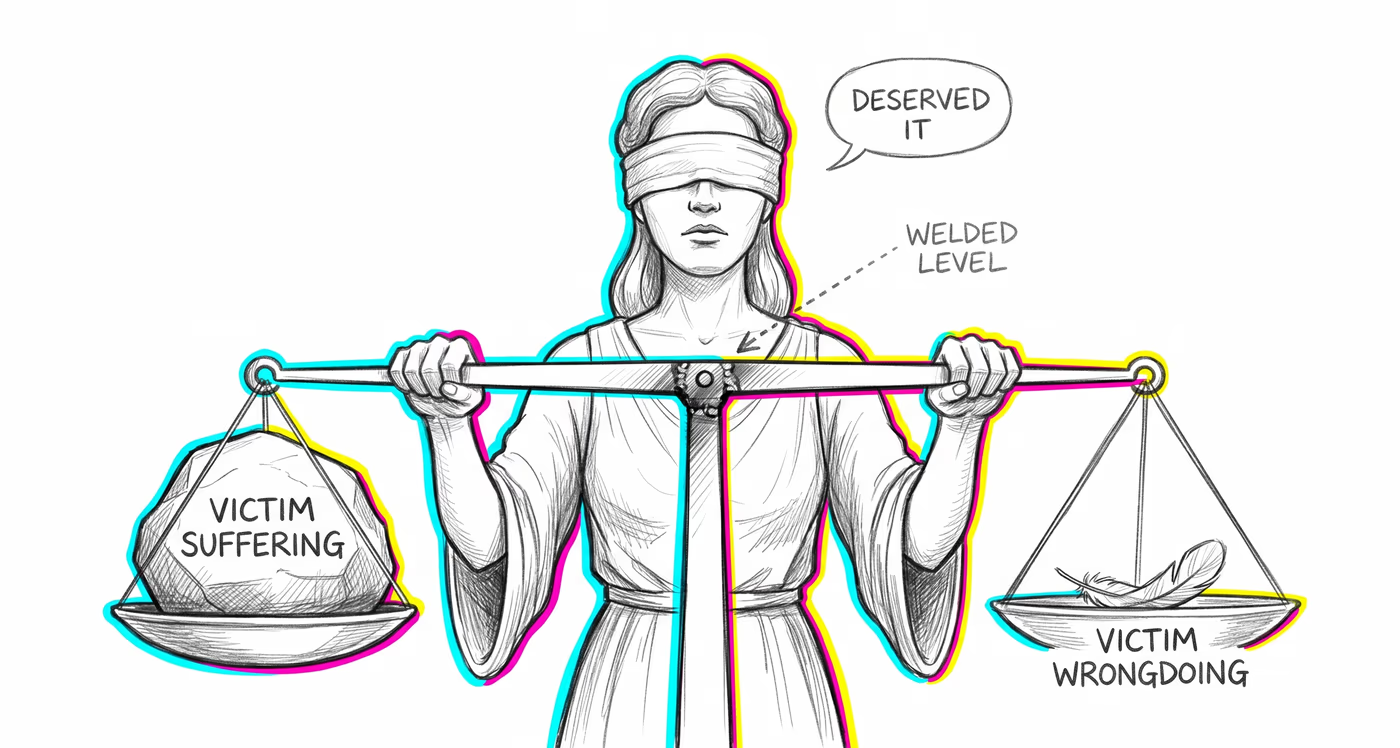
Believing the world is fundamentally fair, so people must deserve what happens to them — often leading to blaming victims.

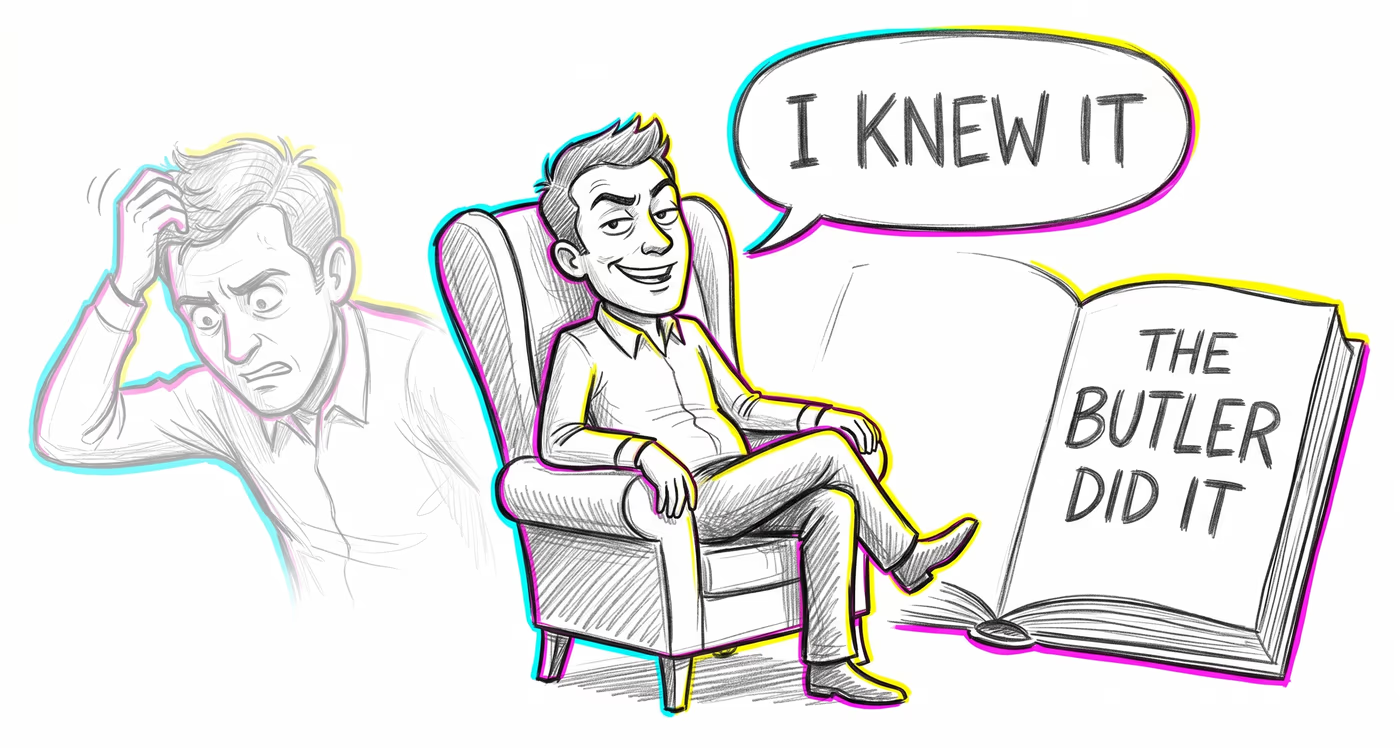
Illustration: Just-World Hypothesis
WHAT IT IS

The glitch, explained plainly.

Imagine you believe that if you're a good kid, only good things will happen to you. So when something bad happens to another kid—like they fall off their bike and get hurt—instead of feeling sorry for them, your brain whispers 'well, they must have been doing something wrong.' Your brain does this because it's scary to think that bad things can happen to good people for no reason at all.

The just-world hypothesis describes the deeply motivated belief that the social environment is fundamentally fair—that noble actions will be rewarded and wrongdoing will be punished. When people encounter evidence of innocent suffering that threatens this belief, they experience cognitive dissonance and employ strategies to restore it, most commonly by reinterpreting the victim's character or behavior as somehow deserving of the negative outcome. This bias operates across two dimensions: belief in a just world for oneself (personal BJW) and belief in a just world for others (general BJW), each with distinct psychological consequences. The belief serves a protective psychological function by making the world feel predictable and controllable, but it systematically distorts moral judgment and reduces compassion for those who suffer through no fault of their own.

SOUND FAMILIAR?

Where it shows up.

  1. 01 After reading a news article about a family losing their home in a flood, Maria catches herself thinking, 'They should have known better than to buy a house in that area.' She focuses on the family's location choice rather than considering inadequate infrastructure, climate change, or the affordability constraints that limited where they could live.
  2. 02 During a jury deliberation for a fraud case, one juror argues that the elderly victim 'had it coming' because she should have been more cautious with her savings. Several jurors nod, and the discussion shifts from the defendant's elaborate scheme to the victim's supposed naivety, as if her gullibility made the crime partially her fault.
  3. 03 A manager reviews two employees' annual results. One exceeded targets thanks to being assigned a booming market territory; the other missed targets after inheriting a declining region. The manager rates the first employee as 'exceptional talent' and the second as 'lacking initiative,' genuinely convinced each person's outcome reflects their character rather than their assignment.
  4. 04 When a successful entrepreneur is profiled in a magazine, readers overwhelmingly credit her relentless work ethic and vision. When a nearly identical entrepreneur fails due to a sudden regulatory change, the same readers conclude he must have been reckless or insufficiently prepared—despite both facing similar market conditions with one key external difference.
  5. 05 A policy analyst opposes expanding unemployment benefits, reasoning that extended support will only enable laziness. When pressed, she acknowledges structural factors like automation and regional economic collapse but still feels that truly deserving people would find a way—because in her framework, sustained hardship must ultimately reflect something about the person experiencing it.
IN DIFFERENT DOMAINS

Where it shows up at work.

The same glitch looks different depending on the terrain. Finance, medicine, a relationship, a team — same mechanism, different costume.

Finance & investing

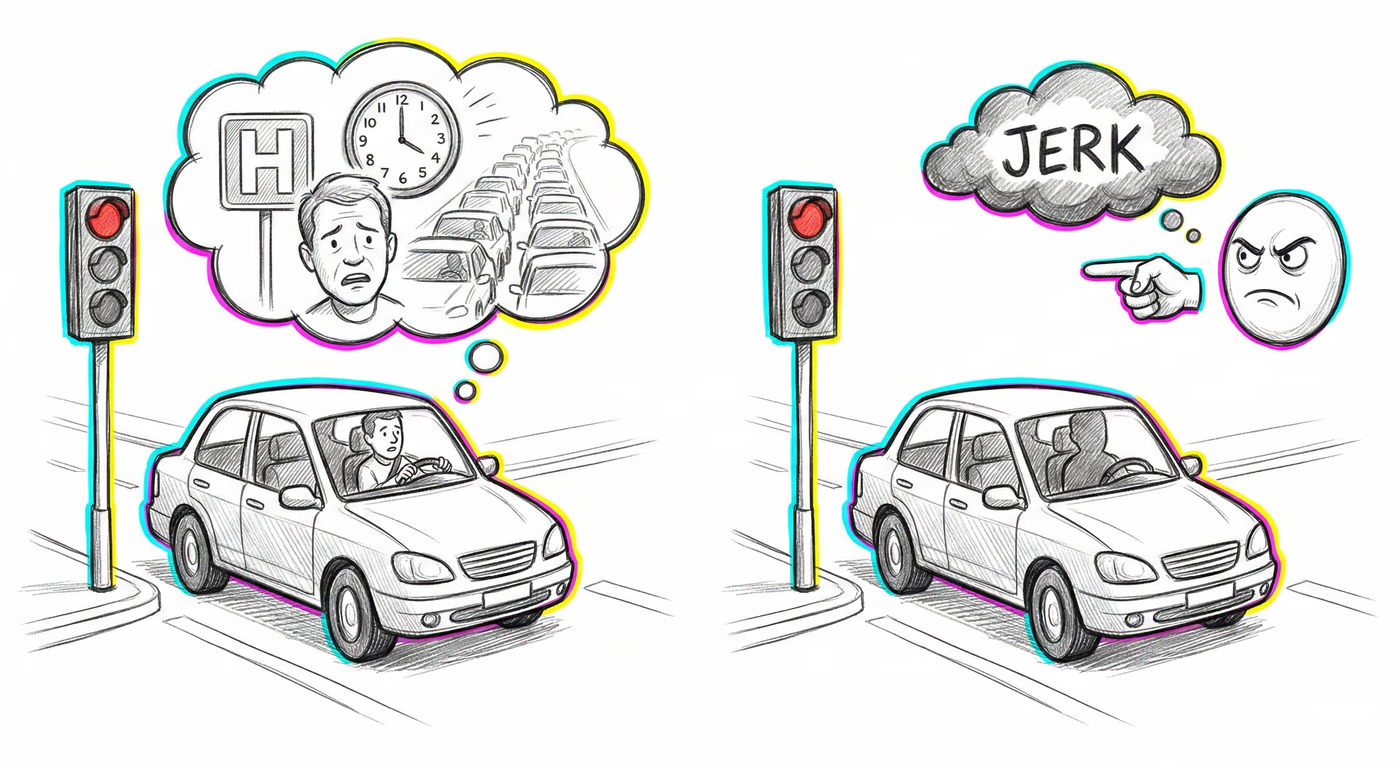
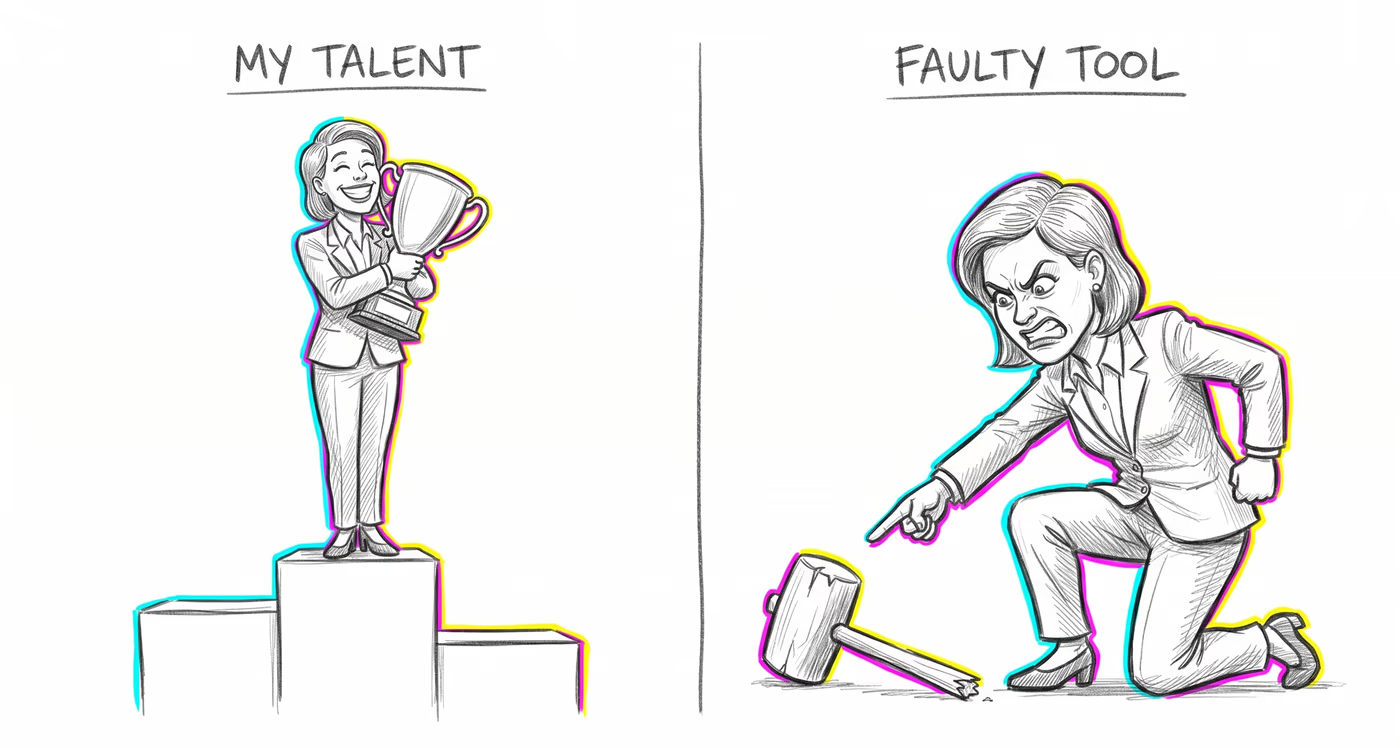
Investors attribute market losses to the poor judgment of those who lost money while crediting gains to their own skill, reinforcing the belief that financial outcomes are deserved rather than partly random. This leads to under-diversification and excessive risk-taking based on the assumption that smart people don't lose money.
Medicine & diagnosis

Patients with lifestyle-related illnesses (e.g., lung cancer, obesity-related conditions) receive less empathy and lower-quality care from clinicians who implicitly believe the patients brought illness upon themselves. Patients themselves may delay seeking treatment out of self-blame, worsening outcomes.

Education & grading

Teachers may unconsciously attribute struggling students' poor performance to laziness or lack of ability rather than to external factors like unstable home environments, learning disabilities, or food insecurity. This reduces the likelihood of providing additional support to the students who need it most.

Relationships

People in relationships may rationalize a partner's suffering by attributing it to character flaws, reducing empathy during crises. Friends of someone going through a divorce may assume the person 'must have done something wrong,' distancing themselves rather than offering support.

Tech & product

Product designers may attribute user errors to user incompetence rather than poor design, resisting UI improvements because they believe competent users should be able to figure it out. Negative app reviews get dismissed as coming from users who 'didn't read the instructions.'

Workplace & hiring

HR departments and managers tend to view terminated employees as having deserved their firing, which discourages examination of systemic issues like toxic management, unclear expectations, or biased evaluation processes. Conversely, promoted individuals are presumed to be the most deserving, reinforcing existing hierarchies.

Politics Media

Voters and media consumers resist narratives about structural poverty or systemic discrimination because accepting them challenges the belief that outcomes are fair. This fuels opposition to welfare programs, affirmative action, and criminal justice reform, as people assume beneficiaries or victims are personally responsible for their circumstances.

HOW TO SPOT IT

Ask yourself…

  • Am I assuming this person's outcome says something about their character rather than their circumstances?
  • Would I judge this situation the same way if it happened to me or someone I love?
  • Am I looking for reasons the victim 'brought it on themselves' to make myself feel safer?
HOW TO DEFEND AGAINST IT

The playbook.

  • Explicitly separate the question 'What caused this outcome?' from 'What does this person deserve?' — causation is not moral desert.
  • Use the 'swap test': Imagine the exact same circumstances happening to you or a loved one. Does your explanation still feel fair?
  • Actively generate three situational or systemic explanations for any negative outcome before allowing character-based explanations.
  • Study base rates: research how common the negative outcome is in the relevant population to calibrate whether individual behavior can plausibly explain it.
  • Practice the habit of offering help or compassion first, and analysis later—action disrupts the derogation pathway.
FAMOUS CASES

In history.

  • Widespread victim-blaming of sexual assault survivors throughout the history of rape prosecutions, where defense strategies routinely focus on victim behavior and clothing.
  • Public attitudes toward AIDS patients in the 1980s, where many believed the disease was divine punishment for immoral behavior, reducing support for research and treatment.
  • Attitudes toward poverty during the Great Depression, where despite mass unemployment caused by systemic economic failure, many Americans still blamed the poor for their own circumstances.
  • Post-Hurricane Katrina discourse in 2005, where public commentary frequently blamed New Orleans residents for not evacuating rather than examining government failures and structural inequality.
WHERE IT COMES FROM
Academic origin

Melvin J. Lerner, 1960s. Formalized in his 1980 monograph 'The Belief in a Just World: A Fundamental Delusion.' Measurement scales developed by Zick Rubin and Letitia Anne Peplau in 1973/1975.

Evolutionary origin

In small ancestral groups, believing that prosocial behavior would be reciprocated and antisocial behavior punished was largely accurate—reputation-based systems of cooperation and punishment did create rough justice. This belief motivated individuals to invest in long-term cooperative strategies, delay gratification, and adhere to social norms, all of which conferred survival and reproductive advantages. The psychological need for a just world may have evolved as a commitment device that kept individuals engaged in goal-directed, socially regulated behavior.

IN AI SYSTEMS

How the machines inherit it.

Training data reflects centuries of just-world reasoning embedded in language and narrative structures. LLMs may reproduce patterns that attribute outcomes to individual character rather than systemic factors, generate victim-blaming framings in summarization tasks, or reinforce meritocratic narratives when discussing inequality. Recommendation algorithms may also perpetuate the bias by surfacing success stories that confirm deservingness while filtering out structural explanations.

Read more on Wikipedia
FREE FIELD ZINE

10 glitches quietly running your life.

A free field-zine PDF — ten cognitive glitches named, illustrated, with a defense move for each. Plus the weekly Glitch Report on Fridays — one bias named, two spotted in the wild, one defense move. Unsubscribe any time.

EXPLORE MORE

Related glitches.

LAUNCH PRICE

Train against your blindspots.

50 cards are free to preview. Buyers unlock the rest of the deck plus the interactive training — Spot-the-Bias Quiz unlimited, Swipe Deck with spaced repetition, My Blindspots, Decision Pre-Flight, the Printable Deck + Cheat Sheets, and the Field Guide e-book. $29.50$59.

Unlock the full deck

Everything below — yours forever. Pay once, use across every device.

Half-off launch — limited to the first 100 readers. Auto-applied at checkout.
$59 $29.50
one-time payment · lifetime access
  • All interactive digital cards — search, filter, flip, shuffle on any device
  • Five training modes — Spot-the-Bias Quiz, Swipe Deck, Pre-Flight, Blindspots, Journal
  • Curated Lenses + Decision Templates + Defense Playbook
  • Printable Deck PDFs + Field Guide e-book + Cheat Sheets + Anki Export
  • Every future improvement, included
Unlock  $29.50

30-day refund · no questions asked

Unlock the full deck

Everything below — yours forever. Pay once, use across every device.

Half-off launch — limited to the first 100 readers. Auto-applied at checkout.
$59 $29.50
one-time payment · lifetime access
  • All interactive digital cards — search, filter, flip, shuffle on any device
  • Five training modes — Spot-the-Bias Quiz, Swipe Deck, Pre-Flight, Blindspots, Journal
  • Curated Lenses + Decision Templates + Defense Playbook
  • Printable Deck PDFs + Field Guide e-book + Cheat Sheets + Anki Export
  • Every future improvement, included
Unlock  $29.50

30-day refund · no questions asked