Moral Luck

aka Outcome-Based Moral Judgment · Resultant Luck Effect

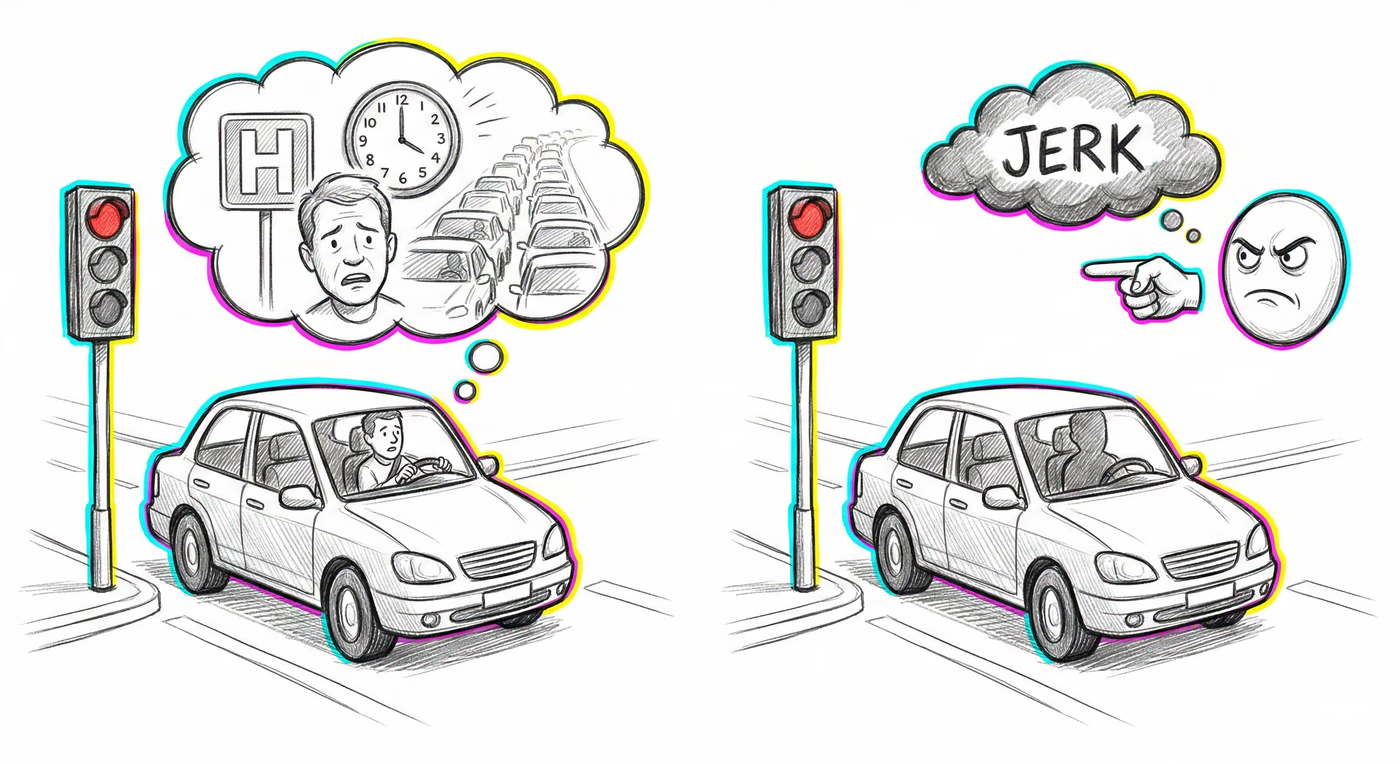
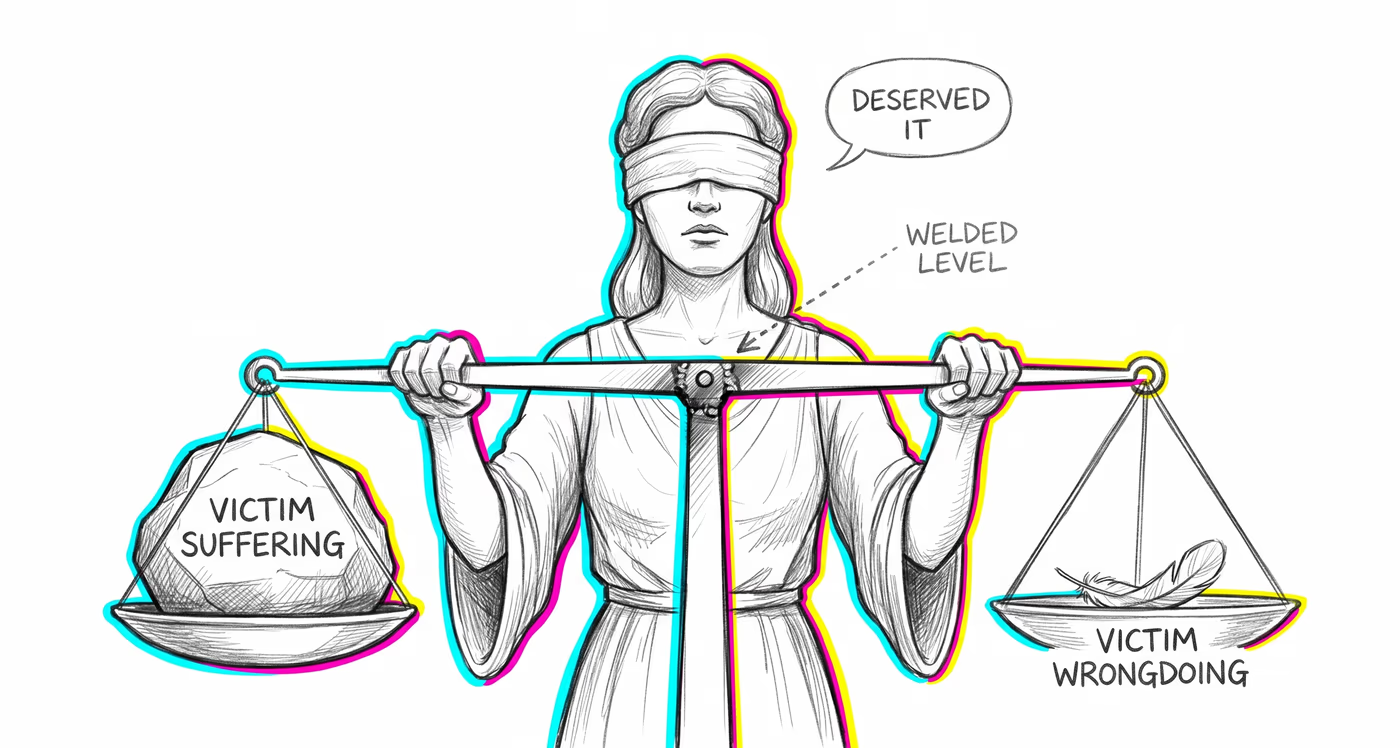
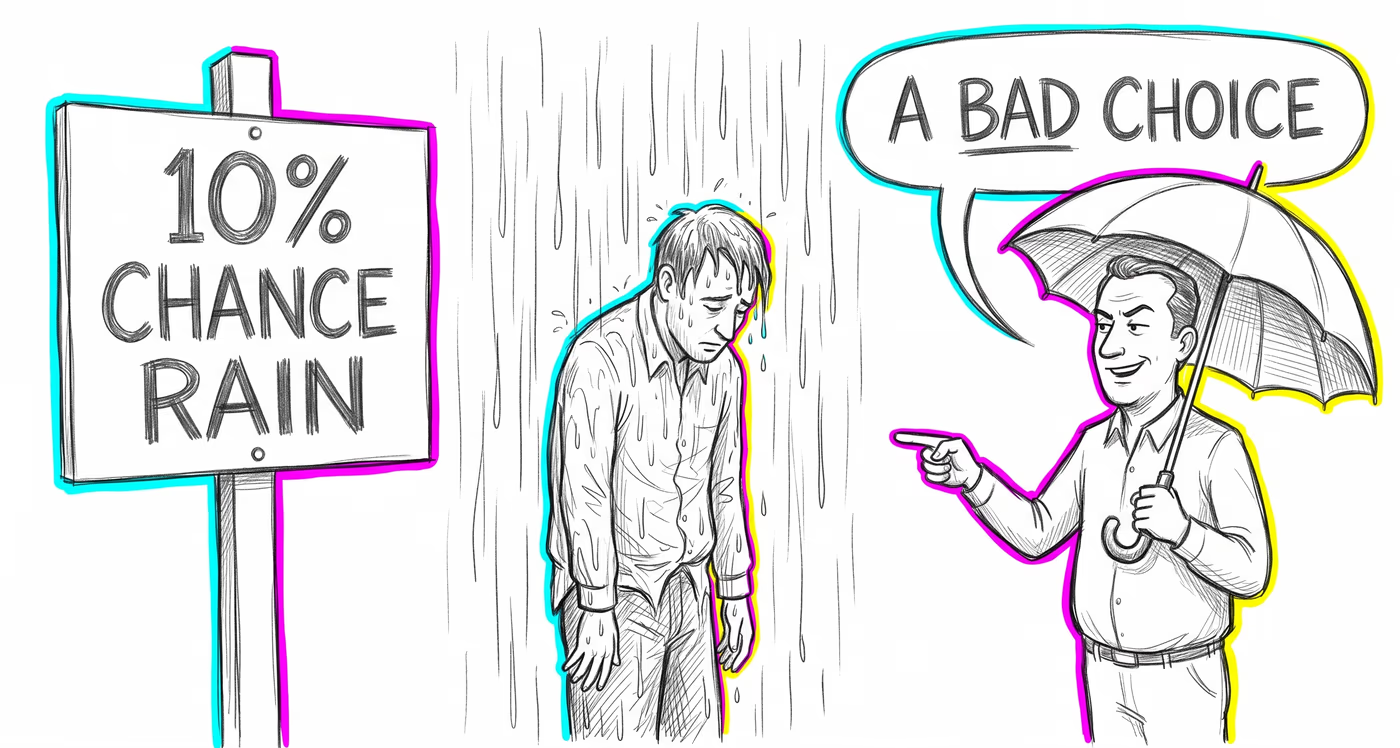
Judging someone's actions as more blameworthy or praiseworthy based on the outcome, even when the outcome was beyond their control.

WHAT IT IS

The glitch, explained plainly.

Imagine two kids both throw a ball in the house. One kid's ball misses everything and bounces harmlessly. The other kid's ball breaks a vase. Even though both kids did the exact same thing, the one who broke the vase gets in way more trouble. We judge people not just by what they chose to do, but by what happened afterward — even when the result was just luck.

Moral luck describes the robust human tendency to let uncontrollable outcomes distort our moral evaluations of people. Two individuals can perform exactly the same action with the same intentions and the same degree of negligence, yet the one whose action happens to produce a bad outcome is judged far more harshly than the one who was simply lucky enough to avoid harmful consequences. This bias extends beyond resultant luck to include circumstantial luck (the situations life places you in), constitutive luck (the character traits you were born with or shaped into), and causal luck (the chain of prior events that determined your choices). The phenomenon reveals a deep tension between our stated belief that people should only be judged for what they can control and our actual practice of heavily weighting outcomes in moral evaluation.

SOUND FAMILIAR?

Where it shows up.

  1. 01 Dr. Patel and Dr. Singh both prescribe the same off-label medication to patients with identical conditions, following the same reasoning. Dr. Patel's patient recovers fully, while Dr. Singh's patient develops a rare adverse reaction. The hospital review board launches an investigation into Dr. Singh's 'questionable judgment' but commends Dr. Patel for 'innovative thinking.'
  2. 02 Two managers both approve the same cost-cutting measure that carries a small risk of supply chain disruption. Manager A's region experiences no disruption; Manager B's region is hit by an unforeseeable port closure. At year-end reviews, Manager A is praised as 'strategically efficient,' while Manager B is criticized for 'failing to anticipate risks' and is passed over for promotion.
  3. 03 A venture capitalist reflects on two identical investment decisions she made years ago using the same analysis. The first startup succeeded and she's featured in a magazine as a 'visionary.' The second startup failed due to an unrelated market crash, and she privately wonders whether she was being 'reckless with other people's money.' She now considers the failed bet evidence of poor judgment, despite having used the same due diligence for both.
  4. 04 After a long hike, two friends both leave their campfires with the same residual embers. A sudden wind reignites one campfire, causing a small brush fire, while the other dies out naturally. Park rangers fine and publicly reprimand only the first hiker, and local media runs a story about their 'irresponsible behavior.'
  5. 05 A software engineer ships code with a known edge-case bug, deciding the risk is acceptably low. When a competitor's engineer ships code with an identical bug and a user happens to trigger it — causing a brief outage — the competitor's engineer is put on a performance improvement plan. The first engineer, whose bug was never triggered, receives no scrutiny and is later promoted for 'shipping fast and decisively.'
IN DIFFERENT DOMAINS

Where it shows up at work.

The same glitch looks different depending on the terrain. Finance, medicine, a relationship, a team — same mechanism, different costume.

Finance & investing

Investors and fund managers who take identical risks are evaluated very differently depending on market conditions beyond their control. Profitable trades are retrospectively labeled 'smart investing,' while identical losing trades are recharacterized as 'speculation' or 'gambling,' and the fund manager may face reputational or career consequences solely due to outcome.
Medicine & diagnosis

Surgeons who perform identical procedures with equal skill face vastly different malpractice exposure based on patient outcomes influenced by uncontrollable biological variation. Bad outcomes trigger investigations into the physician's competence, while equally risky decisions that happen to succeed go unquestioned, distorting clinical risk culture.

Education & grading

Teachers whose students perform well on standardized tests are credited with excellent pedagogy, while teachers using identical methods with a cohort that happens to test poorly may be placed under remediation plans. The outcome — driven by student demographics, home environment, and test-day factors — becomes the sole basis for evaluating teacher quality.

Relationships

Partners who make the same well-intentioned but imperfect decisions are judged very differently based on consequences. Forgetting to lock the door is a minor oversight if nothing happens, but becomes evidence of 'not caring about the family's safety' if a burglary occurs, creating asymmetric blame for identical behavior.

Tech & product

Product teams that launch features with identical risk profiles are evaluated based on user reception and market timing outside their control. A feature that happens to go viral is attributed to the team's 'brilliant product sense,' while an identical feature that flops leads to post-mortems about 'poor decision-making' and leadership changes.

Workplace & hiring

Hiring decisions are evaluated based on how the new employee performs, even though performance depends heavily on team dynamics, onboarding, and market conditions. Hiring managers whose picks succeed are seen as having 'great instincts,' while those whose picks underperform — despite using identical evaluation criteria — are questioned about their judgment.

Politics Media

Political leaders who implement identical policies are judged almost entirely on outcomes shaped by global forces. A president whose term coincides with economic growth is hailed as competent, while one who faces a recession caused by external shocks is blamed for 'mismanagement,' and media narratives reinforce this outcome-dependent evaluation.

HOW TO SPOT IT

Ask yourself…

  • Am I judging this person's decision differently than I would if the outcome had been different, even though the decision itself was identical?
  • Would I be praising this exact same choice if it had led to a good outcome instead of a bad one?
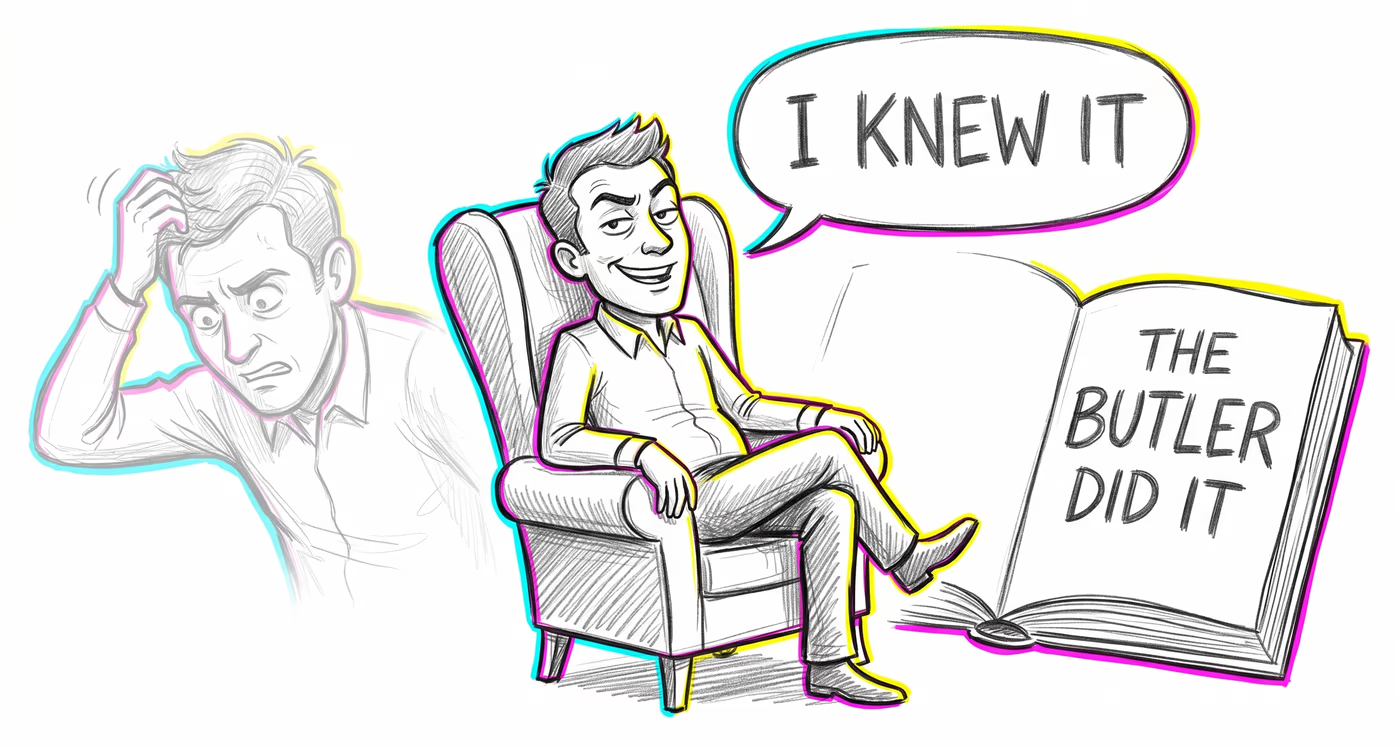
  • Am I confusing 'they should have known better' with 'I now know what happened' — is hindsight making me attribute foresight they couldn't have had?
HOW TO DEFEND AGAINST IT

The playbook.

  • Apply the 'outcome swap' test: Before evaluating someone's decision, ask yourself how you would judge the exact same decision if the outcome had been the opposite.
  • Evaluate decisions based on the information available at the time they were made, not on information revealed afterward.
  • In organizational settings, implement process-based reviews that assess decision quality independently of outcomes — review the reasoning, not just the results.
  • When serving on juries or review boards, explicitly separate the evaluation of the agent's conduct from the severity of the outcome before rendering judgment.
  • Practice perspective-taking: remember a time when you made an identical choice that happened to turn out well, and notice the asymmetry in how you judge yourself versus the unlucky person.
FAMOUS CASES

In history.

  • The differential sentencing of attempted versus completed crimes throughout legal history, where identical criminal intent receives vastly different punishment based solely on whether the crime happened to succeed.
  • The public and legal consequences for the engineers of the Challenger space shuttle disaster versus other NASA missions that carried similar known risks but did not result in catastrophe.
  • The retrospective moral condemnation of Nazi collaborators in occupied Europe versus the lack of moral scrutiny for individuals with identical dispositions who happened to emigrate before the war — a case Nagel specifically highlighted in his foundational essay.
WHERE IT COMES FROM
Academic origin

The concept was independently formalized by philosopher Bernard Williams (1976) and Thomas Nagel (1976) in their respective essays both titled 'Moral Luck.' Williams introduced the term, and Nagel's response articulated the four varieties (resultant, circumstantial, constitutive, and causal). Psychological investigation followed through researchers like Cushman, Young, Knobe, and others from the 2000s onward.

Evolutionary origin

Punishing based on outcomes, even accidental ones, may have served an adaptive function by incentivizing caution. If harmful accidents lead to social punishment regardless of intent, individuals are motivated to take extra precautions to avoid causing harm. From a pedagogical perspective, outcome-based punishment exploits the offender's capacity to learn from consequences, reinforcing avoidance of dangerous behaviors even when harm was unintended. In ancestral environments where understanding others' true mental states was unreliable, outcomes served as the most observable and verifiable signal of risk.

IN AI SYSTEMS

How the machines inherit it.

Machine learning models trained on historical outcome data inherit moral luck bias by learning to associate negative outcomes with the decisions that preceded them, regardless of whether those decisions were sound at the time. Recidivism prediction algorithms, for instance, may penalize individuals whose circumstances led to worse outcomes while treating identically situated individuals who were luckier as lower risk. Reward-based reinforcement learning systems also embed moral luck by optimizing for outcomes rather than decision quality, potentially learning that identical strategies are 'good' or 'bad' based on stochastic environmental variation.

FREE FIELD ZINE

10 glitches quietly running your life.

A free field-zine PDF — ten cognitive glitches named, illustrated, with a defense move for each. Plus the weekly Glitch Report on Fridays — one bias named, two spotted in the wild, one defense move. Unsubscribe any time.

EXPLORE MORE

Related glitches.

LAUNCH PRICE

Train against your blindspots.

50 cards are free to preview. Buyers unlock the rest of the deck plus the interactive training — Spot-the-Bias Quiz unlimited, Swipe Deck with spaced repetition, My Blindspots, Decision Pre-Flight, the Printable Deck + Cheat Sheets, and the Field Guide e-book. $29.50$59.

Unlock the full deck

Everything below — yours forever. Pay once, use across every device.

Half-off launch — limited to the first 100 readers. Auto-applied at checkout.
$59 $29.50
one-time payment · lifetime access
  • All interactive digital cards — search, filter, flip, shuffle on any device
  • Five training modes — Spot-the-Bias Quiz, Swipe Deck, Pre-Flight, Blindspots, Journal
  • Curated Lenses + Decision Templates + Defense Playbook
  • Printable Deck PDFs + Field Guide e-book + Cheat Sheets + Anki Export
  • Every future improvement, included
Unlock  $29.50

30-day refund · no questions asked

Unlock the full deck

Everything below — yours forever. Pay once, use across every device.

Half-off launch — limited to the first 100 readers. Auto-applied at checkout.
$59 $29.50
one-time payment · lifetime access
  • All interactive digital cards — search, filter, flip, shuffle on any device
  • Five training modes — Spot-the-Bias Quiz, Swipe Deck, Pre-Flight, Blindspots, Journal
  • Curated Lenses + Decision Templates + Defense Playbook
  • Printable Deck PDFs + Field Guide e-book + Cheat Sheets + Anki Export
  • Every future improvement, included
Unlock  $29.50

30-day refund · no questions asked