Naïve Cynicism

aka Naive Cynicism · Cynical Egoism Bias · Biased Assumptions of Bias

Expecting others to be more selfish and biased than they actually are, while seeing your own views as objective.

WHAT IT IS

The glitch, explained plainly.

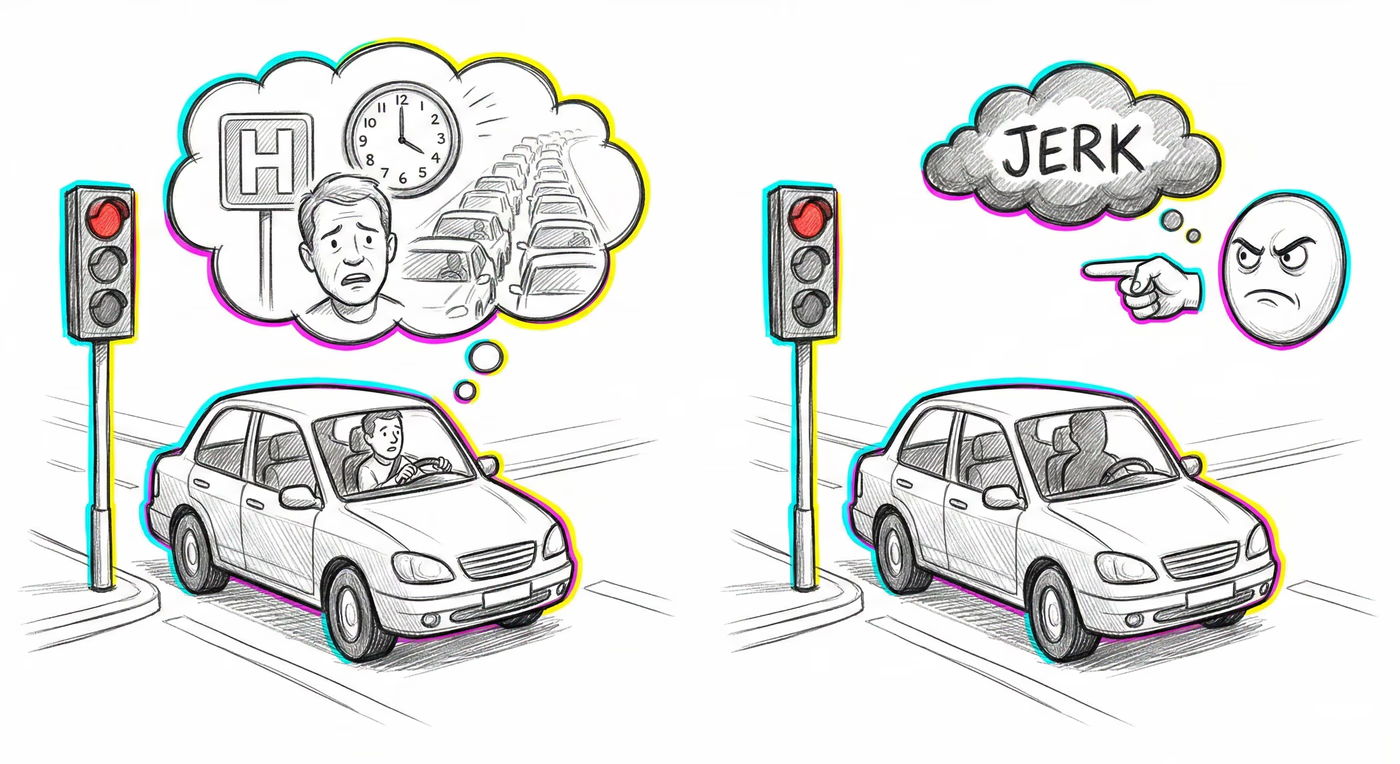
Imagine you and your friend both want the last cookie. You think, 'I want it because I'm genuinely hungry,' but you assume your friend wants it just because they're greedy. You give yourself a good reason, but you assume the other person has a selfish reason — even though they might be just as hungry as you.

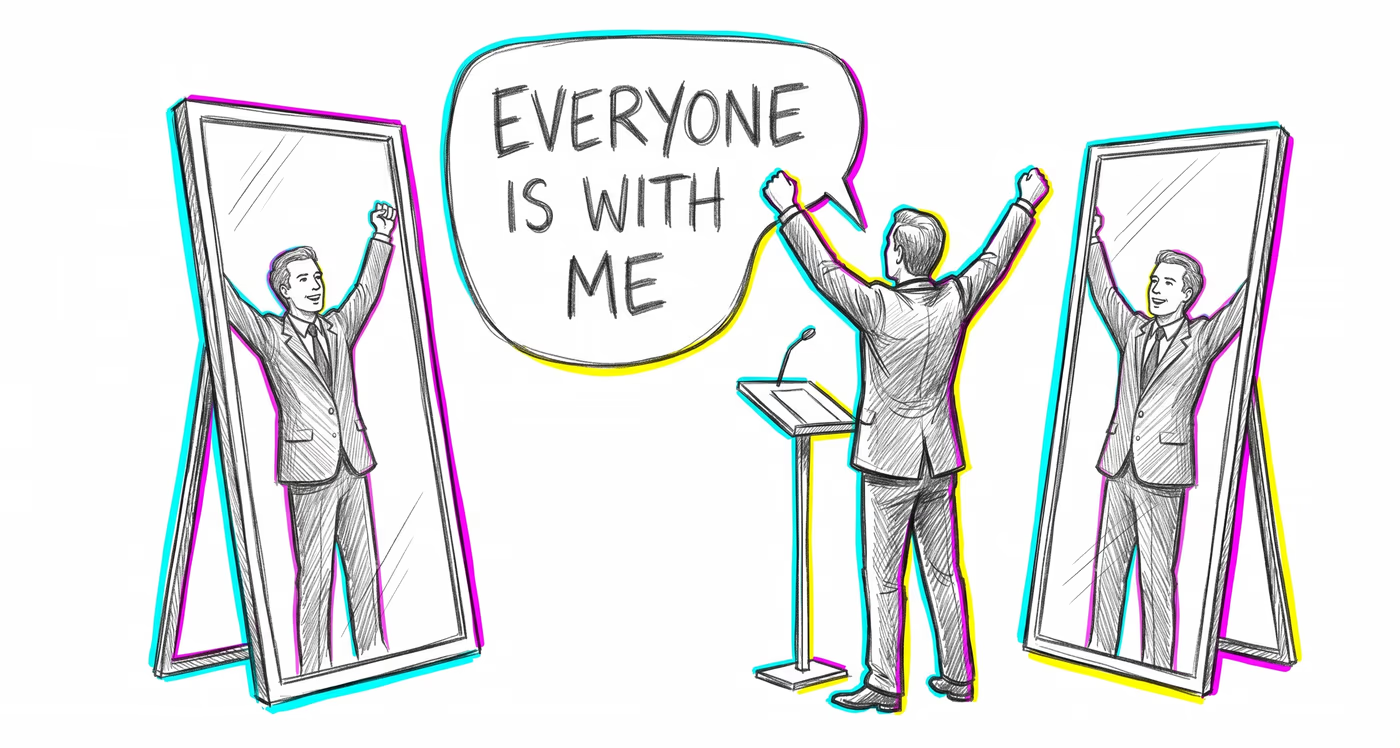
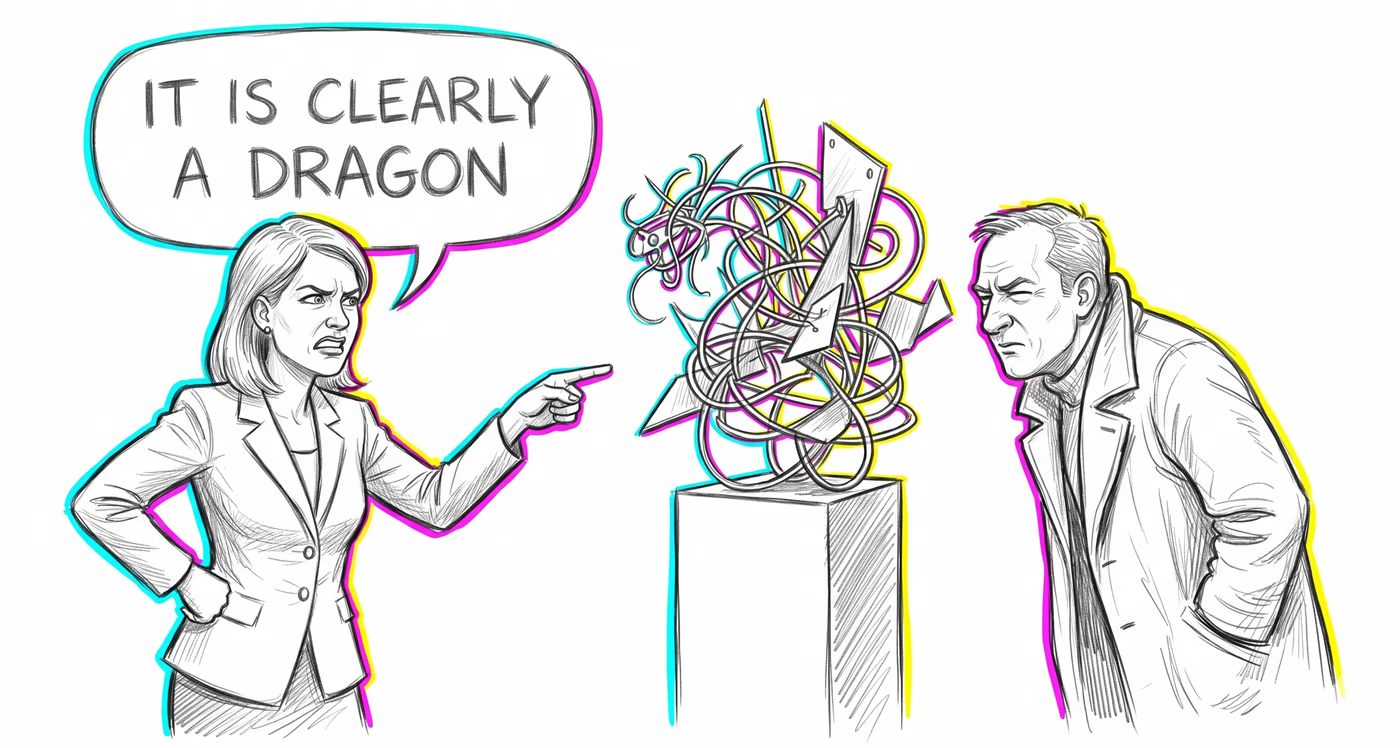
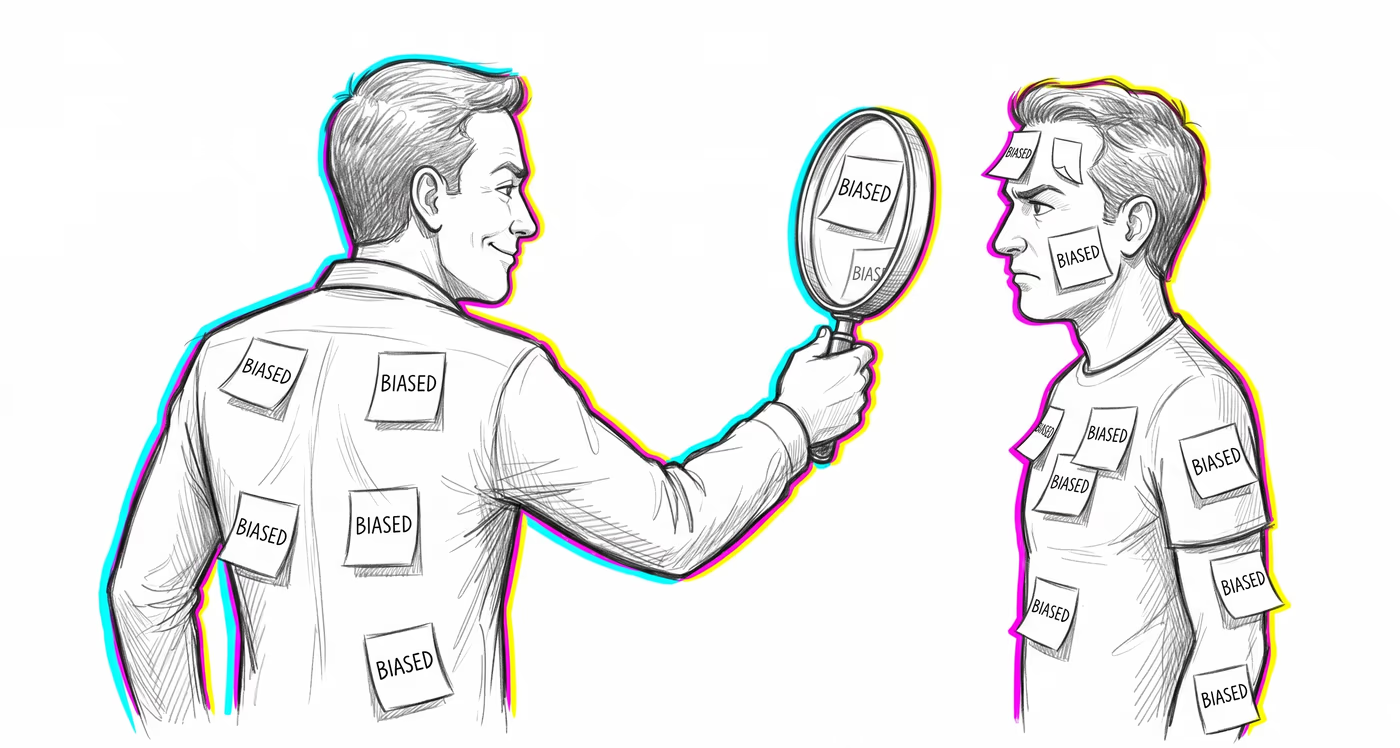
Naïve cynicism describes a systematic asymmetry in how people evaluate their own versus others' motivations: individuals tend to see their own positions as objective and fair while assuming that others who disagree are driven by hidden self-interest or egocentric bias. This goes beyond healthy skepticism — naïve cynics overestimate the degree to which others' judgments are motivationally corrupted, often attributing selfish intent where none exists. The bias operates as a three-part belief structure: (1) I am not biased, (2) you are biased if you disagree with me, and (3) your actions reflect those underlying egocentric biases. This creates a self-reinforcing cycle where the more someone disagrees with the naïve cynic, the more their disagreement is taken as proof of their corruption rather than as a legitimate difference of perspective.

SOUND FAMILIAR?

Where it shows up.

  1. 01 During a group project at work, Priya suggests that the team redistribute tasks so that she takes over client communications while her colleague handles data analysis. Her colleague immediately thinks, 'She just wants the client-facing role so she can take credit with management,' despite Priya's genuine belief that the redistribution plays to each person's strengths.
  2. 02 Marcus and his wife are discussing vacation plans. She suggests visiting her hometown instead of the beach resort he wants. Marcus thinks, 'Of course she wants to go there — she just wants to see her friends and doesn't care about what I want.' He doesn't consider that she might have practical reasons, like saving money by staying with family, and assumes her preference is entirely self-serving.
  3. 03 A city council member proposes a zoning change that would allow mixed-use development in a residential neighborhood. Residents opposing the change assume the council member must own property nearby that would increase in value, rather than considering the policy might be motivated by a genuine interest in affordable housing. They see their own opposition as principled, but the council member's support as corrupt.
  4. 04 During salary negotiations, an HR manager offers a candidate a comprehensive benefits package with slightly lower base pay. The candidate assumes the company structured the offer this way to save money, not realizing that the HR manager genuinely believes the benefits package is more valuable to the candidate's situation. The candidate sees their own negotiating stance as fair but perceives the company's offer as a calculated ploy.
  5. 05 A researcher reviews a peer's paper that challenges her own published findings. She rates the methodology as flawed, believing the competing researcher is motivated by a desire to build their career by contradicting established work. She considers her own critical review to be purely objective and scientific, never questioning whether her defensiveness about her prior work might be coloring her evaluation of the paper's actual merits.
IN DIFFERENT DOMAINS

Where it shows up at work.

The same glitch looks different depending on the terrain. Finance, medicine, a relationship, a team — same mechanism, different costume.

Finance & investing

Investors often assume that financial advisors, analysts, or fund managers recommending products are primarily motivated by commissions or self-interest, leading them to dismiss sound advice or avoid professional guidance altogether — even when the recommendations are genuinely aligned with the client's goals.
Medicine & diagnosis

Patients may assume that a doctor recommending a particular treatment is motivated by pharmaceutical kickbacks or a desire to bill for procedures, rather than clinical judgment. This cynicism can lead to non-compliance or refusal of effective treatments, particularly when the recommendation involves costly interventions.

Education & grading

Teachers may interpret a student's challenge to a grade as motivated purely by grade-grubbing rather than a legitimate concern about fairness. Conversely, students may assume a teacher's strict grading reflects personal dislike rather than genuine academic standards, undermining the teacher-student relationship.

Relationships

Partners chronically attribute selfish motives to each other's suggestions and preferences — interpreting a partner's desire to spend time with friends as avoidance, or their gift-giving as guilt-driven — while viewing their own identical behaviors as natural and well-intentioned. This asymmetric attribution erodes intimacy over time.

Tech & product

Product teams may dismiss user feedback or feature requests as users being lazy or wanting things for free, rather than recognizing legitimate usability problems. Cross-functional teams also fall prey: designers assume engineers resist UI changes to avoid work, while engineers assume designers push aesthetics over performance for portfolio reasons.

Workplace & hiring

During performance reviews or promotion discussions, employees tend to view their own contributions as merit-based while assuming that colleagues who advance are benefiting from political maneuvering, favoritism, or self-promotion rather than genuine competence. This breeds resentment and reduces collaborative behavior.

Politics Media

Voters and partisans routinely assume that politicians from the opposing party are motivated entirely by power, donors, or personal gain, while viewing their own side's politicians as principled public servants. This asymmetric attribution of motive makes bipartisan compromise appear as capitulation to corruption rather than pragmatic governance.

HOW TO SPOT IT

Ask yourself…

  • Am I assuming this person has a hidden selfish motive without concrete evidence, simply because they disagree with me?
  • Would I attribute the same selfish motive to myself if I held this person's position, or would I give myself a more charitable explanation?
  • Am I treating my own perspective as objective while treating their different perspective as proof of bias?
HOW TO DEFEND AGAINST IT

The playbook.

  • Apply the 'Same Shoes' test: Before attributing selfish motives to someone, ask what charitable explanation you would give yourself if you held their exact position.
  • Practice the 'Steel Man' exercise: Construct the strongest, most good-faith version of the other person's reasoning before evaluating their motives.
  • Keep a motive attribution journal: When you catch yourself assuming someone's selfish, write down the evidence for and against that assumption. Review it after a week.
  • Use the 'Outsider Perspective' technique: Imagine a neutral third party observing both you and the other person — would they see the same asymmetry in motives that you perceive?
  • Default to 'earned trust' rather than 'earned distrust': Extend good faith initially and let actual behavior — not assumptions — determine your level of trust.
FAMOUS CASES

In history.

  • Cold War nuclear disarmament negotiations, where each superpower assumed the other's proposals were strategic ploys rather than genuine peace efforts, contributing to decades of stalemate.
  • The Israeli-Palestinian peace process, where research by Maoz, Ward, Katz, and Ross (2002) showed that identical peace proposals were devalued when attributed to the opposing side, partly driven by cynical assumptions about the other side's motives.
WHERE IT COMES FROM
Academic origin

Justin Kruger and Thomas Gilovich, 1999. Formalized in their paper 'Naive cynicism in everyday theories of responsibility assessment: On biased assumptions of bias,' published in the Journal of Personality and Social Psychology, 76(5), 743–753. The concept builds on earlier work by Solomon Asch and Gustav Ichheiser (1949) on social perception asymmetries, and Lee Ross's research on naïve realism.

Evolutionary origin

In ancestral environments, assuming that out-group members or competitors acted primarily out of self-interest was a protective heuristic. Individuals who were vigilant about others' potentially exploitative motives were less likely to be deceived, cheated in resource exchanges, or manipulated in coalitional politics. Erring on the side of suspecting selfish motives in others — even when incorrect — carried lower survival costs than being naïvely trusting and getting exploited.

IN AI SYSTEMS

How the machines inherit it.

AI systems trained on human-generated text can inherit and amplify naïve cynicism patterns. Sentiment analysis models may systematically rate statements from certain groups as more likely to be deceptive or self-serving. Recommendation systems may encode cynical assumptions, such as modeling all user behavior as purely self-interested rather than accounting for altruistic or cooperative motivations, leading to overly transactional interaction designs.

Read more on Wikipedia
FREE FIELD ZINE

10 glitches quietly running your life.

A free field-zine PDF — ten cognitive glitches named, illustrated, with a defense move for each. Plus the weekly Glitch Report on Fridays — one bias named, two spotted in the wild, one defense move. Unsubscribe any time.

EXPLORE MORE

Related glitches.

LAUNCH PRICE

Train against your blindspots.

50 cards are free to preview. Buyers unlock the rest of the deck plus the interactive training — Spot-the-Bias Quiz unlimited, Swipe Deck with spaced repetition, My Blindspots, Decision Pre-Flight, the Printable Deck + Cheat Sheets, and the Field Guide e-book. $29.50$59.

Unlock the full deck

Everything below — yours forever. Pay once, use across every device.

Half-off launch — limited to the first 100 readers. Auto-applied at checkout.
$59 $29.50
one-time payment · lifetime access
  • All interactive digital cards — search, filter, flip, shuffle on any device
  • Five training modes — Spot-the-Bias Quiz, Swipe Deck, Pre-Flight, Blindspots, Journal
  • Curated Lenses + Decision Templates + Defense Playbook
  • Printable Deck PDFs + Field Guide e-book + Cheat Sheets + Anki Export
  • Every future improvement, included
Unlock  $29.50

30-day refund · no questions asked

Unlock the full deck

Everything below — yours forever. Pay once, use across every device.

Half-off launch — limited to the first 100 readers. Auto-applied at checkout.
$59 $29.50
one-time payment · lifetime access
  • All interactive digital cards — search, filter, flip, shuffle on any device
  • Five training modes — Spot-the-Bias Quiz, Swipe Deck, Pre-Flight, Blindspots, Journal
  • Curated Lenses + Decision Templates + Defense Playbook
  • Printable Deck PDFs + Field Guide e-book + Cheat Sheets + Anki Export
  • Every future improvement, included
Unlock  $29.50

30-day refund · no questions asked