Overjustification Effect

aka Motivation Crowding Out · Undermining Effect · Hidden Cost of Reward

External rewards like money or prizes killing intrinsic motivation for an activity previously enjoyed for its own sake.

WHAT IT IS

The glitch, explained plainly.

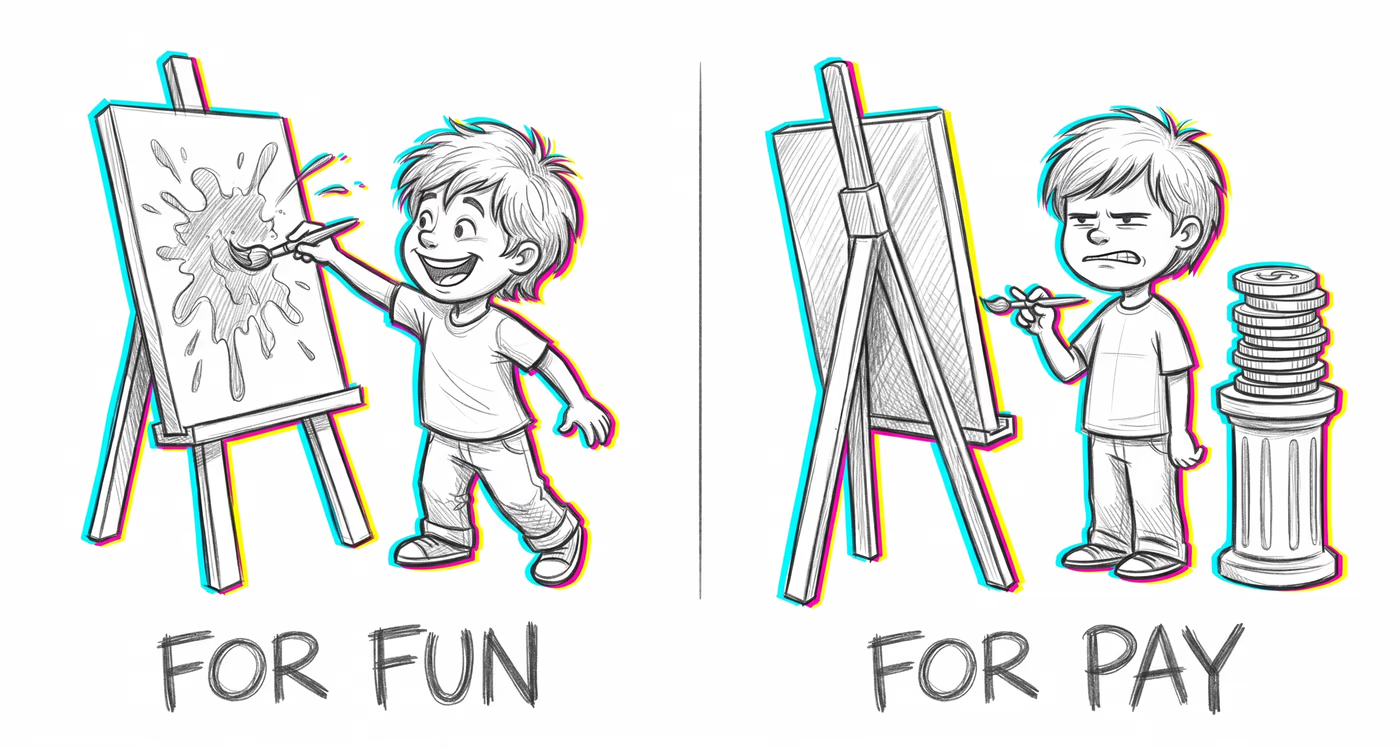
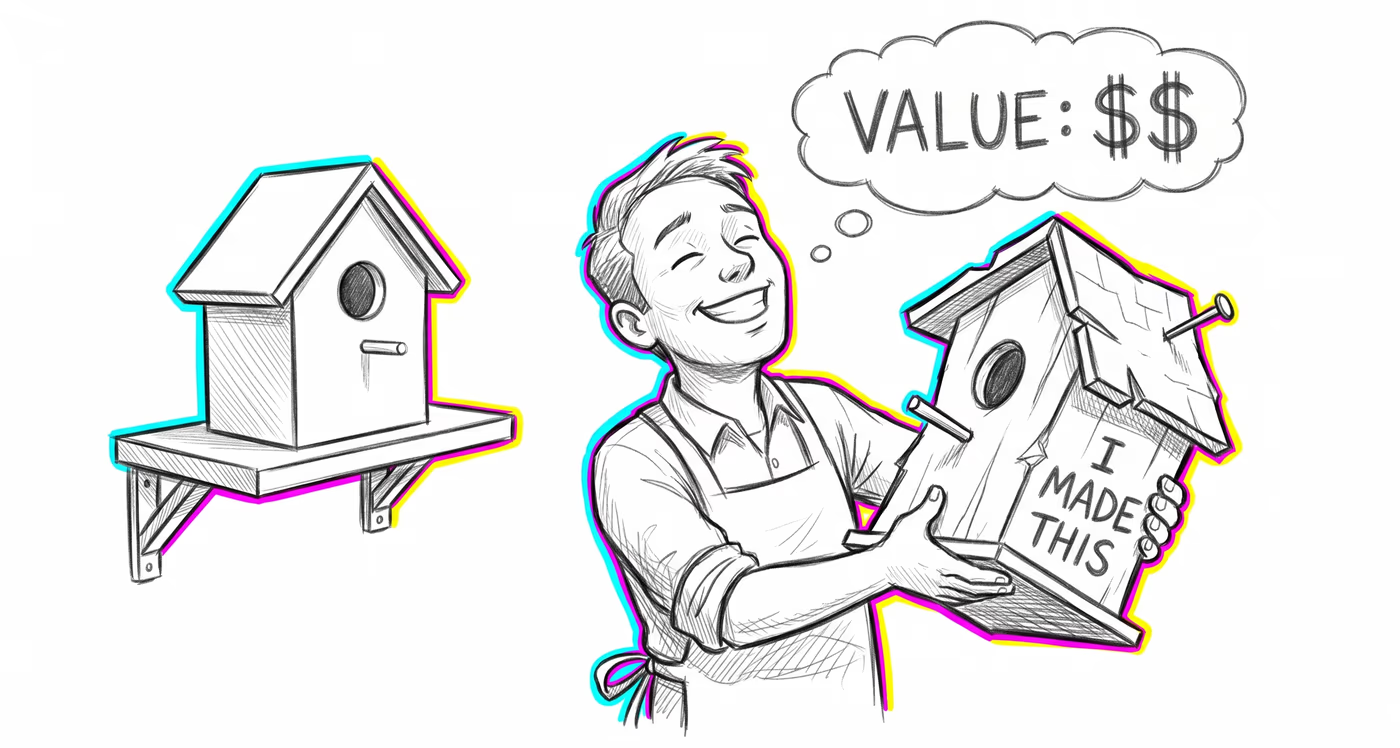
Imagine you love drawing pictures just for fun. Then someone starts giving you a gold star every time you draw. After a while, you stop thinking 'I draw because it's fun' and start thinking 'I draw because I get gold stars.' When the gold stars stop coming, you don't want to draw anymore — even though you used to love it before the gold stars ever existed.

The overjustification effect occurs when providing an expected external incentive for a previously enjoyable activity causes the person to re-attribute their motivation from internal enjoyment to the external reward. Once the reward is removed, the individual's interest in the activity drops below its original baseline level, because the activity has been cognitively reclassified from 'play' to 'work.' The effect is strongest when rewards are tangible, expected in advance, and contingent on task completion rather than on quality of performance. Verbal praise and unexpected rewards generally do not produce the same undermining effect, and the phenomenon is more pronounced in children than in adults.

SOUND FAMILIAR?

Where it shows up.

  1. 01 Maria has always loved gardening and spent every Saturday morning tending to her flower beds. Her neighbor starts paying her $20 each week to also tend his yard. After three months, the neighbor moves away. Maria now finds herself skipping her own garden on Saturdays, feeling strangely unmotivated despite having gardened happily for years before.
  2. 02 A software company introduces a bonus program that pays developers $50 for every bug they find and report. Bug reports spike initially, but after the program is discontinued due to budget cuts, developers stop reporting bugs they notice — even though they used to flag them voluntarily as part of professional pride.
  3. 03 Jake, a passionate amateur photographer, starts selling prints at a local market. Sales are decent for a year, but when demand drops, he finds himself unable to pick up his camera even for personal trips. He tells his wife he's 'lost the spark' and doesn't understand why, since he shot happily for a decade before selling anything.
  4. 04 A nonprofit that relied on enthusiastic volunteers for beach cleanups begins offering branded merchandise as thank-you gifts. Attendance initially rises, but when the organization runs out of merchandise budget, volunteer turnout drops well below its pre-merchandise baseline, puzzling the organizers.
  5. 05 Dr. Patel, a university researcher who publishes prolifically out of intellectual curiosity, receives a large grant that ties funding to publication quotas. Over three years, she meets every quota but finds her work increasingly formulaic. When the grant ends, she takes a sabbatical and struggles to find topics that genuinely excite her, even though she had no shortage of ideas before the grant.
IN DIFFERENT DOMAINS

Where it shows up at work.

The same glitch looks different depending on the terrain. Finance, medicine, a relationship, a team — same mechanism, different costume.

Finance & investing

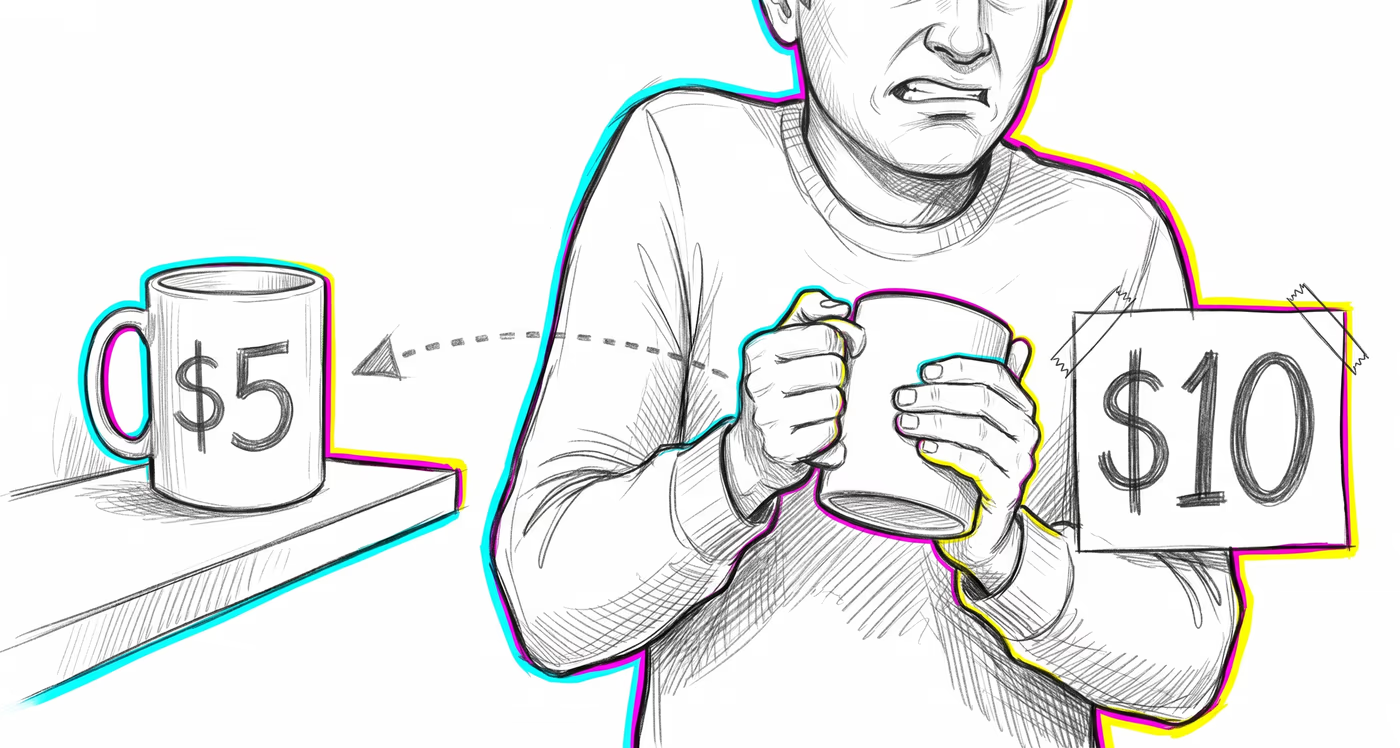
Employees offered performance bonuses for tasks they already find engaging may shift their motivation entirely to the bonus, leading to disengagement or reduced effort quality when incentive structures change or bonuses are removed.
Medicine & diagnosis

Healthcare workers who enter the profession out of a calling to help others may experience motivational erosion when performance-based pay or productivity metrics become the primary feedback mechanism, contributing to burnout and reduced patient care quality.

Education & grading

Students rewarded with prizes, stickers, or money for reading or academic performance may lose their intrinsic curiosity and love of learning, becoming dependent on external incentives and disengaging when rewards are removed.

Relationships

When a partner begins compensating the other for household contributions (e.g., paying for chores), the previously willing contributor may start viewing shared responsibilities as transactional, reducing spontaneous helpfulness once the compensation stops.

Tech & product

Gamification systems that rely on badges, points, and leaderboards to drive user engagement can backfire — users who initially enjoyed the platform for its content may disengage when the reward system is altered or removed, as their motivation has shifted from intrinsic interest to extrinsic recognition.

Workplace & hiring

Introducing monetary rewards for creative contributions or innovation proposals can paradoxically reduce the quality and frequency of such contributions over time, as employees begin viewing ideation as work-for-pay rather than an intellectually stimulating activity.

Politics Media

Citizen journalism and grassroots political activism driven by civic passion can be undermined when participants begin receiving payment or recognition, shifting their motivation from civic duty to compensation and reducing participation when funding dries up.

HOW TO SPOT IT

Ask yourself…

  • Am I doing this because I genuinely enjoy it, or because I'm expecting a reward or recognition?
  • If the reward or payment were suddenly removed, would I still want to do this activity?
  • Have I noticed that something I used to find fun now feels like a chore ever since incentives were introduced?
HOW TO DEFEND AGAINST IT

The playbook.

  • Use unexpected or informational rewards rather than expected, contingent ones — surprise bonuses preserve intrinsic motivation better than promised incentives.
  • When rewarding others, emphasize verbal praise and competence feedback over tangible prizes to avoid shifting the perceived locus of causality.
  • Periodically engage in your passion projects with zero external stakes — no sharing, no metrics, no monetization — to reconnect with intrinsic enjoyment.
  • Before introducing incentives for any activity, ask: 'Are people already doing this willingly? If so, will a reward improve or undermine their engagement?'
  • If you notice motivation declining after incentives were added, deliberately remove the reward structure and allow a 'recovery period' for intrinsic interest to rebuild.
FAMOUS CASES

In history.

  • The Pizza Hut 'Book It!' reading incentive program faced criticism from educators who observed that rewarding children with pizza for reading books risked undermining their intrinsic love of reading, illustrating the overjustification effect in a large-scale educational context.
  • Israel's daycare late-pickup study (Gneezy & Rustichini, 2000) demonstrated a related crowding-out phenomenon: when a fine was introduced for parents picking up children late, lateness increased because the moral obligation was replaced by a transactional cost — and when the fine was removed, lateness remained high.
  • Early gamification efforts on platforms like Foursquare saw initial surges in check-in behavior driven by badges and mayorships, but user engagement often dropped when novelty wore off, consistent with the overjustification effect undermining genuine interest in location-sharing.
WHERE IT COMES FROM
Academic origin

Edward Deci first demonstrated the undermining effect of extrinsic rewards on intrinsic motivation in 1971. The term 'overjustification' was formalized by Mark R. Lepper, David Greene, and Richard E. Nisbett in their 1973 paper published in the Journal of Personality and Social Psychology, drawing on Daryl Bem's self-perception theory.

Evolutionary origin

In ancestral environments, humans needed to flexibly allocate effort toward activities that yielded concrete survival payoffs (food, shelter, mating opportunities). A cognitive system that tracks and prioritizes external rewards helped ensure that effort was directed toward tangible outcomes. This reward-tracking mechanism was adaptive when resources were scarce, as it prevented wasting energy on activities without clear survival benefits.

IN AI SYSTEMS

How the machines inherit it.

Reinforcement learning systems trained with extrinsic reward signals can exhibit reward hacking — optimizing for the proxy reward rather than the intended behavior, analogous to how humans shift focus to the reward rather than the activity. Additionally, recommendation algorithms that use engagement metrics as rewards may optimize for clickbait over genuine user interest, creating a systemic version of overjustification where platform incentives crowd out authentic content creation.

Read more on Wikipedia
FREE FIELD ZINE

10 glitches quietly running your life.

A free field-zine PDF — ten cognitive glitches named, illustrated, with a defense move for each. Plus the weekly Glitch Report on Fridays — one bias named, two spotted in the wild, one defense move. Unsubscribe any time.

EXPLORE MORE

Related glitches.

LAUNCH PRICE

Train against your blindspots.

50 cards are free to preview. Buyers unlock the rest of the deck plus the interactive training — Spot-the-Bias Quiz unlimited, Swipe Deck with spaced repetition, My Blindspots, Decision Pre-Flight, the Printable Deck + Cheat Sheets, and the Field Guide e-book. $29.50$59.

Unlock the full deck

Everything below — yours forever. Pay once, use across every device.

Half-off launch — limited to the first 100 readers. Auto-applied at checkout.
$59 $29.50
one-time payment · lifetime access
  • All interactive digital cards — search, filter, flip, shuffle on any device
  • Five training modes — Spot-the-Bias Quiz, Swipe Deck, Pre-Flight, Blindspots, Journal
  • Curated Lenses + Decision Templates + Defense Playbook
  • Printable Deck PDFs + Field Guide e-book + Cheat Sheets + Anki Export
  • Every future improvement, included
Unlock  $29.50

30-day refund · no questions asked

Unlock the full deck

Everything below — yours forever. Pay once, use across every device.

Half-off launch — limited to the first 100 readers. Auto-applied at checkout.
$59 $29.50
one-time payment · lifetime access
  • All interactive digital cards — search, filter, flip, shuffle on any device
  • Five training modes — Spot-the-Bias Quiz, Swipe Deck, Pre-Flight, Blindspots, Journal
  • Curated Lenses + Decision Templates + Defense Playbook
  • Printable Deck PDFs + Field Guide e-book + Cheat Sheets + Anki Export
  • Every future improvement, included
Unlock  $29.50

30-day refund · no questions asked