Extrinsic Incentive Bias

aka Extrinsic Incentives Bias · Extrinsic Incentive Error

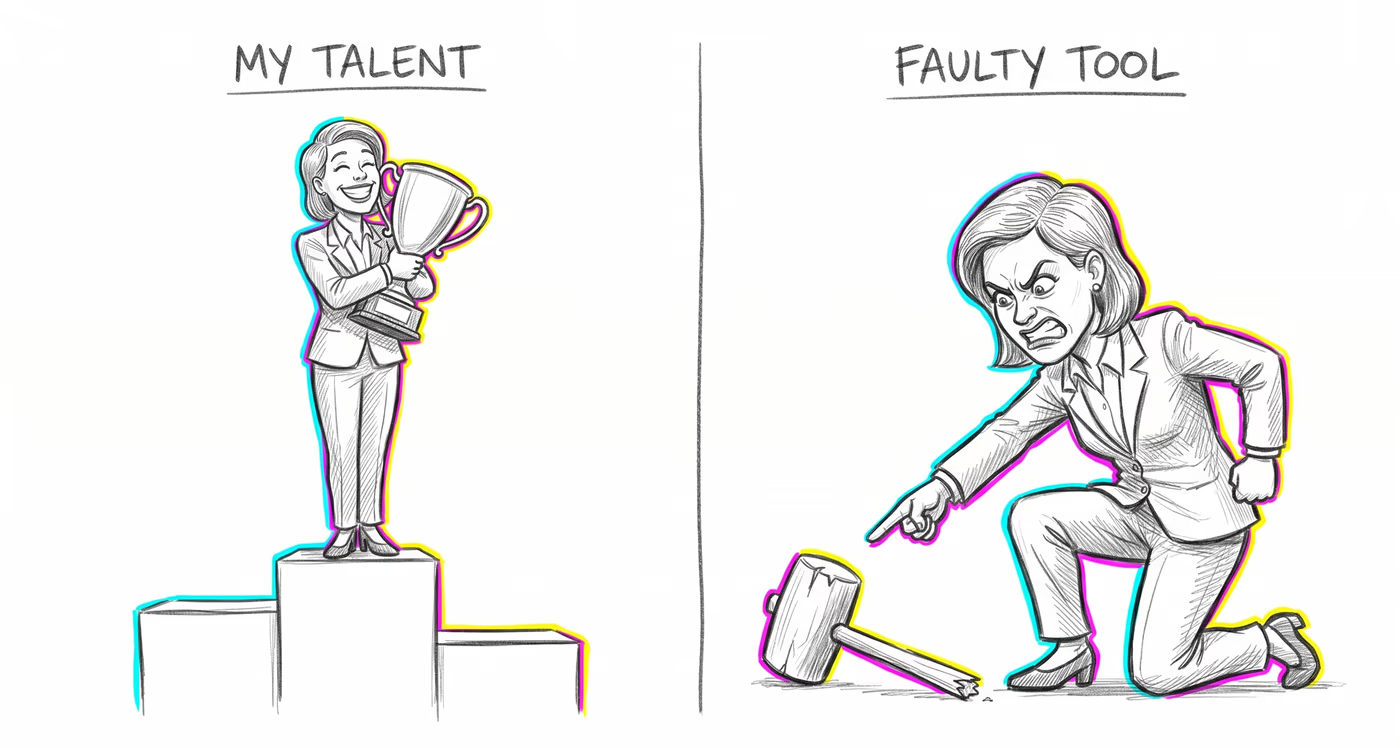
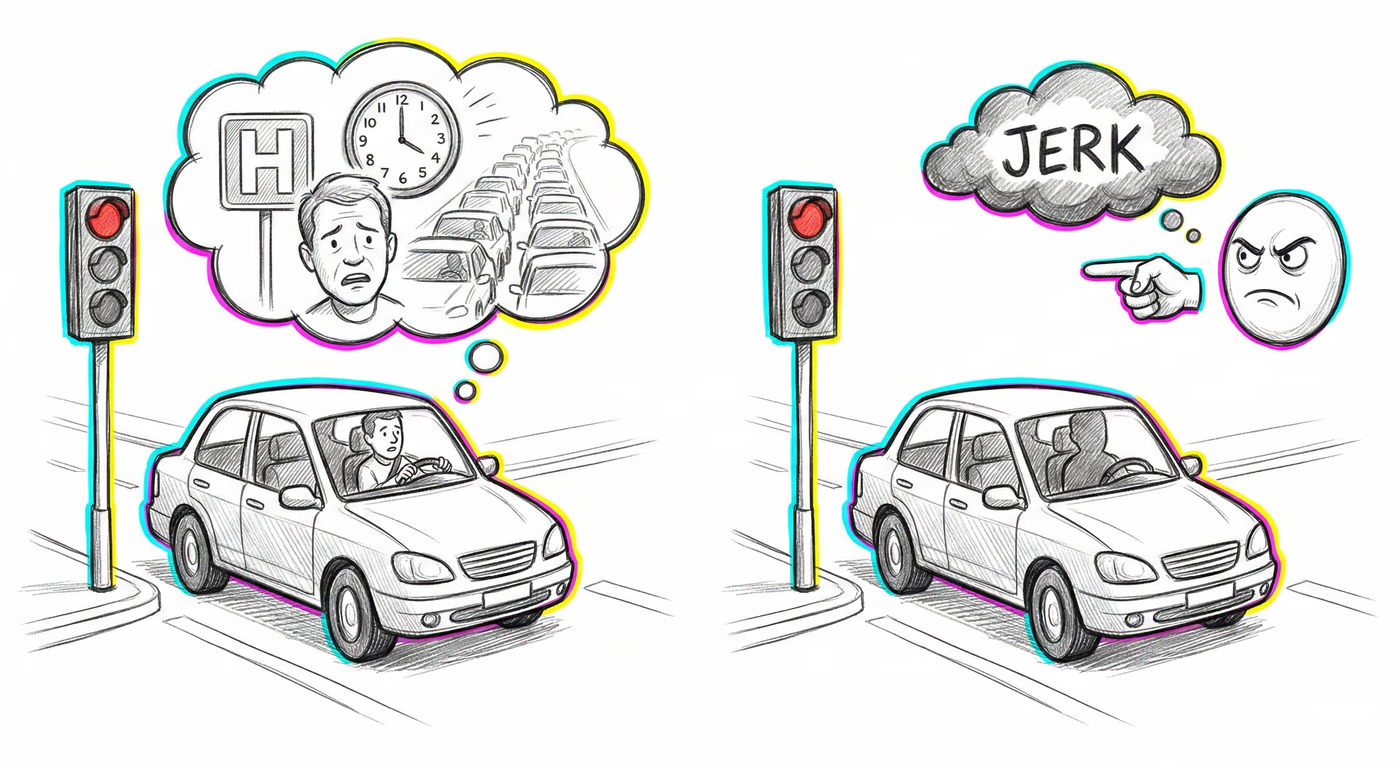
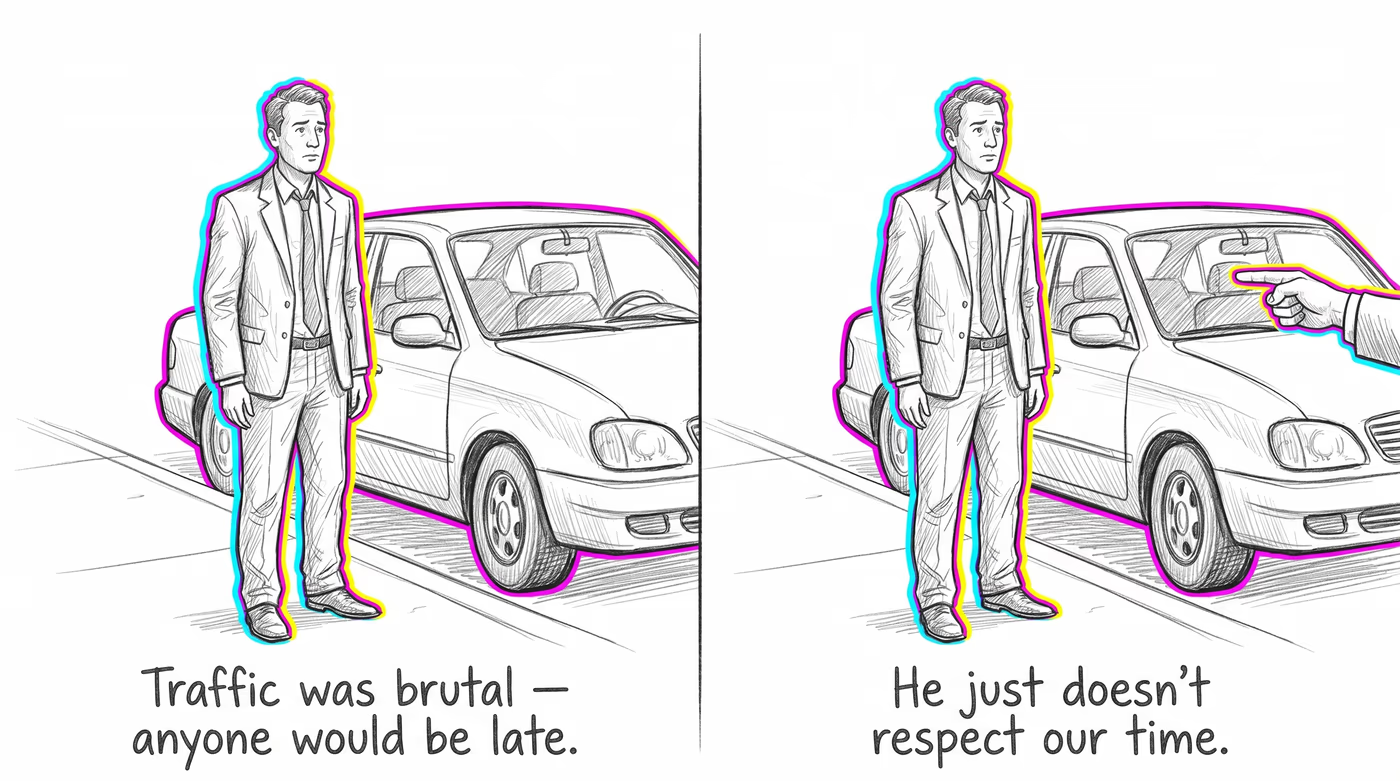
Assuming others are motivated by money or status while believing your own motivations are driven by passion or principle.

WHAT IT IS

The glitch, explained plainly.

Imagine you love building sandcastles at the beach just because it's fun. But when you see another kid building sandcastles, you think, 'They must be doing it because someone promised them ice cream.' You think YOU do things because you love them, but OTHERS only do things because they get prizes.

Extrinsic Incentive Bias describes the systematic asymmetry in how people explain their own motivations versus others' motivations. When evaluating why other people work, volunteer, or engage in activities, individuals consistently overweight external rewards such as salary, bonuses, recognition, and job security, while underweighting internal drivers such as curiosity, skill development, and personal fulfillment. Crucially, people do not apply this same cynical lens to themselves — they rate their own motivations as predominantly intrinsic and noble. This creates a fundamental misunderstanding in principal-agent relationships, where managers, leaders, and policymakers design incentive structures based on a flawed model of what actually drives human behavior.

SOUND FAMILIAR?

Where it shows up.

  1. 01 A startup CEO designs a compensation package for new engineers that is 90% performance bonuses and stock options with minimal emphasis on creative autonomy or learning opportunities. When asked why, she explains: 'Engineers go where the money is — that's just how tech hiring works.' Meanwhile, she herself joined the startup because she found the mission inspiring.
  2. 02 Marcus manages a team of customer service reps. He's puzzled why turnover remains high despite raising wages twice this year. He keeps telling HR, 'We need to pay even more — that's the only thing these people respond to.' He never considers that his reps might be leaving because of lack of growth opportunities or meaningful feedback — things he values deeply in his own career.
  3. 03 A hospital administrator concludes that the primary way to keep nurses from leaving is retention bonuses. She dismisses a proposal to improve nurse autonomy and mentorship programs, reasoning that 'at the end of the day, people work in healthcare for the paycheck.' She herself, however, describes her own career choice as driven by a desire to improve patient outcomes.
  4. 04 During a policy debate, a senator argues that the only way to increase organ donation rates is to offer tax credits to donors' families. A colleague suggests investing in public awareness campaigns about the gift of life, but the senator dismisses this: 'People won't donate organs out of goodwill — they need a tangible incentive.' The senator herself carries a donor card because she finds it morally important.
  5. 05 A professor designing a research mentorship program insists on paying undergraduate research assistants above market rate, reasoning that students won't commit time to research without strong financial incentives. She overlooks data showing that students rank intellectual curiosity and faculty mentorship as their top reasons for joining labs. She herself recalls entering academia because she found the pursuit of knowledge deeply fulfilling, not because of the pay.
IN DIFFERENT DOMAINS

Where it shows up at work.

The same glitch looks different depending on the terrain. Finance, medicine, a relationship, a team — same mechanism, different costume.

Finance & investing

Investment managers may assume traders are motivated purely by bonuses and commission structures, leading firms to over-rely on performance-based pay that can incentivize excessive risk-taking, while neglecting the intellectual challenge and professional mastery that many traders actually value.

Medicine & diagnosis

Hospital administrators may design retention strategies around salary increases alone, assuming healthcare workers are primarily financially motivated, while overlooking intrinsic factors like patient relationships, professional autonomy, and sense of purpose that research shows are stronger predictors of clinician satisfaction and retention.
Education & grading

Teachers and administrators may assume students are motivated only by grades, test scores, and external rewards like sticker charts, leading to reward systems that can undermine the curiosity and love of learning that students actually possess. This creates a self-fulfilling prophecy where intrinsic motivation declines.

Relationships

People may assume their partner does thoughtful things primarily to receive something in return, attributing gift-giving or acts of service to obligation or expectation rather than genuine affection, while viewing their own identical gestures as heartfelt expressions of love.

Tech & product

Product managers may assume users engage with a platform primarily for tangible rewards like discounts or loyalty points, leading to over-gamification that crowds out the intrinsic enjoyment, social connection, or creative satisfaction that initially attracted users.

Workplace & hiring

Managers systematically over-rely on monetary bonuses, promotions, and performance metrics to motivate employees, while underinvesting in autonomy, mastery, purpose, and workplace culture — the intrinsic factors that research consistently shows drive engagement and retention more powerfully than pay alone.

Politics Media

Politicians and policymakers assume that citizens respond primarily to financial incentives and penalties when designing policy (e.g., tax credits for desired behaviors), while underestimating the power of moral framing, civic duty, and social norms — even though they describe their own political engagement as values-driven.

HOW TO SPOT IT

Ask yourself…

  • Am I assuming this person is doing something primarily for the money, status, or reward, while I would describe my own similar behavior as passion-driven?
  • When designing an incentive or reward for someone else, am I defaulting to external rewards because I believe that's all that motivates them?
  • Would I feel insulted if someone attributed my own work to purely extrinsic motives — and if so, why am I attributing that to others?
HOW TO DEFEND AGAINST IT

The playbook.

  • Before designing an incentive for someone, explicitly list what intrinsic motivations they might have — curiosity, mastery, social connection, purpose — and ask yourself whether your plan addresses or undermines those.
  • Practice the 'motivation mirror test': if someone attributed your behavior to the same extrinsic motive you're attributing to them, would you feel that was fair and accurate?
  • Directly ask people what motivates them rather than assuming — Heath's research showed that self-reported motivations were dramatically different from what others predicted.
  • Study self-determination theory (Deci & Ryan) to internalize the evidence that autonomy, competence, and relatedness are universal human motivators, not just personal quirks.
  • When managing others, design incentive structures that include both extrinsic and intrinsic elements, erring toward supporting intrinsic motivation rather than crowding it out.
FAMOUS CASES

In history.

  • Chip Heath's 1999 Citibank study: MBA students predicted that customer service representatives were motivated primarily by pay and job security, but the representatives themselves ranked intrinsic factors like learning and feeling good about themselves as their top motivators — nearly reversing the predicted order.
  • Edward Deci's 1971 puzzle experiment demonstrated that paying people for intrinsically enjoyable tasks reduced their subsequent willingness to do those tasks for free, illustrating the real-world consequences of over-applying extrinsic incentive assumptions.
WHERE IT COMES FROM
Academic origin

Chip Heath, 1999 — formalized in the paper 'On the Social Psychology of Agency Relationships: Lay Theories of Motivation Overemphasize Extrinsic Incentives' published in Organizational Behavior and Human Decision Processes, Vol. 78, No. 1, pp. 25–62.

Evolutionary origin

In ancestral environments, accurately predicting what others wanted — especially whether they were cooperating out of genuine alliance or mere transactional exchange — was critical for detecting free-riders and negotiating reciprocal relationships. Assuming others are motivated by material gain provided a conservative, protective heuristic: it's safer to assume a stranger is trading for resources than to assume altruistic intent and risk exploitation. Simultaneously, viewing oneself as intrinsically motivated reinforced group commitment signals and social status.

IN AI SYSTEMS

How the machines inherit it.

Recommendation systems and workforce analytics tools trained on observable behavioral data (clicks, purchases, task completion) may systematically overweight extrinsic engagement signals while being unable to capture intrinsic motivations like curiosity or satisfaction, reinforcing a machine-level version of this bias in how algorithms model and predict human behavior.

Read more on Wikipedia
FREE FIELD ZINE

10 glitches quietly running your life.

A free field-zine PDF — ten cognitive glitches named, illustrated, with a defense move for each. Plus the weekly Glitch Report on Fridays — one bias named, two spotted in the wild, one defense move. Unsubscribe any time.

EXPLORE MORE

Related glitches.

LAUNCH PRICE

Train against your blindspots.

50 cards are free to preview. Buyers unlock the rest of the deck plus the interactive training — Spot-the-Bias Quiz unlimited, Swipe Deck with spaced repetition, My Blindspots, Decision Pre-Flight, the Printable Deck + Cheat Sheets, and the Field Guide e-book. $29.50$59.

Unlock the full deck

Everything below — yours forever. Pay once, use across every device.

Half-off launch — limited to the first 100 readers. Auto-applied at checkout.
$59 $29.50
one-time payment · lifetime access
  • All interactive digital cards — search, filter, flip, shuffle on any device
  • Five training modes — Spot-the-Bias Quiz, Swipe Deck, Pre-Flight, Blindspots, Journal
  • Curated Lenses + Decision Templates + Defense Playbook
  • Printable Deck PDFs + Field Guide e-book + Cheat Sheets + Anki Export
  • Every future improvement, included
Unlock  $29.50

30-day refund · no questions asked

Unlock the full deck

Everything below — yours forever. Pay once, use across every device.

Half-off launch — limited to the first 100 readers. Auto-applied at checkout.
$59 $29.50
one-time payment · lifetime access
  • All interactive digital cards — search, filter, flip, shuffle on any device
  • Five training modes — Spot-the-Bias Quiz, Swipe Deck, Pre-Flight, Blindspots, Journal
  • Curated Lenses + Decision Templates + Defense Playbook
  • Printable Deck PDFs + Field Guide e-book + Cheat Sheets + Anki Export
  • Every future improvement, included
Unlock  $29.50

30-day refund · no questions asked