Pessimism Bias

aka Negative Expectation Bias · Unrealistic Pessimism · Pessimistic Bias

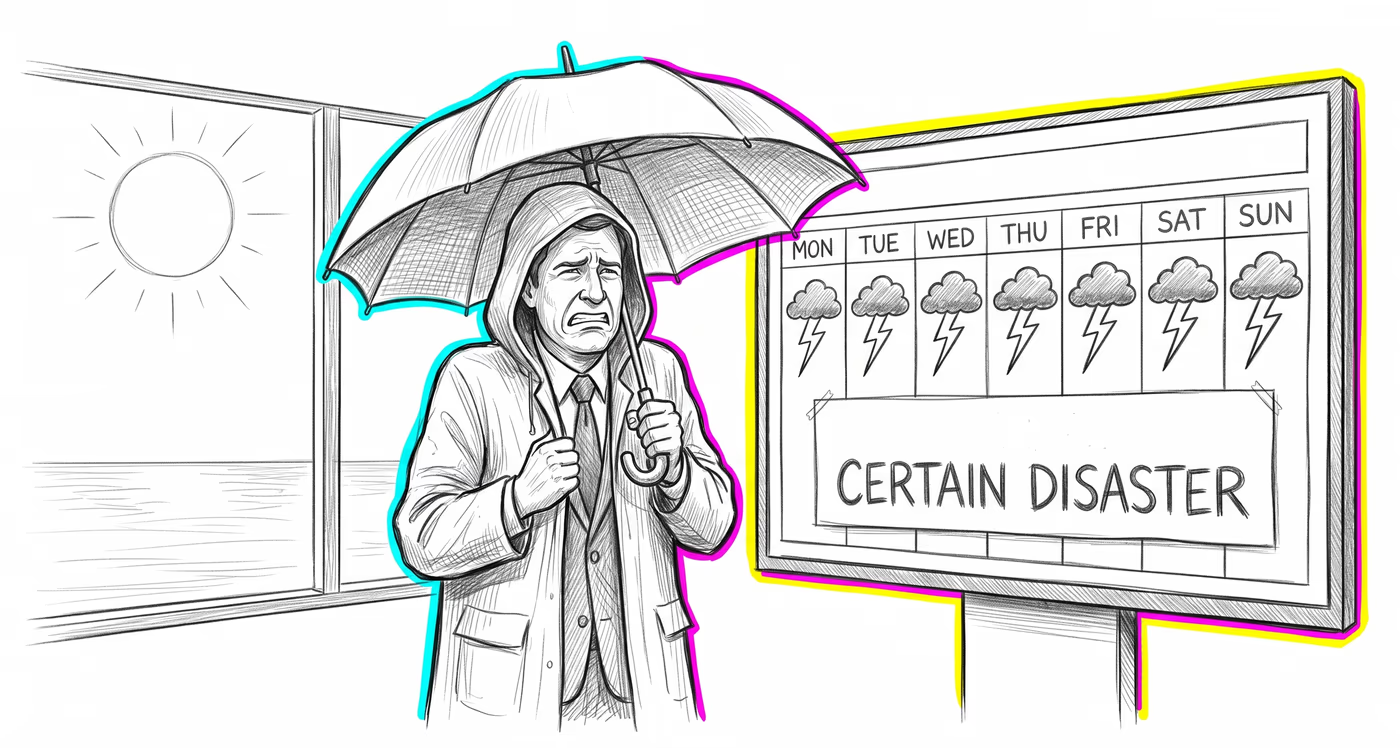
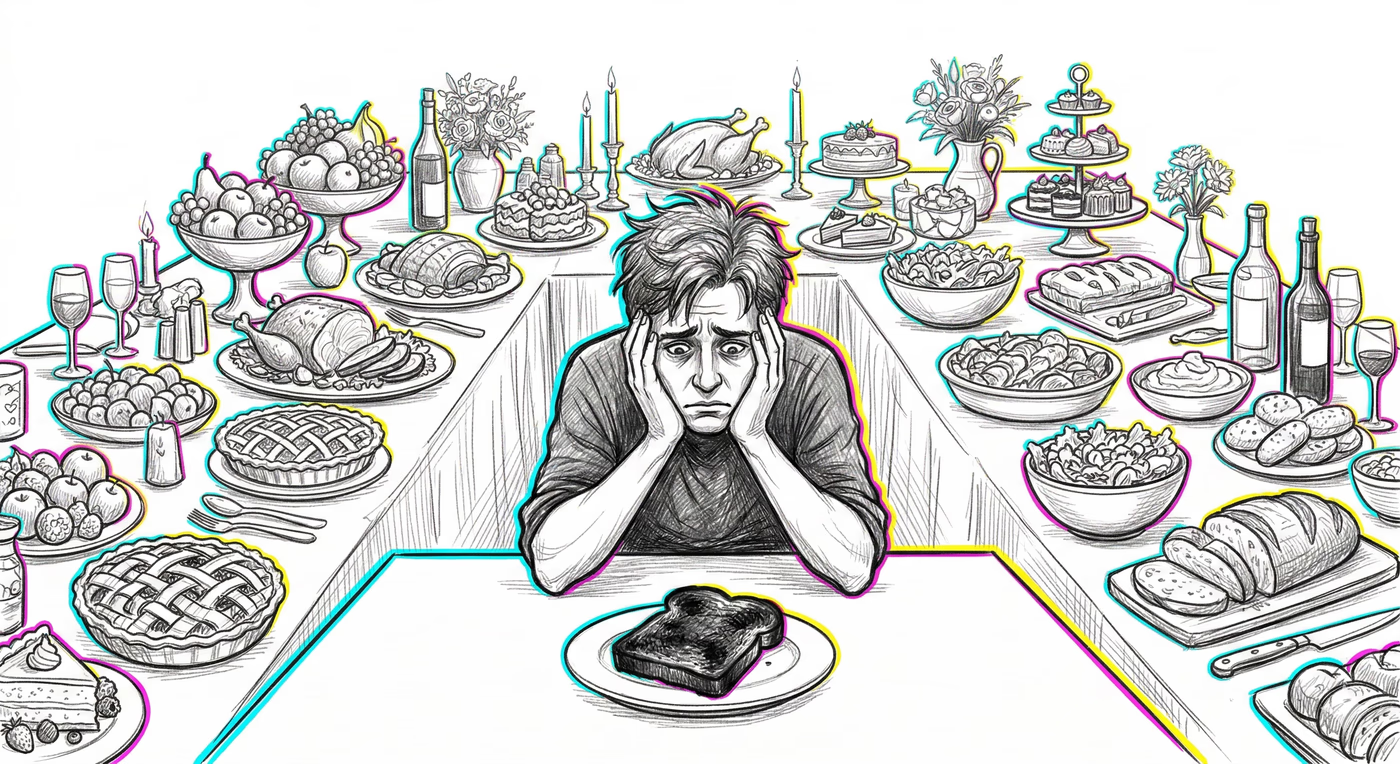
Overestimating the likelihood of negative outcomes and underestimating positive ones, especially about your own future.

Illustration: Pessimism Bias
WHAT IT IS

The glitch, explained plainly.

Imagine you have a jar with 8 green marbles and 2 red marbles. Most people would guess they'll pull a green one. But someone with pessimism bias keeps saying, 'I bet I'll pull a red one,' even though there are way more green marbles. They just feel like the bad thing is going to happen, even when the numbers say otherwise.

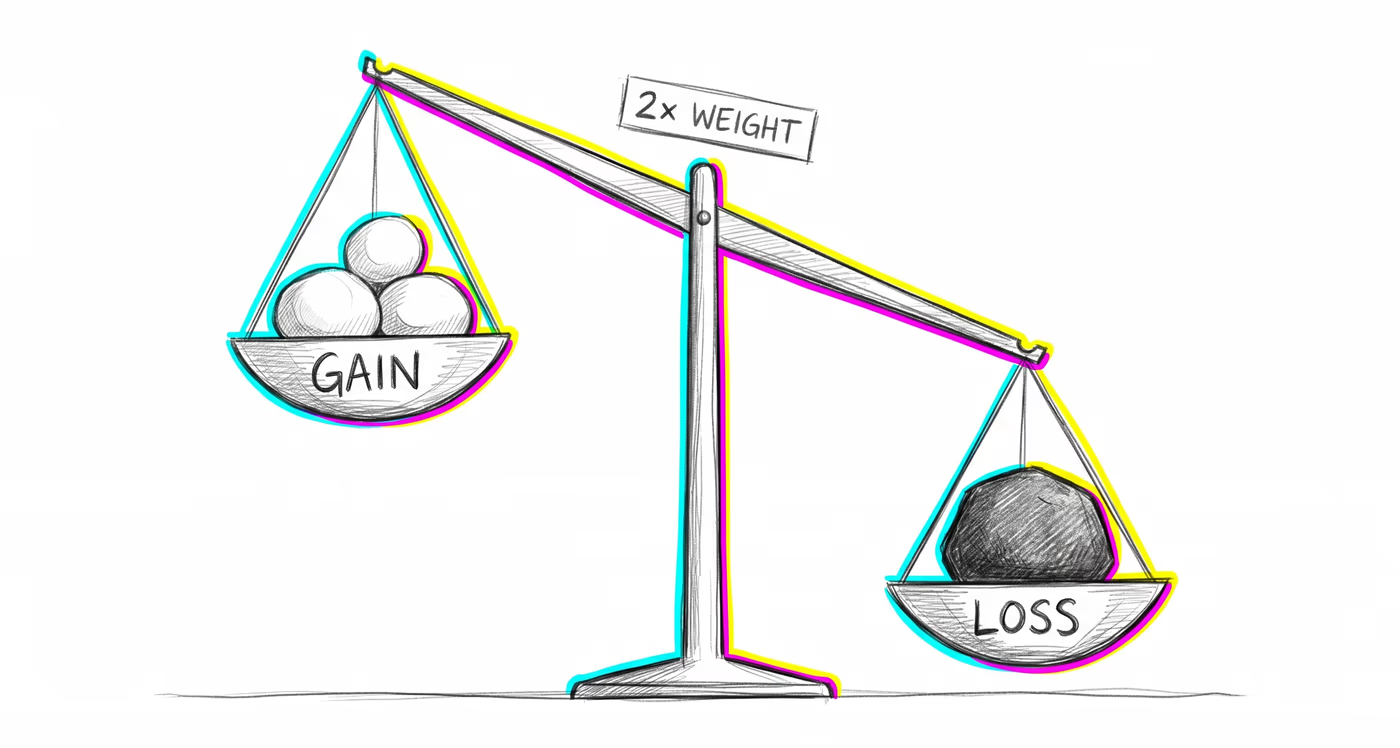
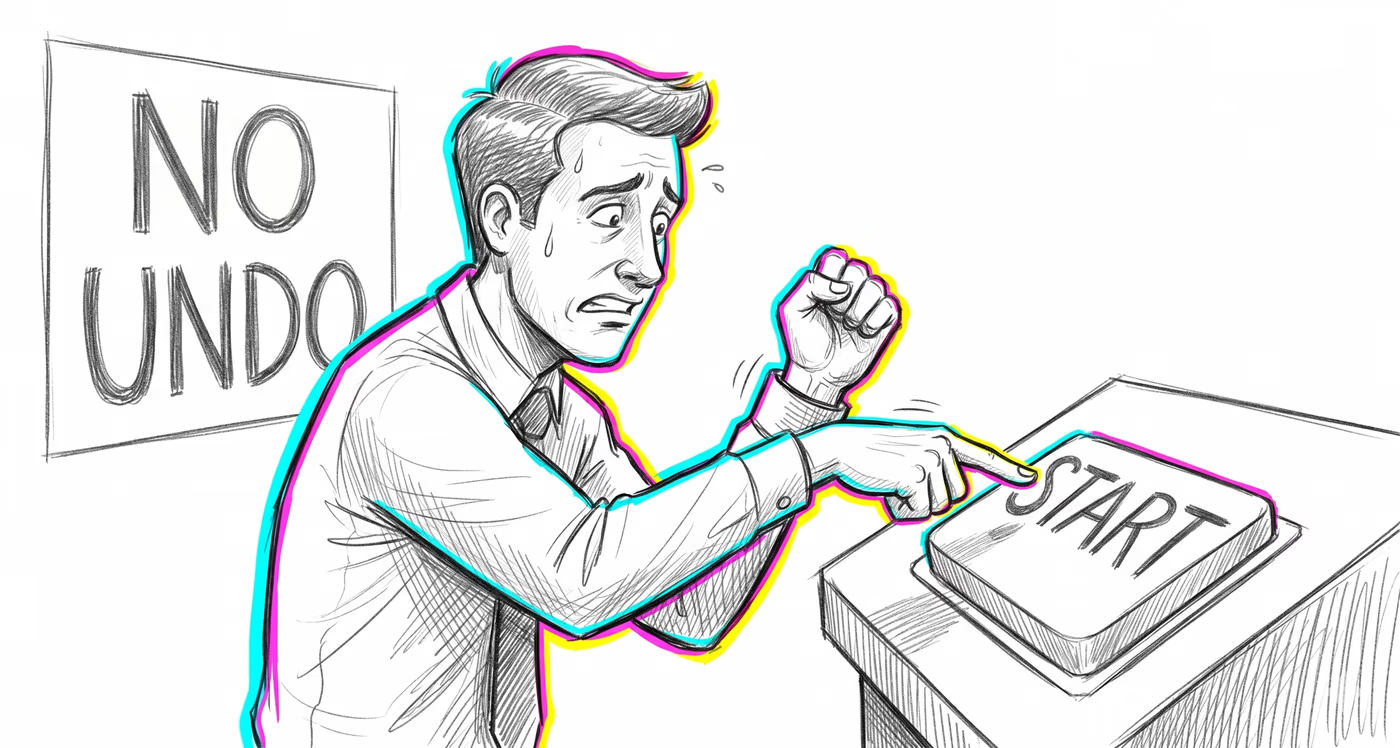
Pessimism bias causes individuals to systematically skew their predictions of future events in a negative direction, believing bad outcomes are more probable than they actually are while discounting the chances of good outcomes. Unlike generalized negativity or mood-based sadness, this bias specifically distorts probabilistic reasoning about upcoming events, causing people to overweight worst-case scenarios even when base rates and evidence suggest otherwise. The bias is particularly pronounced in self-referential predictions — people often expect worse things to happen to themselves than statistical reality warrants. It can lead to excessive risk aversion, missed opportunities, reduced motivation, and a self-reinforcing cycle where avoidance of action produces the very failures the person expected.

SOUND FAMILIAR?

Where it shows up.

  1. 01 Maria has been invited to give a keynote speech at a conference. She has given successful presentations before and received excellent feedback each time. Despite this track record, she spends the week before the event convinced she will freeze on stage, forget her material, and humiliate herself in front of 500 people.
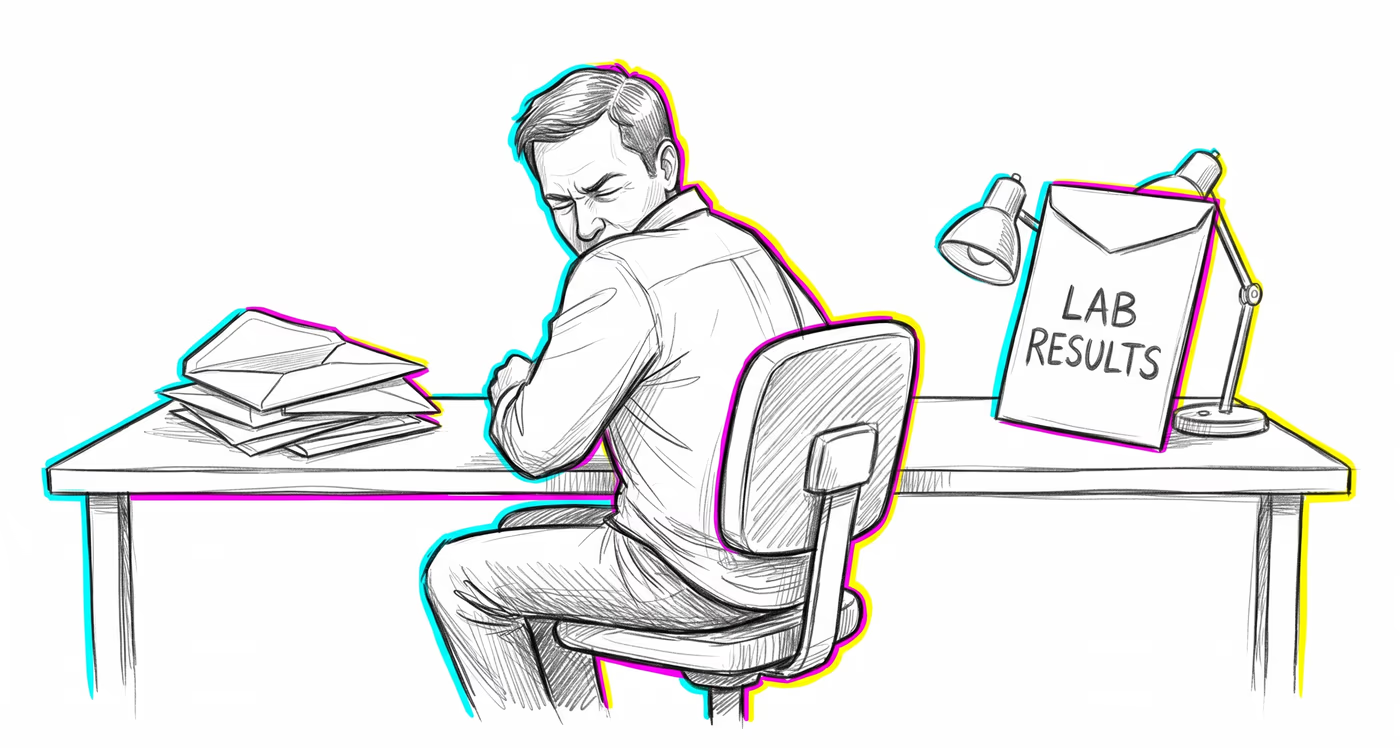
  2. 02 Tom's doctor tells him that a routine blood test came back with one slightly elevated marker, but reassures him that 95% of the time it's benign and suggests a follow-up in three months. Tom immediately begins researching terminal illnesses and cancels his vacation because he's certain the result means something catastrophic.
  3. 03 A startup founder reviews her company's financials and sees that revenue grew 40% this quarter. Instead of celebrating, she fixates on the possibility that next quarter will bring a downturn and decides to freeze hiring and cut the marketing budget preemptively, despite no market indicators suggesting a decline.
  4. 04 David is considering proposing to his long-term girlfriend. Their relationship is strong and communicative, and she has hinted about wanting to get married. He delays for months because he keeps envisioning scenarios where she says no, even though every piece of evidence suggests she would say yes.
  5. 05 An experienced portfolio manager reviews a diversified fund that has consistently outperformed benchmarks over the past decade. When presented with economic data showing moderate growth ahead, she allocates a disproportionate share of assets to cash and bonds, reasoning that the data 'can't be trusted' and a crash is likely imminent — not based on analysis, but on a persistent feeling that positive trends are fragile and temporary.
IN DIFFERENT DOMAINS

Where it shows up at work.

The same glitch looks different depending on the terrain. Finance, medicine, a relationship, a team — same mechanism, different costume.

Finance & investing

Investors exhibiting pessimism bias tend to hold excess cash or overweight defensive assets even during bull markets, sell winning positions too early fearing reversal, and avoid entering markets altogether because they chronically overestimate the probability of downturns, leading to significant long-term underperformance relative to balanced strategies.

Medicine & diagnosis

Patients with pessimism bias overestimate their risk of developing serious diseases, leading to excessive health anxiety, unnecessary medical tests, or paradoxically, avoidance of screening because they assume results will be devastating. Clinicians affected by this bias may overestimate the likelihood of treatment failure and default to more conservative interventions than evidence warrants.
Education & grading

Students with pessimism bias chronically underestimate their ability to succeed on exams and assignments, which can reduce study motivation through a 'why bother' mentality, or conversely drive excessive over-preparation that crowds out rest and well-being. Teachers may underestimate certain students' potential and assign them to lower tracks based on pessimistic assumptions about outcomes.

Relationships

People with pessimism bias may avoid initiating romantic relationships or deepening existing ones because they expect rejection or eventual abandonment. In established relationships, they tend to interpret ambiguous partner behavior as signs of dissatisfaction or impending breakup, creating a self-fulfilling prophecy where their anxious, withdrawn behavior actually pushes partners away.

Tech & product

Product teams influenced by pessimism bias may over-invest in edge-case failure modes at the expense of feature development, or abandon promising product ideas prematurely because they overestimate the likelihood of user rejection. Users with this bias tend to distrust new app features and resist software updates, assuming changes will make things worse.

Workplace & hiring

Hiring managers with pessimism bias may reject qualified candidates by overweighting minor resume gaps or imagined future performance problems. Employees affected by this bias may avoid volunteering for high-visibility projects, negotiating raises, or pursuing promotions because they are convinced they will fail or be turned down.

Politics Media

Pessimism bias drives the perception that the world is getting worse even when many global metrics are improving. Media coverage amplifying negative events reinforces this bias, leading consumers to overestimate crime rates, economic decline, and social deterioration. Voters affected by pessimism bias may support regressive or protectionist policies driven by catastrophic predictions rather than data.

HOW TO SPOT IT

Ask yourself…

  • Am I predicting a negative outcome despite evidence suggesting a more positive one is statistically likely?
  • Would I give the same grim forecast to a friend in this exact situation, or would I tell them things will probably be fine?
  • Am I confusing how I feel about this situation with what is objectively probable?
HOW TO DEFEND AGAINST IT

The playbook.

  • Track predictions vs. outcomes in a written log over weeks. Most people discover their pessimistic forecasts are wrong far more often than they expected.
  • Apply the 'friend test': Ask yourself what you would tell a close friend in this identical situation. The discrepancy between your self-directed pessimism and your advice to others reveals the bias.
  • Use base rate anchoring: Before making a prediction, look up the actual statistical probability of the negative event you're dreading. Force yourself to start from the data, not the feeling.
  • Practice pre-mortem analysis both ways: Imagine the project failing AND succeeding, then list reasons for each. This balances the asymmetry in scenario generation.
  • Engage in cognitive behavioral reframing: When you catch a catastrophic prediction, write down the thought, rate your belief (0-100%), identify the cognitive distortion, and generate a balanced alternative.
FAMOUS CASES

In history.

  • During the 2008-2009 financial crisis, many investors who panic-sold at the market bottom and refused to reinvest for years afterward exhibited pessimism bias, missing the subsequent recovery that produced significant gains.
  • Y2K hysteria in 1999 saw widespread public pessimism about catastrophic infrastructure failures that were vastly overestimated relative to the actual (manageable) technical problems that occurred.
  • Post-Fukushima nuclear policy in several countries reflected pessimism bias, with nations like Germany rapidly phasing out nuclear power based on worst-case emotional projections rather than comparative risk data.
WHERE IT COMES FROM
Academic origin

Aaron Beck (1967) laid the theoretical groundwork through his cognitive triad of depression, identifying pessimistic thinking about self, world, and future as central to depressive cognition. The bias was more formally studied as a predictive phenomenon by Lauren Alloy and Ahrens (1987), who demonstrated that depressed individuals make systematically more pessimistic forecasts than nondepressed individuals given identical information. Neil Weinstein's (1980) work on unrealistic optimism also defined pessimism bias as the inverse condition.

Evolutionary origin

In ancestral environments, overestimating threats — a predator behind every bush, a failed harvest around every corner — could be lifesaving. Organisms that assumed the worst and prepared accordingly were more likely to survive genuine dangers than those who remained naively optimistic. This 'better safe than sorry' heuristic conferred a survival advantage when the cost of missing a real threat was death, even though it meant frequent false alarms.

IN AI SYSTEMS

How the machines inherit it.

If training data overrepresents negative outcomes or failure cases — common in news corpora, medical case studies, and incident reports — models can develop a pessimistic skew in their predictions and recommendations. Sentiment analysis models trained on imbalanced datasets may over-flag neutral content as negative. Recommendation systems may underweight opportunities or positive outcomes if their reward signals are asymmetrically sensitive to loss.

Read more on Wikipedia
FREE FIELD ZINE

10 glitches quietly running your life.

A free field-zine PDF — ten cognitive glitches named, illustrated, with a defense move for each. Plus the weekly Glitch Report on Fridays — one bias named, two spotted in the wild, one defense move. Unsubscribe any time.

EXPLORE MORE

Related glitches.

LAUNCH PRICE

Train against your blindspots.

50 cards are free to preview. Buyers unlock the rest of the deck plus the interactive training — Spot-the-Bias Quiz unlimited, Swipe Deck with spaced repetition, My Blindspots, Decision Pre-Flight, the Printable Deck + Cheat Sheets, and the Field Guide e-book. $29.50$59.

Unlock the full deck

Everything below — yours forever. Pay once, use across every device.

Half-off launch — limited to the first 100 readers. Auto-applied at checkout.
$59 $29.50
one-time payment · lifetime access
  • All interactive digital cards — search, filter, flip, shuffle on any device
  • Five training modes — Spot-the-Bias Quiz, Swipe Deck, Pre-Flight, Blindspots, Journal
  • Curated Lenses + Decision Templates + Defense Playbook
  • Printable Deck PDFs + Field Guide e-book + Cheat Sheets + Anki Export
  • Every future improvement, included
Unlock  $29.50

30-day refund · no questions asked

Unlock the full deck

Everything below — yours forever. Pay once, use across every device.

Half-off launch — limited to the first 100 readers. Auto-applied at checkout.
$59 $29.50
one-time payment · lifetime access
  • All interactive digital cards — search, filter, flip, shuffle on any device
  • Five training modes — Spot-the-Bias Quiz, Swipe Deck, Pre-Flight, Blindspots, Journal
  • Curated Lenses + Decision Templates + Defense Playbook
  • Printable Deck PDFs + Field Guide e-book + Cheat Sheets + Anki Export
  • Every future improvement, included
Unlock  $29.50

30-day refund · no questions asked