Suggestibility

aka Memory Suggestibility · Interrogative Suggestibility

Incorporating misleading information from others into your own memory without realizing the memory has been altered.

WHAT IT IS

The glitch, explained plainly.

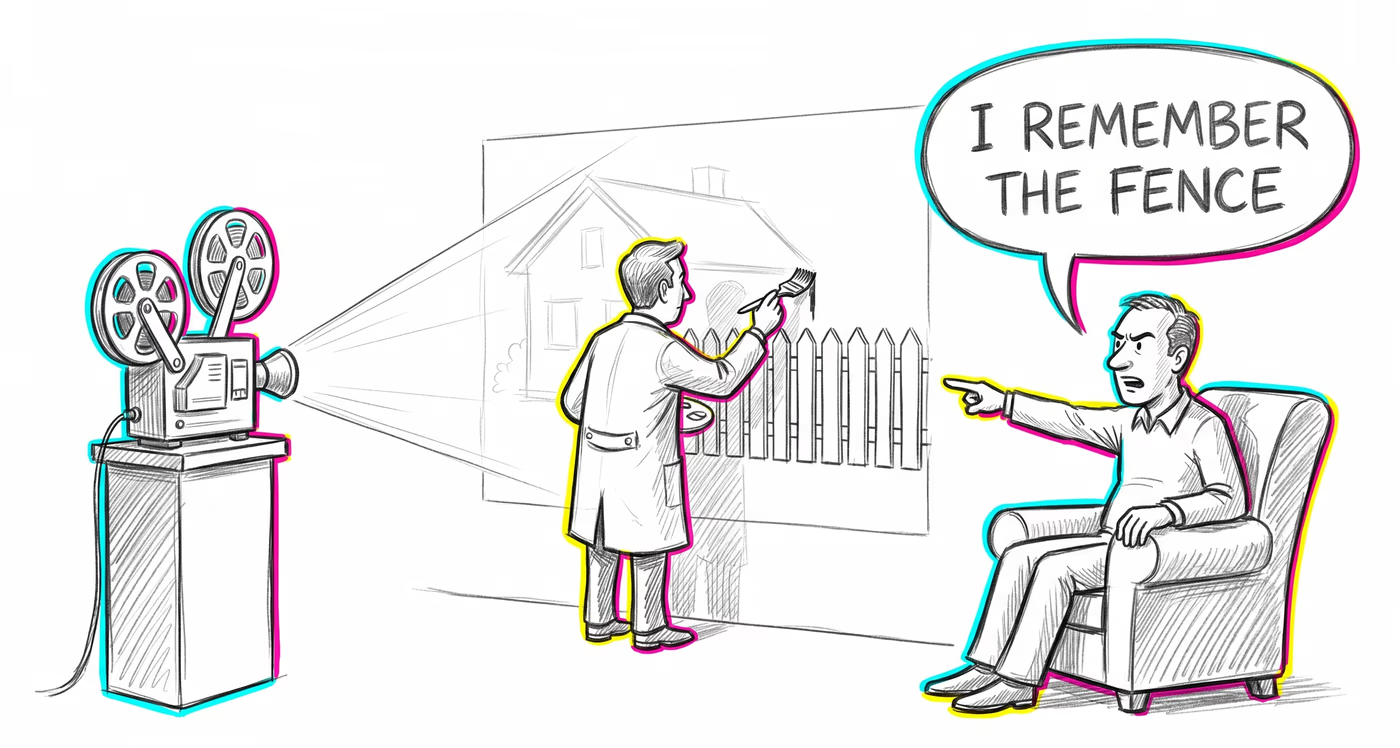
Imagine you built a sandcastle at the beach, but overnight the waves smoothed parts of it away. The next morning, your friend says 'Remember that cool moat you dug around it?' You didn't actually dig a moat, but because some of your memory has washed away and your friend sounds sure, your brain fills in the gap with their version — and now you genuinely remember digging a moat that never existed.

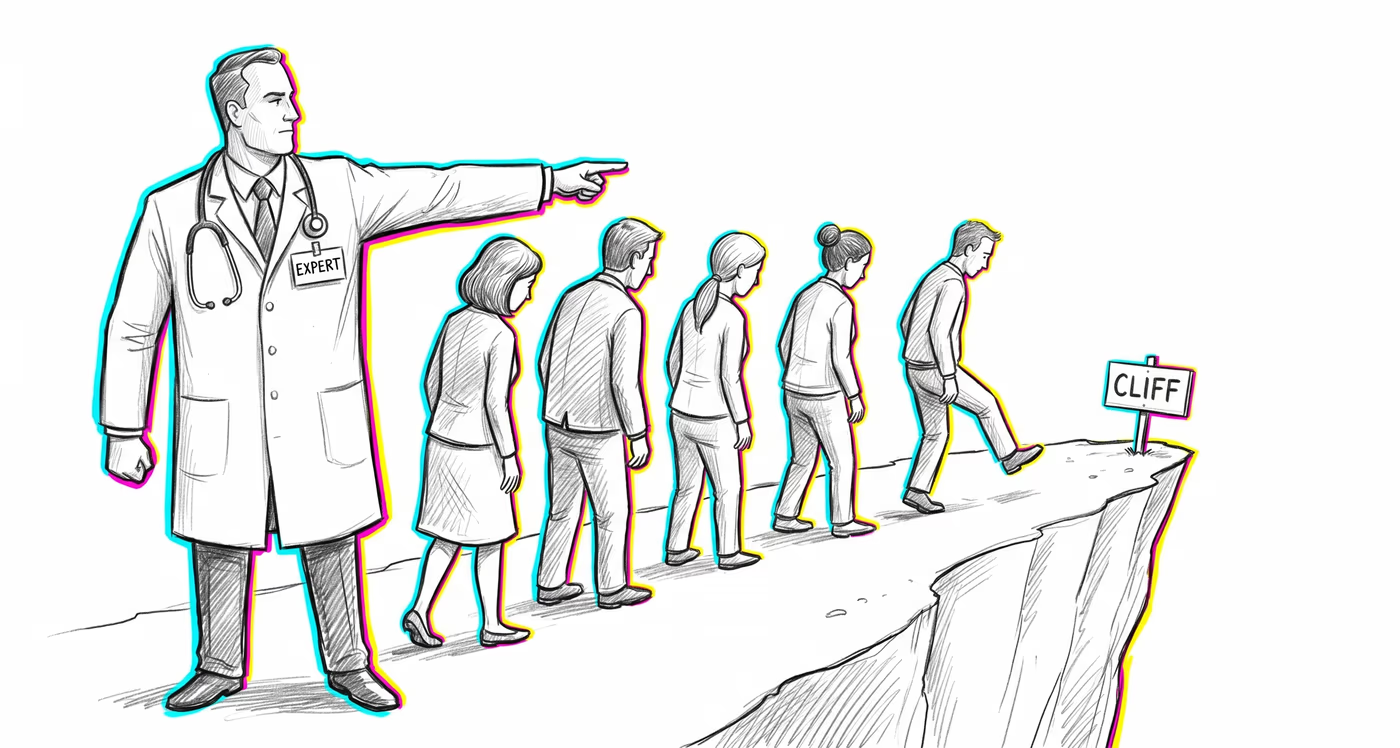
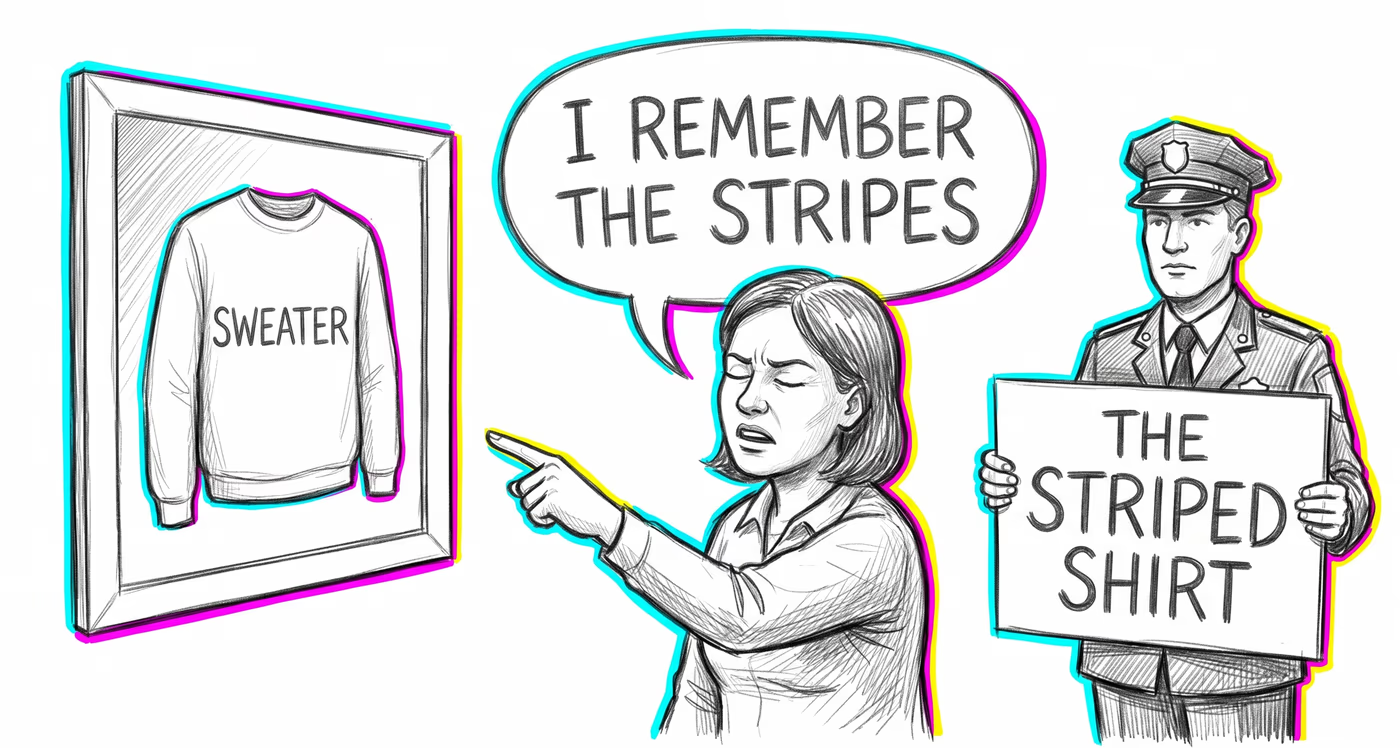
Suggestibility describes the process by which external information — delivered through leading questions, social pressure, authoritative framing, or post-event narratives — becomes woven into a person's memory so seamlessly that they believe it to be their own authentic recollection. Unlike simple persuasion, which changes opinions, suggestibility actually rewrites the remembered experience itself, creating vivid and confidently held memories of events that were distorted or never occurred. The effect is amplified when the original memory trace is weak, when the source of the suggestion is perceived as credible, and when time has elapsed between the event and the suggestion. Classified by Daniel Schacter as one of the seven 'sins of memory,' suggestibility sits at the intersection of social influence and reconstructive memory, making it particularly dangerous in legal, clinical, and interpersonal contexts.

SOUND FAMILIAR?

Where it shows up.

  1. 01 During a therapy session, Dr. Patel repeatedly asks Maria whether she ever felt 'trapped' during family dinners as a child. Over several weeks, Maria begins to recall vivid scenes of being forced to stay at the table for hours — memories her siblings insist never happened, and which Maria herself had no recollection of before therapy began.
  2. 02 After witnessing a shoplifting incident, Tom is interviewed by a store detective who asks, 'Did you see the man put the red jacket in his bag?' Tom hadn't noticed the jacket's color, but on a later police report, he confidently states the stolen item was a red jacket — a detail the detective, not Tom, had introduced.
  3. 03 A product focus group moderator says, 'Many testers found the new formula had a slightly bitter aftertaste.' In the next round of tasting, participants who heard this comment report bitterness at three times the rate of the control group who received no such framing, even though the formula is identical.
  4. 04 During a corporate investigation, an HR representative interviews employees about a colleague's behavior by asking, 'Can you recall any times when Jake raised his voice during meetings?' Several employees who initially had no specific complaints now recall specific instances of Jake being aggressive — instances that calendar and audio records later show did not occur.
  5. 05 A historian interviewing elderly residents about a 1970s factory fire asks detailed questions about 'the explosion that preceded the blaze.' Several interviewees subsequently provide rich, confident accounts of hearing and seeing an explosion, even though official fire department records confirm there was no explosion — only a slow-spreading electrical fire.
IN DIFFERENT DOMAINS

Where it shows up at work.

The same glitch looks different depending on the terrain. Finance, medicine, a relationship, a team — same mechanism, different costume.

Finance & investing

Financial advisors who describe past market events using dramatic language ('the crash,' 'the collapse') can inadvertently reshape clients' memories of their own past investment experiences, causing them to recall feeling more panic or taking different actions than they actually did, which then distorts future risk assessments.
Medicine & diagnosis

Physicians who ask leading symptom questions ('Is the pain sharp and stabbing?') can cause patients to report symptoms shaped by the question rather than their actual experience, leading to diagnostic anchoring on conditions suggested by the phrasing rather than the patient's organic presentation.

Education & grading

Teachers who provide post-test feedback using leading language ('Remember, we covered this concept using the graph') can cause students to falsely believe they learned material through methods that were never used, distorting their metacognitive understanding of their own learning process.

Relationships

When friends or family members repeatedly narrate a shared past event with particular emotional framing ('That was such a terrible vacation'), individuals gradually adopt that emotional coloring in their own memories, even if their original experience was neutral or positive.

Tech & product

User research sessions that employ leading questions ('Did you find the navigation confusing?') systematically inflate reported usability problems, contaminating product feedback with researcher-introduced assumptions rather than capturing authentic user experience.

Workplace & hiring

Performance review processes where managers discuss an employee with peers before writing evaluations absorb colleagues' characterizations, causing the reviewing manager to 'remember' witnessing behaviors they only heard described by others.

Politics Media

News coverage that uses loaded phrasing when describing political events shapes viewers' memories of those events; audiences later recall details consistent with the media framing rather than the raw footage they originally saw.

HOW TO SPOT IT

Ask yourself…

  • Am I remembering this detail because I actually experienced it, or because someone described it to me afterward?
  • Did my memory of this event change after I discussed it with someone else or consumed media about it?
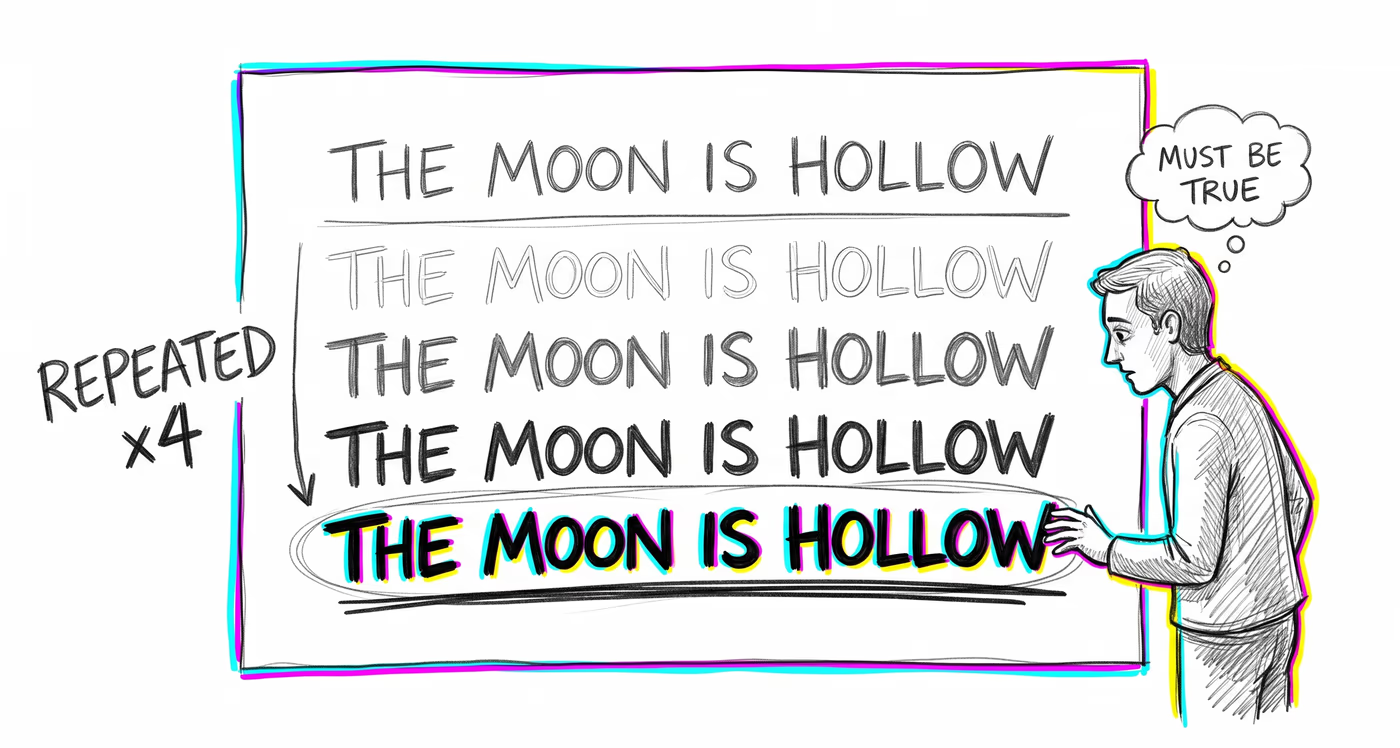
  • Could the confidence I feel about this memory be inflated by how many times I've heard this version of events rather than how vivid my original experience was?
HOW TO DEFEND AGAINST IT

The playbook.

  • Record your initial recollection of important events in writing before discussing them with others, creating an uncontaminated baseline.
  • When someone offers details about a shared past event, mentally flag those details as 'external input' rather than immediately integrating them into your own memory.
  • Ask yourself the source-monitoring question: 'Do I remember seeing/hearing/experiencing this myself, or do I remember being told about it?'
  • In professional contexts (investigations, therapy, research), use open-ended questions ('What happened next?') rather than leading questions ('Did X happen?').
  • Be especially cautious about adopting memories when you feel socially pressured to agree, when the source is an authority figure, or when significant time has elapsed since the original event.
FAMOUS CASES

In history.

  • The 1980s–1990s 'recovered memory' therapy cases, where therapeutic suggestion led numerous patients to develop detailed but false memories of childhood abuse, resulting in wrongful prosecutions and destroyed families.
  • The McMartin preschool trial (1983–1990), where suggestive interviewing techniques by investigators implanted elaborate false memories of abuse in young children, leading to one of the longest and most expensive criminal trials in U.S. history with no convictions.
  • Elizabeth Loftus's 'Lost in the Mall' study (1995) demonstrated that approximately 25% of participants could be led to create rich false memories of being lost in a shopping mall as a child through familial suggestion alone.
WHERE IT COMES FROM
Academic origin

The concept of suggestibility has roots in Alfred Binet's 1900 work 'La Suggestibilité,' but its modern cognitive framework was formalized by Elizabeth Loftus through her misinformation paradigm research beginning in the mid-1970s. Daniel Schacter classified it as one of the seven 'sins of memory' in 1999. Gísli Gudjonsson developed the Gudjonsson Suggestibility Scale in 1984 to measure interrogative suggestibility.

Evolutionary origin

In ancestral environments, rapidly updating memories with socially shared information was adaptive. If a tribe member reported that a watering hole had become dangerous, it was survival-advantageous to integrate that report into one's own mental model without demanding firsthand verification. This bias toward accepting group testimony as one's own experience supported cooperative information sharing and faster threat response in environments where independent verification was often impractical or lethal.

IN AI SYSTEMS

How the machines inherit it.

Large language models exhibit a form of computational suggestibility: when users embed false premises in prompts ('As we know, Einstein failed all his math classes...'), models often accept and build upon these premises rather than correcting them. Fine-tuning on biased or leading training data can 'implant' false factual associations that the model then reproduces with high confidence, analogous to how post-event misinformation becomes embedded in human memory.

FREE FIELD ZINE

10 glitches quietly running your life.

A free field-zine PDF — ten cognitive glitches named, illustrated, with a defense move for each. Plus the weekly Glitch Report on Fridays — one bias named, two spotted in the wild, one defense move. Unsubscribe any time.

EXPLORE MORE

Related glitches.

LAUNCH PRICE

Train against your blindspots.

50 cards are free to preview. Buyers unlock the rest of the deck plus the interactive training — Spot-the-Bias Quiz unlimited, Swipe Deck with spaced repetition, My Blindspots, Decision Pre-Flight, the Printable Deck + Cheat Sheets, and the Field Guide e-book. $29.50$59.

Unlock the full deck

Everything below — yours forever. Pay once, use across every device.

Half-off launch — limited to the first 100 readers. Auto-applied at checkout.
$59 $29.50
one-time payment · lifetime access
  • All interactive digital cards — search, filter, flip, shuffle on any device
  • Five training modes — Spot-the-Bias Quiz, Swipe Deck, Pre-Flight, Blindspots, Journal
  • Curated Lenses + Decision Templates + Defense Playbook
  • Printable Deck PDFs + Field Guide e-book + Cheat Sheets + Anki Export
  • Every future improvement, included
Unlock  $29.50

30-day refund · no questions asked

Unlock the full deck

Everything below — yours forever. Pay once, use across every device.

Half-off launch — limited to the first 100 readers. Auto-applied at checkout.
$59 $29.50
one-time payment · lifetime access
  • All interactive digital cards — search, filter, flip, shuffle on any device
  • Five training modes — Spot-the-Bias Quiz, Swipe Deck, Pre-Flight, Blindspots, Journal
  • Curated Lenses + Decision Templates + Defense Playbook
  • Printable Deck PDFs + Field Guide e-book + Cheat Sheets + Anki Export
  • Every future improvement, included
Unlock  $29.50

30-day refund · no questions asked