Reality Apathy

aka Information Apathy · Truth Fatigue · Epistemic Apathy

Giving up on distinguishing real from fake information when overwhelmed by contradictions, deepfakes, and disinformation.

WHAT IT IS

The glitch, explained plainly.

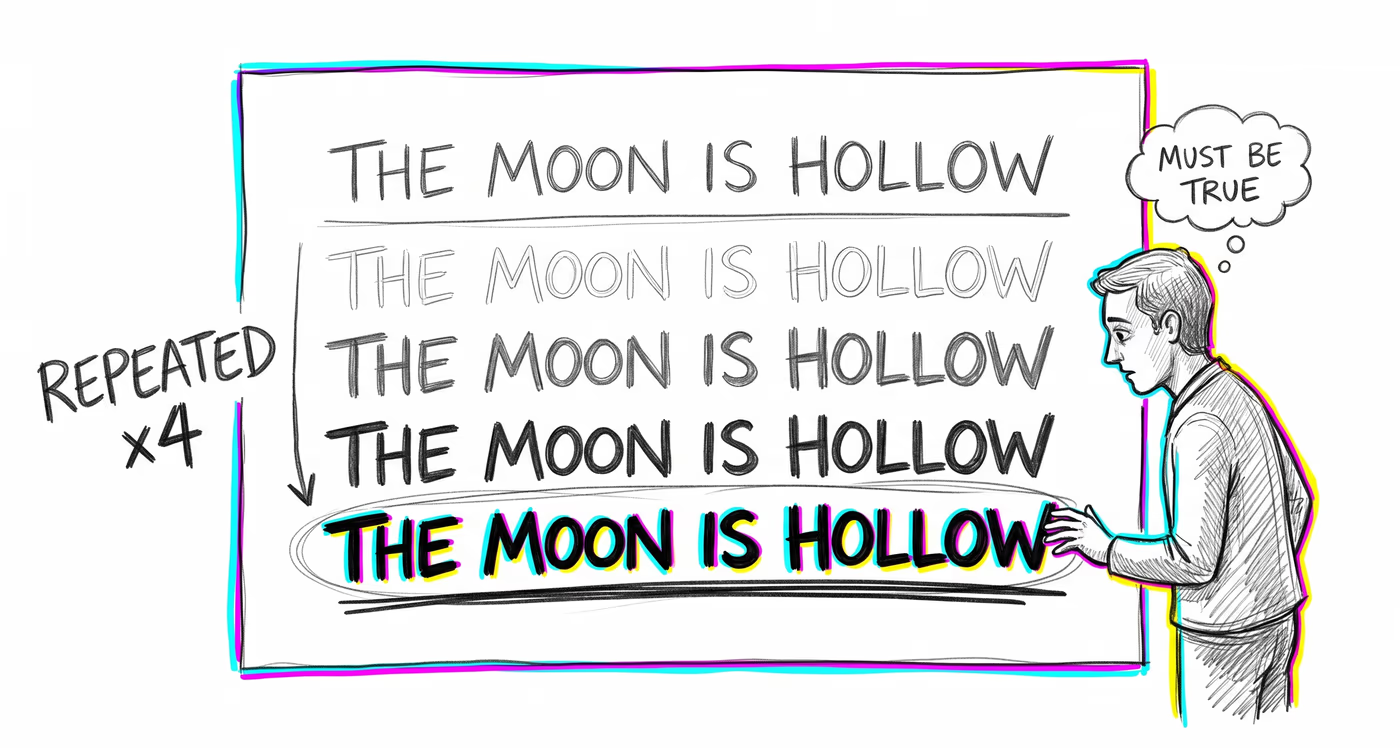
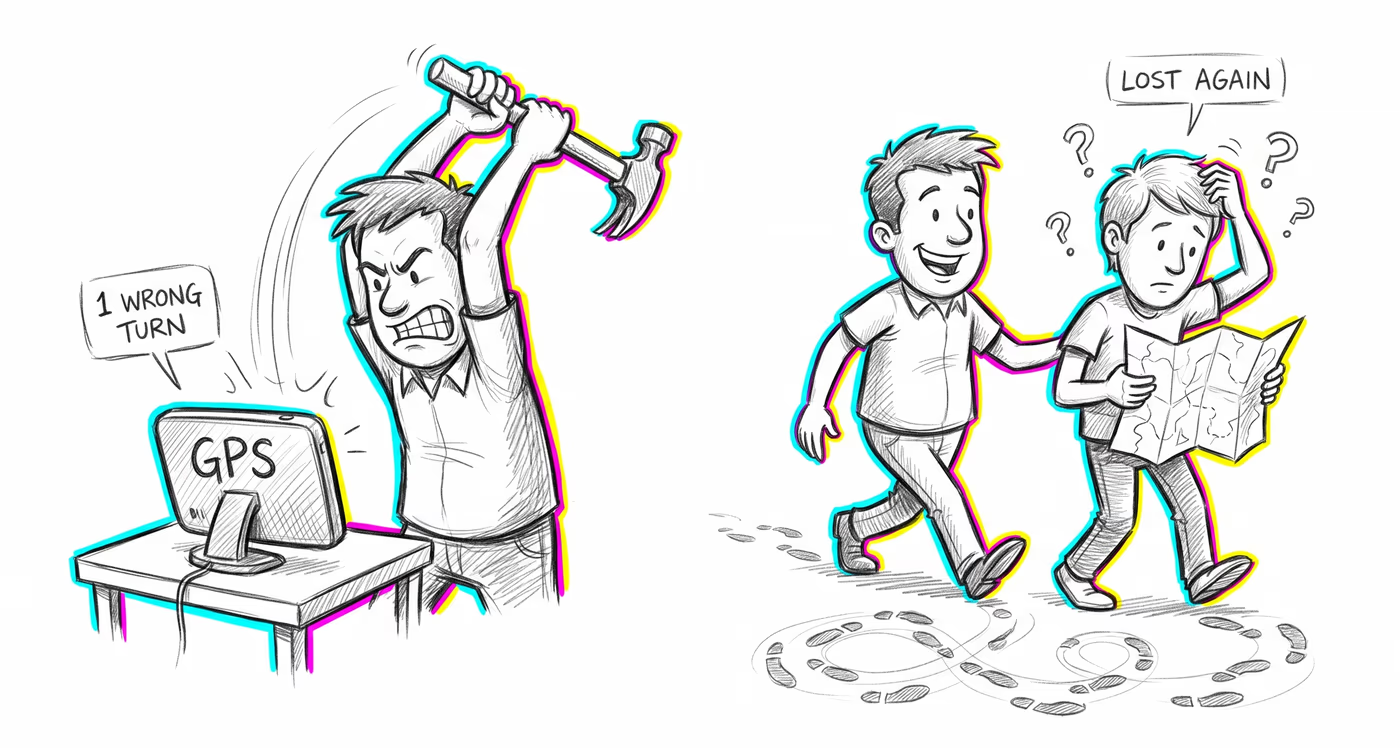
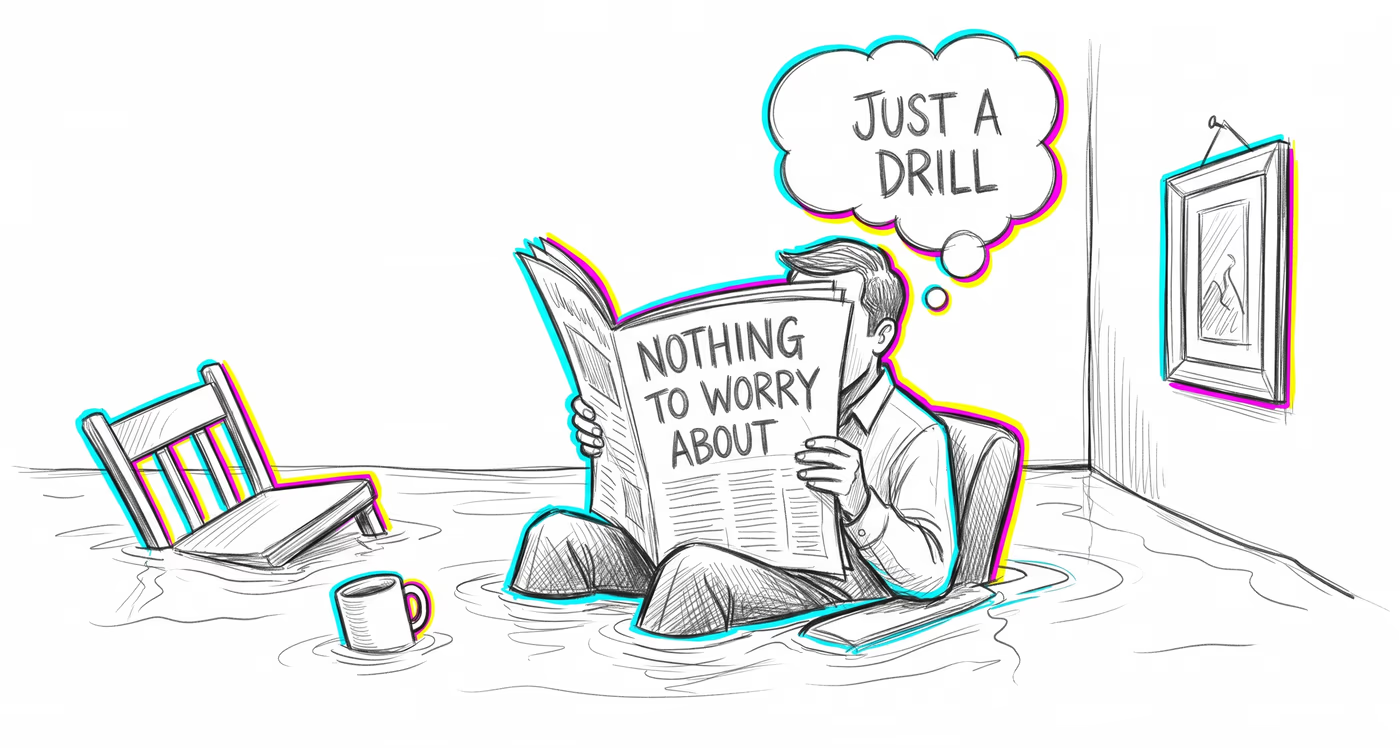
Imagine you're in a room where every person is talking at the same time, some telling the truth and some lying, but they all sound exactly the same. After a while, you just stop trying to figure out who's lying and who isn't — you cover your ears and say 'I don't care anymore, none of it matters.' That's Reality Apathy: you get so tired of trying to figure out what's real that you just give up on all of it.

Reality Apathy is a psychological state in which individuals lose the motivation to evaluate whether information is true or false after prolonged exposure to sophisticated disinformation, deepfakes, and contradictory media content. Unlike simple ignorance or laziness, it represents a protective cognitive shutdown: the brain determines that the effort required to verify each piece of information exceeds the cognitive resources available, and so it disengages from the verification process entirely. This creates a paradoxical outcome where the person achieves short-term psychological relief from the stress of constant vigilance, but becomes more vulnerable to manipulation because they no longer discriminate between trustworthy and untrustworthy sources. The phenomenon is especially prevalent in digitally saturated, politically polarized information environments where the line between authentic and synthetic content grows increasingly blurred.

SOUND FAMILIAR?

Where it shows up.

  1. 01 Maria used to carefully read multiple news sources to form opinions on current events. After months of encountering deepfake videos, retracted stories, and dueling fact-checks that contradict each other, she now swipes past all political news on her phone without reading any of it, telling herself that it's impossible to know what's real anymore.
  2. 02 During a company-wide meeting, the CEO presents data showing the firm's environmental impact has improved. James has seen so many greenwashing exposés and counter-exposés online that he doesn't bother evaluating the data at all — he simply shrugs and assumes every company lies about sustainability, so checking the numbers would be pointless.
  3. 03 Dr. Patel notices a new clinical study contradicting last month's widely shared study on a treatment protocol. Rather than reading the methodology of either study to determine which is more rigorous, she sighs and continues following the hospital's existing protocol, reasoning that medical evidence seems to flip-flop so often that investigating further is a waste of her time.
  4. 04 A leaked audio recording surfaces of a local politician making discriminatory remarks. Despite the recording being verified by three independent forensic analysts, a significant portion of the public dismisses it without engaging, saying 'anything can be faked these days' — not because they believe it is fake, but because they've lost the energy to care about determining authenticity.
  5. 05 Lena is a thoughtful voter who historically researched candidates thoroughly. This election cycle, after encountering AI-generated campaign ads, manipulated quotes attributed to both candidates, and social media posts debunking the debunkers, she decides not to vote at all — not out of protest, but because the cognitive effort of sorting signal from noise feels genuinely impossible and she no longer trusts her own ability to reach an informed judgment.
IN DIFFERENT DOMAINS

Where it shows up at work.

The same glitch looks different depending on the terrain. Finance, medicine, a relationship, a team — same mechanism, different costume.

Finance & investing

Investors exposed to constant contradictory market analyses, AI-generated financial news, and conflicting expert predictions may disengage from evaluating information quality altogether, making investment decisions based on inertia or herd behavior rather than informed analysis.

Medicine & diagnosis

Patients overwhelmed by conflicting health information online — one study says a supplement helps, another says it's harmful, a third says the second was funded by competitors — may stop seeking medical information entirely and either blindly follow or ignore their doctor's advice without engagement.

Education & grading

Students exposed to search results containing a mix of credible academic sources and AI-generated misinformation may develop a generalized skepticism that undermines their willingness to engage deeply with any source, reducing the quality of research and critical thinking.

Relationships

After repeatedly encountering contradictory relationship advice from social media, podcasts, and self-help content, individuals may stop actively working on relationship problems, adopting a fatalistic stance that nothing reliably works.

Tech & product

Users overwhelmed by privacy policy contradictions, data breach notifications, and conflicting security recommendations may stop reading permissions dialogs entirely, accepting all defaults without evaluation — making them more vulnerable to data exploitation.

Workplace & hiring

Employees exposed to frequent organizational changes, contradictory management messaging, and corporate communications they perceive as spin may disengage from reading company updates altogether, missing genuinely important information.

Politics Media

Citizens bombarded with partisan media, deepfake political content, and weaponized fact-checks may withdraw from political participation entirely — not from apathy about issues, but from exhaustion at the impossibility of determining what is actually happening.

HOW TO SPOT IT

Ask yourself…

  • Am I dismissing this information without evaluating it, simply because I feel overwhelmed by contradictory content in general?
  • Have I said or thought 'nothing is real anymore' or 'who even knows' as a reason to stop engaging, rather than as a genuine epistemic conclusion?
  • Am I confusing the difficulty of verification with the impossibility of verification?
HOW TO DEFEND AGAINST IT

The playbook.

  • Practice 'strategic verification' — select a small number of high-stakes claims to verify carefully each week rather than trying to evaluate everything, which preserves cognitive resources while maintaining engagement.
  • Curate a short list (3-5) of pre-vetted, high-credibility sources and commit to checking them regularly, reducing the overwhelm of evaluating unknown sources.
  • Distinguish between 'hard to verify' and 'impossible to verify' — most important claims can be checked with modest effort; the feeling of impossibility is often the bias talking.
  • Set information intake boundaries — scheduled news consumption windows rather than constant scrolling — to prevent the cognitive overload that triggers disengagement.
  • When you notice yourself thinking 'nothing matters' or 'everything is fake,' treat it as a red flag for cognitive exhaustion rather than an accurate assessment of reality.
FAMOUS CASES

In history.

  • The 2016 U.S. presidential election saw widespread disinformation campaigns that contributed to voter disengagement, with researchers noting that information flooding led segments of the public to discount all political media.
  • Russian information warfare strategy ('firehose of falsehood') has been documented as deliberately producing contradictory narratives not to convince, but to exhaust audiences into disengagement from truth-seeking.
  • The COVID-19 infodemic saw healthcare workers and citizens alike becoming fatigued by contradictory guidance, leading many to disengage from evaluating evolving public health recommendations.
WHERE IT COMES FROM
Academic origin

The term 'reality apathy' was coined by technologist Aviv Ovadya around 2016-2018, introduced publicly in a February 2018 BuzzFeed News interview by Charlie Warzel as part of Ovadya's 'Infocalypse' framework warning about the consequences of AI-enabled disinformation. The concept was further developed in a 2020 CNAS (Center for a New American Security) report on digital threats to democracy.

Evolutionary origin

In ancestral environments, when information signals were persistently unreliable or contradictory — such as conflicting threat cues in an unfamiliar territory — conserving cognitive energy by disengaging and defaulting to safe behaviors (staying put, not acting on ambiguous signals) was adaptive. Investing scarce mental resources into evaluating unreliable signals had diminishing returns, so a threshold-based shutdown mechanism helped preserve energy for clearer, higher-stakes decisions.

IN AI SYSTEMS

How the machines inherit it.

AI systems trained on large web datasets absorb the noise-to-signal problem that drives reality apathy in humans. More critically, generative AI dramatically amplifies the conditions that create reality apathy: by enabling mass production of synthetic content at near-zero cost, AI floods information environments with plausible but fabricated text, images, and video, making verification harder for both humans and automated systems. The 'liar's dividend' is also AI-enabled — deepfake technology makes it trivially easy for bad actors to claim authentic evidence is AI-generated.

FREE FIELD ZINE

10 glitches quietly running your life.

A free field-zine PDF — ten cognitive glitches named, illustrated, with a defense move for each. Plus the weekly Glitch Report on Fridays — one bias named, two spotted in the wild, one defense move. Unsubscribe any time.

EXPLORE MORE

Related glitches.

LAUNCH PRICE

Train against your blindspots.

50 cards are free to preview. Buyers unlock the rest of the deck plus the interactive training — Spot-the-Bias Quiz unlimited, Swipe Deck with spaced repetition, My Blindspots, Decision Pre-Flight, the Printable Deck + Cheat Sheets, and the Field Guide e-book. $29.50$59.

Unlock the full deck

Everything below — yours forever. Pay once, use across every device.

Half-off launch — limited to the first 100 readers. Auto-applied at checkout.
$59 $29.50
one-time payment · lifetime access
  • All interactive digital cards — search, filter, flip, shuffle on any device
  • Five training modes — Spot-the-Bias Quiz, Swipe Deck, Pre-Flight, Blindspots, Journal
  • Curated Lenses + Decision Templates + Defense Playbook
  • Printable Deck PDFs + Field Guide e-book + Cheat Sheets + Anki Export
  • Every future improvement, included
Unlock  $29.50

30-day refund · no questions asked

Unlock the full deck

Everything below — yours forever. Pay once, use across every device.

Half-off launch — limited to the first 100 readers. Auto-applied at checkout.
$59 $29.50
one-time payment · lifetime access
  • All interactive digital cards — search, filter, flip, shuffle on any device
  • Five training modes — Spot-the-Bias Quiz, Swipe Deck, Pre-Flight, Blindspots, Journal
  • Curated Lenses + Decision Templates + Defense Playbook
  • Printable Deck PDFs + Field Guide e-book + Cheat Sheets + Anki Export
  • Every future improvement, included
Unlock  $29.50

30-day refund · no questions asked