Recognition Heuristic

aka Recognition Principle · Name Recognition Heuristic

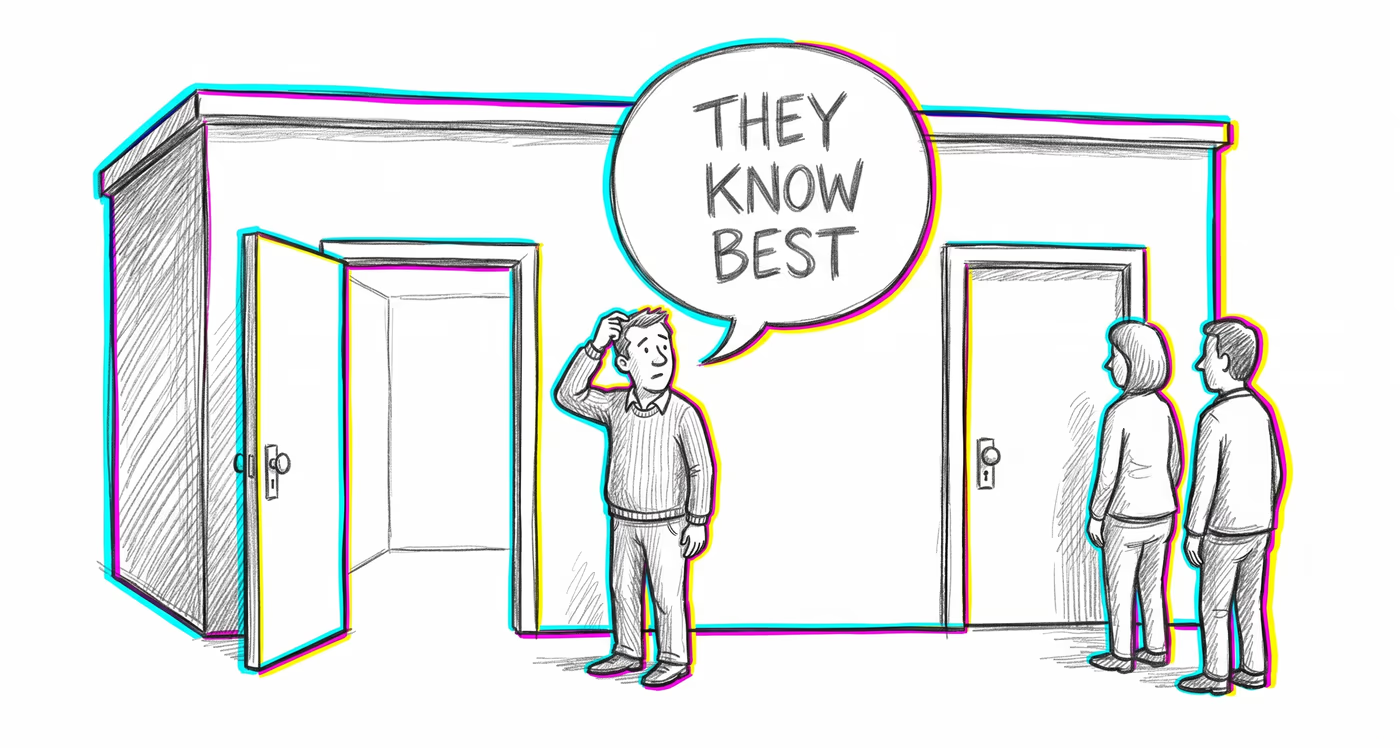
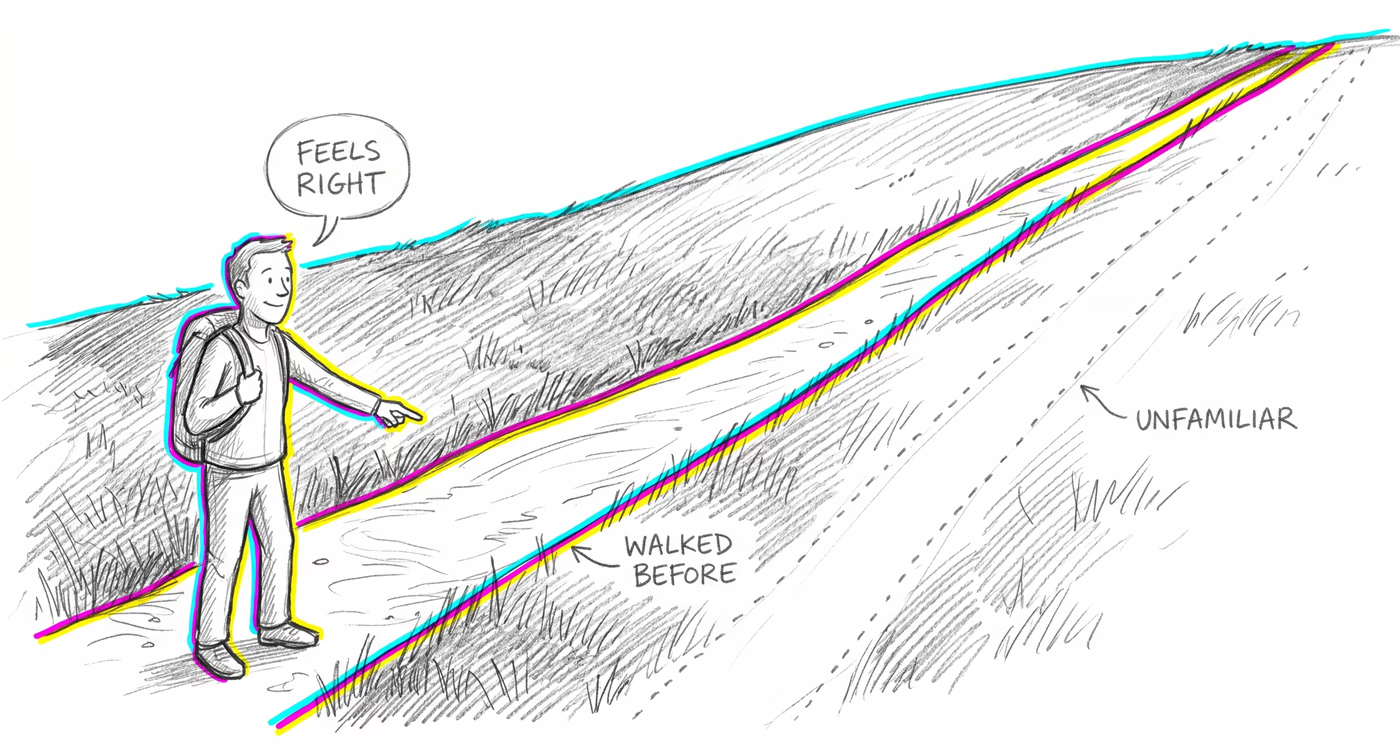
Choosing a recognized option over an unrecognized one purely because familiarity feels like evidence of quality.

WHAT IT IS

The glitch, explained plainly.

Imagine you're asked which of two cities is bigger — one you've heard of and one you haven't. You pick the one you've heard of, because you figure if it were small and unimportant, you probably never would have heard about it in the first place. It's like picking the cereal brand you recognize at the store — you assume the one you know must be more popular or better because its name made it into your head somehow.

The recognition heuristic is a decision strategy in which, when choosing between two options and only one is recognized, the decision-maker infers that the recognized option scores higher on the criterion of interest. It operates as a non-compensatory rule, meaning that when deployed, recognition overrides other available cues or knowledge. The heuristic is ecologically rational in environments where recognition is systematically correlated with the criterion — for example, larger cities tend to appear more frequently in news media, making their names more recognizable. Critically, the heuristic can produce a counterintuitive 'less-is-more effect,' where people with partial knowledge sometimes outperform those with more complete knowledge, because partial knowers can leverage the recognition–criterion correlation that full knowers cannot access.

SOUND FAMILIAR?

Where it shows up.

  1. 01 Maria is asked to guess which of two rivers is longer: the Danube or the Glomma. She has heard of the Danube but has never encountered the name Glomma. Without any other knowledge about either river's length, she confidently selects the Danube simply because she recognizes the name.
  2. 02 During a trivia competition, Raj must decide which of two tech companies had higher annual revenue. He recognizes one company from seeing its logo on billboards but knows nothing else about either firm. Despite a teammate suggesting the other company might be larger based on employee count data, Raj goes with the recognized name and ignores the additional information.
  3. 03 An investor is selecting between two pharmaceutical stocks. She recognizes one company because it was mentioned in a news article about a lawsuit, while the other is completely unknown to her. She invests in the recognized company, reasoning that its name wouldn't have reached her if it weren't significant — not considering that the recognition came from negative coverage rather than financial success.
  4. 04 A hiring manager reviews two candidates for a consulting role. One graduated from a university whose name he instantly recognizes; the other attended an institution he has never heard of. Despite both candidates having comparable résumés, the manager ranks the candidate from the recognized school higher, reasoning that a school he's heard of must produce better graduates.
  5. 05 A group of amateur soccer fans is asked to predict which team will win a match between two foreign clubs. Most fans pick the club whose name they've encountered before, and collectively their predictions match the accuracy of expert analysts — because the teams that are more widely known tend to be the stronger ones in this particular league.
IN DIFFERENT DOMAINS

Where it shows up at work.

The same glitch looks different depending on the terrain. Finance, medicine, a relationship, a team — same mechanism, different costume.

Finance & investing

Investors tend to buy stocks of companies whose names they recognize, forming 'recognition portfolios' that can sometimes match or outperform market indices — but can also lead to over-concentration in heavily advertised firms while overlooking undervalued unknowns.
Medicine & diagnosis

Patients often choose recognized brand-name medications over equally effective generics, and physicians may default to well-known diagnostic labels over rarer but more accurate diagnoses, simply because the familiar condition comes to mind via recognition rather than careful differential analysis.

Education & grading

Students and parents tend to rank recognized university names higher in prestige and quality, even when unfamiliar institutions may offer superior programs in specific fields, leading to enrollment decisions driven by name familiarity rather than program fit.

Relationships

People tend to trust and feel warmer toward individuals whose names or faces they recognize from prior exposure, even when that recognition carries no real information about the person's character or intentions.

Tech & product

Users gravitate toward software tools and platforms with recognized brand names, and product teams leverage this by investing heavily in brand awareness, knowing that mere name recognition drives adoption independent of feature quality.

Workplace & hiring

In hiring and vendor selection, decision-makers frequently favor candidates from recognized companies or schools and vendors with recognizable brand names, using name familiarity as an implicit quality signal that can overshadow objective performance data.

Politics Media

Voters disproportionately support candidates whose names they recognize, which is why incumbents and well-funded challengers with high media exposure have structural advantages — name recognition alone can predict election outcomes in low-information races.

HOW TO SPOT IT

Ask yourself…

  • Am I choosing this option primarily because I've heard of it, rather than because I have evidence it's actually better?
  • Would I still prefer this option if I stripped away name familiarity and compared them on objective criteria alone?
  • Could my recognition of this option come from advertising or media exposure rather than from genuine quality or importance?
HOW TO DEFEND AGAINST IT

The playbook.

  • Before choosing the recognized option, ask: 'What do I actually know about this beyond its name?' If the answer is nothing, treat it as a flag to investigate further.
  • Deliberately seek information about the unrecognized option — look up reviews, data, or ratings to create a level comparison field.
  • Consider the source of your recognition: Was it earned through genuine quality (word-of-mouth, awards) or manufactured through advertising and media saturation?
  • In important decisions, use structured comparison criteria (price, quality metrics, expert reviews) that force evaluation beyond mere name familiarity.
  • Apply a 'blind taste test' approach: strip away brand names and labels to evaluate options on their merits before reintroducing identity.
FAMOUS CASES

In history.

  • Borges et al. (1999) demonstrated that stock portfolios built from the most recognized company names by laypeople outperformed market indices and randomly assembled portfolios over a six-month period on both the New York and Frankfurt exchanges.
  • Serwe and Frings (2006) showed that laypeople using only name recognition to predict 2003 Wimbledon tennis match outcomes performed as well as or better than official ATP rankings and expert seedings.
  • Gaissmaier and Marewski (2011) found that collective name recognition of political parties predicted German federal election results as well as representative opinion polls.
WHERE IT COMES FROM
Academic origin

Daniel G. Goldstein and Gerd Gigerenzer, first formally described in 1996 (Gigerenzer & Goldstein, 'Reasoning the fast and frugal way,' Psychological Review) and fully elaborated in 2002 (Goldstein & Gigerenzer, 'Models of ecological rationality: The recognition heuristic,' Psychological Review).

Evolutionary origin

In ancestral environments, recognizing a plant, animal, path, or waterhole typically meant prior safe encounters or social knowledge transmission about its value. Organisms that could rapidly distinguish the recognized from the novel — and act on that distinction — gained survival advantages: recognized foods were safer to eat, recognized locations were more reliably navigable, and recognized group members were more trustworthy. This deep-rooted capacity for recognition memory became a foundational building block for fast inference under uncertainty.

IN AI SYSTEMS

How the machines inherit it.

Machine learning models and recommendation algorithms can replicate the recognition heuristic by over-weighting frequently occurring items in training data. Popular entities that appear more often in datasets get higher predicted relevance scores, reinforcing a popularity-driven feedback loop. LLMs similarly tend to generate or recommend well-known options over obscure but potentially superior alternatives, because frequently mentioned entities have stronger learned associations in the model's parameters.

Read more on Wikipedia
FREE FIELD ZINE

10 glitches quietly running your life.

A free field-zine PDF — ten cognitive glitches named, illustrated, with a defense move for each. Plus the weekly Glitch Report on Fridays — one bias named, two spotted in the wild, one defense move. Unsubscribe any time.

EXPLORE MORE

Related glitches.

LAUNCH PRICE

Train against your blindspots.

50 cards are free to preview. Buyers unlock the rest of the deck plus the interactive training — Spot-the-Bias Quiz unlimited, Swipe Deck with spaced repetition, My Blindspots, Decision Pre-Flight, the Printable Deck + Cheat Sheets, and the Field Guide e-book. $29.50$59.

Unlock the full deck

Everything below — yours forever. Pay once, use across every device.

Half-off launch — limited to the first 100 readers. Auto-applied at checkout.
$59 $29.50
one-time payment · lifetime access
  • All interactive digital cards — search, filter, flip, shuffle on any device
  • Five training modes — Spot-the-Bias Quiz, Swipe Deck, Pre-Flight, Blindspots, Journal
  • Curated Lenses + Decision Templates + Defense Playbook
  • Printable Deck PDFs + Field Guide e-book + Cheat Sheets + Anki Export
  • Every future improvement, included
Unlock  $29.50

30-day refund · no questions asked

Unlock the full deck

Everything below — yours forever. Pay once, use across every device.

Half-off launch — limited to the first 100 readers. Auto-applied at checkout.
$59 $29.50
one-time payment · lifetime access
  • All interactive digital cards — search, filter, flip, shuffle on any device
  • Five training modes — Spot-the-Bias Quiz, Swipe Deck, Pre-Flight, Blindspots, Journal
  • Curated Lenses + Decision Templates + Defense Playbook
  • Printable Deck PDFs + Field Guide e-book + Cheat Sheets + Anki Export
  • Every future improvement, included
Unlock  $29.50

30-day refund · no questions asked