Source Confusion

aka Source Misattribution · Source Monitoring Error · Unconscious Transference

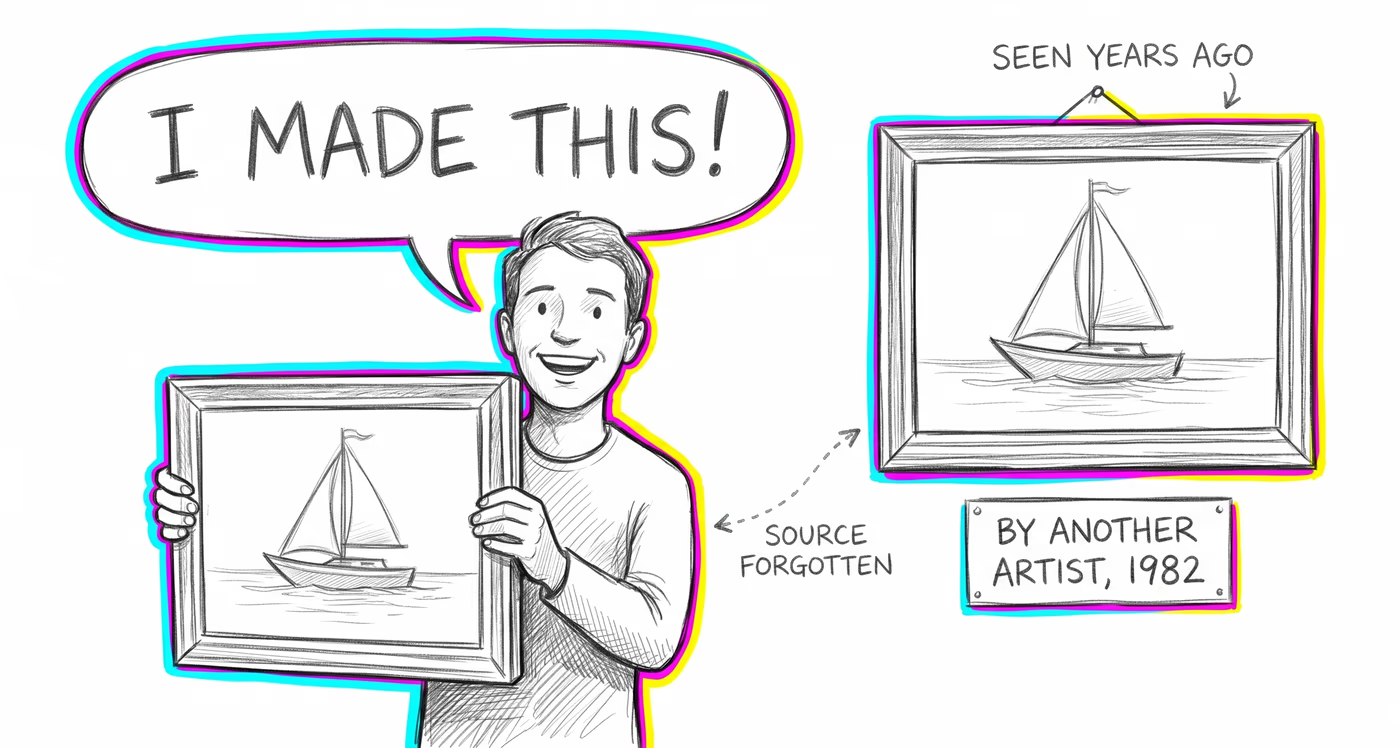
Correctly remembering information but incorrectly remembering where, when, or how it was originally learned.

WHAT IT IS

The glitch, explained plainly.

Imagine you hear a really funny joke, but a few days later you can't remember if your best friend told it to you or if you saw it on YouTube. You remember the joke perfectly, but who told it got all mixed up in your head. Your brain kept the joke but lost the label saying where it came from.

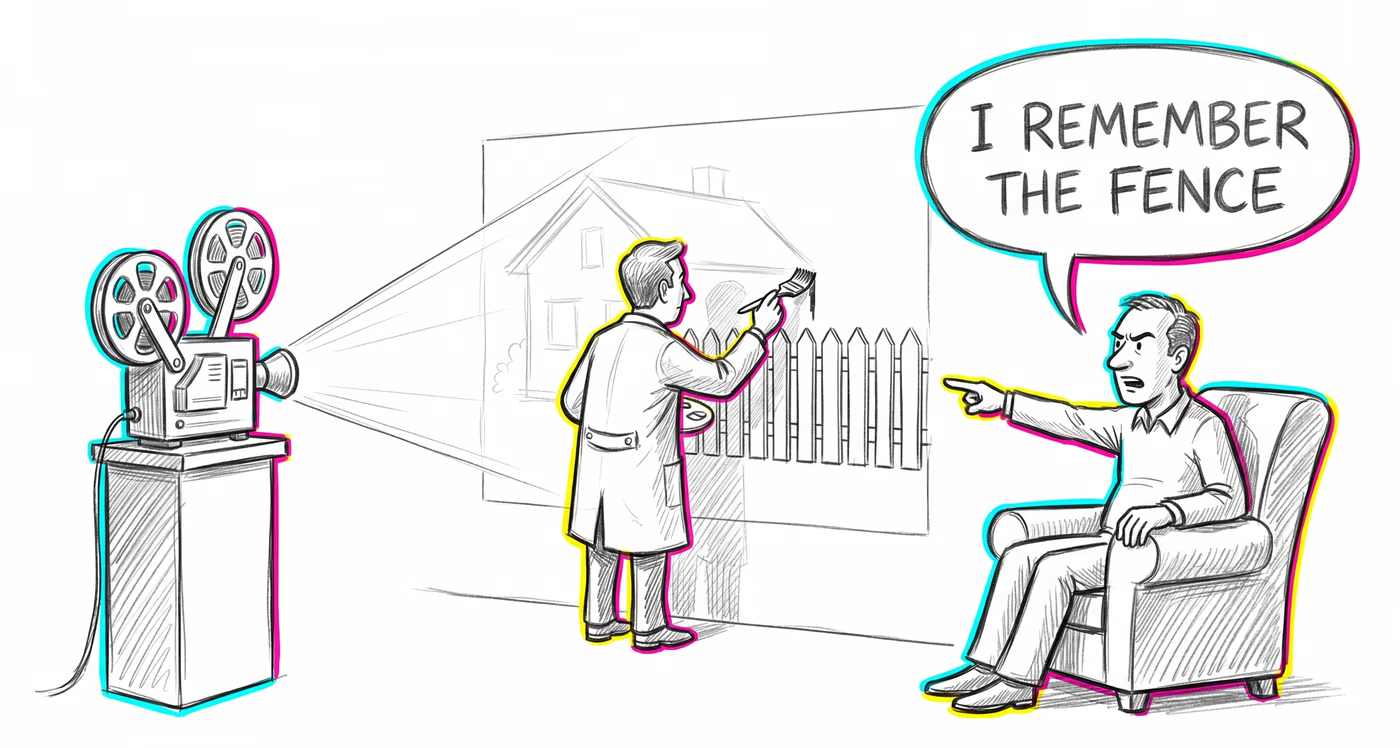
Source confusion occurs when the brain successfully stores the content of an experience — a fact, a face, a story — but fails to preserve the contextual tag linking that content to its origin. People may remember hearing a piece of information but confuse whether they read it in a newspaper, saw it on TV, or heard it from a friend. This error is especially common when multiple sources share perceptual or contextual similarities, when significant time has elapsed, or when cognitive load at encoding was high. The bias reveals that human memory is a reconstructive process rather than a recording device: the brain infers the source of a memory based on qualitative features like vividness, emotional tone, and perceptual detail, and these inferences are frequently wrong.

SOUND FAMILIAR?

Where it shows up.

  1. 01 After weeks of brainstorming, Priya pitches what she believes is her original marketing tagline to the team. A colleague points out that a competitor ran an identical slogan in an ad campaign last quarter — one Priya had seen but forgotten about. She is genuinely shocked, because in her memory the phrase felt self-generated.
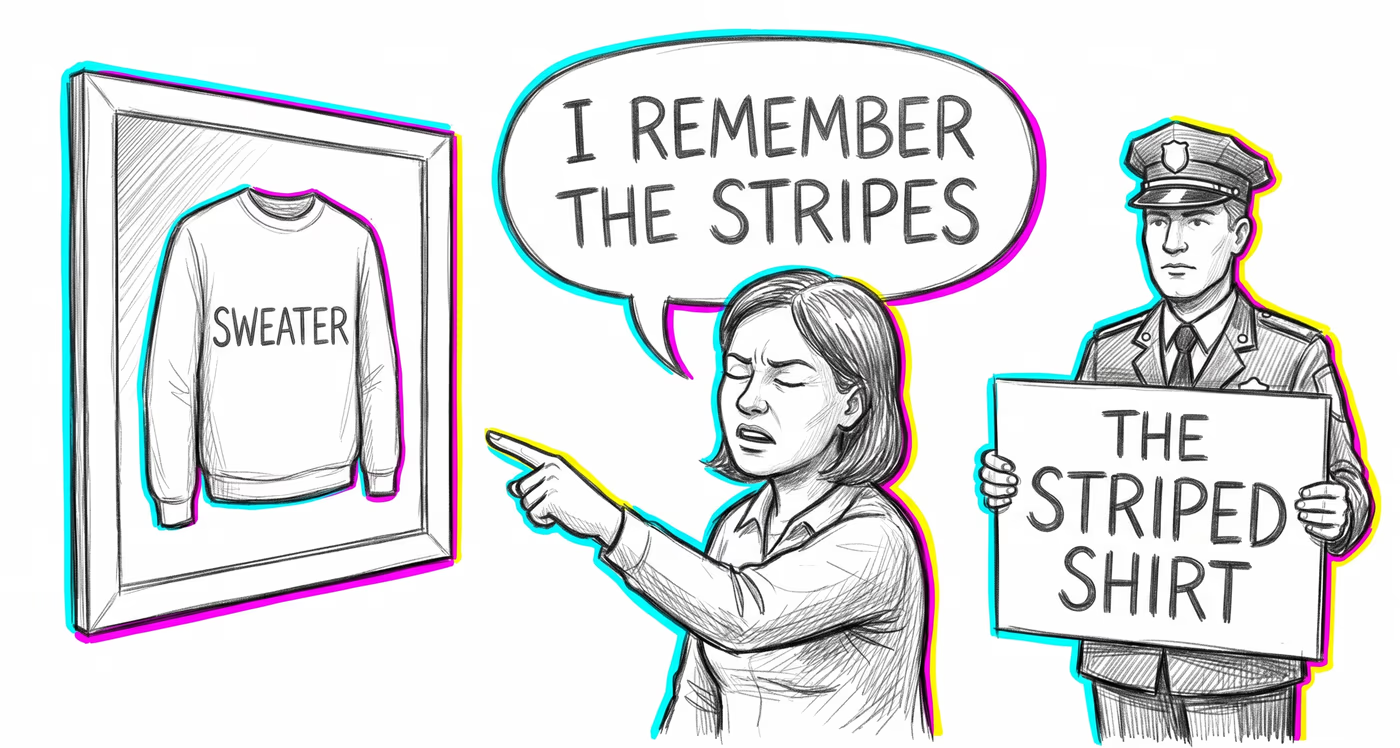
  2. 02 During a police lineup, Marcus confidently identifies a man as the person who robbed his store. It later turns out Marcus had seen this man at a bus stop near the crime scene earlier that day, not during the robbery itself. Marcus's memory of the face was real, but he attributed it to the wrong encounter.
  3. 03 Lena tells her therapist about a vivid childhood memory of being lost at a county fair. Her mother later confirms that Lena was never lost at a fair, but that Lena's older cousin had told a dramatic story about being lost at one when Lena was six. Lena had absorbed the narrative and over time came to remember it as her own experience.
  4. 04 A journalist writes a feature article and includes a specific claim about deforestation rates, citing a peer-reviewed study. When fact-checked, the study contains no such claim — the journalist actually encountered that figure in an unverified blog post she had read around the same time, but mentally tagged it as coming from the academic paper.
  5. 05 During a product strategy meeting, David pushes back on a colleague's proposal, saying the CEO explicitly opposed this approach in a recent all-hands. His colleague checks the recording and finds the CEO never mentioned it. David realizes he had read a critical comment about similar strategies in an industry newsletter and unconsciously repackaged that external opinion as the CEO's stated position.
IN DIFFERENT DOMAINS

Where it shows up at work.

The same glitch looks different depending on the terrain. Finance, medicine, a relationship, a team — same mechanism, different costume.

Finance & investing

Investors may recall a bullish forecast about a stock but misattribute it to a credible analyst when it actually came from an anonymous forum post, leading them to place unwarranted confidence in the prediction.

Medicine & diagnosis

Patients frequently report symptoms or medication effects they read about online as things their doctor told them, complicating clinical history-taking and potentially leading to incorrect treatment decisions.

Education & grading

Students may reproduce ideas from a lecture or textbook in essays without citation, genuinely believing the ideas are their own original thoughts — a form of unintentional plagiarism rooted in source confusion rather than dishonesty.

Relationships

People may misremember which partner or friend made a particular promise or said something hurtful, causing conflict when they confront the wrong person about a statement that individual never made.

Tech & product

Users exposed to multiple onboarding tutorials, help articles, and tooltips often misattribute instructions from one platform to another, leading to frustration when expected features do not exist in the product they are currently using.

Workplace & hiring

Managers may attribute a good idea to the wrong team member during performance reviews, crediting the person who presented it rather than the person who originally proposed it in an earlier meeting.

Politics Media

Voters may remember a claim from a satirical news source or partisan blog as coming from a mainstream outlet, lending false credibility to misinformation and shaping their political judgments accordingly.

HOW TO SPOT IT

Ask yourself…

  • Can I specifically recall where, when, and how I first learned this piece of information, or am I just confident about the content itself?
  • Am I attributing this idea, memory, or quote to a particular source because I genuinely remember it coming from there, or because that source seems plausible?
  • Could I be blending details from two separate experiences or sources into a single memory?
HOW TO DEFEND AGAINST IT

The playbook.

  • When a fact or idea feels important, write down where you encountered it immediately — do not rely on later reconstruction.
  • Before citing or sharing information, try to trace the specific chain: Where exactly did I see/hear this? Can I find the original source?
  • Ask yourself: 'Am I remembering the source, or am I inferring the source because it seems like the kind of thing that source would say?'
  • In high-stakes contexts like testimony or journalism, actively cross-reference your memory against physical records, notes, or recordings.
  • Practice distinguishing between 'I remember the content' and 'I remember the context' — acknowledging the gap reduces overconfidence in source attributions.
FAMOUS CASES

In history.

  • George Harrison was found guilty of 'subconscious plagiarism' in 1976 for his song 'My Sweet Lord,' which closely resembled the Chiffons' 'He's So Fine' — a textbook case of cryptomnesia driven by source confusion.
  • Ronald Reagan reportedly recounted to the Congressional Medal of Honor Society a moving story about a pilot who received a posthumous Medal of Honor — but the incident he described was actually a scene from the 1944 film Wing and a Prayer.
  • A rape victim misidentified psychologist Donald Thomson as her attacker because she had seen his face on television shortly before the assault, confusing the source of the facial memory.
WHERE IT COMES FROM
Academic origin

Marcia K. Johnson and Carol L. Raye introduced the concept of 'reality monitoring' in 1981, distinguishing internal from external memory sources. Johnson, Hashtroudi, and Lindsay formalized the broader 'Source Monitoring Framework' in a landmark 1993 Psychological Bulletin paper.

Evolutionary origin

In ancestral environments, remembering the content of survival-relevant information (e.g., which berries are poisonous, where predators lurk) was far more critical than remembering the exact source of that knowledge. Brains that prioritized gist-level semantic storage over precise contextual tagging could process and act on information more rapidly, even if the cost was occasional misattribution of the source.

IN AI SYSTEMS

How the machines inherit it.

Large language models routinely exhibit source confusion by generating text that blends and misattributes information across training documents. An LLM may attribute a quote to the wrong author, conflate findings from separate studies, or present fictional citations as real — a form of 'hallucination' that mirrors human source monitoring failures. Training data provenance is lost during the learning process, making accurate source attribution structurally difficult for these models.

Read more on Wikipedia
FREE FIELD ZINE

10 glitches quietly running your life.

A free field-zine PDF — ten cognitive glitches named, illustrated, with a defense move for each. Plus the weekly Glitch Report on Fridays — one bias named, two spotted in the wild, one defense move. Unsubscribe any time.

EXPLORE MORE

Related glitches.

LAUNCH PRICE

Train against your blindspots.

50 cards are free to preview. Buyers unlock the rest of the deck plus the interactive training — Spot-the-Bias Quiz unlimited, Swipe Deck with spaced repetition, My Blindspots, Decision Pre-Flight, the Printable Deck + Cheat Sheets, and the Field Guide e-book. $29.50$59.

Unlock the full deck

Everything below — yours forever. Pay once, use across every device.

Half-off launch — limited to the first 100 readers. Auto-applied at checkout.
$59 $29.50
one-time payment · lifetime access
  • All interactive digital cards — search, filter, flip, shuffle on any device
  • Five training modes — Spot-the-Bias Quiz, Swipe Deck, Pre-Flight, Blindspots, Journal
  • Curated Lenses + Decision Templates + Defense Playbook
  • Printable Deck PDFs + Field Guide e-book + Cheat Sheets + Anki Export
  • Every future improvement, included
Unlock  $29.50

30-day refund · no questions asked

Unlock the full deck

Everything below — yours forever. Pay once, use across every device.

Half-off launch — limited to the first 100 readers. Auto-applied at checkout.
$59 $29.50
one-time payment · lifetime access
  • All interactive digital cards — search, filter, flip, shuffle on any device
  • Five training modes — Spot-the-Bias Quiz, Swipe Deck, Pre-Flight, Blindspots, Journal
  • Curated Lenses + Decision Templates + Defense Playbook
  • Printable Deck PDFs + Field Guide e-book + Cheat Sheets + Anki Export
  • Every future improvement, included
Unlock  $29.50

30-day refund · no questions asked