Cryptomnesia

aka Unconscious Plagiarism · Inadvertent Plagiarism · Hidden Memory

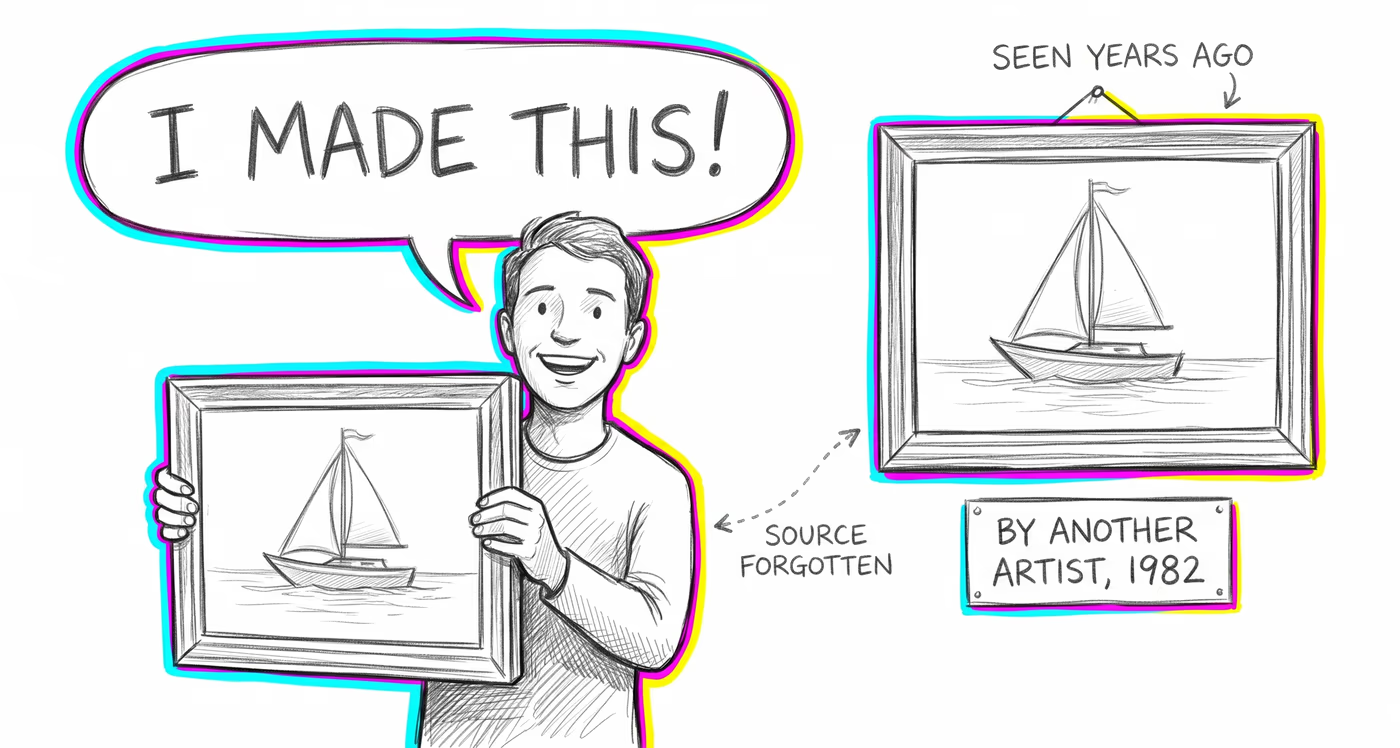
Recalling a previously encountered idea but sincerely believing it is your own original creation.

Illustration: Cryptomnesia
WHAT IT IS

The glitch, explained plainly.

Imagine you hear a really funny joke at a party. Months later, you're telling your friends what you think is a joke you made up yourself, and everyone laughs. But you didn't make it up—your brain just forgot where it heard the joke and tricked you into thinking it was your own brilliant idea.

Cryptomnesia occurs when a forgotten memory resurfaces in consciousness but is experienced not as a recollection but as a novel, self-generated idea. The individual genuinely believes they are producing something original—a thought, melody, story, or solution—when they are actually retrieving material previously encountered from an external source. This is not deliberate theft but a failure of source monitoring: the brain retains the content of a memory while losing the contextual tag that identifies where it came from. The phenomenon is especially prevalent in creative and collaborative environments where ideas are exchanged rapidly and the cognitive resources needed to track attribution are overwhelmed.

SOUND FAMILIAR?

Where it shows up.

  1. 01 A novelist spends months writing a climactic scene involving a character escaping a locked room using a hidden tunnel behind a bookcase. When the book is published, a reader points out that an almost identical scene exists in a novel the author reviewed for a literary magazine three years ago. The author is shocked—she has no memory of that scene and insists it came to her spontaneously during a late-night writing session.
  2. 02 A product designer presents a new app navigation concept at a design review, calling it a breakthrough approach. A senior colleague quietly pulls up wireframes from a competitor analysis deck the designer participated in six months ago, showing the same interaction pattern. The designer genuinely cannot recall ever seeing those wireframes and is visibly distressed by the accusation.
  3. 03 A PhD student develops what she believes is a novel theoretical framework for her dissertation. Her advisor notices striking similarities to a paper they discussed in a seminar two years earlier. The student has no citation for that paper in her notes and sincerely believes the framework emerged from her own synthesis of the literature, not from that specific source.
  4. 04 A songwriter composes a bridge section he finds hauntingly beautiful and records a demo. His bandmate says it sounds familiar but can't place it. The songwriter is so confident it's original that he proceeds to register the copyright. Months later, a fan identifies the bridge as nearly identical to an obscure B-side track from an album the songwriter had listened to heavily during college but hasn't played in a decade.
  5. 05 During a corporate strategy retreat, a VP proposes a new market-entry framework that impresses the executive team. She developed it over a weekend and is certain of its originality. However, the framework closely mirrors one presented by an external consultant at a conference she attended 18 months prior—a conference she remembers attending but whose specific content she believes she has forgotten. She attributes the idea entirely to her own strategic reasoning.
IN DIFFERENT DOMAINS

Where it shows up at work.

The same glitch looks different depending on the terrain. Finance, medicine, a relationship, a team — same mechanism, different costume.

Finance & investing

Financial analysts may unknowingly reproduce investment theses or valuation frameworks they encountered in research reports, presenting them as original analysis in client presentations, which can create attribution disputes and erode credibility when the overlap is discovered.
Medicine & diagnosis

Physicians or researchers may propose diagnostic criteria or treatment protocols that closely mirror published guidelines they previously read but forgot, potentially leading to unattributed duplication in clinical publications or grant proposals.

Education & grading

Students may reproduce arguments, phrasings, or conceptual frameworks from lectures and readings in their essays, genuinely believing the ideas are their own synthesis, leading to unintentional plagiarism that is difficult to distinguish from deliberate cheating.

Relationships

A person may retell their partner's stories or repeat their partner's insights in social settings as though they were their own experiences or ideas, causing friction when the partner feels their contributions are being appropriated.

Tech & product

Designers and engineers may propose features, interface patterns, or architectural solutions they previously encountered in competitor products or conference talks, leading to intellectual property concerns and design convergence that teams mistakenly believe is independent innovation.

Workplace & hiring

In brainstorming sessions, team members frequently claim others' earlier suggestions as their own new ideas, especially when ideas were shared rapidly under time pressure, creating interpersonal conflict and undermining collaborative trust.

Politics Media

Speechwriters and columnists may unconsciously reproduce phrases, arguments, or rhetorical structures from sources they have consumed, leading to plagiarism scandals that damage political careers and media credibility.

HOW TO SPOT IT

Ask yourself…

  • Am I unusually confident that this idea is original, even though I haven't verified it against my prior reading or conversations?
  • Could I have encountered this concept, phrase, or melody somewhere before and simply forgotten the source?
  • If I try to trace how I arrived at this idea step by step, can I actually reconstruct the reasoning, or did it just 'appear' fully formed?
HOW TO DEFEND AGAINST IT

The playbook.

  • Keep a detailed 'idea journal' that records not just ideas but where you encountered them, including conversations, books, articles, and media.
  • Before publishing or presenting an idea you believe is original, search for it explicitly in your prior reading, notes, and relevant literature.
  • In collaborative settings, make written records of who contributed which ideas during brainstorming sessions.
  • When an idea feels like it arrived 'fully formed' without a traceable reasoning process, treat that as a red flag for possible cryptomnesia.
  • Use plagiarism detection tools on your own writing as a routine check, not just as a defense against accusation.
FAMOUS CASES

In history.

  • George Harrison was found guilty of 'subconscious plagiarism' in the 1976 case Bright Tunes Music v. Harrisongs Music, after his song 'My Sweet Lord' was ruled to have unconsciously copied the melody of the Chiffons' 'He's So Fine.'
  • Helen Keller, as a child, wrote a story called 'The Frost King' that was nearly identical to 'Frost Fairies' by Margaret Canby, which had been read to her four years earlier. The resulting plagiarism accusation deeply traumatized her.
  • Friedrich Nietzsche's 'Thus Spoke Zarathustra' contained a near-verbatim passage from a book published around 1835 that he had read as a teenager, an instance Carl Jung analyzed as a classic case of cryptomnesia.
  • Robert Louis Stevenson acknowledged discovering embarrassing similarities between passages in 'Treasure Island' and earlier works he had read, which he attributed to unconscious memory.
WHERE IT COMES FROM
Academic origin

The term was coined by psychiatrist Théodore Flournoy around 1900 while studying the medium Hélène Smith. Carl Jung explored it in his 1902 thesis and 1905 article. The first controlled empirical study was conducted by Alan S. Brown and Dana R. Murphy in 1989, published in the Journal of Experimental Psychology: Learning, Memory, and Cognition.

Evolutionary origin

In ancestral environments, rapidly absorbing useful information—survival techniques, tool designs, foraging strategies—from social groups was more important than meticulously tracking who said what. Brains evolved to prioritize content acquisition over source attribution, because acting on good information quickly mattered more than crediting its originator. The bias toward claiming ownership may also have served social signaling purposes, as demonstrating generative ability conferred status.

IN AI SYSTEMS

How the machines inherit it.

Large language models inherently exhibit a form of cryptomnesia: they generate text that may closely reproduce training data without any mechanism to attribute or cite sources. Since LLMs lack source monitoring entirely, they can produce passages, code, or ideas that are effectively unattributed reproductions of copyrighted or proprietary material, raising significant intellectual property concerns. This is analogous to human cryptomnesia at massive scale—content is 'remembered' without any trace of its origin.

Read more on Wikipedia
FREE FIELD ZINE

10 glitches quietly running your life.

A free field-zine PDF — ten cognitive glitches named, illustrated, with a defense move for each. Plus the weekly Glitch Report on Fridays — one bias named, two spotted in the wild, one defense move. Unsubscribe any time.

EXPLORE MORE

Related glitches.

LAUNCH PRICE

Train against your blindspots.

50 cards are free to preview. Buyers unlock the rest of the deck plus the interactive training — Spot-the-Bias Quiz unlimited, Swipe Deck with spaced repetition, My Blindspots, Decision Pre-Flight, the Printable Deck + Cheat Sheets, and the Field Guide e-book. $29.50$59.

Unlock the full deck

Everything below — yours forever. Pay once, use across every device.

Half-off launch — limited to the first 100 readers. Auto-applied at checkout.
$59 $29.50
one-time payment · lifetime access
  • All interactive digital cards — search, filter, flip, shuffle on any device
  • Five training modes — Spot-the-Bias Quiz, Swipe Deck, Pre-Flight, Blindspots, Journal
  • Curated Lenses + Decision Templates + Defense Playbook
  • Printable Deck PDFs + Field Guide e-book + Cheat Sheets + Anki Export
  • Every future improvement, included
Unlock  $29.50

30-day refund · no questions asked

Unlock the full deck

Everything below — yours forever. Pay once, use across every device.

Half-off launch — limited to the first 100 readers. Auto-applied at checkout.
$59 $29.50
one-time payment · lifetime access
  • All interactive digital cards — search, filter, flip, shuffle on any device
  • Five training modes — Spot-the-Bias Quiz, Swipe Deck, Pre-Flight, Blindspots, Journal
  • Curated Lenses + Decision Templates + Defense Playbook
  • Printable Deck PDFs + Field Guide e-book + Cheat Sheets + Anki Export
  • Every future improvement, included
Unlock  $29.50

30-day refund · no questions asked