Techno-Solutionism

aka Promethean Bias · Technological Optimism Bias · Techno-Prometheanism

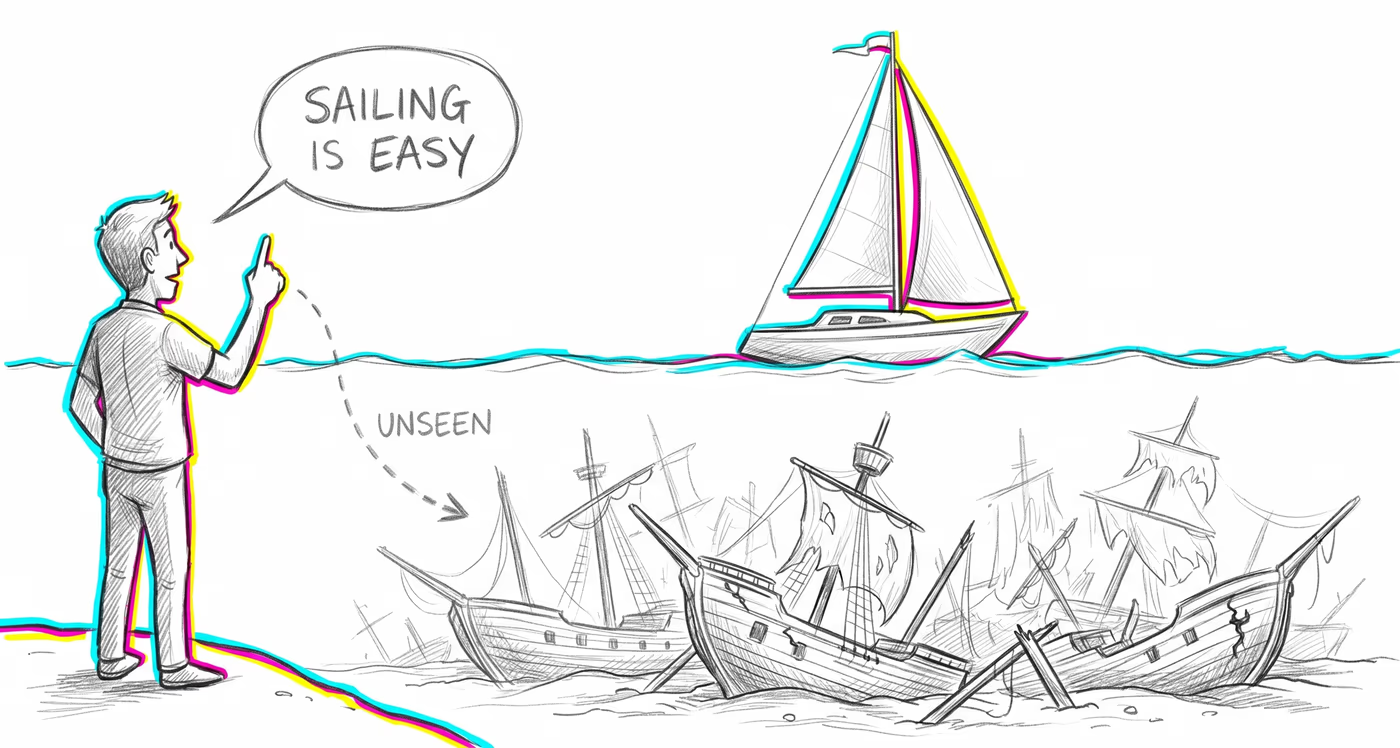
Assuming technology can fix problems that are fundamentally social, political, or moral in nature.

WHAT IT IS

The glitch, explained plainly.

Imagine you keep making a bigger and bigger mess in your room, but every time your mom says to clean it up, you say 'Don't worry, I'll invent a robot to do it later.' You never actually clean the room because you always believe the next invention will fix everything—but the mess just keeps growing.

Promethean Bias describes the systematic overestimation of technology's capacity to resolve complex problems—especially those rooted in social, political, or ecological systems—while underestimating the risks, unintended consequences, and structural barriers that technology alone cannot address. Named after the mythological Titan Prometheus who gave fire to humanity, this bias manifests as an implicit faith that innovation is inherently progressive and that any negative side effects of one technology can be remedied by the next. It leads individuals and institutions to favor novel technical interventions over behavioral, political, or systemic solutions, even when evidence suggests the latter would be more effective. The bias is particularly insidious because it reframes legitimate concerns about risk, equity, or sustainability as irrational resistance to progress.

SOUND FAMILIAR?

Where it shows up.

  1. 01 A city council debates rising homelessness. One member dismisses proposals for affordable housing policy reform, arguing instead that the city should invest in a data-driven app that matches homeless individuals with available shelter beds. When colleagues point out that the core issue is a shortage of beds and affordable units, she responds, 'The technology will optimize what we have—we just need a smarter system.'
  2. 02 A startup founder pitches investors on a wearable device that monitors employee stress hormones and automatically adjusts workload. When asked whether the company has considered simply reducing working hours or improving management culture, he replies, 'That's the old way of thinking. We can solve burnout without changing any organizational structures.'
  3. 03 A parent hears that her child is being bullied at school. Rather than contacting the school or speaking with the bully's parents, she downloads a social-emotional learning app and tells her child to use it for 15 minutes a day, confident that the research-backed exercises will equip the child to handle the situation independently.
  4. 04 A hospital administrator notices that diagnostic errors have increased. She invests heavily in an AI diagnostic tool rather than investigating whether the errors correlate with physician overwork from understaffing. She reasons that human error is inevitable, so the real solution is to augment human judgment with machine precision.
  5. 05 A policymaker reviewing agricultural water shortages in a drought-prone region advocates for massive desalination plants and genetically engineered drought-resistant crops. He dismisses a colleague's proposal to reform water rights, reduce agricultural subsidies for water-intensive crops, and incentivize conservation, calling it 'defeatist thinking that accepts scarcity instead of engineering abundance.'
IN DIFFERENT DOMAINS

Where it shows up at work.

The same glitch looks different depending on the terrain. Finance, medicine, a relationship, a team — same mechanism, different costume.

Finance & investing

Investors systematically overvalue companies with novel technological solutions to systemic problems (e.g., fintech replacing financial literacy, blockchain replacing regulatory trust) while underweighting the social and institutional infrastructure required for these technologies to function, leading to inflated valuations and subsequent market corrections.

Medicine & diagnosis

Healthcare systems invest disproportionately in high-tech interventions (robotic surgery, genomic medicine, AI diagnostics) while underinvesting in low-tech but high-impact measures (community health workers, patient education, addressing social determinants of health like housing and nutrition), resulting in impressive technology that fails to improve population-level outcomes.


Education & grading

Schools and districts adopt expensive educational technology platforms—adaptive learning software, virtual reality classrooms, AI tutors—expecting them to close achievement gaps, while neglecting evidence that teacher quality, class size, and family stability are stronger predictors of student success.

Relationships

Individuals rely on dating algorithms and compatibility apps to find ideal partners, assuming the technology will solve what is fundamentally a challenge of vulnerability, communication, and emotional maturity, leading to serial dissatisfaction as each new platform fails to deliver the promised perfect match.

Tech & product

Product teams prioritize adding new features and AI-powered capabilities to solve user pain points that actually stem from poor information architecture or confusing workflows, creating layers of technical complexity on top of a fundamentally flawed design rather than simplifying the core experience.

Workplace & hiring

Organizations implement employee engagement software, pulse survey tools, and algorithmic performance management systems to address morale problems that actually originate from toxic leadership, inadequate compensation, or lack of career development—treating cultural dysfunction as an information problem solvable with better data.

Politics Media

Political discourse frames complex systemic issues—poverty, inequality, crime—as engineering problems awaiting the right technological intervention, marginalizing policy approaches that require redistribution, regulation, or behavioral change, and creating cycles where failed tech solutions are replaced by newer tech solutions rather than structural reform.

HOW TO SPOT IT

Ask yourself…

  • Am I assuming that a technical solution exists for this problem without first asking whether the problem is fundamentally technical in nature?
  • Am I dismissing non-technological approaches (behavioral, political, cultural) as 'unrealistic' while treating an unbuilt technology as 'realistic'?
  • Am I ignoring potential unintended consequences of this technology because I'm focused on the problem it's supposed to solve?
HOW TO DEFEND AGAINST IT

The playbook.

  • Apply the 'Is this a nail?' test: Before reaching for a technological hammer, ask whether the problem is actually a nail. Explicitly list the social, political, behavioral, and structural dimensions of the problem before evaluating whether technology addresses the root cause or merely a symptom.
  • Conduct a pre-mortem for unintended consequences: Before adopting a technological solution, imagine it has been implemented for five years and has created new problems. What are they? This forces consideration of second-order effects.
  • Seek out the failure museum: Actively research past technological 'solutions' that failed or created worse problems in the same domain. If DDT, leaded gasoline, and social media were all once hailed as transformative, what makes this technology different?
  • Require a non-technical alternative analysis: For any proposed tech solution, mandate that at least one non-technological approach also be evaluated with equal rigor and resources before a decision is made.
  • Consult people affected by the problem, not just those building the solution: Those experiencing the problem often have clearer insight into whether a technical fix addresses their actual needs or merely the aspects of the problem visible from an engineering perspective.
FAMOUS CASES

In history.

  • The 1950s-1960s 'Atoms for Peace' era, in which nuclear energy was widely promoted as a universal solution to energy scarcity, food preservation, and even canal-building, with minimal public consideration of waste disposal, meltdown risk, or weapons proliferation.
  • The early 2010s techno-optimism around social media as a tool for democratic liberation (the 'Arab Spring' narrative), which obscured how the same platforms would later be weaponized for surveillance, propaganda, and authoritarian control.
  • The promotion of DDT as a miracle pesticide that would eradicate malaria and agricultural pests, before its catastrophic ecological consequences were recognized decades later.
WHERE IT COMES FROM
Academic origin

Evgeny Morozov popularized the term 'solutionism' in his 2013 book 'To Save Everything, Click Here: The Folly of Technological Solutionism' (PublicAffairs). The concept draws on earlier critiques of technological determinism and instrumental rationality.

Evolutionary origin

Humans evolved as tool-makers, and tool use was one of the primary drivers of survival advantage. Ancestral environments rewarded those who believed they could manipulate their surroundings—shaping stone, controlling fire, building shelter. This deep-seated confidence in our ability to engineer solutions to environmental threats became a core feature of human cognition, creating an adaptive bias toward action and invention over acceptance of natural limits.

IN AI SYSTEMS

How the machines inherit it.

AI systems inherit Promethean Bias when they are deployed as solutions to problems that are fundamentally social or political in nature—such as using predictive policing algorithms to address crime without addressing its socioeconomic roots, or using content moderation AI to fix misinformation without addressing the economic incentives that produce it. The bias also appears in AI development culture itself, where teams assume that scaling models or adding more data will resolve issues of fairness, bias, and safety that actually require governance, diverse stakeholder input, and institutional design.

FREE FIELD ZINE

10 glitches quietly running your life.

A free field-zine PDF — ten cognitive glitches named, illustrated, with a defense move for each. Plus the weekly Glitch Report on Fridays — one bias named, two spotted in the wild, one defense move. Unsubscribe any time.

EXPLORE MORE

Related glitches.

LAUNCH PRICE

Train against your blindspots.

50 cards are free to preview. Buyers unlock the rest of the deck plus the interactive training — Spot-the-Bias Quiz unlimited, Swipe Deck with spaced repetition, My Blindspots, Decision Pre-Flight, the Printable Deck + Cheat Sheets, and the Field Guide e-book. $29.50$59.

Unlock the full deck

Everything below — yours forever. Pay once, use across every device.

Half-off launch — limited to the first 100 readers. Auto-applied at checkout.
$59 $29.50
one-time payment · lifetime access
  • All interactive digital cards — search, filter, flip, shuffle on any device
  • Five training modes — Spot-the-Bias Quiz, Swipe Deck, Pre-Flight, Blindspots, Journal
  • Curated Lenses + Decision Templates + Defense Playbook
  • Printable Deck PDFs + Field Guide e-book + Cheat Sheets + Anki Export
  • Every future improvement, included
Unlock  $29.50

30-day refund · no questions asked

Unlock the full deck

Everything below — yours forever. Pay once, use across every device.

Half-off launch — limited to the first 100 readers. Auto-applied at checkout.
$59 $29.50
one-time payment · lifetime access
  • All interactive digital cards — search, filter, flip, shuffle on any device
  • Five training modes — Spot-the-Bias Quiz, Swipe Deck, Pre-Flight, Blindspots, Journal
  • Curated Lenses + Decision Templates + Defense Playbook
  • Printable Deck PDFs + Field Guide e-book + Cheat Sheets + Anki Export
  • Every future improvement, included
Unlock  $29.50

30-day refund · no questions asked