Tip of the Tongue

aka TOT State · Lethologica · Tip-of-the-Tongue State

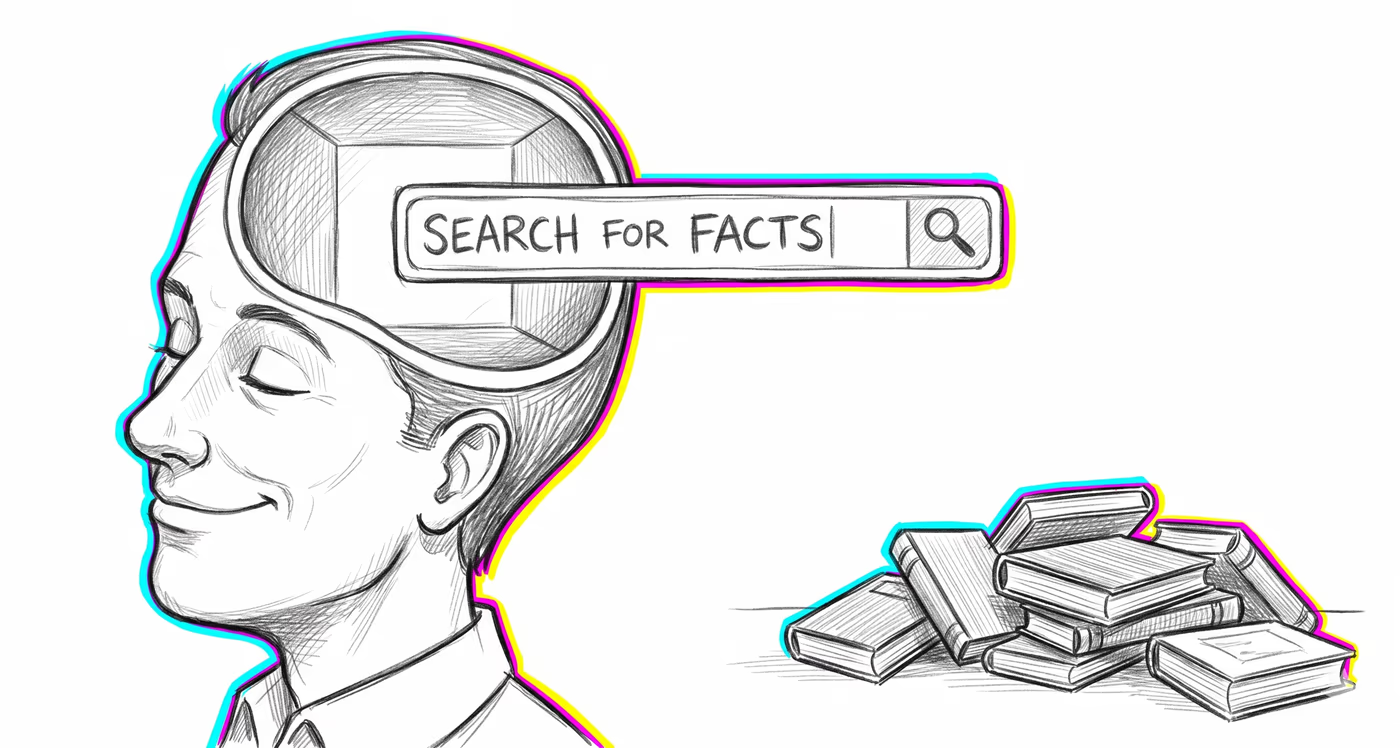
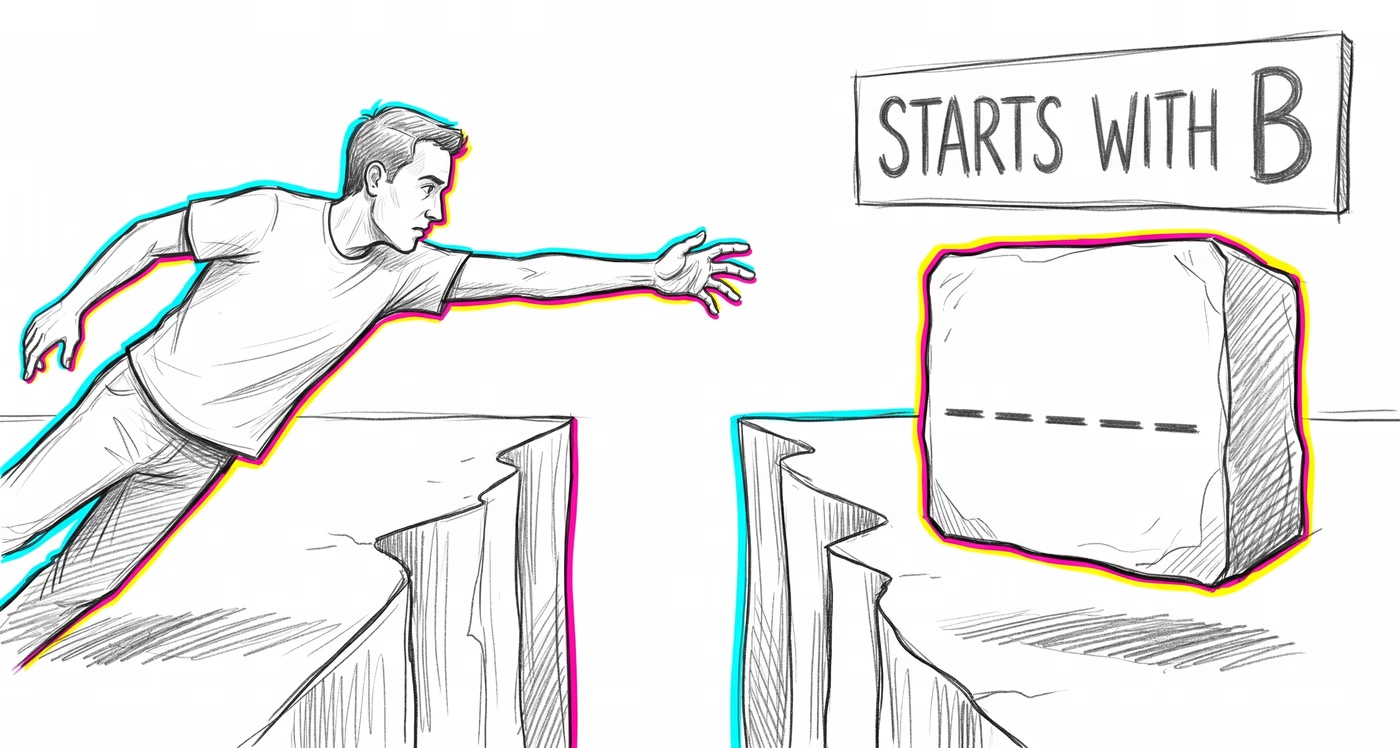
Being certain you know a word or name but being temporarily unable to retrieve it, despite recalling partial details like its first letter.

WHAT IT IS

The glitch, explained plainly.

Imagine you have a toy box with all your toys labeled. You know the exact toy you want — you can picture what it looks like, you remember playing with it — but the label fell off and got stuck under another toy. You're digging around, finding pieces of the label ('it starts with a B... it's a long word...'), but you just can't pull out the whole name. Then suddenly, hours later, the label pops right back up on its own.

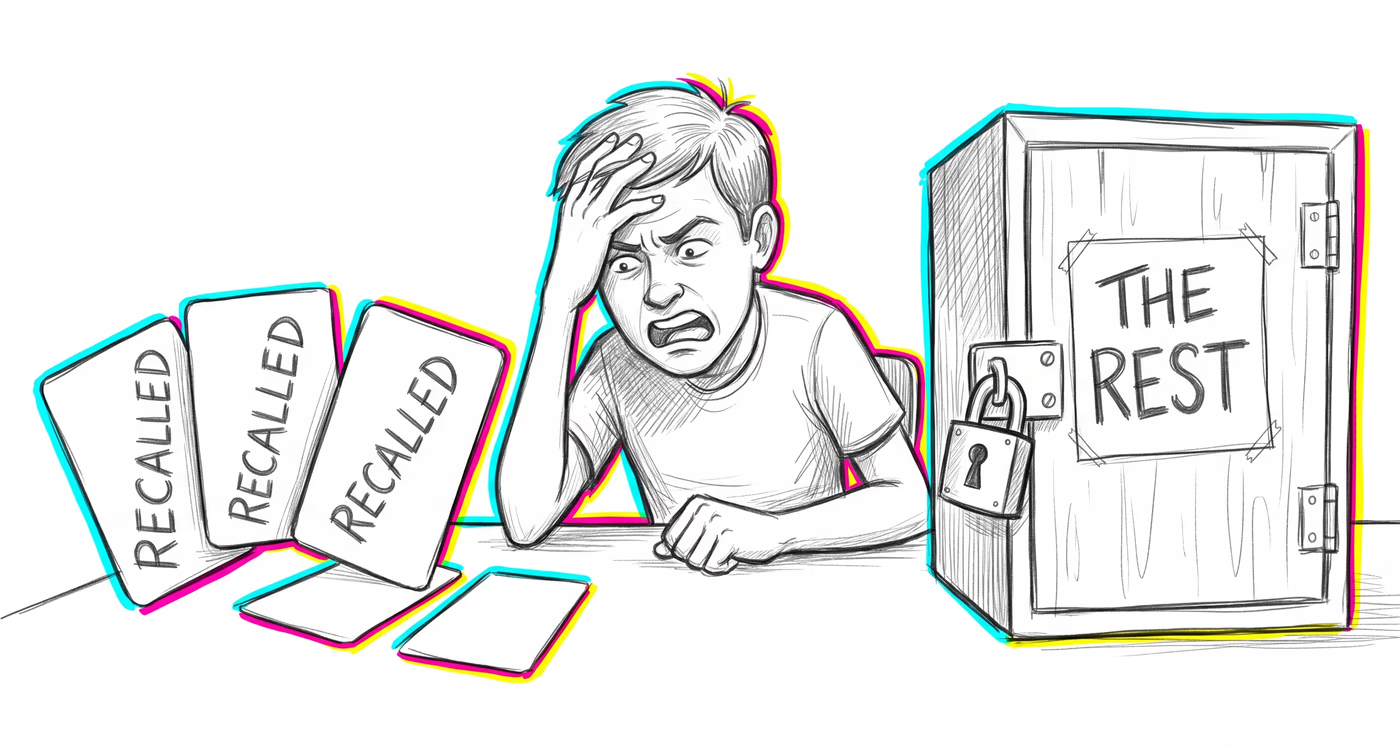
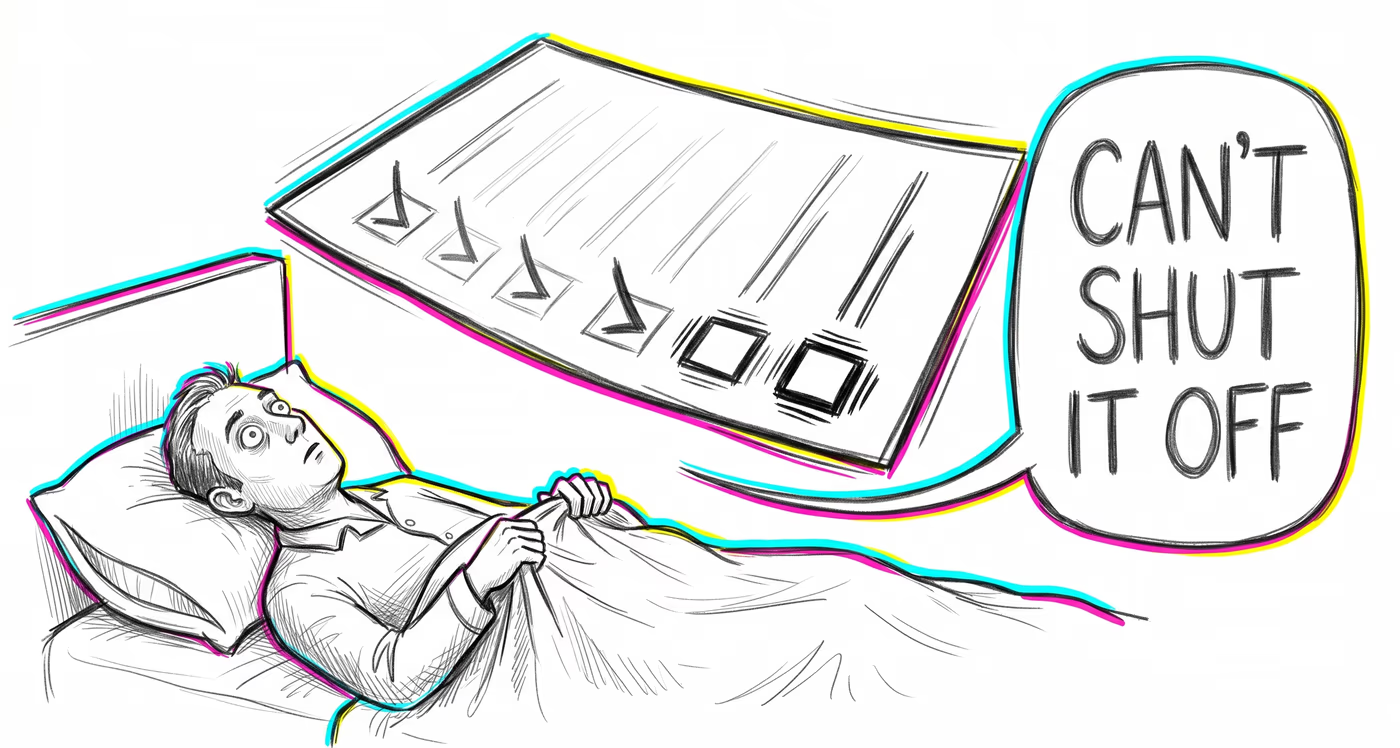
The Tip of the Tongue phenomenon is a metacognitive state in which a person is temporarily unable to produce a known word despite having a strong subjective feeling that the word is on the verge of being recalled. During this state, individuals can often access partial information about the target word — such as its first letter, number of syllables, stress pattern, or semantically related words — even though the complete phonological form remains inaccessible. The experience is emotionally charged, typically involving mild anguish during the search and a distinct sense of relief upon resolution. TOT states occur universally across languages, ages, and education levels, though they increase in frequency with aging and are more common for proper nouns and infrequently used words.

SOUND FAMILIAR?

Where it shows up.

  1. 01 During a presentation, Marcia wants to name the specific psychological term for when people irrationally escalate commitment to a failing project. She can recall it starts with 'S' and has four syllables, and she pictures the textbook page where she read it. She pauses, stumbles, and finally says 'you know, that thing where you keep going because you already invested too much.' The actual term comes to her on the drive home.
  2. 02 A retired professor is asked at dinner who directed 'Vertigo.' He immediately pictures the director's silhouette, remembers the man was British, knows the last name has two syllables starting with 'H' — but cannot produce 'Hitchcock' for nearly a full minute, despite absolute certainty he knows it.
  3. 03 A pharmacist is counseling a patient and reaches for the name of a specific drug interaction she studied extensively. She can recall the drug class, the mechanism, the color of the pill — every detail except the medication's name. She tells the patient, 'Give me one moment,' and the name surfaces only after she stops actively searching and checks another patient's chart.
  4. 04 During a bilingual team meeting, Tomás switches from Spanish to English and freezes mid-sentence trying to produce the English word 'procurement.' He knows the concept, can feel the word is close, and even recalls it ends in '-ment,' but the Spanish equivalent 'adquisición' keeps intruding and blocking his retrieval of the English term.
  5. 05 An architect is reviewing building codes and wants to reference a specific structural term she used fluently last month. She can recall it rhymes with something, has three syllables, and she used it in an email recently — but each time she reaches for it, a similar-sounding but incorrect technical word keeps surfacing instead, making her feel increasingly certain the real word is 'right there' while simultaneously unable to produce it.
IN DIFFERENT DOMAINS

Where it shows up at work.

The same glitch looks different depending on the terrain. Finance, medicine, a relationship, a team — same mechanism, different costume.

Finance & investing

Financial analysts may experience TOT states for specific ticker symbols, fund names, or technical terms during time-pressured earnings calls, leading them to use vague circumlocutions that undermine credibility or slow decision-making.
Medicine & diagnosis

Clinicians under cognitive load may experience TOT states for drug names, anatomical terms, or diagnostic labels, potentially delaying communication during time-sensitive situations or leading to imprecise chart documentation.

Education & grading

Students frequently experience TOT states during exams, where they can recall contextual details about where they studied the material but cannot produce the specific term, leading to partial-credit answers and test anxiety that further impairs retrieval.

Relationships

People experience TOT states for the names of a partner's friends, extended family members, or details from shared experiences, which can be misinterpreted as inattentiveness or lack of care despite genuine knowledge of the person.

Tech & product

Search engines and autocomplete features are specifically designed to resolve TOT states by offering suggestions from partial input — users who can type the first few letters rely on the system to complete the retrieval their own memory cannot.

Workplace & hiring

Professionals may experience TOT states for colleagues' names, acronyms, or project terminology during meetings, leading to awkward pauses that can undermine perceived competence, especially in high-stakes presentations.

Politics Media

Journalists and politicians experiencing TOT states on live broadcasts create viral 'gaffe' moments that are often misinterpreted as ignorance rather than temporary retrieval failure, disproportionately damaging credibility.

HOW TO SPOT IT

Ask yourself…

  • Am I certain I know this word but simply cannot produce it right now?
  • Can I recall partial features of the word — its first letter, syllable count, or similar-sounding alternatives — without accessing the full form?
  • Is a related but incorrect word repeatedly intruding and blocking my retrieval of the target?
HOW TO DEFEND AGAINST IT

The playbook.

  • Stop actively searching: prolonged struggling reinforces the error state and increases the chance of future TOT states for the same word. Redirect attention and let the word surface on its own.
  • Look it up immediately rather than struggling: research shows that extended time in the TOT state creates 'incorrect practice' that trains your brain to repeat the failure.
  • Use phonological cues: mentally run through the alphabet or think of words with similar sounds to prime the retrieval pathway.
  • Write down words and names you frequently forget to strengthen the encoding through additional modalities.
  • For important presentations or meetings, prepare a written list of key terms, names, and technical vocabulary in advance to reduce retrieval demands.
WHERE IT COMES FROM
Academic origin

First described as a psychological phenomenon by William James in The Principles of Psychology (1890). The first empirical study was conducted by Roger Brown and David McNeill at Harvard, published in 1966 in the Journal of Verbal Learning and Verbal Behavior. The transmission deficit model was later developed by Deborah M. Burke and Donald G. MacKay (1991).

Evolutionary origin

The staged architecture of lexical retrieval — separating meaning from sound form — likely evolved to support the enormous vocabulary demands of human language. Decoupling semantic and phonological representations allows for flexible, combinatorial communication, but the trade-off is occasional retrieval failure when the connection between meaning and sound weakens due to disuse, recency, or neural degradation.

IN AI SYSTEMS

How the machines inherit it.

Language models do not experience TOT states in the human sense because they do not have staged lexical retrieval. However, they can produce analogous failures — generating semantically appropriate but lexically incorrect substitutions (hallucinated names, blended terms) when the precise token has low probability in context, mimicking the partial-activation and blocking dynamics of human TOT states.

Read more on Wikipedia
FREE FIELD ZINE

10 glitches quietly running your life.

A free field-zine PDF — ten cognitive glitches named, illustrated, with a defense move for each. Plus the weekly Glitch Report on Fridays — one bias named, two spotted in the wild, one defense move. Unsubscribe any time.

EXPLORE MORE

Related glitches.

LAUNCH PRICE

Train against your blindspots.

50 cards are free to preview. Buyers unlock the rest of the deck plus the interactive training — Spot-the-Bias Quiz unlimited, Swipe Deck with spaced repetition, My Blindspots, Decision Pre-Flight, the Printable Deck + Cheat Sheets, and the Field Guide e-book. $29.50$59.

Unlock the full deck

Everything below — yours forever. Pay once, use across every device.

Half-off launch — limited to the first 100 readers. Auto-applied at checkout.
$59 $29.50
one-time payment · lifetime access
  • All interactive digital cards — search, filter, flip, shuffle on any device
  • Five training modes — Spot-the-Bias Quiz, Swipe Deck, Pre-Flight, Blindspots, Journal
  • Curated Lenses + Decision Templates + Defense Playbook
  • Printable Deck PDFs + Field Guide e-book + Cheat Sheets + Anki Export
  • Every future improvement, included
Unlock  $29.50

30-day refund · no questions asked

Unlock the full deck

Everything below — yours forever. Pay once, use across every device.

Half-off launch — limited to the first 100 readers. Auto-applied at checkout.
$59 $29.50
one-time payment · lifetime access
  • All interactive digital cards — search, filter, flip, shuffle on any device
  • Five training modes — Spot-the-Bias Quiz, Swipe Deck, Pre-Flight, Blindspots, Journal
  • Curated Lenses + Decision Templates + Defense Playbook
  • Printable Deck PDFs + Field Guide e-book + Cheat Sheets + Anki Export
  • Every future improvement, included
Unlock  $29.50

30-day refund · no questions asked