Zeigarnik Effect

aka Incomplete Task Effect · Open Loop Effect

Unfinished tasks staying stuck in your mind while completed ones fade — the mental nagging of things left undone.

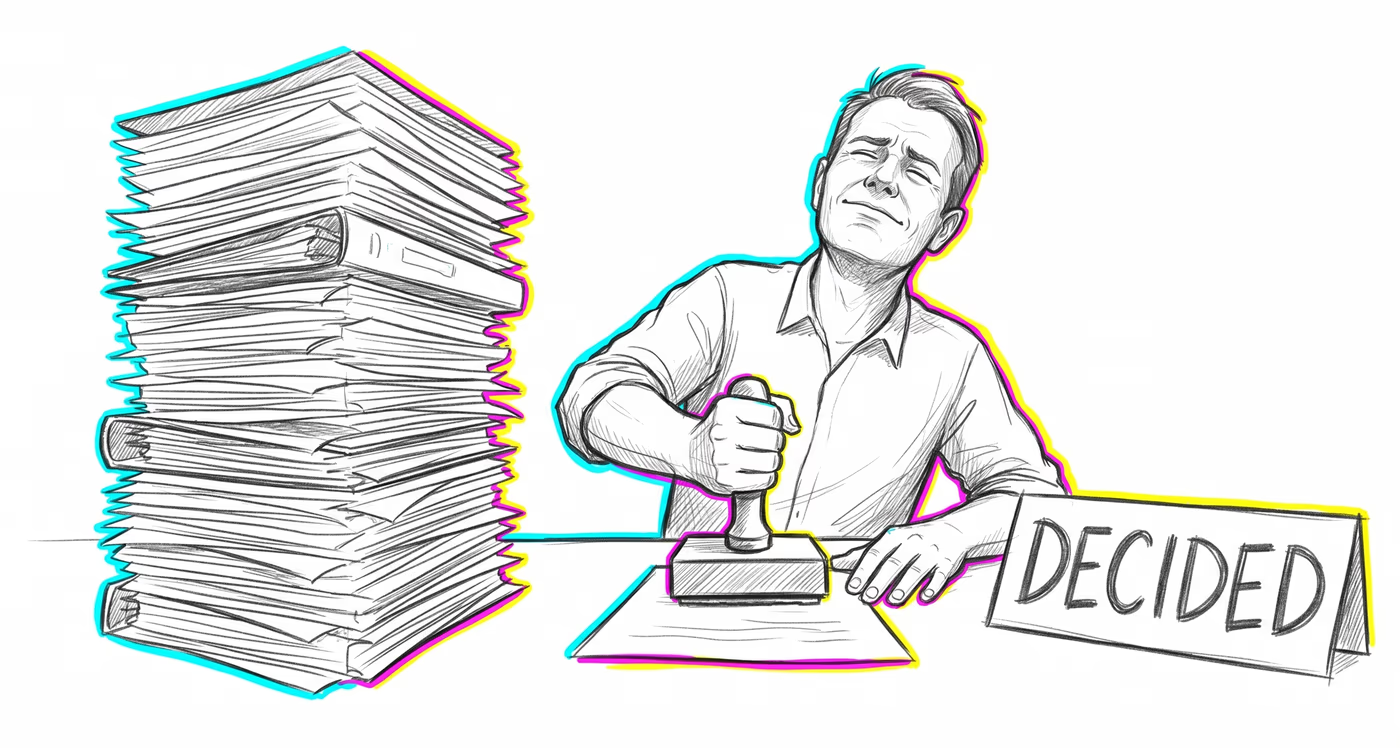
Illustration: Zeigarnik Effect
WHAT IT IS

The glitch, explained plainly.

Imagine you're building a really cool LEGO castle but your mom says 'time for dinner' right in the middle. You'll keep thinking about that castle all through dinner because it's not done yet. But once you finish building it, poof—you barely remember what it looked like. Your brain is like an alarm that won't stop buzzing until you finish what you started.

The Zeigarnik Effect describes the mind's tendency to maintain heightened cognitive accessibility for tasks that have been started but not completed, while rapidly discarding memory traces of finished activities. When a goal-directed task is initiated, it creates what Kurt Lewin called a 'quasi-need'—a state of psychological tension that keeps task-relevant information active in working memory. This tension functions as a persistent internal reminder, producing intrusive thoughts about the unfinished work until the task is resolved or a concrete completion plan is formed. The effect is modulated by individual motivation, personality (extraverts show it more than introverts), and how the interruption is perceived—external interference amplifies it, while perceived personal failure can reverse it through repression.

SOUND FAMILIAR?

Where it shows up.

  1. 01 A project manager finishes her Friday knowing three deliverables are still pending. Over the weekend, she finds herself involuntarily rehearsing the details of those three items during family dinners and walks, yet she cannot recall the specifics of the five reports she successfully submitted that same week.
  2. 02 A novelist deliberately stops writing each day mid-sentence rather than at the end of a chapter. He finds that when he sits down the next morning, the words flow immediately because the unfinished passage has been cycling through his mind overnight, whereas on days he finished a chapter cleanly, he struggles to begin the next one.
  3. 03 A language-learning app shows users a progress bar stuck at 73% completion for their Spanish module. Users who see this incomplete indicator return to the app at twice the rate of users whose module is marked 'Complete,' even though both groups learned the same amount of material.
  4. 04 A therapist notices that her client obsessively replays a relationship that ended abruptly with no closure conversation, yet barely thinks about a longer relationship that ended with a mutual, thorough goodbye. The therapist suspects the cognitive burden comes not from the relationship's importance but from its unresolved status.
  5. 05 A researcher notices that students given a surprise interruption during a memorization task outperform those who studied without breaks on a recall test one hour later. She attributes this not to the break refreshing attention, but to the interruption itself creating persistent mental tension that kept the material cognitively active.
IN DIFFERENT DOMAINS

Where it shows up at work.

The same glitch looks different depending on the terrain. Finance, medicine, a relationship, a team — same mechanism, different costume.

Finance & investing

Investors tend to ruminate over open positions—stocks they haven't yet sold—far more than closed trades. An unrealized loss occupies disproportionate mental bandwidth compared to a realized one of equal magnitude, because the open position represents an unresolved financial goal.
Medicine & diagnosis

Clinicians may find themselves mentally returning to unresolved diagnostic cases long after their shift ends, while straightforwardly diagnosed patients fade from memory. This can contribute to burnout as open medical cases accumulate cognitive load.

Education & grading

Students who take strategic breaks during study sessions often retain material better than those who study in uninterrupted blocks. Educators can leverage this by designing curricula with built-in pauses and incomplete problem sets that encourage learners to mentally revisit content.

Relationships

Relationships that end abruptly without closure tend to occupy far more mental real estate than those that concluded with mutual resolution. The unresolved emotional 'task' generates persistent intrusive thoughts and idealization of the lost partner.

Tech & product

Product designers use progress bars, incomplete profile badges, and streak counters to exploit the Zeigarnik Effect, compelling users to return and complete onboarding flows. Leaving a checklist at 80% completion is a standard retention tactic in SaaS products.

Workplace & hiring

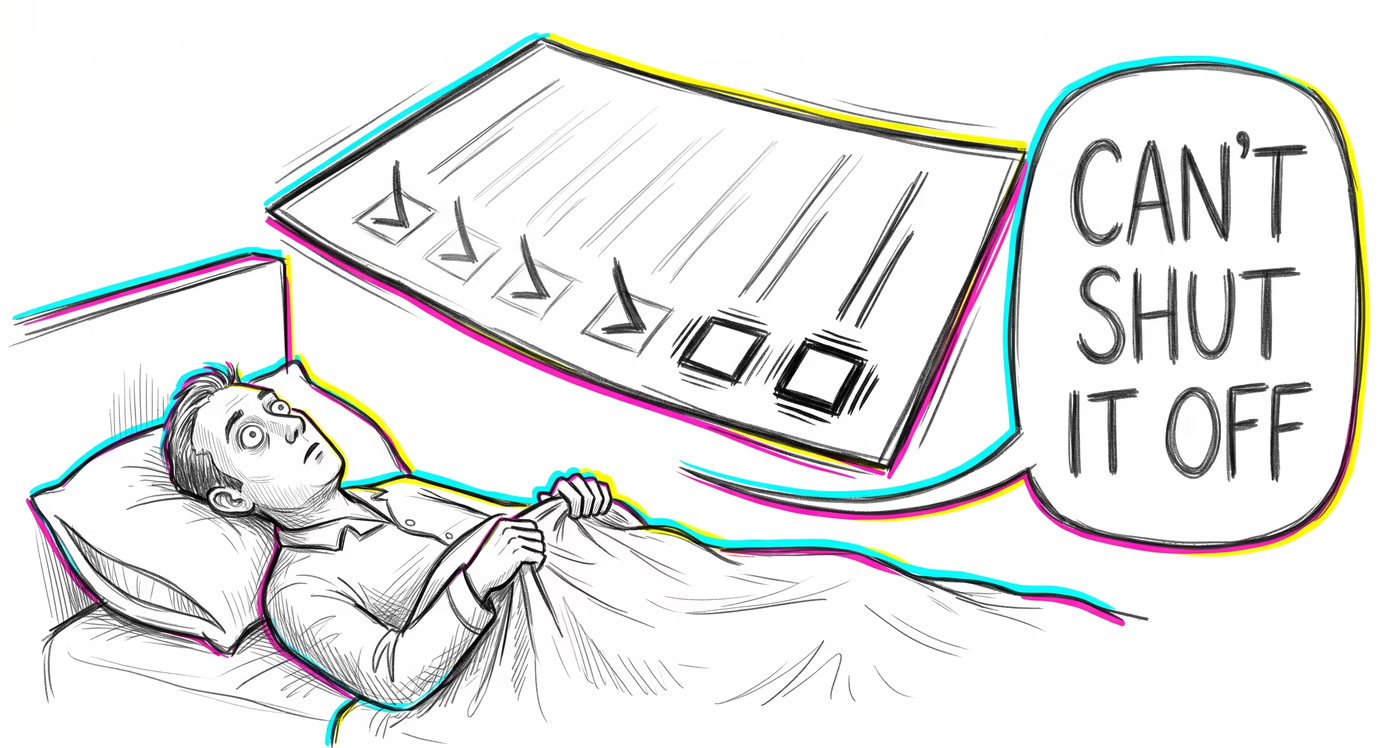
Employees who leave work with unfinished tasks experience more after-hours rumination and poorer sleep quality compared to those who complete their tasks or at least write a concrete plan for finishing them the next day.

Politics Media

News media routinely end segments on cliffhangers or teasers—'After the break: what officials haven't told you yet'—exploiting viewers' need for closure to prevent channel-switching and ensure return viewership.

HOW TO SPOT IT

Ask yourself…

  • Am I ruminating about this task because it's genuinely urgent, or simply because I haven't finished it?
  • Would writing down a concrete completion plan release this mental pressure without actually doing the task right now?
  • Is my brain giving this unfinished item more importance than it deserves relative to my completed accomplishments?
HOW TO DEFEND AGAINST IT

The playbook.

  • Write a specific, actionable completion plan (who, what, when) for each open task—research shows this discharges the cognitive tension almost as effectively as completing the task itself.
  • Use a trusted external system (to-do list, calendar, project board) to offload open loops from working memory, giving your brain permission to let go.
  • Deliberately define 'done' before starting a task so your brain has clear completion criteria rather than an endlessly open goal.
  • At the end of each workday, perform a 'shutdown ritual': review open tasks, write next actions for each, and explicitly tell yourself the day is closed.
  • When ruminating about an unfinished personal matter (e.g., an unresolved conversation), write down exactly what you would say or do next, even if you can't act on it yet.
FAMOUS CASES

In history.

  • Bluma Zeigarnik's original 1927 experiment was inspired by Kurt Lewin's observation that Viennese waiters remembered unpaid orders perfectly but forgot them immediately after payment.
  • Television producers have systematically used cliffhanger endings since the 1980 'Who shot J.R.?' Dallas episode, one of the most-watched broadcasts in TV history, explicitly leveraging the psychological tension of an unresolved narrative.
  • Ernest Hemingway reportedly used the effect deliberately, stopping his writing sessions mid-sentence so the unfinished thought would pull him back to the desk the next morning.
WHERE IT COMES FROM
Academic origin

Bluma Zeigarnik, 1927, based on research conducted under Kurt Lewin at the University of Berlin. Published as 'Über das Behalten erledigter und unerledigter Handlungen' (On Finished and Unfinished Tasks) in Psychologische Forschung.

Evolutionary origin

In ancestral environments, forgetting an incomplete survival task—an unfinished shelter, an untreated wound, a half-tracked prey animal—could be fatal. The brain evolved to maintain heightened salience for unresolved goals as an internal prompting system, ensuring critical unfinished business would intrude into consciousness and drive the organism back toward completion before environmental threats materialized.

IN AI SYSTEMS

How the machines inherit it.

Recommendation algorithms and engagement systems exploit the Zeigarnik Effect by design—showing partial progress, incomplete series, or unfinished playlists to drive re-engagement. The effect itself does not pollute AI models per se, but AI systems are engineered to trigger it in users through notifications about incomplete tasks, abandoned carts, or unread content queues.

Read more on Wikipedia
FREE FIELD ZINE

10 glitches quietly running your life.

A free field-zine PDF — ten cognitive glitches named, illustrated, with a defense move for each. Plus the weekly Glitch Report on Fridays — one bias named, two spotted in the wild, one defense move. Unsubscribe any time.

EXPLORE MORE

Related glitches.

LAUNCH PRICE

Train against your blindspots.

50 cards are free to preview. Buyers unlock the rest of the deck plus the interactive training — Spot-the-Bias Quiz unlimited, Swipe Deck with spaced repetition, My Blindspots, Decision Pre-Flight, the Printable Deck + Cheat Sheets, and the Field Guide e-book. $29.50$59.

Unlock the full deck

Everything below — yours forever. Pay once, use across every device.

Half-off launch — limited to the first 100 readers. Auto-applied at checkout.
$59 $29.50
one-time payment · lifetime access
  • All interactive digital cards — search, filter, flip, shuffle on any device
  • Five training modes — Spot-the-Bias Quiz, Swipe Deck, Pre-Flight, Blindspots, Journal
  • Curated Lenses + Decision Templates + Defense Playbook
  • Printable Deck PDFs + Field Guide e-book + Cheat Sheets + Anki Export
  • Every future improvement, included
Unlock  $29.50

30-day refund · no questions asked

Unlock the full deck

Everything below — yours forever. Pay once, use across every device.

Half-off launch — limited to the first 100 readers. Auto-applied at checkout.
$59 $29.50
one-time payment · lifetime access
  • All interactive digital cards — search, filter, flip, shuffle on any device
  • Five training modes — Spot-the-Bias Quiz, Swipe Deck, Pre-Flight, Blindspots, Journal
  • Curated Lenses + Decision Templates + Defense Playbook
  • Printable Deck PDFs + Field Guide e-book + Cheat Sheets + Anki Export
  • Every future improvement, included
Unlock  $29.50

30-day refund · no questions asked