Memory Inhibition

aka Part-Set Cuing Effect · Retrieval-Induced Forgetting · Retrieval Inhibition

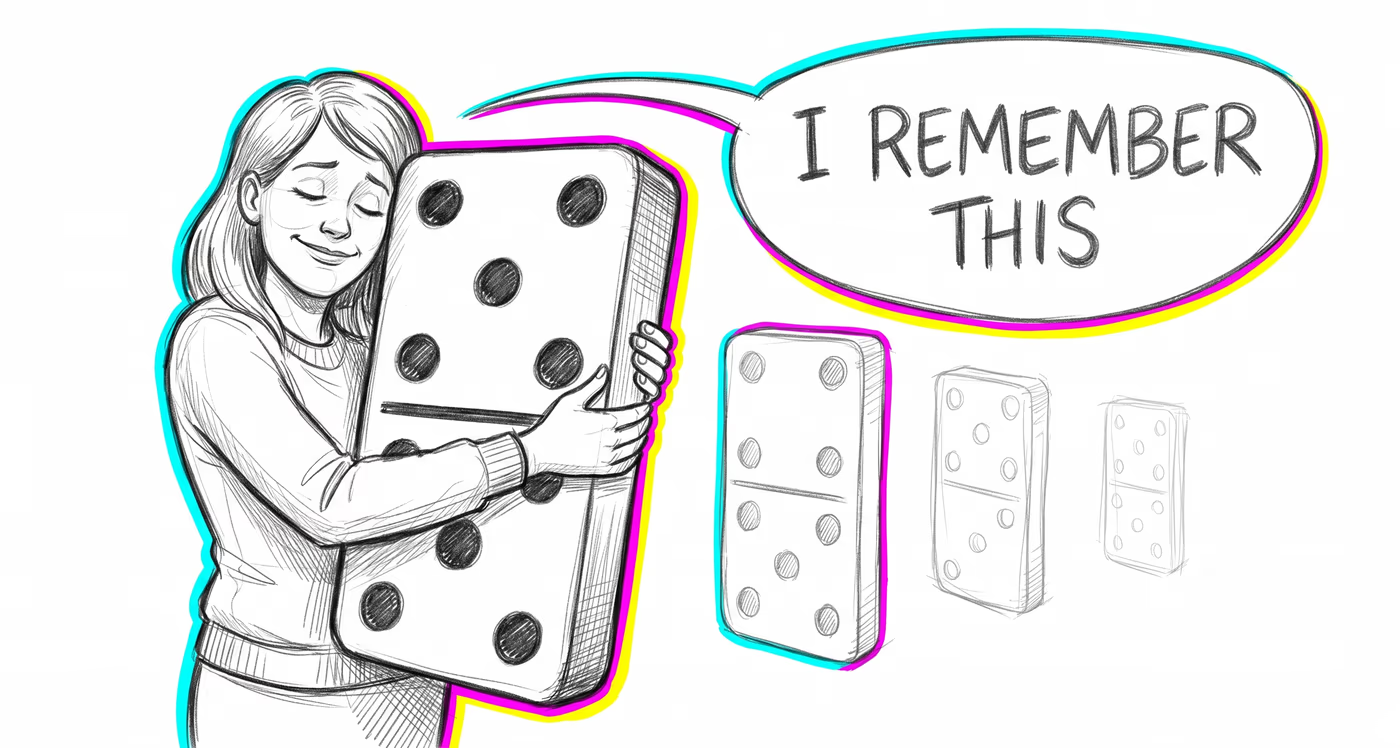
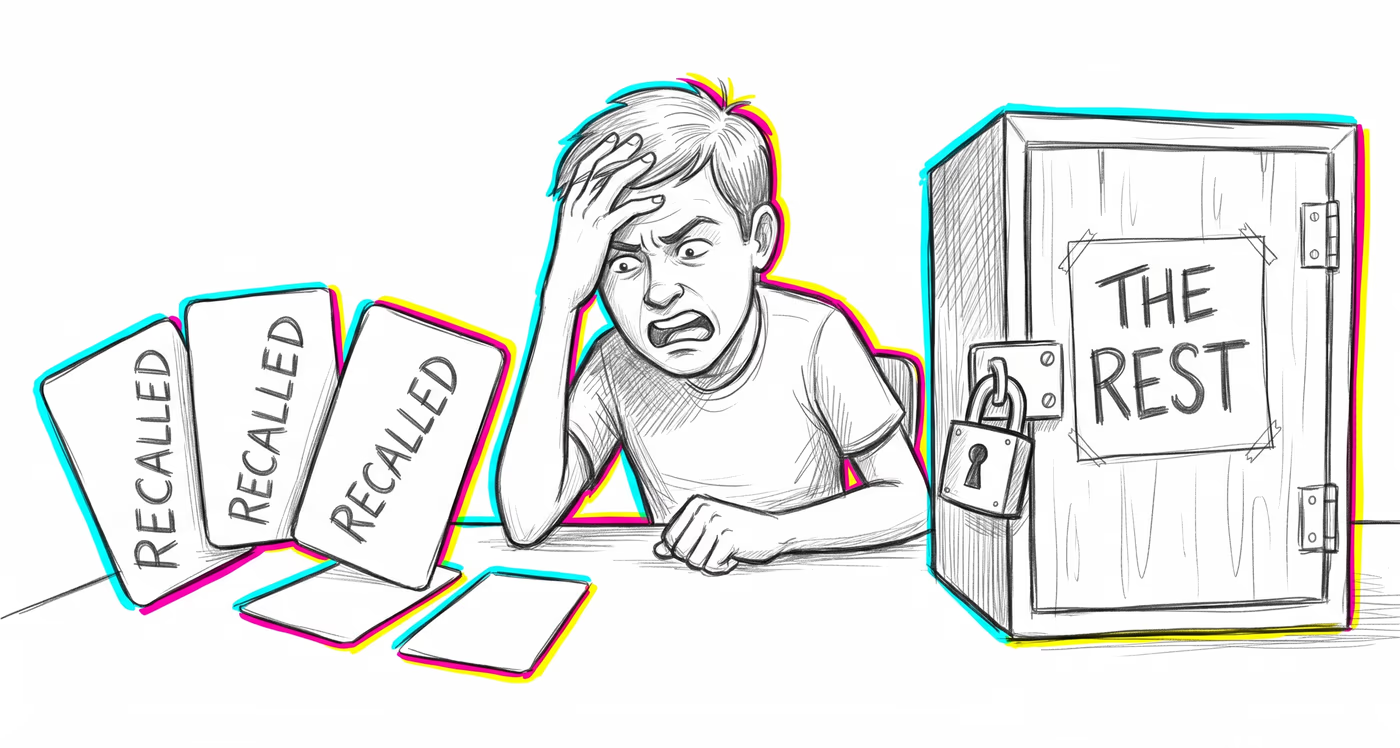
Recalling some items from a learned set making the remaining items harder to remember, even if they were well-learned.
WHAT IT IS

The glitch, explained plainly.

Imagine you have a toy box with 10 toys. If your mom pulls out 3 toys and shows them to you, then asks you to name the rest, you'd actually do worse than if she never showed you anything at all. It's like your brain gets so focused on the toys it just saw that it accidentally hides the other toys deeper in the box.

Memory inhibition occurs when the act of recalling or being shown a subset of previously learned information actively suppresses the accessibility of related but unretrieved information. Unlike simple forgetting through decay, this is an active cognitive process where the brain dampens competing memory traces to facilitate efficient retrieval of target items. The effect is paradoxical because the cues or retrieval practice that should theoretically help recall actually make the uncued items less accessible than they would have been with no cues at all. This phenomenon operates largely below conscious awareness and persists even after the initial retrieval episode has ended.

SOUND FAMILIAR?

Where it shows up.

  1. 01 A detective reviews crime scene photos focusing on three key pieces of evidence with a witness. When later asked about other details she clearly noticed at the scene, the witness performs worse than another witness who wasn't shown any photos at all before recalling.
  2. 02 A medical student prepares for an exam by intensively drilling half the symptoms of a disease. During the test, she confidently lists the practiced symptoms but cannot recall the other symptoms she originally knew well—performing worse on those items than classmates who did equal but non-selective review.
  3. 03 A brainstorming facilitator starts the session by listing five ideas already generated. The team then produces fewer novel ideas than a control group that started from scratch, despite all members having independently come up with several ideas beforehand.
  4. 04 A sommelier asks a customer to name Italian wines. After the sommelier helpfully suggests 'Chianti and Barolo,' the customer—who actually knows a dozen Italian wines—suddenly struggles to name any beyond those two, performing worse than if no suggestions had been offered.
  5. 05 A lawyer repeatedly rehearses three key arguments for her closing statement. In court, she delivers those three points flawlessly, but the two additional arguments she had planned—and could easily articulate the day before—have become inexplicably inaccessible, leaving her feeling as though she never prepared them.
IN DIFFERENT DOMAINS

Where it shows up at work.

The same glitch looks different depending on the terrain. Finance, medicine, a relationship, a team — same mechanism, different costume.

Finance & investing

Analysts who repeatedly review a subset of risk factors for a portfolio may find that equally important but unrehearsed risks become harder to recall during decision-making, leading to incomplete risk assessments.

Medicine & diagnosis

Physicians who mentally rehearse a few candidate diagnoses when evaluating a patient may inadvertently suppress recall of other plausible diagnoses, contributing to diagnostic narrowing and missed conditions.

Education & grading

Students who use selective review strategies—studying only some topics from a course—may find that the unreviewd topics become harder to recall than expected on exams, even when originally well-learned.

Relationships

When recounting a shared experience, one partner's selective retelling of certain events can suppress both partners' memories of other aspects of the experience, gradually narrowing the shared narrative.

Tech & product

Autocomplete and suggestion features that display a subset of search results or options can suppress users' ability to generate or recall alternative queries or choices they would have otherwise considered.

Workplace & hiring

In team meetings where a few solutions are discussed prominently, team members may find it harder to recall alternative approaches they had considered independently, reducing the diversity of ideas brought forward.

Politics Media

Media coverage that repeatedly highlights a few aspects of a political event can suppress the public's recall of other reported details, effectively narrowing collective memory of the event.

HOW TO SPOT IT

Ask yourself…

  • Am I struggling to recall things I previously knew well, specifically because I just reviewed or was reminded of related information?
  • Did someone's helpful suggestions or partial list actually make it harder for me to think of other items I know?
  • Would I perform better at recalling this information if I hadn't just been primed with a subset of it?
HOW TO DEFEND AGAINST IT

The playbook.

  • Before receiving partial cues or suggestions, attempt free recall of everything you know on the topic first.
  • Use diverse and independent retrieval cues rather than relying on a single shared category cue to access memories.
  • When studying, practice retrieving all items in a set rather than selectively reviewing only a portion.
  • In brainstorming sessions, have each participant generate ideas independently before sharing any subset with the group.
  • Space retrieval practice across all items evenly rather than concentrating on a few high-priority items.
WHERE IT COMES FROM
Academic origin

Nornan J. Slamecka first demonstrated the part-set cuing effect in 1968. Michael C. Anderson, Robert A. Bjork, and Elizabeth L. Bjork formalized retrieval-induced forgetting as an inhibitory mechanism in 1994. Hasher and Zacks (1988) influentially connected inhibitory processes to memory and aging.

Evolutionary origin

Efficient memory retrieval in survival contexts required rapid access to the most relevant information without being overwhelmed by competing associations. An organism that could suppress irrelevant memories—such as yesterday's predator sighting location when recalling today's—would respond faster and more accurately to environmental threats, gaining a survival advantage.

IN AI SYSTEMS

How the machines inherit it.

In retrieval-augmented generation systems, presenting a language model with a subset of retrieved documents can bias it away from generating information consistent with unretrieved but relevant documents. Similarly, when training data is selectively curated or emphasized, models may underweight related but de-emphasized patterns, creating blind spots analogous to human retrieval-induced forgetting.

Read more on Wikipedia
FREE FIELD ZINE

10 glitches quietly running your life.

A free field-zine PDF — ten cognitive glitches named, illustrated, with a defense move for each. Plus the weekly Glitch Report on Fridays — one bias named, two spotted in the wild, one defense move. Unsubscribe any time.

EXPLORE MORE

Related glitches.

LAUNCH PRICE

Train against your blindspots.

50 cards are free to preview. Buyers unlock the rest of the deck plus the interactive training — Spot-the-Bias Quiz unlimited, Swipe Deck with spaced repetition, My Blindspots, Decision Pre-Flight, the Printable Deck + Cheat Sheets, and the Field Guide e-book. $29.50$59.

Unlock the full deck

Everything below — yours forever. Pay once, use across every device.

Half-off launch — limited to the first 100 readers. Auto-applied at checkout.
$59 $29.50
one-time payment · lifetime access
  • All interactive digital cards — search, filter, flip, shuffle on any device
  • Five training modes — Spot-the-Bias Quiz, Swipe Deck, Pre-Flight, Blindspots, Journal
  • Curated Lenses + Decision Templates + Defense Playbook
  • Printable Deck PDFs + Field Guide e-book + Cheat Sheets + Anki Export
  • Every future improvement, included
Unlock  $29.50

30-day refund · no questions asked

Unlock the full deck

Everything below — yours forever. Pay once, use across every device.

Half-off launch — limited to the first 100 readers. Auto-applied at checkout.
$59 $29.50
one-time payment · lifetime access
  • All interactive digital cards — search, filter, flip, shuffle on any device
  • Five training modes — Spot-the-Bias Quiz, Swipe Deck, Pre-Flight, Blindspots, Journal
  • Curated Lenses + Decision Templates + Defense Playbook
  • Printable Deck PDFs + Field Guide e-book + Cheat Sheets + Anki Export
  • Every future improvement, included
Unlock  $29.50

30-day refund · no questions asked