Finance & investing
Financial professionals underestimate the time required for routine compliance checks, audits, or quarterly reconciliations they have performed many times, leading to understaffing and deadline pressure during reporting periods.
Underestimating how long a familiar route takes while overestimating the time for unfamiliar ones.
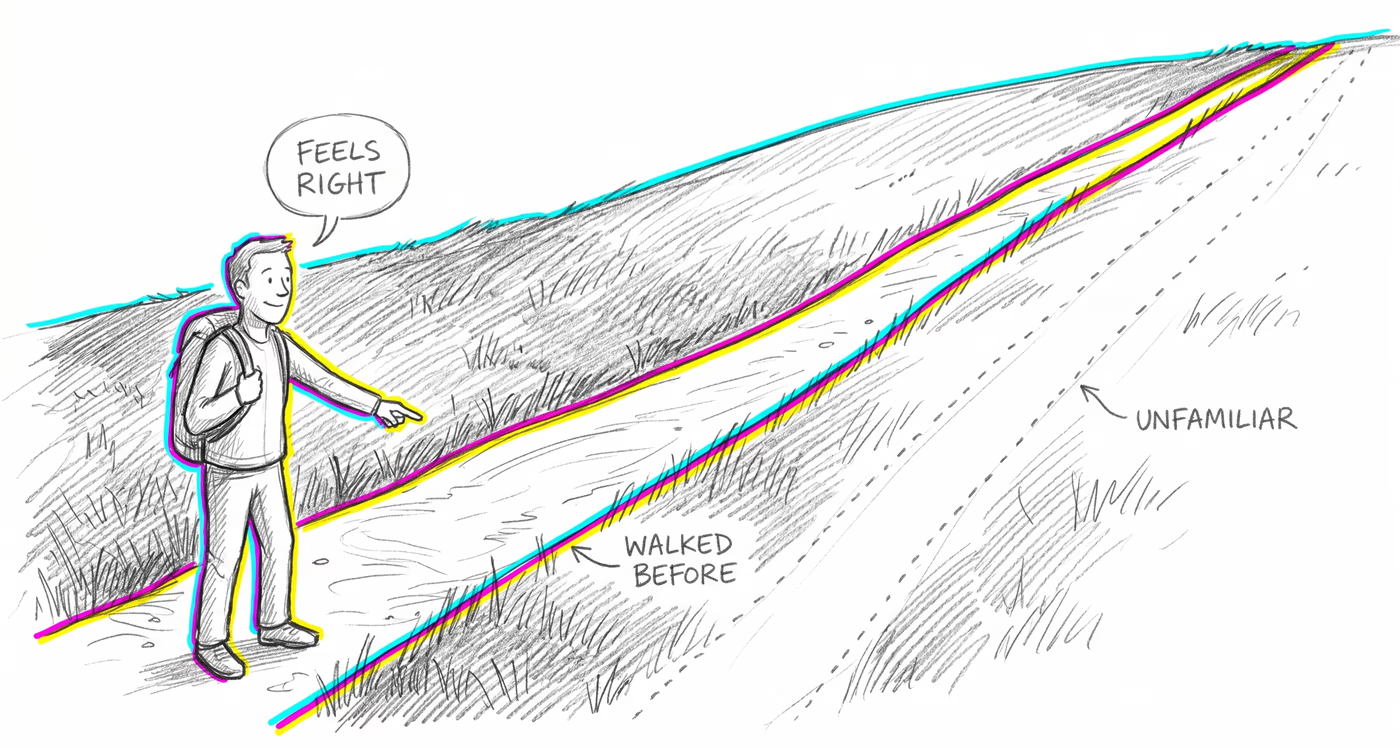
Imagine you walk to the ice cream shop near your house every single day. After a while, the walk feels super quick because you know every tree and every crack in the sidewalk—your brain kind of goes on autopilot. But if your mom takes you to a brand-new ice cream shop far away, that trip feels like it takes forever because everything is new and your brain is busy looking at all the stuff. The walk to the old shop didn't actually get shorter—it just feels shorter because your brain stopped paying attention.
The Well-Travelled Road Effect describes a systematic distortion in time estimation linked to route familiarity: people consistently judge familiar journeys as shorter than they objectively are and unfamiliar journeys as longer. This occurs because repeated exposure to a route shifts navigation from effortful, conscious processing to automatic, low-attention processing, which compresses the subjective experience of elapsed time. The bias extends beyond literal travel—any routine task that has become automatic is remembered as taking less time than it actually did. This compressed memory then feeds forward into future estimates, creating a self-reinforcing cycle of underestimation for familiar activities.
The same glitch looks different depending on the terrain. Finance, medicine, a relationship, a team — same mechanism, different costume.
Financial professionals underestimate the time required for routine compliance checks, audits, or quarterly reconciliations they have performed many times, leading to understaffing and deadline pressure during reporting periods.
Experienced surgeons may underestimate how long a routine procedure will take when scheduling operating room time, causing cascading delays in surgical schedules throughout the day.
The effect has been observed anecdotally for centuries but was first studied scientifically in the 1980s–1990s, building on the heuristics-and-biases framework of Kahneman and Tversky. Dinah Avni-Babad and Ilana Ritov (2003) published key experimental work on routine and time perception. Michael M. Roy and Nicholas J. S. Christenfeld (2005–2008) extensively researched the memory-bias mechanisms underlying duration underestimation for familiar tasks.
Automatic processing of familiar environments freed cognitive resources for detecting novel threats or opportunities. In ancestral settings, habitual routes between shelter, water, and foraging sites needed minimal attention, allowing vigilance to be redirected toward predators, competitors, or new food sources. The trade-off of compressed time perception was inconsequential when precise scheduling did not exist.
Navigation and logistics algorithms trained on user-reported travel times rather than objective measurements may inherit the bias, systematically underestimating durations for frequently traveled routes. Recommendation systems may also overweight familiar paths or options because user engagement data reflects compressed time perception, making familiar routes appear more efficient than they are.
This page taught you the name. The deck turns the name into reflex. 1,100+ swipeable scenarios, 1,100+ defenses, 650+ detection prompts — spaced-repetition Swipe Deck, unlimited Spot-the-Bias Quiz, Defense Playbook, Pre-Flight, My Blindspots, Cheat Sheets, Field Guide e-book. $39.53$59.